
TL;DR:
- D modeling creates digital representations essential for design, simulation, gaming, and manufacturing. It is increasingly important across industries, supported by AI-driven automation and software tools like Blender, Maya, Fusion 360, and SolidWorks. Skilled modelers remain vital, as AI accelerates workflows without replacing expertise, making 3D modeling a crucial yet underrated tech skill.
3D modeling is the process of creating three-dimensional digital representations of objects using specialized software, and it serves as the foundational layer for design, simulation, and product development across technology industries. Tools like Blender, Maya, Fusion 360, and SolidWorks power everything from animated film characters to aerospace prototypes. The role of 3D modeling in tech has expanded far beyond visual effects. The global 3D modeling market was valued at $6.17 billion in 2024 and is projected to reach $22.31 billion by 2032. That growth reflects how deeply 3D modeling has embedded itself in manufacturing, healthcare, robotics, gaming, and immersive commerce.
How does 3D modeling improve design and prototyping in tech?
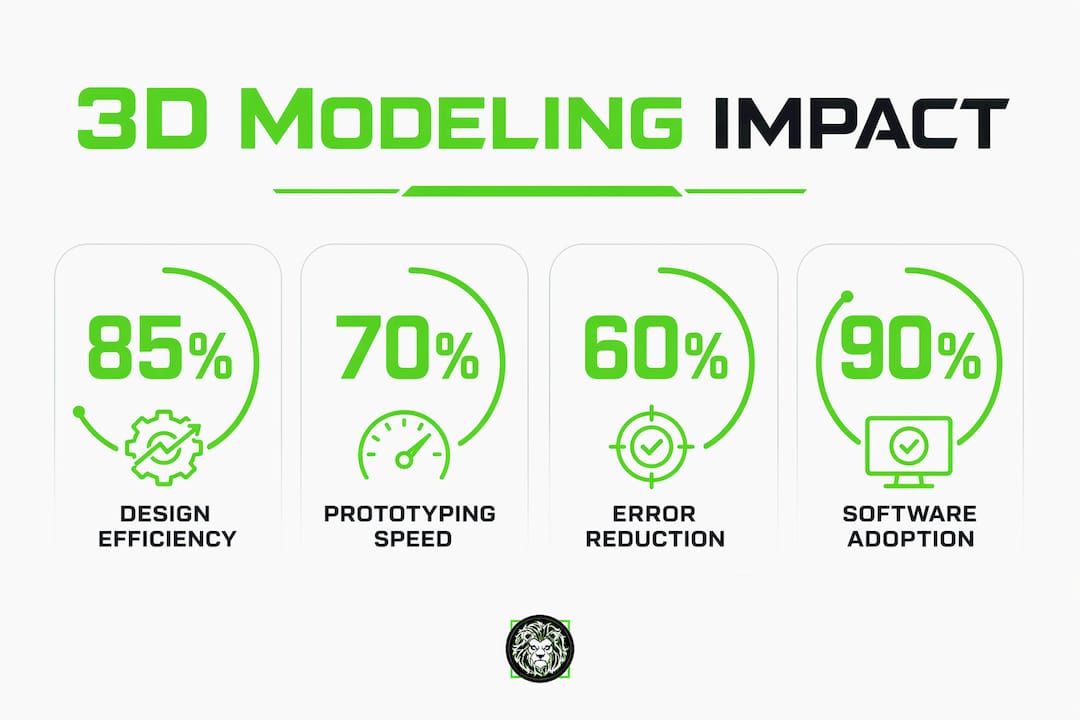
3D modeling transforms the prototyping process by letting engineers and designers test a product virtually before a single physical component is made. A car door, a medical implant, or a consumer electronics casing can be rotated, stress-tested, and refined entirely in software. That capability removes entire rounds of expensive physical iteration.

The benefits for prototyping are especially visible in automotive and aerospace engineering, where aerodynamic performance and structural integrity must be validated before production. A physical wind tunnel test costs far more than a simulation run in Fusion 360 or SolidWorks. Teams catch design flaws at the digital stage, where fixes cost hours instead of thousands of dollars.
Key advantages 3D modeling delivers to the design process include:
- Multi-angle visualization: Designers review every surface and internal structure without building a physical model.
- Real-world simulation: Software simulates heat, pressure, and stress to predict how a product will behave in use.
- Faster iteration cycles: Changes made in a 3D file propagate instantly across the design, cutting revision time.
- Cross-team collaboration: A shared 3D file gives engineers, marketers, and manufacturers the same reference point.
AI is accelerating these gains further. AI-assisted automation now handles tedious tasks like topology corrections and UV unwrapping, freeing artists and engineers to focus on design decisions rather than technical cleanup.
Pro Tip: Integrating your 3D models with real-time engines like Unity or Unreal Engine lets your team review interactive prototypes in a live environment, not just static renders. That feedback loop cuts review cycles dramatically.
What software tools and techniques do tech industries use for 3D modeling?
The software a team chooses depends entirely on whether the goal is creative modeling or engineering precision. 3D modeling combines art and technology to produce detailed, visually realistic objects, and the tools reflect that split.
| Software | Primary Use | Key Strength | Industry Preference |
|---|---|---|---|
| Blender | Creative modeling, animation | Free, full pipeline | Film, gaming, indie studios |
| Maya | Character animation, VFX | Industry-standard rigging | Film, broadcast, AAA games |
| Fusion 360 | CAD engineering design | Parametric modeling | Aerospace, consumer products |
| SolidWorks | Mechanical engineering | Assembly simulation | Manufacturing, automotive |
Creative tools like Blender and Maya work with polygon meshes and focus on visual realism and animation readiness. CAD tools like Fusion 360 and SolidWorks use parametric modeling, where dimensions and constraints drive the geometry. That distinction matters when choosing a pipeline. A product designer building a physical part needs SolidWorks. A game studio building a character needs Maya or Blender.
Rendering sits at the end of the modeling pipeline and deserves its own mention. Cloud rendering tools like V-Ray, Enscape, and Chaos Cloud let artists produce photorealistic visuals from their models without waiting hours for a local machine to process frames. The model is the structure. The render is the final image. Both steps require different skills and different software.
Emerging AI tools are now blurring the line between these categories. Text-to-3D generators can produce rough assets quickly, but final refinement still requires a skilled modeler who understands edge topology and animation constraints.
How is AI and spatial intelligence changing 3D modeling workflows?
3D content is no longer just a visual tool. AI-powered 3D is becoming digital infrastructure comparable to cloud computing, powering robotics training, manufacturing digital twins, and immersive commerce at scale. That shift changes what 3D modeling means for technology teams.
AI-generated 3D models now produce structured polygon meshes that are ready for real-time use, drastically reducing iteration cycles. A task that once took a modeler days can now be seeded by AI and refined in hours. The speed gain is real, but the quality ceiling still depends on human expertise.
Spatial AI takes this further. Rather than generating isolated objects, spatial AI models entire dynamic environments where objects interact under physical constraints. That capability is critical for:
- Robotics training: Robots learn to navigate and manipulate objects inside simulated environments that mirror real-world physics.
- Digital twins: Manufacturers build virtual replicas of factory floors to test process changes before implementing them physically.
- Immersive commerce: Retailers let customers place photorealistic 3D products in their own spaces using AR before purchasing.
- Autonomous vehicle simulation: Self-driving systems train on millions of simulated driving scenarios generated from spatial models.
"3D content is transitioning from a visual tool to essential spatial intelligence infrastructure impacting robotics, simulation, and immersive commerce." — IBTimes UK
Pro Tip: The shift in AI-assisted 3D modeling is moving from manual polygon construction toward intent-driven workflows. Define what you need, and AI generates a structured starting point. Your job becomes directing and refining, not building from scratch.
The integration of AI in 3D modeling enables workflows where creators define intent and machines generate ready-to-use models. That is a fundamental change in how digital content gets made, and tech professionals who adapt early will hold a significant advantage.
What practical applications show the real impact of 3D modeling?
The applications of 3D modeling span every major technology sector, and the professional demand reflects that breadth. A professional 3D designer earns a median annual salary of around $98,000 in 2026. That figure signals how specialized and valued these skills have become across industries.
Here are the four areas where 3D modeling delivers the clearest measurable impact:
-
Animation and VFX: Studios use 3D models to build characters, environments, and effects that would be physically impossible to film. Every creature in a major film production starts as a polygon mesh in Maya or ZBrush before it reaches the screen.
-
Gaming: 3D models are essential in gaming pipelines, creating assets that support immersive real-time experiences. Integration with engines like Unity and Unreal Engine determines how those assets perform under real-time rendering constraints. A model that looks great in Maya must also run efficiently inside a game engine at 60 frames per second.
-
Product development: Engineers use 3D models to prototype complex devices, simulate performance under load, and validate design changes before committing to tooling. Consumer electronics companies like those producing smartphones and wearables run hundreds of virtual iterations before a physical sample is ordered.
-
VR and AR applications: Realistic 3D models are the raw material for every virtual and augmented reality experience. The quality of the model directly determines the quality of the immersion. Low-polygon assets break presence. High-fidelity models built for real-time engines create experiences that feel physical.
The 3D modeling process for games illustrates how technical and creative demands converge. A game asset must be visually convincing, physically accurate in its collision geometry, and light enough to render without dropping frame rates. That balance requires both artistic judgment and engineering discipline.
Key Takeaways
3D modeling is the foundational digital infrastructure for design, simulation, gaming, and AI-driven spatial computing across every major technology sector.
| Point | Details |
|---|---|
| Market growth signals adoption | The 3D modeling market is projected to reach $22.31 billion by 2032, reflecting deep industrial adoption. |
| Software choice determines output | Use Blender or Maya for creative work; use Fusion 360 or SolidWorks for engineering and CAD precision. |
| AI accelerates but does not replace | AI automates topology and UV tasks, but skilled modelers remain critical for creative direction and quality. |
| Spatial AI expands the scope | Spatial AI models entire dynamic environments, powering robotics, digital twins, and immersive commerce. |
| Professional demand is high | 3D designers earn a median of $98,000 annually, reflecting specialized skills across animation, gaming, and product design. |
Why I think 3D modeling is the most underrated tech skill right now
Most conversations about technology skills in 2026 center on machine learning, prompt engineering, or blockchain development. 3D modeling rarely makes that list. That is a mistake.
The reason is simple. Every spatial computing platform, every AR product, every robotics simulation, and every digital twin runs on 3D models. You cannot build the metaverse, train an autonomous robot, or create an immersive retail experience without them. The skill is not optional infrastructure. It is the foundation.
What I find most interesting is the democratization happening right now. Blender is free and genuinely professional-grade. AI tools are removing the steepest technical barriers, like UV unwrapping and retopology, that used to take years to master. Independent creators can now produce work that would have required a studio team five years ago.
The professionals who will lead in this space are not the ones who wait for AI to do everything. They are the ones who understand 3D modeling fundamentals deeply enough to direct AI tools with precision and fix what those tools get wrong. The skill floor is dropping. The skill ceiling is rising. That gap is where the real opportunity lives.
— Amal
Proud Lion Studios brings 3D modeling expertise to your tech projects
Proud Lion Studios works with startups and enterprises that need production-ready 3D assets integrated into real technology products, not just rendered images. The studio's team covers the full pipeline from concept modeling to animation, and connects that work directly to game development, mobile applications, and blockchain-based digital experiences.
If your project involves gaming, VR, AR, or product visualization, Proud Lion Studios delivers assets built for real-time engines and optimized for the platforms your users actually run. The team also builds NFT and digital asset platforms where 3D content becomes a tradeable, interactive product. For teams ready to move from concept to production, explore the full range of 3D modeling and animation services Proud Lion Studios offers.
FAQ
What is the role of 3D modeling in tech?
3D modeling creates the digital representations that power design, simulation, gaming, robotics, and spatial computing. It serves as the foundational layer for virtually every technology that requires a visual or physical digital object.
Which 3D modeling software is best for engineering vs. creative work?
Fusion 360 and SolidWorks are the standard choices for engineering and CAD work. Blender and Maya are preferred for creative modeling, animation, and game asset production.
How does AI change the 3D modeling workflow?
AI automates tasks like UV unwrapping and topology corrections, and text-to-3D tools generate rough assets quickly. Skilled modelers still direct the process and refine outputs for production quality.
What industries rely most on 3D modeling?
Manufacturing, aerospace, automotive, gaming, film and VFX, healthcare, and retail all depend heavily on 3D modeling for prototyping, simulation, content creation, and product visualization.
How much do professional 3D modelers earn?
Professional 3D designers earn a median annual salary of around $98,000 in 2026, reflecting demand across animation, architecture, gaming, and product design industries.