

TL;DR:
- Waiting 20 minutes for support when resolution takes just 10 seconds harms customer experience and business growth. AI chatbots now outperform traditional systems by automating routine inquiries, reducing response times, and increasing scalability across industries. Successful deployment requires clear strategy, continuous monitoring, human oversight, and secure integration to optimize long-term enterprise results.
Every time a customer waits 20 minutes for a support agent to answer a question that takes 10 seconds to resolve, your business loses ground. Traditional customer service models were built for a different era, and the gap between what customers expect and what legacy support systems deliver keeps widening. Recent technical performance gains tracked by Stanford show AI models improving on coding benchmarks from 4.4% to 71.7% accuracy, signaling that the technology behind modern chatbots is no longer experimental. This guide walks business leaders through every critical stage of AI chatbot development, from identifying where it adds the most value to scaling it across enterprise operations.
Table of Contents
- Assess your business needs for AI chatbots
- Choose the right tools and platforms for development
- Design, build, and integrate your AI chatbot
- Optimize and scale for enterprise results
- Expert perspective: What most business leaders miss about AI chatbot development
- Take the next step with AI chatbot solutions
- Frequently asked questions
Key Takeaways
| Point | Details |
|---|---|
| Define business needs | Pinpoint your operational challenges before selecting or designing an AI chatbot. |
| Select scalable technology | Choose platforms that offer proven AI performance and integration with your existing tools. |
| Follow best practices | Use stepwise development and robust data security to ensure reliability and trust. |
| Continuous optimization | Monitor chatbot performance and iterate based on user feedback for ongoing success. |
| Blend AI with human expertise | Combine automation and human oversight for optimal customer engagement and operational efficiency. |
Assess your business needs for AI chatbots
Before you write a single line of code or sign a contract with a platform vendor, you need clarity on what problems you are actually trying to solve. This is where most organizations stumble. They see a competitor deploy a chatbot, rush to do the same, and end up with a tool that frustrates users instead of helping them.
Start by mapping your highest-volume customer interactions. Look at your support ticket data, call logs, and live chat transcripts for the past 90 days. You will quickly spot patterns: frequently asked questions, repetitive account inquiries, order status requests, basic troubleshooting steps. These are the workflows where conversational AI solutions generate immediate, measurable returns.
Here are the core pain points that AI chatbots address most effectively:
- High call and ticket volume on routine inquiries such as account balances, shipping updates, or password resets
- After-hours customer support gaps where teams are unavailable but customers still need answers
- Slow first-response times that erode customer satisfaction scores and increase churn
- Inconsistent support quality caused by varying agent skill levels or training gaps
- Lead qualification bottlenecks in sales pipelines where prospects wait too long for initial contact
- Onboarding friction in SaaS or financial products where users need guided walkthroughs at scale
Once you have identified the pain points, the next question is whether a fully automated chatbot or a blended model makes more sense. Forrester research emphasizes blended AI-human experiences as the standard for enterprise-scale customer service, combining agentic AI execution with continuous optimization and human oversight for complex cases. For emotionally sensitive or high-stakes interactions like billing disputes or legal inquiries, a human handoff protocol is not optional. It is essential.
Reviewing examples of AI agent use cases across different industries can sharpen your thinking here. Healthcare organizations use chatbots for appointment scheduling and symptom triage. Retail enterprises deploy them for product recommendations and order tracking. Fintech startups use agentic AI to guide users through loan applications. The right fit depends entirely on your industry, customer base, and existing infrastructure.
Pro Tip: Start with customer-facing tasks that are high-volume and routine. A single workflow that handles 500 repetitive tickets per week delivers faster ROI than a complex AI model trying to solve everything at once.
Choose the right tools and platforms for development
Once you have defined your needs, it is time to select the right technology to turn vision into reality. The platform you choose will shape development speed, integration flexibility, and long-term scalability. Getting this decision wrong is expensive, not just in dollars, but in time and technical debt.

The AI landscape has shifted dramatically. As the Stanford AI Index 2025 reports, performance on graduate-level reasoning benchmarks like GPQA improved by 48.9 percentage points in a single year. This means the underlying models powering enterprise chatbots today are meaningfully more capable than those available just 18 months ago.
Here is a comparison of the most widely used chatbot development platforms for enterprise and startup contexts:
| Platform | Best for | Customization | Integration capability | Scalability |
|---|---|---|---|---|
| Dialogflow (Google) | Multilingual, global deployments | Medium | Strong (Google ecosystem) | High |
| Azure Bot Service | Microsoft-stack enterprises | High | Excellent (Teams, Dynamics) | High |
| Rasa | Custom, open-source builds | Very high | Fully custom | Medium to high |
| OpenAI API + LangChain | LLM-powered, flexible agents | Very high | API-first, broad | High |
| Amazon Lex | AWS-native operations | Medium | Strong (AWS ecosystem) | High |
When evaluating platforms, prioritize these factors:
- Security and compliance: GDPR, HIPAA, and regional data residency requirements must be addressed before anything else
- Integration depth: Can the platform connect natively with your CRM, ERP, helpdesk, or e-commerce stack?
- Customization headroom: Will you hit a ceiling trying to build more complex conversational flows?
- Developer ecosystem: Is there a strong community, documentation, and support structure?
- Cost model: Usage-based pricing can spiral at enterprise scale, so model your expected call volume carefully
The growth of AI in software development has also brought powerful co-development tools that accelerate chatbot prototyping significantly. If your organization is building for mobile first, understanding the role of AI for mobile apps helps you evaluate which platforms offer the best SDK support for iOS and Android environments. For teams starting from scratch, a custom AI agent guide can walk you through architecture decisions before you commit to a framework.
Design, build, and integrate your AI chatbot
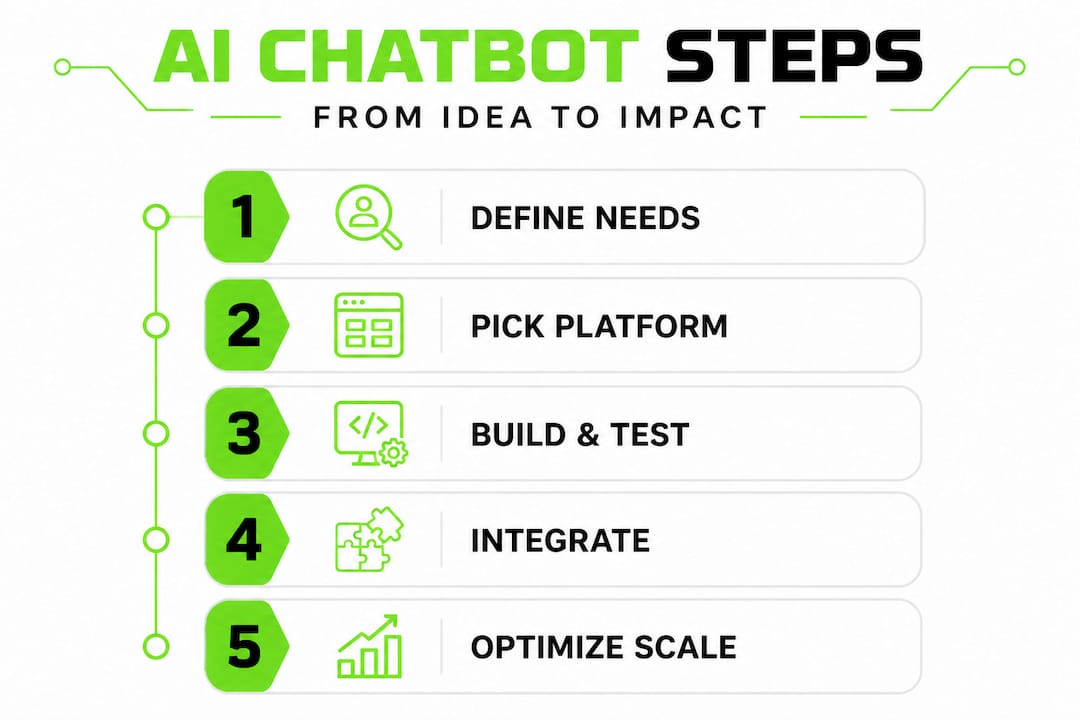
With the right platform chosen, the real work begins. Building a chatbot that customers actually want to use requires a structured, iterative approach. Here is a practical workflow:
-
Define conversation flows and use cases. Before training any model, map out dialog trees for every key scenario the chatbot will handle. Include fallback paths for when the bot does not understand a query. Users forgive a bot that says "I'm not sure, let me connect you with a specialist" far more readily than one that gives wrong answers confidently.
-
Gather and clean training data. Pull real conversation logs, customer emails, and support tickets. Clean and label them by intent. The quality of your training data is directly proportional to the quality of your chatbot's responses. This step is where most technical teams underinvest.
-
Train and fine-tune the model. Use your platform's tools to train intent classifiers and entity extractors. For LLM-based bots, this may involve prompt engineering and retrieval-augmented generation (RAG), which allows the model to pull answers from your actual knowledge base instead of hallucinating responses.
-
Integrate with business channels. Deploy the chatbot across your website, mobile app, WhatsApp, email, and any other customer touchpoints. AI agents for business automation work best when they can access live data, meaning your chatbot should connect to back-end systems via secure APIs. This includes integrating AI with CRM and ERP platforms so the bot can look up order history, update records, and trigger workflows in real time.
-
Run closed beta testing. Before going live, test with a small internal group and then a limited set of real users. Collect qualitative feedback aggressively. Watch session recordings. Look for points where users abandon the conversation or express frustration.
-
Deploy and monitor from day one. Set up dashboards tracking resolution rate, escalation rate, average session length, and customer satisfaction scores immediately at launch. This is not optional configuration work. It is the feedback loop your team will rely on for months.
Critical note on data security: Every integration point between your chatbot and internal systems is a potential vulnerability. Before deploying, conduct a formal security review of all API connections, enforce the principle of least privilege for data access, and ensure all customer data transmitted through the chatbot is encrypted in transit and at rest. This is non-negotiable in regulated industries like finance and healthcare.
Pro Tip: Iterative testing beats perfection planning. Launch a working version quickly, gather real user data, and improve continuously rather than spending months trying to perfect a system in isolation.
Here is a quick reference table for key integration channels and the metrics that matter most for each:
| Channel | Primary metric | Secondary metric |
|---|---|---|
| Website live chat | Resolution rate | Escalation rate |
| Mobile app | Session completion rate | Drop-off point |
| WhatsApp / SMS | Response time | Opt-out rate |
| Voice assistant | Transcription accuracy | Task completion |
| CRM integration | Data sync accuracy | Trigger success rate |
The role of AI in business efficiency is clearest when these integration channels work together seamlessly, creating a unified customer experience regardless of where the interaction begins.
Optimize and scale for enterprise results
Now that your chatbot is running, continuous improvement is what turns a good deployment into a great one. The businesses that see the strongest long-term returns from AI chatbots are the ones that treat launch as the beginning, not the finish line.
Here are the most practical optimization strategies for enterprise deployments:
- Review low-confidence and escalated conversations weekly. These are your best training signals. Every time the bot fails to resolve an issue, it is telling you exactly where your training data has gaps.
- A/B test conversation flows. Test different phrasings for common prompts and measure which variants produce higher resolution rates. Even small wording changes can shift completion rates by 15 to 20 percent.
- Monitor for concept drift. Customer language evolves. New products launch. Regulations change. Your chatbot's training data needs periodic refreshes to stay accurate and relevant.
- Expand use cases incrementally. Once your first chatbot workflow is performing well, add adjacent use cases rather than overhauling the entire system. This keeps risk manageable and lets your team build competence gradually.
- Build multilingual capability if operating globally. Enterprise scaling almost always means serving customers in multiple languages. Plan for this architecturally rather than trying to retrofit it later.
Common mistakes at the enterprise level include deploying a single monolithic chatbot to handle every possible scenario, which creates brittle systems that break unpredictably. Another frequent error is ignoring the escalation experience. If a customer is handed off to a human agent after a failed bot interaction, that agent should receive the full conversation context automatically. Without that context, the customer has to repeat everything, which is arguably worse than no chatbot at all.
Strategic AI automation insights consistently show that organizations scaling effectively use modular architectures, separate specialized agents handling distinct domains rather than one agent doing everything. This mirrors what Forrester advocates for enterprise CX: agentic execution paired with ongoing optimization cycles and meaningful human-in-the-loop governance.
Pro Tip: Blend AI automation with human oversight deliberately, not reactively. Establish clear escalation rules before you launch, define which query types always go to a human agent, and train your human team on how to work alongside AI effectively.
Expert perspective: What most business leaders miss about AI chatbot development
Here is the uncomfortable truth: most AI chatbot projects fail not during development but after deployment. Leaders invest heavily in building and launching, then dramatically underestimate what it takes to keep the system performing well over time. The chatbot goes live, leadership celebrates, and then six months later nobody is looking at the dashboards anymore. Resolution rates quietly slide. User frustration grows. The technology gets blamed when the real failure was operational neglect.
AI chatbots are not infrastructure you install and walk away from. They are products that require the same ongoing attention you would give any customer-facing service. The organizations that treat post-launch optimization as a budget line from day one consistently outperform those that treat it as optional.
There is also a broader mindset issue. Many executives approach chatbot deployment as a cost-cutting exercise rather than a capability expansion. That framing shapes every decision downstream, from how much training data gets collected to whether user feedback is acted on. When you think of a chatbot purely as a way to reduce headcount, you under-invest in the quality that makes it actually useful.
Forrester's research on enterprise AI-human models makes a compelling case that the winning formula is not AI replacing humans but AI augmenting human capacity. The teams and companies that internalize this are the ones building conversational AI solutions that customers genuinely prefer over calling a support line. That is a fundamentally different outcome than deploying a bot to deflect tickets.
Pro Tip: Allocate at least 20 percent of your chatbot project budget for the first year post-launch. This covers ongoing training, content updates, performance reviews, and the engineering time needed to act on what the data tells you.
Take the next step with AI chatbot solutions
Building a high-performing AI chatbot requires more than selecting a platform. It demands clear strategy, technical precision, and a commitment to continuous improvement from the people leading the project.
At Proud Lion Studios, we help startups and enterprises across the UAE and beyond move from chatbot concept to deployed, integrated product built around real business outcomes. Our AI chatbot development services are fully customized, meaning no templates, no off-the-shelf constraints, just solutions shaped around your operations, your customers, and your growth targets. If you want to see what an AI-powered customer experience can look like in practice, explore our example AI chatbot projects and see how we approach everything from initial discovery through enterprise-scale deployment.
Frequently asked questions
What are the key benefits of deploying an AI chatbot in my business?
AI chatbots streamline routine support, improve response times, and scale customer engagement without proportional increases in headcount. Forrester highlights that the most effective deployments blend agentic AI with human oversight for consistently high customer satisfaction.
What technical improvements have made AI chatbots more effective recently?
AI benchmarks have seen dramatic gains, with SWE-bench scores rising from 4.4% to 71.7% and GPQA improving by 48.9 percentage points, making today's chatbot models far more capable of handling complex, context-sensitive conversations than earlier versions.
What are common mistakes to avoid during AI chatbot deployment?
Skipping iterative testing, neglecting post-launch monitoring, and failing to establish human escalation protocols are the most damaging errors. Forrester's enterprise CX model emphasizes that continuous optimization is what separates successful deployments from underperforming ones.
How do AI chatbots integrate with existing enterprise systems like CRM or ERP?
Chatbots connect to CRM and ERP platforms through secure APIs and workflow connectors, enabling real-time data lookup, record updates, and automated task triggering without manual intervention from support staff.
How do I ensure my chatbot maintains security and data privacy?
Enforce the principle of least privilege for all API connections, encrypt data in transit and at rest, and schedule regular security audits throughout both the development and live operation phases of your chatbot.