

TL;DR:
- Building a secure crypto app requires careful technology stack selection, security, and compliance practices.
- Costs and timelines for development vary from $50K with 3 months to over $200K and 18 months for enterprise solutions.
- Security measures like multi-sig wallets, 2FA, audits, and off-chain storage are essential for safeguarding user assets.
Building a secure, scalable crypto application is one of the most technically demanding projects a startup or enterprise team can take on. The wrong stack choice can lock you into poor performance, and a single security gap can expose millions in user funds. Beyond the code itself, you're navigating regulatory pressure, audit requirements, and user expectations that keep rising. This guide breaks down the core technology stacks, realistic costs and timelines, security protocols, and scaling strategies you need to make smart decisions and ship a crypto app that holds up in production.
Table of Contents
- Core technology stacks for crypto app development
- Cost, timeline, and skills required: What to expect
- Security and compliance: Essential protocols
- Scaling, performance, and special cases
- A smarter approach to crypto app development: What experts usually miss
- How Proud Lion Studios accelerates your crypto app journey
- Frequently asked questions
Key Takeaways
| Point | Details |
|---|---|
| Choose the right tech stack | Match your blockchain platform and tools to your app's purpose, compliance needs, and user experience. |
| Budget smartly for resources | Expect $50K–$200K or more and a specialized team for a robust crypto app build. |
| Prioritize security from day one | Implement multi-layered defenses including 2FA, cold wallets, and audits. |
| Plan for scalability | Use Layer 2 solutions and next-gen frameworks for high throughput and enterprise scale. |
| Focus on business fit | Let user needs and data privacy shape technology decisions—not just blockchain hype. |
Core technology stacks for crypto app development
Choosing your technology stack is the single most consequential early decision. It shapes everything from developer hiring to long-term upgrade paths. The good news is that the ecosystem has matured fast, so you have proven options for nearly every use case.
Here is a quick reference for the core layers you'll need:
| Layer | Options | Best for |
|---|---|---|
| Smart contracts | Solidity, Rust | EVM chains, Solana, Aptos |
| Frontend integration | Web3.js, Ethers.js | DApp browser interfaces |
| Development/testing | Hardhat, Truffle | Local dev, automated testing |
| Enterprise permissioned | Hyperledger Fabric | Private enterprise networks |
| Backend APIs | Node.js, Go | Off-chain logic, oracles |
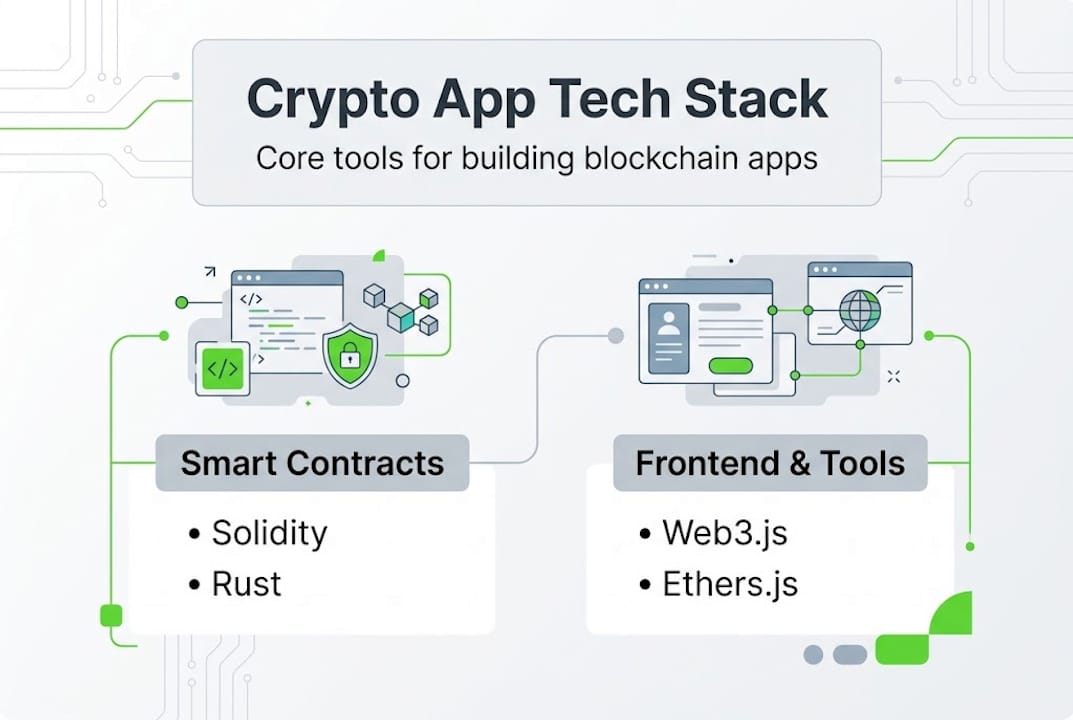
Key technology stacks include Solidity and Rust for smart contracts, Web3.js and Ethers.js for frontend integration, Hardhat and Truffle for development, and Hyperledger Fabric for enterprise permissioned networks. These are not interchangeable. Solidity is the default for Ethereum and EVM-compatible chains. Rust powers Solana and Aptos, which offer dramatically lower fees and higher throughput.
For startups building public-facing DApps, a white-label or modular approach using existing SDKs can compress time to market significantly. Services like Coinbase APIs let you plug wallet creation, payments, and key management directly into your app without rebuilding core infrastructure. Enterprises, by contrast, usually need compliance-ready frameworks and often choose permissioned networks where transaction data stays private and access is controlled.
Key considerations when picking your stack:
- Public DApps: Ethereum or Aptos with Solidity or Move, Ethers.js on the frontend
- Enterprise permissioned: Hyperledger Fabric with Go chaincode and strict access policies
- Wallet and payment apps: Leverage existing custody APIs to reduce liability and development time
- Cross-chain products: Plan for bridge contracts and interoperability from the start
A solid Web3 development checklist will save you from costly late-stage rewrites. Working with top Web3 agencies early in the design phase is worth the investment if your internal team is new to blockchain architecture.
Pro Tip: Don't default to Ethereum simply because it's well-known. Evaluate chain performance benchmarks, average transaction fees, validator decentralization, and your three-year scaling needs before committing.
If you want a deeper look at structuring your project, the blockchain app guide and decentralized app development resources lay out the architecture decisions in detail.
Cost, timeline, and skills required: What to expect
Underestimating budget and timeline is one of the most common mistakes teams make in crypto projects. The numbers here are not small, and the complexity scales fast once you add compliance, audits, and real transaction volume.
| Project type | Estimated cost | Timeline |
|---|---|---|
| Basic POC / MVP | $50K–$100K | 3–6 months |
| Mid-tier production app | $100K–$200K | 6–12 months |
| Enterprise-grade platform | $200K+ | 8–18 months |
Development costs range from $50K to $200K for basic apps and exceed $200K for enterprise-grade builds, with timelines spanning 3 to 6 months for a proof of concept up to 8 to 18 months for full production. These figures assume you are building for real users, not just internal demos.
The major phases you should plan for:
- Discovery and architecture: Define business requirements, pick chain, map data flows, set compliance scope.
- UI/UX design and prototyping: Design wallet flows, transaction screens, onboarding, and error states.
- Smart contract and backend development: Write, test, and internally audit core contract logic.
- MVP launch and QA: Deploy to testnet, run penetration testing, and fix critical issues.
- Mainnet and scaling: Optimize gas usage, load test, set up monitoring, and prepare for growth.
The core team you need includes blockchain developers who specialize in your target chain, frontend engineers with Web3 experience, smart contract specialists who understand attack vectors, a QA engineer focused on transaction edge cases, and a dedicated security reviewer. Skipping any of these roles typically creates technical debt that costs more to fix later.

Three factors that consistently push costs up: security audits from reputable third parties (budget $15K to $50K per audit), KYC and AML compliance integration, and multi-chain support. Review the Web3 app workflow guide to plan your build phases so nothing gets dropped under deadline pressure.
Security and compliance: Essential protocols
Security is not a feature you add at the end. In crypto, a vulnerability in production means real financial loss, often irreversible. The threat landscape is aggressive and specific to blockchain apps.
A 2023 ImmuniWeb study found that 74% of crypto apps have outdated software dependencies and 25% carry known vulnerabilities. These are not edge cases. They are the industry baseline without disciplined security practices.
"The majority of top cryptocurrency exchange platforms expose users to significant risk through outdated libraries, missing security headers, and weak authentication practices." — ImmuniWeb security research
Your security checklist for every crypto app build:
- Multi-signature wallets: Require multiple keys for high-value transactions to eliminate single points of failure
- Two-factor authentication (2FA): Enforce for all user accounts, especially withdrawal actions
- Hot and cold wallet separation: Keep the majority of funds in offline cold storage
- End-to-end encryption: Protect all data in transit and at rest
- Smart contract audits: Third-party code review before any mainnet deployment
- Penetration testing: Simulate real attacks on API endpoints and wallet interfaces
- Dependency scanning: Automate checks for outdated packages in your CI/CD pipeline
For enterprises, compliance is not optional. KYC (Know Your Customer) and AML (Anti-Money Laundering) requirements vary by jurisdiction but are universally expected by regulators. Building compliance hooks into your architecture from day one is far cheaper than retrofitting them post-launch. Review compliance case studies from regulated industries to understand what auditors actually look for.
Your security checklist for Web3 should be treated as a living document, updated every sprint as new vulnerabilities are disclosed.
Pro Tip: Schedule your third-party smart contract audit at least four weeks before your target launch date. Audit firms are booked out, and findings always require remediation time you haven't planned for.
Scaling, performance, and special cases
A crypto app that performs well in testing can fall apart under real user load. Throughput, latency, and cost-per-transaction all behave differently at scale. Planning for this early is what separates production-grade builds from demos.
| Approach | Max TPS | Best use case | Tradeoffs |
|---|---|---|---|
| Layer 1 (Ethereum) | ~15–30 TPS | Decentralized finance, NFTs | High fees, slower finality |
| Layer 2 (Polygon, Arbitrum) | ~2,000–7,000 TPS | Retail payments, gaming | Bridge complexity, UX overhead |
| Fabric-X (CBDC/enterprise) | 100,000+ TPS | Central bank digital currency, supply chain | Permissioned only |
Hyperledger Fabric demonstrated real-world impact when Walmart traced food origins in seconds rather than days using blockchain tracking. That same architecture now underpins Fabric-X, designed specifically for high-frequency enterprise workloads like CBDC settlement.
For high-frequency trading platforms or financial settlement systems, native development on a high-throughput chain like Aptos or a Layer 2 is usually the right call. Cross-platform frameworks introduce latency that is acceptable for consumer apps but unacceptable for millisecond-sensitive trading.
Steps to design for scale from the start:
- Set TPS targets early: Define your peak transaction expectations before picking your chain.
- Use off-chain computation: Move complex logic off-chain and only write final state to the ledger.
- Implement caching layers: Reduce redundant RPC calls with indexed data layers like The Graph.
- Load test on testnet: Simulate 10x expected traffic before mainnet deployment.
- Plan for chain upgrades: Build adapter layers so you can migrate without a full rewrite.
Explore the scalable blockchain app guide for mobile-specific performance patterns, and check the Aptos vs Ethereum comparison if you are choosing between these two ecosystems for your specific workload.
A smarter approach to crypto app development: What experts usually miss
Most guides focus on tools and timelines. What gets skipped is the harder question: should your app actually use blockchain at all, and which parts of it should?
We see teams over-engineer on-chain storage for data that has no business being there. User profile details, large media files, and transaction metadata rarely need to live on a public ledger. Use off-chain storage for sensitive or high-volume data, and reserve on-chain writes for state changes that genuinely require immutability or trustless verification. Zero-knowledge proofs (ZKPs) offer a powerful middle ground when you need to prove something without revealing the underlying data.
The native versus cross-platform debate is another area where conventional wisdom often misses the mark. For critical financial workloads, native development on your target chain is worth the extra cost. The performance gap is real, and so is the security surface area introduced by abstraction layers. Validate your regulatory and interoperability requirements before your MVP, not after. Retrofitting compliance is expensive, and so is rebuilding a bridge integration you didn't plan for.
AI integration is also moving from experimental to practical in 2026. Teams are using ML-based anomaly detection for real-time transaction monitoring and AI agents for automated compliance checks. The future of web development is increasingly a blend of blockchain's trustless guarantees and AI's pattern recognition, and crypto apps that ignore this will need to catch up quickly.
How Proud Lion Studios accelerates your crypto app journey
Building a production-grade crypto app requires more than a capable team. It requires a partner who has navigated the decisions outlined in this guide across real projects.
At Proud Lion Studios, our blockchain development services cover the full build lifecycle, from architecture and smart contract development to security reviews and mainnet deployment. Whether you're launching a DeFi platform, integrating payments, or building enterprise infrastructure, we tailor every solution to your specific compliance, performance, and scale requirements. Explore our tokenization and DApp projects to see the range of solutions we've shipped, and browse our NFT portfolio for creative and technical reference points.
Frequently asked questions
What are the key programming languages for crypto app development?
Solidity and Rust are the most widely used languages for smart contracts, while Web3.js and Ethers.js handle frontend blockchain integration. Your choice depends on which chain you are building for.
How long does it take to build an enterprise-grade crypto app?
Plan for 8 to 18 months for a full production-ready platform, accounting for compliance integration, third-party audits, and iterative QA cycles. A basic proof of concept can be ready in 3 to 6 months.
What security measures are essential for any crypto app?
Multi-sig wallets, 2FA, encryption, hot/cold wallet separation, and regular smart contract audits from independent firms are non-negotiable for any app handling real user funds.
How can crypto apps achieve high transaction throughput?
Layer 2 solutions like Polygon or Arbitrum handle thousands of transactions per second, and enterprise platforms like Fabric-X achieve over 100,000 TPS for high-frequency workloads like CBDC settlement.
What's the difference between public and permissioned blockchains?
Public blockchains allow anyone to participate and view transactions, while permissioned networks like Hyperledger Fabric restrict access to approved participants, making them better suited for enterprise use cases requiring privacy and regulatory control.
Recommended
- How to build blockchain apps: step-by-step startup guide
- How to Build a Web3 Startup: Expert Guide to Success
- Blockchain mobile apps guide: build scalable solutions in 2026
- Understand decentralized apps: guide for blockchain developers 2026
- Custom app development guide for startup founders 2026 | HK