

TL;DR:
- Blockchain security relies on cryptography and consensus but faces most real risks from operational failures and human mistakes. Key vulnerabilities include weak private key management, insecure smart contracts, and social engineering attacks, which cause most losses. Implementing multi-signature wallets, hardware security modules, formal contract verification, and continuous monitoring strengthens protection.
Blockchain security is the comprehensive framework that protects distributed ledger data and transactions from tampering, fraud, and cyberattacks. It combines cryptographic hashing, consensus mechanisms, and operational safeguards to guarantee data integrity across every node in a network. Explaining blockchain security means going beyond the base protocol. The real risks live at the application layer, in smart contract code, private key storage, and human behavior. Standards like ISO 27001 and SOC 2 apply here, but they require adaptation for decentralized systems where no single organization controls every node. This guide covers how blockchain security works, where it breaks down, and what you can do to protect your assets and networks.
How does blockchain enforce security through cryptography and consensus?
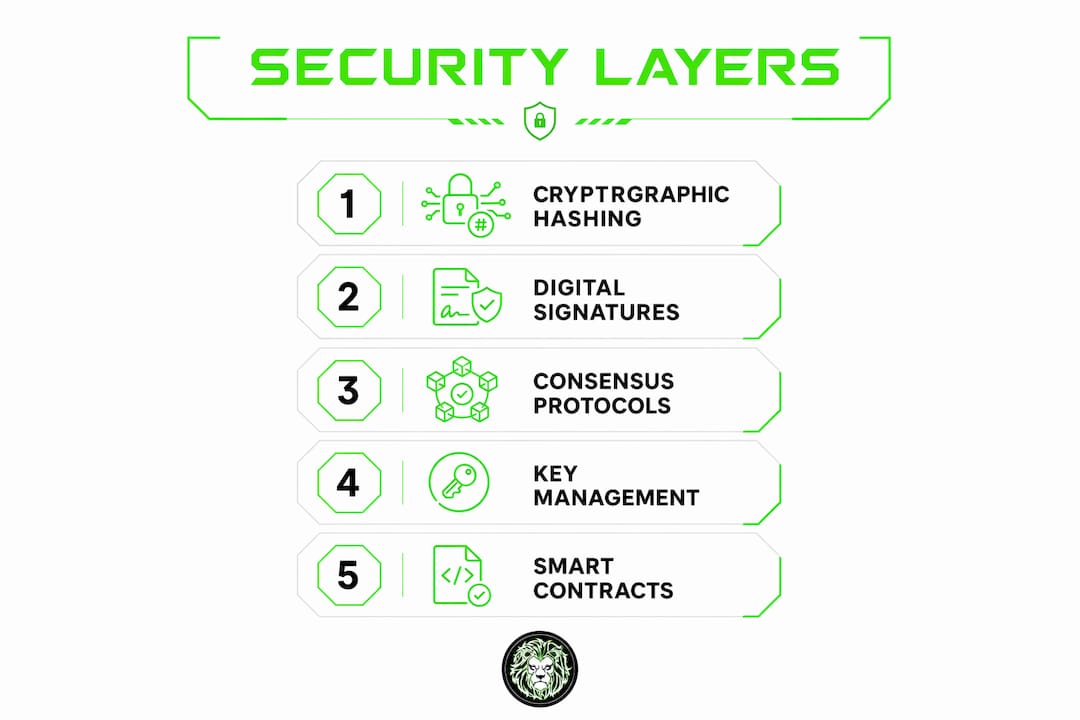
Blockchain security rests on three interlocking mechanisms: cryptographic hashing, digital signatures, and consensus protocols. Each one addresses a different attack surface. Together, they make unauthorized changes mathematically expensive and socially difficult to execute.
Cryptographic hashing and tamper evidence
Every block in a blockchain contains a cryptographic hash of the previous block. Changing a single transaction breaks the entire hash chain, making unauthorized edits immediately detectable. This is not a policy control. It is a mathematical guarantee baked into the data structure itself.

Digital signatures extend this protection to individual transactions. When you send a transaction, you sign it with your private key. Every node on the network can verify that signature using your public key, confirming both identity and data integrity without a central authority.
Consensus mechanisms and the 51% problem
Consensus protocols determine which version of the ledger is "true." Proof-of-Work requires nodes to solve computationally expensive puzzles before adding a block. Proof-of-Stake requires validators to lock up economic value as collateral. Both designs make rewriting history costly.
The 51% attack is the theoretical breaking point. An attacker who controls the majority of network nodes can override consensus and rewrite recent blocks. In practice, most exploits occur at the application layer, not through consensus attacks. That distinction matters because it shifts your security focus away from the protocol and toward your code and operations.
Pro Tip: Treat consensus security as a baseline, not a ceiling. Your smart contracts and key management practices carry more real-world risk than a 51% attack on any major network.
What are the common vulnerabilities and risks beyond the protocol?
Most real-world blockchain losses stem from operational failures, weak key management, and rushed smart contract deployment, not from flaws in the underlying cryptography. Understanding where security actually breaks down is the first step toward fixing it.
Smart contract vulnerabilities
Smart contracts are programs that execute automatically on-chain. They are also adversarial environments where every bug is monetizable. Attackers scan deployed contracts continuously, looking for reentrancy flaws, integer overflows, and access control gaps. Once a malicious transaction confirms, it cannot be reversed.
Common smart contract risks include:
- Reentrancy attacks: A malicious contract calls back into the victim contract before the first execution completes, draining funds in a loop.
- Integer overflow and underflow: Arithmetic errors that wrap around numeric limits, creating unintended token balances or bypassing checks.
- Access control failures: Functions that should be restricted to admins are left publicly callable due to missing modifiers.
- Business logic flaws: The code executes exactly as written but the logic itself is wrong, producing outcomes the developer never intended.
- Unverified external calls: Contracts that call unknown addresses without validating return values, opening the door to manipulation.
Pro Tip: Never deploy a smart contract without a formal security audit. Treat every deployment as launching code into a hostile environment with a financial bounty attached to every bug.
Private key management failures
Your private key is your identity on a blockchain. Lose it and you lose access permanently. Expose it and an attacker owns everything you control. Most high-profile thefts trace back to poor key storage: keys saved in plain text, stored on internet-connected devices, or managed by a single person with no backup process.
Network-level and social engineering threats
Node eclipse attacks isolate a target node by surrounding it with attacker-controlled peers, feeding it a false view of the blockchain. Sybil attacks flood a network with fake identities to gain disproportionate influence. Social engineering and phishing remain the most reliable attack vectors because they bypass cryptography entirely by targeting the humans who hold the keys.
What are the best practices for safeguarding blockchain assets?
Blockchain security consists of cryptography, consensus, governance, and disciplined operations working together. No single control is sufficient. The strongest programs layer technical controls with process and compliance mapping.
Technical controls
- Multi-signature wallets: Require multiple private keys to authorize a transaction. A single compromised key cannot drain funds. Apply multi-sig to all high-value treasury functions and administrative contract calls.
- Hardware security modules (HSMs): Store private keys in tamper-resistant hardware that never exposes the key in plaintext. Best practices in 2026 include HSMs as the standard for enterprise key management.
- Formal verification of smart contracts: Use mathematical proofs to verify that contract code behaves exactly as specified under all possible inputs. This goes beyond traditional code review.
- Continuous on-chain monitoring: Deploy automated tools that watch for unusual transaction patterns, unexpected contract calls, and anomalous node behavior in real time.
- Penetration testing: Run static and dynamic code audits that test for known vulnerabilities, business logic flaws, and misconfigurations specific to your blockchain environment.
Compliance and governance mapping
Blockchain's inherent security benefits do not replace traditional controls. ISO 27001 and SOC 2 frameworks still apply, but they need adaptation. You often do not control every node in a decentralized network, which creates gaps in standard asset inventory and access control requirements. Map each framework control to the nearest blockchain equivalent and document where gaps exist.
The table below shows how traditional compliance controls translate to blockchain environments.
| Traditional control | Blockchain equivalent |
|---|---|
| Access control policy | Multi-signature authorization and role-based contract permissions |
| Asset inventory | On-chain address registry and node inventory |
| Change management | Smart contract upgrade governance and timelocked admin functions |
| Incident response | Pre-defined fork or contract pause procedures |
| Audit logging | Immutable on-chain transaction history plus off-chain node logs |
Cloud security best practices for infrastructure monitoring and HSM deployment apply directly to blockchain node operations, especially when nodes run on cloud infrastructure.
How do you detect and respond to blockchain security events?
Formal verification and continuous on-chain monitoring are essential because malicious transactions cannot be reversed once confirmed. Prevention is your primary defense. Detection and response exist to limit damage, not undo it.
Indicators of compromise to watch for
- Sudden spikes in gas usage on a specific contract, which may signal a reentrancy loop or denial-of-service attempt.
- Unexpected calls to administrative functions from addresses outside the approved multi-sig set.
- Large token transfers to newly created addresses with no prior transaction history.
- Node peers changing rapidly or a node losing sync with the main chain, which may indicate an eclipse attack in progress.
- Governance proposals submitted with unusually short voting windows, a common tactic in governance takeover attacks.
Pro Tip: Set automated alerts for any admin function call on your contracts. Most governance attacks succeed because no one noticed the proposal until voting had already closed.
Incident response for immutable systems
Blockchain incident response differs from traditional IT response in one critical way: you cannot roll back confirmed transactions. Your response plan must focus on containment, not reversal. For smart contracts, this means building pause mechanisms and upgrade paths into your architecture before deployment. A contract with no pause function is a contract you cannot stop if it starts behaving maliciously.
A blockchain's security model functions as a series of concentric layers. Attackers must overcome network, consensus, and private key storage defenses in sequence. Incident response should address each layer separately, with dedicated runbooks for node compromise, key exposure, and contract exploit scenarios.
For a deeper look at building these defenses into your code from day one, the secure blockchain application guide from Proud Lion Studios covers HSM integration, formal verification workflows, and monitoring setup in practical detail.
Key Takeaways
Blockchain security requires layered technical controls, disciplined key management, and compliance mapping because the protocol itself protects only the base layer while most losses occur at the application and operational layers.
| Point | Details |
|---|---|
| Protocol security has limits | Cryptographic hashing and consensus protect the base layer; smart contracts and keys carry most real-world risk. |
| Operational failures cause most losses | Weak key management and rushed deployments cause more damage than protocol-level attacks. |
| Multi-sig and HSMs are non-negotiable | Multi-signature wallets and hardware security modules reduce the blast radius of any single compromise. |
| Compliance frameworks need adaptation | ISO 27001 and SOC 2 apply to blockchain but require mapping because you often do not control every node. |
| Prevention beats response | Immutability means you cannot reverse confirmed transactions; build pause mechanisms and upgrade paths before deployment. |
Why most blockchain security advice misses the point
I have reviewed a lot of blockchain security content, and the pattern is consistent. Articles spend most of their words on cryptographic hashing and consensus mechanisms, the parts of the system that almost never fail in practice. The real losses happen in the places that get one paragraph at the end: key management, contract deployment practices, and the humans who hold administrative access.
The adversarial mindset is the concept that changes how you think about this. Trust in blockchain security comes from verifiable computation, not from trusted administrators. That sounds empowering until you realize it means every piece of code you deploy is a public target with a financial reward attached to breaking it. Developers who have not internalized that reality write contracts that work perfectly in testing and drain funds in production.
The other thing I see consistently underweighted is governance. A technically perfect contract with a poorly designed upgrade mechanism or a single-admin key is not a secure contract. It is a ticking clock. The blockchain security essentials guide covers governance architecture in depth, and I think it is the section most teams skip because it feels like a process problem rather than a technical one. It is both.
Emerging tools like formal verification and continuous on-chain monitoring are closing the gap between what developers intend and what code actually does. They are not optional extras for large projects. They are the baseline for any contract handling real value.
— Amal
Proud Lion Studios builds blockchain security into every layer
Proud Lion Studios works with startups and enterprises across multiple countries to design and deploy blockchain systems that treat security as architecture, not an afterthought.

The team at Proud Lion Studios integrates HSM-based key management, formal smart contract verification, and continuous monitoring into every client engagement. Their blockchain development services cover the full stack, from protocol selection and node architecture to smart contract development with built-in pause mechanisms and upgrade governance. If you are building on-chain and need a team that understands the adversarial environment your code will operate in, Proud Lion Studios is the right partner to talk to.
FAQ
What is blockchain security?
Blockchain security is the set of technical and operational controls that protect distributed ledger data and transactions from tampering, fraud, and cyberattacks. It combines cryptographic hashing, consensus mechanisms, and access controls across multiple layers.
How does cryptographic hashing protect a blockchain?
Each block contains a hash of the previous block, so changing any transaction breaks the entire chain and makes the edit immediately detectable. This creates tamper evidence without requiring a central authority.
What causes most blockchain security breaches?
Most losses come from operational failures such as weak private key management and unaudited smart contract deployments, not from attacks on the underlying cryptography or consensus protocol.
What is a 51% attack?
A 51% attack occurs when a single entity controls the majority of a network's nodes and can rewrite recent transaction history. In practice, this attack is rare on large networks because the cost of acquiring that much computing power or stake is prohibitive.
What are the most important blockchain security best practices?
The most effective controls are multi-signature wallets for high-value functions, hardware security modules for key storage, formal verification of smart contracts before deployment, and continuous on-chain monitoring for anomalous activity.