

TL;DR:
- Building scalable, secure dApps requires careful architecture, data management, and ongoing optimization.
- Gas costs, security vulnerabilities, and performance bottlenecks persist as major challenges for live dApps.
- Continuous monitoring, multi-layer security, and iterative improvements are essential for long-term success.
Many entrepreneurs assume that launching a decentralized application is just a matter of deploying a smart contract and watching the users roll in. The reality hits harder. Cold storage writes inflate gas fees by 20%, security attack vectors evolve weekly, and scalability cracks appear the moment real traffic arrives. Even seasoned developers get caught off guard by these hidden complexities. This guide cuts through the noise and gives you a clear, actionable pathway for building modern decentralized apps (dApps) that are performant, secure, and ready to scale using blockchain and AI technologies.
Table of Contents
- The evolution and fundamentals of decentralized applications
- Architectural choices: Blockchain, smart contracts, and AI integration
- Navigating performance and scalability bottlenecks
- Securing decentralized apps: Common risks and advanced defense strategies
- Our take: Why successful dApps demand relentless optimization and security
- Ready for your own decentralized app? Get expert help
- Frequently asked questions
Key Takeaways
| Point | Details |
|---|---|
| Gas costs can spike | Cold storage and deep mappings can inflate transaction fees by 20% or more for decentralized apps. |
| Concurrency affects finality | Moderate transaction concurrency can fill blocks 80-90%, which may double transaction finality times. |
| Defensive design is critical | Proactively address reentrancy, oracle manipulation, and validation gaps to secure your dApp. |
| AI enables smarter dApps | Integrating AI can boost automation but must be balanced with performance and security planning. |
The evolution and fundamentals of decentralized applications
Understanding what defines a decentralized app is the first step. A dApp is software that runs on a blockchain network rather than a centralized server. Unlike traditional apps where a single company controls the backend, dApps distribute logic across thousands of nodes, making censorship or single-point failure nearly impossible.
This architectural shift changes everything. Traditional apps can push a hotfix in minutes. dApps require governance proposals or proxy patterns to update contract logic. The tradeoff is immutability and trustlessness, which users increasingly demand in financial, gaming, and identity applications.
Blockchain and AI together are redefining what dApps can do. Blockchain provides transparent, tamper-proof execution. AI layers on top to add predictive analytics, automated decision-making, and personalized user experiences. Together, they enable use cases that neither technology can achieve alone, like autonomous financial agents or real-time fraud detection on-chain.
The dApp ecosystem has matured significantly. Early Ethereum apps were slow and expensive. Layer 2 networks, alternative blockchains like Aptos and Solana, and improved consensus mechanisms have dramatically expanded what is possible at scale. Business models have shifted from simple token speculation to subscription DAOs, NFT utilities, and on-chain governance frameworks.
Scalability remains the hardest challenge. Research shows that concurrency of 30 to 50 transactions can fill blocks to 80 to 90% capacity, doubling time-to-finality under network load. When your dApp gains traction, this bottleneck becomes a business problem, not just a technical one.
Traditional apps vs. dApps at a glance:
| Feature | Traditional App | Decentralized App |
|---|---|---|
| Hosting | Centralized server | Distributed nodes |
| Data control | Single entity | Protocol/community |
| Update process | Instant deployment | Governance or proxy |
| Downtime risk | High (single point) | Low (distributed) |
| Transparency | Limited | Full on-chain audit |
Key milestones that shaped modern dApp development:
- 2015: Ethereum launched smart contract execution at scale
- 2020: DeFi summer proved real financial utility on-chain
- 2022: Layer 2 networks reduced gas costs by over 90% for many use cases
- 2024: AI-powered smart contract auditing and automation became mainstream
- 2026: Cross-chain interoperability protocols now connect over 50 major networks
If you want to go deeper on the technical side, blockchain development services offer structured support for teams navigating these architectural decisions.
Architectural choices: Blockchain, smart contracts, and AI integration
With the big picture established, the technical choices you make early will define your dApp's performance ceiling and operational costs for years. Start with blockchain selection.
Every blockchain makes different tradeoffs. Ethereum offers the largest developer ecosystem but higher gas costs. Solana delivers high throughput but with more complex node requirements. Aptos uses a Move-based execution model with parallel transaction processing, making it excellent for high-concurrency applications. Your choice should match your use case's transaction volume, cost sensitivity, and target user base.
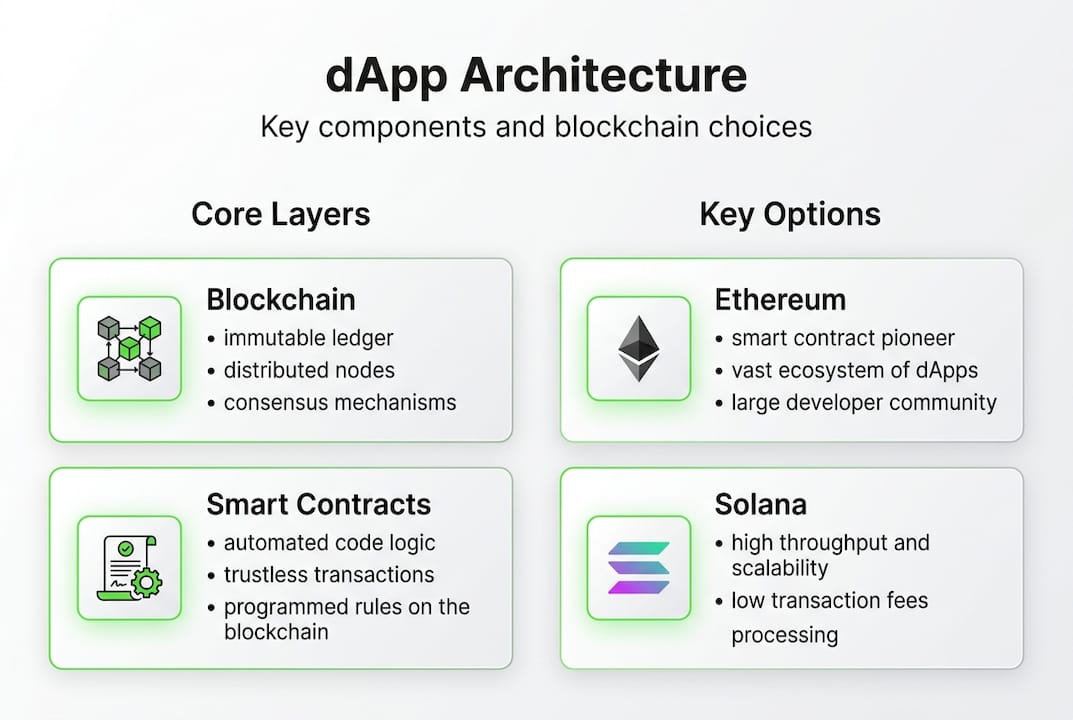
Blockchain comparison for dApp builders:
| Blockchain | TPS (approx.) | Avg. tx cost | Best for |
|---|---|---|---|
| Ethereum | 15-30 | $1-$20 | DeFi, NFTs, DAOs |
| Solana | 2,000-65,000 | <$0.01 | Gaming, payments |
| Aptos | 10,000+ | <$0.01 | Finance, enterprise |
| Polygon | 7,000 | <$0.01 | Scaling Ethereum apps |
Smart contracts are the backbone of every dApp. A common pitfall is treating them like traditional backend code. They are not. Every computation costs gas, and poor data structure choices compound those costs fast. Research confirms that nested mappings substantially increase gas costs, which directly eats into your users' wallets and your product's adoption.
Here is a structured approach to smart contract design:
- Map your data model first. Identify exactly what needs to live on-chain versus off-chain before writing a single line of code.
- Avoid deep nesting. Flat data structures reduce gas consumption meaningfully.
- Use events over storage where possible. Emitting events costs far less than writing storage.
- Separate concerns into multiple contracts. Modular design allows targeted upgrades without full redeployment.
- Audit before deploying. Post-launch vulnerabilities are exponentially more expensive to fix.
For a step-by-step technical walkthrough, the guide on building blockchain apps is worth reading before you finalize your contract architecture.
AI integration adds powerful capabilities but also complexity. On-chain AI is still maturing, so most teams use off-chain AI agents that interact with smart contracts via oracles or API bridges. This hybrid model lets you add machine learning-driven features like dynamic pricing, fraud detection, or personalized recommendations without bloating your contract logic. Learn more about practical AI and blockchain integration patterns that teams are shipping in 2026.
Pro Tip: Avoid storing complex nested data structures in contract storage. Flatten your mappings wherever possible. The gas savings over thousands of transactions are substantial, and your users will notice the difference in fees.
Navigating performance and scalability bottlenecks
Once the architecture is set, it is crucial to recognize where performance bottlenecks appear when deploying and running a dApp at scale. Most teams discover these issues in production, which is the worst possible time.
Storage is one of the most underestimated cost drivers. Cold storage writes, accessing data that has not been touched recently, are significantly more expensive than warm reads. Cold writes and deep mappings inflate gas by 20% or more, and when 30 to 50 concurrent transactions hit your contract simultaneously, block capacity fills to 80 to 90%, doubling transaction confirmation times. This is not a hypothetical edge case. It happens regularly on popular dApps during peak usage.
"Scalability is not a feature you add later. It is a set of decisions baked into every line of contract code and every data structure you choose from day one."
The key performance levers you need to manage:
- Storage access patterns: Minimize cold reads by designing data locality into your contract state
- Batch transactions: Group multiple operations into single calls where the protocol allows
- Off-chain computation: Move heavy logic off-chain and verify results on-chain using cryptographic proofs
- Gas limit buffers: Always simulate transactions under load before deploying to mainnet
- Layer 2 routing: Route high-frequency, low-value transactions to L2 networks to reduce mainnet congestion
For teams building mobile-first experiences, the blockchain app scalability guide covers mobile-specific architectural patterns worth studying. And if you want a structured pre-launch checklist, the web3 optimization checklist is a reliable starting point.
Pro Tip: Monitor your contract's transaction concurrency during testing. Set up alerts when block utilization approaches 70% during load tests. This threshold gives you time to optimize before real users experience delays.
Finality delays hurt user experience more than most teams expect. A user who submits a swap and waits 45 seconds instead of 10 often abandons the app and never returns. Designing around expected finality times, especially under congestion, is a UX decision as much as a technical one.

Securing decentralized apps: Common risks and advanced defense strategies
Once you optimize for performance, safeguarding your application from evolving threats becomes critical. dApp security is fundamentally different from web2 security because exploits are often irreversible. There is no database rollback when a smart contract gets drained.
The attack surface is wider than most new teams realize. Research identifies reentrancy, oracle manipulation, ERC-4337 validation gaps, and XSS combined with IPFS vulnerabilities as leading threats, alongside proxy upgrade collision risks. Each of these requires a distinct defensive layer.
A reentrancy attack occurs when a malicious contract repeatedly calls back into your contract before the first execution finishes, draining funds with each recursive call. The 2016 DAO hack, which cost $60 million, remains the most famous example. Oracle manipulation exploits the gap between off-chain data feeds and on-chain contract logic, allowing attackers to feed false price data to trigger unintended contract behavior. Oracle risks explained in detail for those building DeFi or data-dependent applications.
Your pre-launch and post-launch security checklist:
- Reentrancy guards: Use the checks-effects-interactions pattern and add reentrancy guard modifiers
- Oracle redundancy: Use decentralized oracle networks with multiple independent data sources
- ERC-4337 validation: Implement strict paymaster and bundler validation to close account abstraction gaps
- Frontend XSS hardening: Sanitize all inputs; never trust user-supplied data rendered near contract calls
- IPFS content verification: Hash-verify all IPFS-retrieved content before use
- Proxy upgrade audits: Review storage slot collisions before every upgrade deployment
- Continuous monitoring: Deploy on-chain monitoring tools to flag anomalous transaction patterns in real time
The full web3 security checklist covers each of these areas with implementation guidance.
Pro Tip: Implement multi-layer validation at every trust boundary in your dApp. Validate on the frontend, validate in the oracle layer, and validate inside the contract itself. Redundant checks cost almost nothing compared to a single exploit event.
Security is not a one-time audit. Threat actors adapt constantly, and new attack vectors emerge as protocols evolve. Budget for ongoing security reviews, not just a pre-launch audit.
Our take: Why successful dApps demand relentless optimization and security
Here is what years of shipping decentralized applications across multiple blockchains have taught us. Most teams underestimate the operational demands of a live dApp. They treat launch as the finish line when it is actually the starting gun.
Cold storage inefficiencies and security vulnerabilities are not edge cases reserved for poorly designed apps. They are everyday realities for any project that gains real traction. The projects that survive and scale are the ones with monitoring infrastructure, clear upgrade governance, and a team that treats performance and security as ongoing disciplines rather than launch checklist items.
The uncomfortable truth is that the blockchain's trustless nature, its greatest strength, also means there is no safety net when something goes wrong. Understanding Web3 workflow fundamentals before you build is not optional. It is the foundation of every resilient dApp.
We have seen promising projects collapse because they optimized for demo-day performance instead of production resilience. The future of app development belongs to teams that iterate continuously, monitor relentlessly, and treat security as a product feature rather than an afterthought.
Ready for your own decentralized app? Get expert help
Translating insight into action is easier with the right partners and tools by your side.

At Proud Lion Studios, we build dApps from architecture to launch, with a focus on performance, security, and scalability that holds up under real-world conditions. Our team handles everything from smart contract development and auditing to AI agent solutions that give your application intelligent automation capabilities. Whether you are starting from scratch or scaling an existing protocol, our end-to-end dApp solutions are built around your specific business goals, not templated packages. Let us help you ship something that lasts.
Frequently asked questions
What are the main challenges in decentralized application development?
Major challenges include high and unpredictable gas costs, scalability limits under concurrency, and security vulnerabilities. Reentrancy, oracle manipulation, and nested mapping gas costs rank among the most critical risks teams face in real deployments.
How do gas costs affect decentralized apps?
Gas costs fluctuate based on network congestion and your contract's data structure choices. Cold storage writes inflate gas by 20% or more, and network congestion during peak usage can delay transaction finality significantly, degrading user experience.
What security practices reduce risk in dApp development?
Employ multi-layer validation at every trust boundary, conduct regular smart contract audits, and deploy on-chain monitoring. Multi-layer validation and protocol-specific monitoring measurably reduce exposure to the most common dApp attack vectors.
Can AI improve decentralized application capabilities?
Yes, AI drives smarter automation, real-time analytics, and personalized user experiences within dApps. However, AI features in dApps require robust design to avoid introducing new attack surfaces or resource-intensive patterns that inflate operational costs.