
Launching a mobile app can feel overwhelming when you're unsure where to start or how each stage connects. Many tech entrepreneurs and product managers struggle with unclear timelines, shifting requirements, and design decisions that affect the entire project. This guide breaks down the mobile app development process into clear, actionable stages so you can confidently navigate from initial idea to successful launch. You'll learn the essential steps, proven methodologies, and best practices that help startups and enterprises deliver high-quality apps on time and within budget.
Table of Contents
- Key Takeaways
- Understanding the mobile app development lifecycle
- Choosing the right development methodology: agile vs waterfall
- Designing user-centric mobile apps: UI/UX essentials
- Development, testing, and launch best practices
- Post-launch maintenance and iteration strategies
- Partner with Proud Lion Studios for expert mobile app development
- Frequently asked questions
Key Takeaways
| Point | Details |
|---|---|
| Lifecycle stages | The mobile app lifecycle includes seven essential stages from idea to maintenance to guide planning, resources, and timelines. |
| MVP scope clarity | Defining exactly which features make the cut for version 1.0 before development reduces rework and speeds up launch. |
| Agile advantage | Agile with short sprints lets teams adapt to feedback and changing requirements, which suits startups and MVP projects. |
| Early planning benefits | Investing time in ideation and planning upfront prevents costly changes later and guides all subsequent decisions. |
Understanding the mobile app development lifecycle
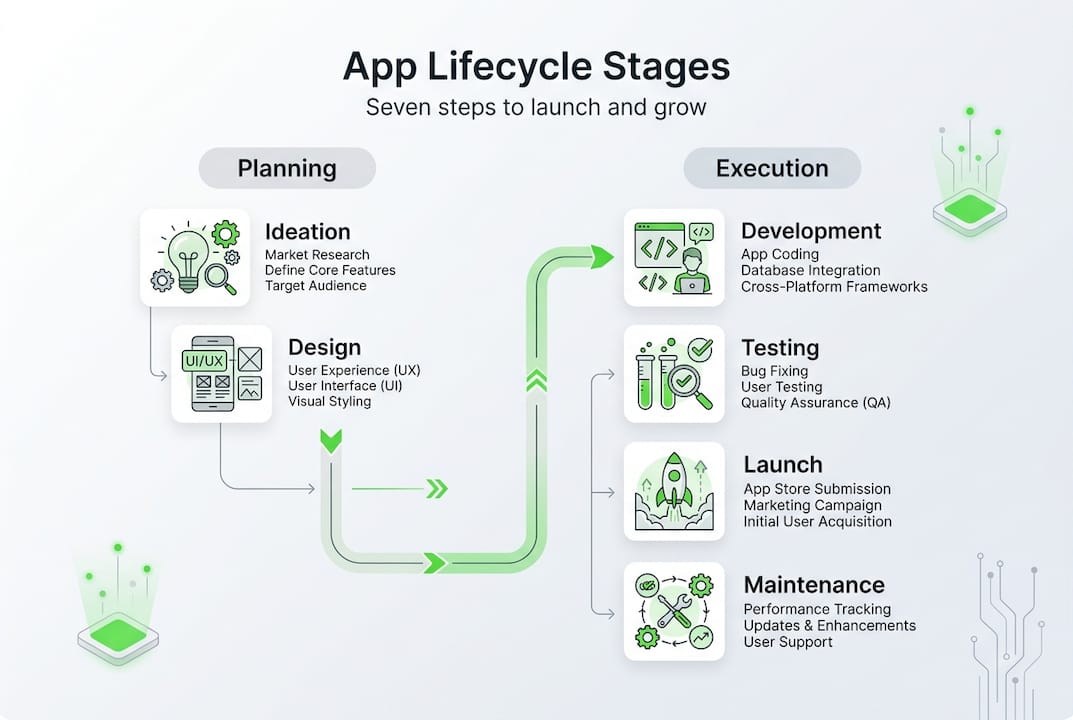
The mobile app development process typically follows 7-8 stages that transform your concept into a live product. Each stage builds on the previous one, creating a structured path from initial brainstorming to ongoing maintenance. Understanding this lifecycle helps you allocate resources effectively, set realistic timelines, and identify potential bottlenecks before they derail your project.
The seven essential stages:
- Ideation and research: Define your app concept, identify target users, analyze competitors, and validate market demand through surveys and interviews.
- Planning and strategy: Create detailed project requirements, select technology stack, define features for MVP, establish budget and timeline.
- UI/UX design: Develop wireframes, create interactive prototypes, design visual interface elements, conduct usability testing with target users.
- Development: Build front-end user interface, develop back-end infrastructure, integrate APIs and third-party services, implement core functionality.
- Testing and QA: Execute unit tests, perform integration testing, conduct user acceptance testing, fix bugs and optimize performance.
- Deployment: Prepare app store listings, submit for review, coordinate launch marketing, monitor initial user feedback.
- Maintenance and iteration: Release regular updates, fix emerging bugs, add new features based on analytics, ensure OS compatibility.
| Stage | Main Goal | Typical Deliverables |
|---|---|---|
| Ideation | Validate concept | Market research report, user personas |
| Planning | Define scope | Requirements document, project roadmap |
| Design | Create user experience | Wireframes, prototypes, design system |
| Development | Build functionality | Working application code, APIs |
| Testing | Ensure quality | Test reports, bug fixes |
| Deployment | Launch app | Live app on stores, analytics setup |
| Maintenance | Sustain performance | Updates, new features, performance reports |
Thorough planning early in the lifecycle prevents costly changes later. When you invest time in the ideation and planning stages, you create a solid foundation that guides all subsequent decisions. Teams that rush through planning often face scope creep, technical debt, and missed deadlines.
Pro Tip: Define your MVP scope with ruthless clarity before development begins. List exactly which features make the cut for version 1.0 and which wait for future releases. This focused approach reduces rework by 40% and accelerates your launch timeline.
The building future of apps proud lion studios approach emphasizes this structured methodology while maintaining flexibility for innovation. Modern mobile app development (ios android) requires balancing systematic processes with adaptive thinking.
Having established the full lifecycle, next we explore methodologies that drive successful project execution and adaptability.
Choosing the right development methodology: agile vs waterfall
Your choice of development methodology shapes how your team works, communicates, and delivers results. The two dominant approaches are agile and waterfall, each suited to different project types and organizational cultures. Understanding their strengths helps you select the right framework for your specific situation.
Agile methodology dominates mobile app development with 1-2 week sprints that allow teams to adjust priorities based on feedback and changing requirements. Waterfall follows a linear sequence where each phase must complete before the next begins. The Agile preferred for startups/MVPs; Waterfall for compliance-heavy projects distinction reflects fundamental differences in flexibility and structure.
| Aspect | Agile | Waterfall |
|---|---|---|
| Structure | Iterative cycles with frequent reviews | Sequential phases with gate approvals |
| Flexibility | High, adapts to changing requirements | Low, changes require formal process |
| Timeline | Continuous delivery in sprints | Fixed phases with defined endpoints |
| Best for | Startups, MVPs, evolving products | Fixed-scope projects, regulatory compliance |
| Risk management | Early detection through iterations | Risks surface late in development |
| Client involvement | Continuous feedback and collaboration | Limited to specific review points |
When agile excels:
- Startup projects where market validation drives feature priorities
- Apps requiring rapid iteration based on user feedback
- Teams with cross-functional collaboration and daily communication
- Projects where requirements evolve as you learn from users
- Mobile apps competing in fast-moving markets
When waterfall makes sense:
- Healthcare or financial apps with strict regulatory requirements
- Projects with completely defined specifications upfront
- Large enterprise systems requiring extensive documentation
- Fixed-budget contracts with predetermined deliverables
- Teams distributed across time zones with limited real-time collaboration
Most successful mobile app projects lean toward agile because user expectations shift rapidly and market feedback is invaluable. You can release a working version quickly, gather real usage data, and refine features based on actual behavior rather than assumptions. This approach reduces the risk of building features nobody wants.
Pro Tip: Consider a hybrid approach for complex enterprise projects. Use waterfall for core infrastructure and compliance requirements, then apply agile methods for user-facing features and experience optimization. This combination provides structure where you need it while maintaining flexibility for innovation.
The future of mobile apps 2026 frameworks tech strategy demonstrates how leading teams adapt methodologies to project needs rather than following rigid frameworks. Your methodology should serve your goals, not constrain them.
With methodology clarified, let's focus on the critical design phase that shapes app usability and user satisfaction.
Designing user-centric mobile apps: UI/UX essentials
UI/UX design is a vital stage influencing user experience and adoption rates. Poor design drives users away regardless of how powerful your features are, while exceptional design can make even simple functionality feel magical. The difference between UI and UX is crucial: UI focuses on visual elements and interactions, while UX encompasses the entire user journey and emotional response.

User interface design includes buttons, typography, color schemes, icons, and layout. User experience design covers information architecture, user flows, pain point resolution, and overall satisfaction. Both disciplines work together to create apps people love using.
Key principles for effective mobile UI/UX:
- Simplicity first: Remove unnecessary elements and focus on core tasks users want to accomplish quickly
- Consistent patterns: Use familiar navigation structures and interaction models that users recognize from other apps
- Touch-friendly targets: Design buttons and interactive elements at least 44x44 pixels for easy tapping
- Visual hierarchy: Guide attention with size, color, and spacing to highlight important actions and information
- Accessibility standards: Ensure sufficient color contrast, support screen readers, and accommodate different abilities
- Performance perception: Use loading animations and skeleton screens to make wait times feel shorter
- Platform conventions: Follow iOS and Android design guidelines to meet user expectations on each platform
Prototyping and user feedback cycles separate good design from guesswork. Create interactive prototypes using tools like Figma or Adobe XD, then test them with real users before writing production code. This iterative process reveals usability issues early when fixes cost hours instead of weeks.
User testing uncovers problems you never anticipated. Watching someone struggle with navigation or miss a critical button provides insights no amount of internal review can match. Schedule testing sessions with 5-8 users from your target audience at each design milestone.
Pro Tip: Implement a design system early in your project. Create a library of reusable components, color palettes, typography scales, and spacing units. This system ensures visual consistency across your app while accelerating development by 30% because designers and developers reference the same source of truth.
The ui ux design prototyping process transforms abstract concepts into tangible experiences users can evaluate. Investment in design reduces development costs by clarifying requirements and preventing expensive rebuilds.
Next, we delve into how the development and testing stages turn designs into high-quality, performant mobile apps.
Development, testing, and launch best practices
Development transforms your designs into functional software through systematic coding, integration, and quality assurance. This stage requires careful coordination between front-end developers building the user interface, back-end engineers creating server infrastructure, and QA specialists ensuring everything works correctly.
Front-end development brings your UI designs to life using native languages like Swift for iOS and Kotlin for Android, or cross-platform frameworks like React Native and Flutter. Back-end development handles data storage, business logic, user authentication, and API endpoints that connect your app to servers and third-party services.
Critical testing stages:
- Unit testing: Developers test individual functions and components in isolation to verify each piece works correctly before integration.
- Integration testing: Teams verify that different modules communicate properly and data flows correctly between components.
- System testing: QA specialists test the complete application to ensure all features work together as intended.
- User acceptance testing: Real users or stakeholders validate that the app meets requirements and solves intended problems.
- Performance testing: Engineers measure load times, memory usage, and battery consumption under various conditions.
- Security testing: Specialists probe for vulnerabilities, test authentication, and verify data encryption.
Testing and QA ensure app reliability before deployment by catching bugs when they're easiest to fix. Iterative testing during agile sprints improves quality incrementally rather than discovering problems all at once before launch.
Deployment essentials for smooth launches:
- Prepare compelling app store listings with clear descriptions, screenshots, and promotional videos
- Follow Apple App Store and Google Play Store guidelines meticulously to avoid rejection
- Set up analytics and crash reporting tools before launch to monitor real-world performance
- Create a staged rollout plan releasing to small user groups before full launch
- Coordinate marketing efforts to drive initial downloads and reviews
- Monitor user feedback closely in the first 48 hours to address critical issues quickly
- Have a rapid response plan ready for emergency fixes if major bugs appear
The mobile apps tech startup growth 2026 landscape rewards teams that launch quickly but maintain high quality standards. Successful mobile app development (ios android)) balances speed with reliability.
Post-launch monitoring is just as important as pre-launch testing. Track crash rates, user retention, feature usage, and performance metrics to identify issues users encounter in real-world conditions. Many problems only surface when thousands of users stress your systems in unexpected ways.
Having covered launch essentials, let's briefly look at how proper maintenance ensures long-term app success.
Post-launch maintenance and iteration strategies
Maintenance and iteration sustain app performance and user satisfaction over time through regular updates and fixes. Your launch is just the beginning of your app's lifecycle. Continuous improvement based on user feedback and technical requirements keeps your app competitive and reliable.
Routine maintenance tasks prevent technical debt from accumulating and ensure your app remains compatible with evolving mobile platforms. Apple and Google release new OS versions annually, often deprecating old APIs and introducing new requirements. Apps that skip updates eventually break or get removed from stores.
Essential maintenance activities:
- Bug fixes: Address crashes, errors, and unexpected behavior reported by users or detected through monitoring
- OS compatibility: Update code to support new iOS and Android versions within weeks of release
- Performance optimization: Improve load times, reduce battery drain, and optimize memory usage based on analytics
- Security patches: Apply updates to dependencies and frameworks to protect against vulnerabilities
- Content updates: Refresh static content, update legal terms, and adjust messaging as needed
- Infrastructure scaling: Expand server capacity and optimize databases as user base grows
Iteration tactics for continuous improvement:
- User feedback integration: Prioritize feature requests and improvements based on support tickets and reviews
- A/B testing: Experiment with different designs, flows, and features to optimize conversion and engagement
- Analytics monitoring: Track user behavior patterns to identify friction points and opportunities
- Feature expansion: Add capabilities that address evolving user needs and market opportunities
- Competitive analysis: Monitor rival apps and industry trends to stay ahead of user expectations
Successful apps evolve based on real usage data rather than assumptions. Your analytics reveal which features users love, which they ignore, and where they get stuck. This insight guides smart iteration that improves metrics that matter.
Pro Tip: Schedule regular update cycles aligned with user expectations and platform requirements. Plan monthly patches for critical bugs, quarterly feature updates for improvements, and annual major versions for significant changes. This predictable cadence helps users trust your app will stay current while giving your team structured planning windows.
The mobile apps tech startup growth 2026 trajectory depends heavily on post-launch commitment. Apps that receive consistent updates retain users at twice the rate of stagnant competitors.
With the full process understood, consider how partnering with expert developers can support your app goals.
Partner with Proud Lion Studios for expert mobile app development
If you want to ensure your mobile app project succeeds, partnering with experienced developers is key. Proud Lion Studios offers comprehensive solutions to bring your vision to life.
Our Dubai-based team specializes in mobile app development (ios android)) for startups and enterprises seeking cutting-edge solutions. We combine mobile expertise with advanced capabilities in blockchain development and ai agents to create next-generation applications that stand out in competitive markets. Our fully UAE-based technical team delivers tailored solutions focused on real business outcomes, not templated packages. Whether you're launching an MVP or scaling an enterprise platform, we guide you through every stage with proven methodologies and emerging technologies. Explore our services to accelerate your app project with a partner committed to your success.
Frequently asked questions
What are the key stages of the mobile app development process?
The key stages include ideation, planning, design, development, testing, deployment, and maintenance. Each stage builds on the previous one to transform your concept into a working product. Agile methods usually apply iterative development with frequent reviews to maintain flexibility and quality throughout the process.
How do agile and waterfall methodologies differ in app development?
Agile uses short sprints and flexibility, ideal for startups and projects with evolving requirements. Waterfall is linear and sequential, best for projects with fixed, known requirements like compliance-heavy applications. Most mobile apps benefit from agile because market feedback drives continuous improvement.
Why is UI/UX design critical to mobile app success?
Good UI/UX design creates enjoyable, intuitive user experiences that boost retention and reduce churn. It reduces development changes by clarifying requirements early through prototypes and user testing. Apps with poor design lose users regardless of feature quality, while exceptional design drives adoption even for simple functionality.
What are common challenges during app deployment?
App store approval delays and compliance issues can affect launch timing when guidelines aren't followed precisely. Thorough testing and adhering to store guidelines reduce deployment risks significantly. Performance problems under real-world load and unexpected user behavior also surface during initial rollout.
How often should mobile apps receive updates after launch?
Plan monthly patches for critical bugs, quarterly feature updates for improvements, and annual major versions for significant changes. Regular updates sustain user trust and ensure OS compatibility as platforms evolve. Apps receiving consistent updates retain users at twice the rate of those that stagnate.