

TL;DR:
- Building a digital product is an ongoing cycle of discovery, design, development, and iteration, not a one-time project.
- Continuous customer evidence and dual track development are essential for staying aligned with market needs and reducing risks.
Building a digital product and shipping it once is not a strategy. It's a gamble. The startups and enterprises winning in 2026 are the ones treating product development as a living, breathing engine rather than a project with a finish line. They are running continuous discovery, shipping fast, learning faster, and staying ahead of assumptions that can quietly erode a product's market fit. If your team is building on blockchain, AI, or mobile technologies, the way you structure your process matters just as much as the technology itself.
Table of Contents
- What digital product development actually means
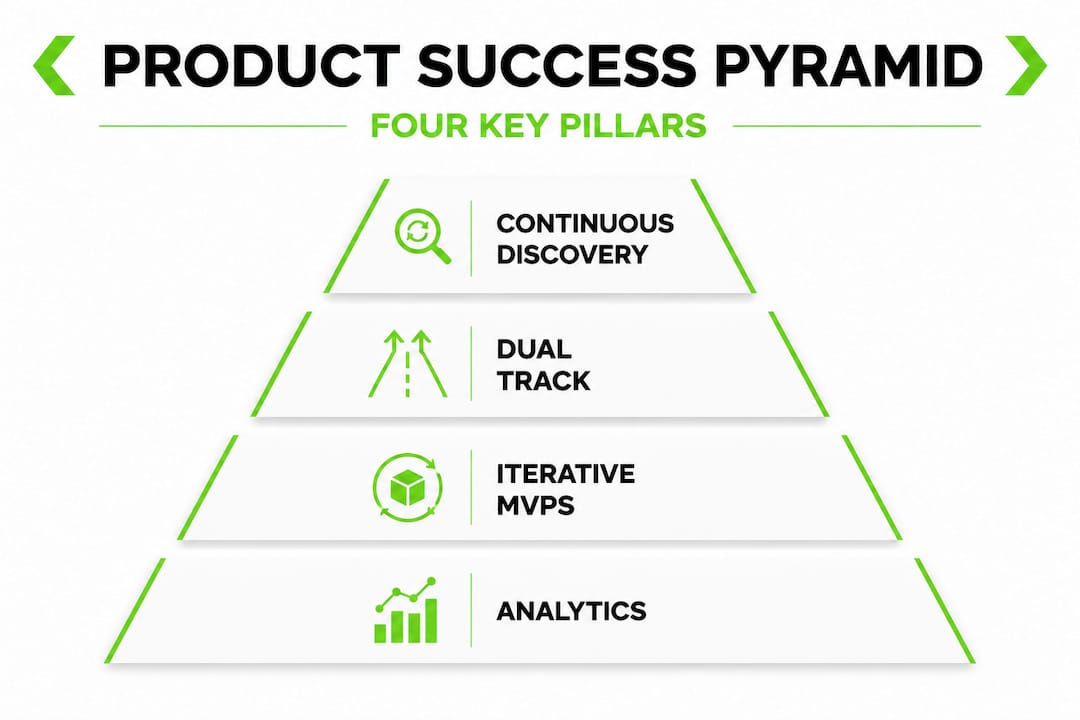
- Blueprint: Four pillars of successful digital product development
- Why DevOps and collaboration matter in product teams
- Applying the four pillars: Blockchain, AI, and mobile technologies
- The truth nobody tells you: Continuous customer evidence is your moat
- Accelerate your digital product success with expert solutions
- Frequently asked questions
Key Takeaways
| Point | Details |
|---|---|
| Continuous discovery wins | Regular customer conversations and evidence pipelines drive product-market fit and ongoing success. |
| Dual track avoids delays | Running discovery and delivery cycles in parallel accelerates innovation and reduces risks. |
| DevOps boosts outcomes | Teams practicing DevOps and high collaboration show faster deployment and fewer failures. |
| Analytics close the loop | Instrumenting feedback and analytics from day one prevents costly mistakes and stale assumptions. |
| Tech choices matter | Prioritizing blockchain, AI, and mobile technologies offers competitive business advantages. |
What digital product development actually means
Most people picture digital product development as a straight line: define requirements, build the product, ship it, done. That mental model is outdated and genuinely dangerous for any startup or enterprise trying to compete in fast-moving technology sectors.
In reality, digital product development is a cycle. It covers four continuous phases: discovery, design, development, and iteration. Each phase feeds the next, and the last one loops right back to the first. There is no "done." There is only "better."
Here is what that cycle actually looks like in practice:
- Discovery: Identify user problems, validate assumptions through customer conversations, and define what to build next.
- Design: Translate validated insights into wireframes, prototypes, and user flows.
- Development: Build the feature or product with technical precision, whether that means writing smart contracts, training a machine learning model, or coding a cross-platform mobile app.
- Iteration: Ship, measure, gather feedback, and feed it back into discovery.
The most dangerous misconception is treating discovery as a one-time event. You run a few user interviews at the start of the project, lock in a roadmap, and then go heads-down for six months. By the time you ship, the market has moved.
"Discovery is not a phase. It is a recurring capability embedded into how your team operates every single week."
The data backs this up clearly. Only 28% of product managers have two or more direct customer conversations per week, and 11% rarely or never do them at all, according to the State of Product Discovery 2026. That means the majority of product teams are building on stale assumptions without even realizing it.
The backbone of effective digital product development today is built on three converging technologies. Tech startup development increasingly runs on blockchain for trust and transparency, AI for automation and intelligence, and mobile for reach and engagement. Understanding how these technologies interact with your discovery and delivery process is what separates teams that ship products with genuine market traction from teams that ship features no one uses.
Exploring paths to scalable innovation is not about picking the flashiest stack. It is about matching your technology choices to validated customer needs, which is exactly what the four-pillar blueprint below is designed to help you do.
Blueprint: Four pillars of successful digital product development
The strongest product teams in 2026 are not operating on instinct. They follow a repeatable, evidence-based blueprint that keeps them aligned with the market while shipping consistently. Based on the State of Product Discovery 2026, here is the practical framework that works:
- Keep discovery continuous. Schedule at least two direct customer conversations per week. Maintain a structured evidence pipeline where insights are captured, tagged, and surfaced in sprint planning. Assumptions that go untested become technical debt.
- Run dual track. Discovery and delivery happen simultaneously, not sequentially. One team validates what to build next while another team ships what was already validated. This eliminates the waterfall trap where you only learn whether your assumptions were right after you have already built the wrong thing.
- Deliver in short iterative cycles. Structure your releases around minimum viable products (MVPs). An MVP is the smallest version of a feature that delivers real value and generates real feedback. Short cycles mean faster learning and lower risk.
- Instrument post-launch analytics and feedback loops. Launching without analytics is flying blind. Track adoption rates, drop-off points, user behavior, and business outcomes. Feed this data back into your discovery process before assumptions go stale.
Pro Tip: The dual track approach is where most product teams feel resistance at first. It requires two distinct workflows running in parallel, and that feels chaotic before it feels natural. Start small: assign one person to own discovery every sprint, even if they also carry development tasks. Consistency matters more than perfection in the early stages.
Here is a quick comparison of waterfall versus iterative approaches for digital product development:
| Factor | Waterfall | Iterative (dual track) |
|---|---|---|
| Customer feedback | Once, at the start | Weekly, continuously |
| Risk of building wrong thing | High | Low |
| Time to first usable release | Long | Short (MVP first) |
| Adaptability to market shifts | Low | High |
| Analytics integration | Post-launch, often late | Built in from day one |
Understanding the mobile app development guide for tech leaders reinforces this blueprint at the product level. Whether you are launching a consumer mobile app or a complex Web3 platform, the same four pillars apply. Digging into the mobile app development process for startup success shows how iterative cycles and discovery integration dramatically shorten time-to-market while improving quality.
If your product roadmap includes a decentralized application or token ecosystem, learning how to approach building a Web3 startup through this same iterative lens will prevent you from over-engineering smart contracts before you have validated the core user behavior you are trying to support.
Why DevOps and collaboration matter in product teams
A strong product blueprint falls apart without the right team structure to execute it. DevOps, which is the practice of integrating development and operations teams around shared tools, shared metrics, and shared accountability, is the operational layer that makes iterative product development sustainable.

Research published in Frontiers in Computer Science found that DevOps improves performance across most team formations, with collaboration intensity standing out as especially important for deployment frequency and incident-related metrics. Teams that collaborate intensely ship more often and recover from failures faster.
Here is what that means in practical terms:
- High collaboration teams consistently outperform low collaboration teams in deployment frequency, lead time for changes, and mean time to recovery.
- Separate development and operations teams with limited collaboration underperform across every key metric, even when both teams are technically skilled.
- Shared tooling and visibility into deployment pipelines mean problems surface earlier, reducing costly rollbacks.
| Team formation | Deployment frequency | Failure recovery | Incident rate |
|---|---|---|---|
| High collaboration DevOps | High | Fast | Low |
| Siloed Dev and Ops | Low | Slow | High |
| Partial collaboration | Medium | Medium | Medium |
For startups, this is particularly relevant because small teams often default to informal collaboration, which works until it doesn't. Formalizing your collaboration practices, shared standups, shared monitoring dashboards, joint retrospectives, is what allows a lean team to scale without accumulating operational chaos.
For enterprises, the challenge is breaking down existing silos. Large organizations often have development, QA, security, and operations running in separate lanes with separate leadership. The empirical evidence is clear: that structure costs you speed and reliability.
Integrating solid CI/CD analytics methods, meaning continuous integration and continuous delivery pipelines paired with analytics, gives both startups and enterprises the real-time visibility they need to catch issues before they become incidents and to measure the impact of every release on user behavior.
Applying the four pillars: Blockchain, AI, and mobile technologies
The blueprint and the DevOps principles described above are not abstract. They apply directly to the three technology areas where the highest-growth digital products are being built right now. Here is how the four pillars play out in each domain.
Blockchain products:
- Discovery for blockchain products means validating whether your users actually need decentralization, tokenization, or on-chain verification, or whether they just need a reliable database. This is a question too many blockchain startups skip.
- Smart contract development benefits enormously from short iterative cycles. Deploy a minimal contract, test it in a staging environment with real user interactions, gather feedback, and upgrade it. The State of Product Discovery 2026 framework applies directly: continuous discovery prevents you from over-engineering token economics that nobody wants.
- Post-launch analytics on a blockchain product should track on-chain activity, wallet engagement, and conversion from awareness to transaction.
AI solutions:
- AI products have a feedback loop built into their architecture. Your machine learning model improves as it processes more data. But the discovery layer, meaning whether you are solving the right problem for the right user, still requires human conversations, not just algorithmic feedback.
- Instrument your AI features with user satisfaction signals from day one. If your AI agent is making recommendations, track whether users act on them and whether those actions lead to positive outcomes.
- Iterative cycles for AI mean releasing model updates frequently rather than waiting for a "perfect" model that takes twelve months to build.
Mobile app launches:
- Mobile is the fastest feedback environment available. App store ratings, session data, and retention metrics tell you within days whether your MVP is resonating.
- Use MVP framing to ship a focused version of your app that solves one core problem really well. Resist the urge to build every feature before launch. The market will tell you what to build next.
- For crypto and Web3 mobile products, reviewing a thorough crypto app development guide helps you navigate the specific UX and security considerations that differentiate successful apps from confusing ones.
Pro Tip: Instrument analytics on your blockchain, AI, or mobile product before you write a single line of feature code. Knowing what you will measure before you build forces clarity about what success actually looks like. Teams that add analytics as an afterthought spend weeks retrofitting event tracking and often miss the data that would have told them whether their MVP was working.
The truth nobody tells you: Continuous customer evidence is your moat
Here is the uncomfortable reality most product teams never confront directly. The biggest competitive advantage in digital product development is not your technology stack. It is not your funding. It is not even your team's technical skill level. It is how consistently you gather and act on direct customer evidence.
Most teams start with good intentions. They run discovery workshops at the beginning of the project. They talk to users in the early stages. But as development pressure builds, discovery gets cut first. Sprint planning fills up, deadlines loom, and the weekly customer conversations quietly disappear from the calendar.
And here is what happens next: the team keeps shipping based on assumptions from conversations they had six months ago. The market has shifted slightly. User needs have evolved. A competitor has launched something that changes what users expect. The team does not know any of this because they stopped asking.
The State of Product Discovery 2026 data is stark: only 28% of product managers maintain two or more direct customer conversations per week. That means 72% of product teams are operating with an increasingly stale picture of their user. In fast-moving sectors like blockchain and AI, stale assumptions can mean a wasted quarter or worse.
The teams that treat customer evidence as a recurring, non-negotiable practice build something competitors cannot easily copy. It is not about any single insight. It is about the compounding effect of weekly learning. Over a year, a team having 100 customer conversations has a fundamentally different understanding of their market than a team that had 5. That gap is a moat.
At Proud Lion Studios, our work with startups across multiple countries has confirmed this pattern repeatedly. The clients who see the strongest results are not necessarily the ones with the biggest budgets. They are the ones who stay relentlessly close to their users and treat discovery as a weekly operating habit rather than a project phase.
Accelerate your digital product success with expert solutions
You now have a clear framework: continuous discovery, dual track development, iterative MVPs, and post-launch analytics. The next step is finding a partner who can execute this with you across the technologies that matter most.
At Proud Lion Studios, we build custom digital products in blockchain, AI, and mobile from a UAE-based technical team with proven results across multiple markets. Whether you need blockchain development services to launch a tokenized platform, or smart contract development to power your decentralized application, our team brings both technical depth and product discipline to every engagement. If mobile is your growth lever, explore our approach to mobile startup growth strategies to see how iterative, analytics-driven development drives real market results. Let's build something that lasts.
Frequently asked questions
How can startups ensure ongoing customer discovery?
Startups should schedule at least two direct customer conversations per week and maintain a structured evidence pipeline so that validated insights automatically feed into sprint planning. The State of Product Discovery 2026 shows that only 28% of product managers currently reach this threshold, making it an immediate differentiator for teams that commit to it.
What is dual track development and why is it important?
Dual track development means running discovery and delivery simultaneously rather than sequentially, so one team is always validating the next feature while another is shipping the current one. According to the State of Product Discovery 2026, this approach directly eliminates the waterfall risks that cause most product teams to ship features users do not actually need.
How does DevOps improve digital product development results?
DevOps improves results by tightening the collaboration between development and operations teams, which directly impacts how frequently teams can deploy and how quickly they recover from incidents. Empirical DevOps research confirms that collaboration intensity is the strongest predictor of deployment frequency and incident reduction across all team formations.
Which technologies should enterprises prioritize in custom digital products?
Enterprises should prioritize blockchain for trust and auditability, AI for automation and intelligent decision making, and mobile for user reach and engagement, treating each technology as a layer in a discovery-driven product strategy rather than an independent initiative. Aligning technology choices to validated customer needs, as the State of Product Discovery 2026 framework recommends, ensures your investment drives real adoption rather than just technical complexity.