
A minute of professional 3D animation in the U.S. falls into three clear bands depending on who produces it and what level of polish you need. Per-minute pricing breaks down like this:
- Freelancer / budget tier: $500–$3,000 per minute. Expect basic modeling, limited rigging, and simple environments. Works for internal mockups, social content, or early-stage prototypes where brand polish is secondary.
- Small to mid-tier studio: $3,000–$25,000 per minute. Covers professional rigging, textured assets, proper lighting, and a structured revision process. The right fit for product demos, explainer videos, and app marketing.
- High-end / cinematic: $25,000–$50,000+ per minute. Photorealistic rendering, complex simulations, broadcast-quality compositing, and full sound design. Required for film, medical visualization, and premium brand campaigns.
One thing to keep in mind: duration alone does not determine price. A 20-second photoreal product shot with cloth simulation and ray-traced lighting can cost more than a 90-second stylized explainer. Complexity per frame, not total runtime, is what drives the invoice.
Key Takeaways
Per-minute 3D animation pricing in the U.S. spans $500 to $50,000+ depending on production tier, and pipeline complexity drives cost more than duration alone.
| Point | Details |
|---|---|
| Know your tier before briefing | Freelancer ($500–$3,000/min), mid-tier studio ($3,000–$25,000/min), cinematic ($25,000–$50,000+/min). |
| Complexity beats duration | A 20-second photoreal shot can cost more than a 90-second stylized explainer. |
| Use the 10-item RFP checklist | Lock down deliverables, asset count, revision rounds, and licensing before requesting quotes. |
| Reserve budget for add-ons | Rush fees, licensed music, VO, and extra revision rounds add 10–100% on top of base rates. |
| Proud Lion Studios | Provides scoped 3D animation with milestone-based delivery and a defined change-order process. |
Table of Contents
- How much does 3D animation cost by production tier?
- Where does your budget actually go in the production pipeline?
- What are the biggest cost drivers in a 3D animation project?
- How long does 3D animation take, and what do rush fees cost?
- When do DIY and AI-assisted tools actually make sense?
- How to get accurate, comparable 3D animation quotes
- Quick budget lookup: 3D animation prices by duration and tier
- Why short clips can cost more than longer ones
- An honest look at how we approach 3D animation pricing
- Work with Proud Lion Studios on your next 3D project
- Sources
How much does 3D animation cost by production tier?
Understanding where your project fits across tiers prevents the most common budget mistake: briefing a cinematic studio on a freelance budget, or expecting broadcast quality from a marketplace gig. Professional 3D projects commonly run from roughly $5,000 to $100,000+ depending on complexity and use case.
| Tier | Per-Minute Range | Best For | Pros | Cons |
|---|---|---|---|---|
| Freelancer | $500–$3,000 | Prototypes, social clips | Low cost, fast turnaround | Limited polish, variable quality |
| Small studio | $3,000–$7,000 | Explainers, product demos | Reliable process, decent assets | Fewer specialists on complex sims |
| Professional company | $8,000–$25,000 | Brand campaigns, app marketing | Full pipeline, dedicated team | Higher minimum engagement |
| Cinematic / broadcast | $25,000–$50,000+ | Film, medical, premium brand | Photorealism, full compositing | Long lead times, premium pricing |
Sample budgets by duration:
- 30-second clip: Freelancer $250–$1,500 / Small studio $1,500–$3,500 / Professional $4,000–$12,500 / Cinematic $12,500–$25,000+
- 60-second clip: Freelancer $500–$3,000 / Small studio $3,000–$7,000 / Professional $8,000–$25,000 / Cinematic $25,000–$50,000+
- 3-minute clip: Freelancer $1,500–$9,000 / Small studio $9,000–$21,000 / Professional $24,000–$75,000 / Cinematic $75,000–$150,000+
Pro Tip: Per-minute pricing works well for explainer-style videos where scenes are roughly equal in complexity. For product launches or cinematic sequences where one 10-second shot requires a full day of rendering, ask studios to quote scene-by-scene instead. You will get a more accurate number and avoid scope disputes mid-project.
Where does your budget actually go in the production pipeline?
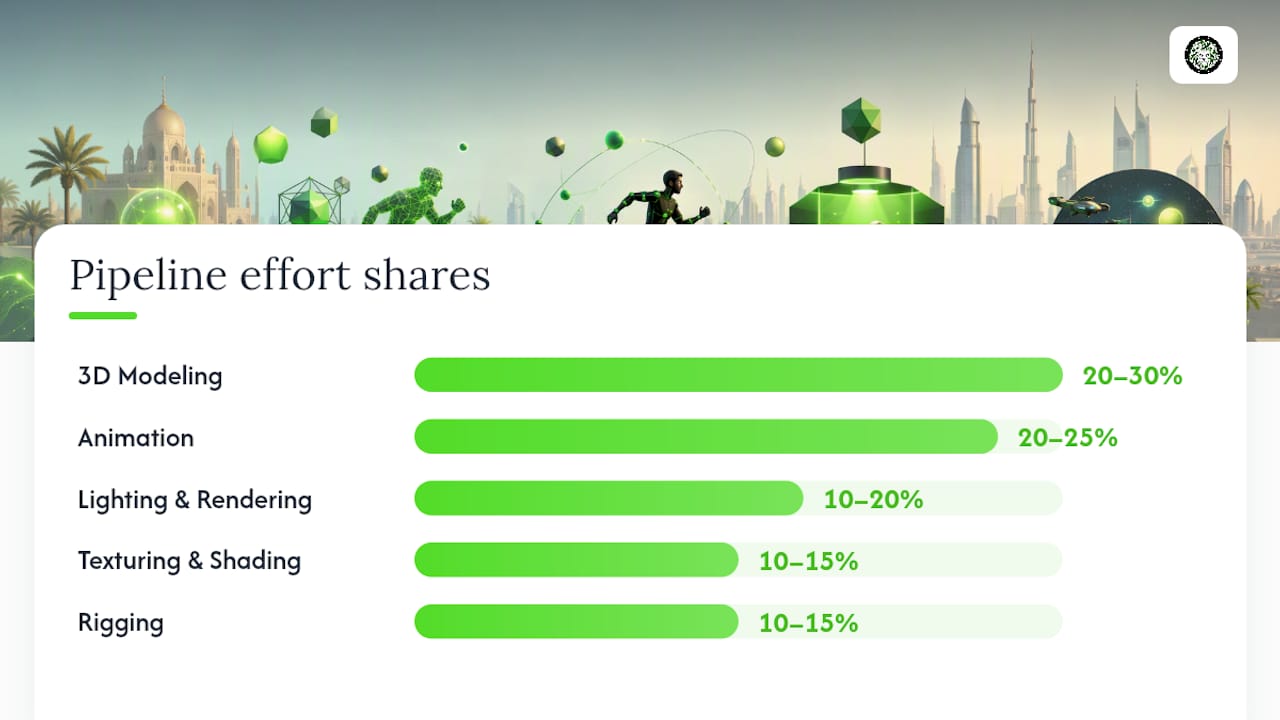
Every dollar in a 3D animation budget maps to a specific pipeline stage. Knowing which stages consume the most effort lets you ask targeted questions and make smarter tradeoffs.
| Pipeline Stage | Typical Share of Total Effort | What Drives Cost Up |
|---|---|---|
| Preproduction (script, storyboard, animatic) | 10–15% | Multiple revision rounds, unclear brief |
| 3D Modeling | 20–30% | Custom characters, high-poly hero assets |
| Rigging | 10–15% | Complex facial rigs, cloth/hair systems |
| Texturing & Shading | 10–15% | Photorealistic PBR materials, large texture sets |
| Animation | 20–25% | Character performance, secondary motion |
| Lighting & Rendering | 10–20% | Ray tracing, global illumination, cloud render time |
| Compositing & VFX | 5–10% | Particle systems, lens effects, color grading |
| Sound Design & VO | 5–10% | Licensed music, professional voice talent |
The labor cost component is significant: multimedia artists and animators are specialized professionals, and their median salaries reflect that. Studios pass that cost directly into their per-minute rates.
A few things that push individual stages well above their typical share:
- Custom characters with full facial rigs and cloth simulation can double the modeling and rigging budget on their own.
- Photorealistic textures using physically based rendering (PBR) workflows require more texture maps, longer shader compile times, and heavier render passes.
- Particle and fluid simulations (smoke, fire, water) are computationally expensive and often billed as a separate line item.
Always ask for source files, layered render passes, and turnaround assets in your contract. Retrieving these after delivery often triggers additional charges that were never discussed upfront. Understanding how 3D rendering fits into the broader workflow helps clarify which pipeline costs are fixed versus variable.
What are the biggest cost drivers in a 3D animation project?
Most budget surprises trace back to a handful of decisions made early in the brief. Here are the levers that move a per-minute price most dramatically:
- Character complexity. A single custom character with full-body and facial rigging can add $2,000–$10,000+ to a project before a single frame is animated. Multiple unique characters multiply that cost.
- Photorealism and lighting quality. Stylized 3D renders at 30fps are far cheaper than photoreal shots with global illumination and ray-traced reflections. The jump from stylized to photoreal is often the single largest cost increase in a project.
- Simulations. Cloth, hair, fluid, and particle simulations require dedicated simulation artists and long compute times. Studios often charge these as separate line items.
- Number of unique assets. Reusing modeled assets across scenes keeps costs down. A project with 20 unique hero props costs significantly more than one that reuses five across multiple shots.
- Revision rounds. Most studios include two to three revision rounds in their base rate. Each additional round, especially post-render, can add 10–25% to the total. Late-stage revisions that require re-rendering are the most expensive.
- Resolution and frame rate. 4K at 60fps requires roughly four times the render time of 1080p at 30fps. Cloud render costs scale directly with resolution and frame rate.
- Licensed music and professional voiceover. These are additive costs that sit outside the animation budget. Professional VO talent and licensed tracks can add $500–$5,000+ depending on usage rights and talent tier.
Vidico's pricing guide confirms that labor from specialized artists and render demands are the principal cost drivers across the $5,000–$50,000+ per-minute range. The animation industry's growth trajectory also puts upward pressure on studio rates as demand for high-quality 3D content increases across gaming, e-commerce, and digital marketing.
How long does 3D animation take, and what do rush fees cost?
Timeline is directly tied to budget. Compressing a production schedule almost always means paying a premium.
Super-rush requests, where the timeline is cut in half or more, often double the base rate because studios must pull additional artists off other projects and run overnight render queues.
Pro Tip: Build review gates into your contract at the animatic stage, the rough animation pass, and the final lighting pass. Approving each gate before the next stage begins prevents the most expensive scenario: discovering a fundamental direction problem after final rendering has started.
When do DIY and AI-assisted tools actually make sense?
Low-cost paths exist, and some of them are genuinely useful for the right use case. The key is knowing where they stop being adequate.
Common low-cost options and realistic cost bands:
- Freelance marketplaces (such as Fiverr): $50–$500 for simple tasks. Quality varies widely, asset ownership terms are often unclear, and revisions are limited.
- Template-based tools (motion graphics platforms with 3D presets): $30–$200/month subscription. Fast output but minimal customization. Brand differentiation is nearly impossible.
- AI-assisted 3D generation tools: Emerging category with rapidly improving quality. Currently best for concept visualization and asset drafts, not final deliverables. Time investment shifts to the client for prompting, iteration, and cleanup.
The honest limitation of DIY and AI tools: They lower cash outlay but shift time and quality risk entirely to you. For social promos, internal prototypes, or early-stage concept validation, that tradeoff can be worth it. For product demos, medical visualization, architectural walkthroughs, or anything representing your brand to enterprise buyers, the quality gap is still significant. A poorly rendered product demo can actively damage credibility rather than build it.
Understanding when professional 3D modeling delivers measurable business value versus when a template will do is the real decision. For B2B contexts where the animation is part of a sales or investor presentation, professional studio work is rarely optional. AI tools in creative workflows are evolving fast, but they currently assist artists rather than replace the pipeline.
How to get accurate, comparable 3D animation quotes
Vague briefs produce vague quotes. The studios that give you the widest price range are usually the ones working with the least information. A tight brief produces tight quotes you can actually compare.
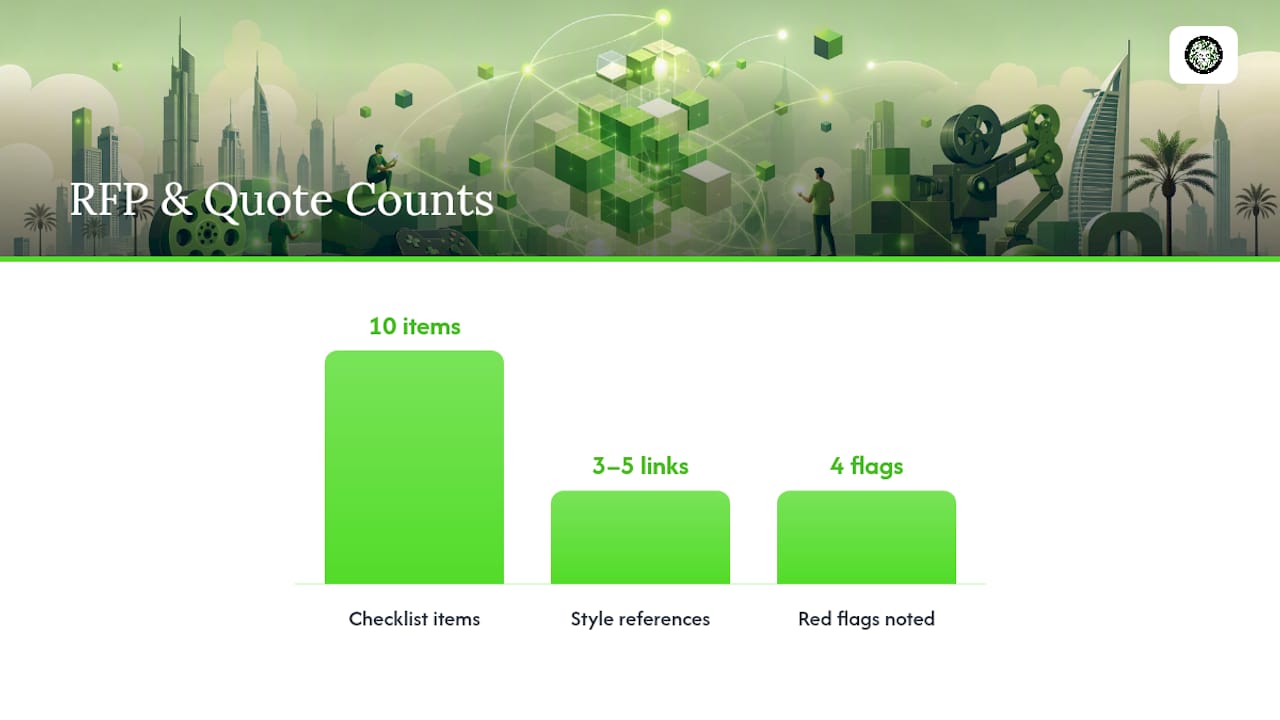
Your 10-item RFP checklist:
- Deliverables: Specify final file formats, resolution, frame rate, and whether you need source files.
- Style references: Include three to five links to animations that match your target aesthetic (ArtStation portfolios and studio showreels work well here).
- Duration and scene count: State total runtime and approximate number of unique scenes or shots.
- Character and asset count: List unique characters, hero props, and environments needed.
- Revision rounds: State how many rounds are included and what counts as a revision versus a scope change.
- Intended use and licensing: Broadcast, web-only, paid social, and in-app use each carry different licensing implications.
- Timeline: Give your hard deadline and flag whether a rush fee applies.
- Budget ceiling: Stating a ceiling filters out mismatched studios and saves everyone time.
- Key contacts and approval chain: Identify who has final sign-off to avoid revision loops caused by late stakeholder input.
- Acceptance criteria: Define what "done" looks like before work begins.
Red flags to watch for in quotes:
- Deliverables described as "final video file" with no format or resolution specified.
- No mention of asset ownership or source file delivery.
- Open-ended revision policy ("revisions until you're happy") with no definition of what constitutes a revision.
- No milestone payment structure, only full payment upfront or full payment on delivery.
Pro Tip: If your project has scenes that vary dramatically in complexity (a simple logo reveal followed by a full character sequence), request a scene-by-scene quote rather than a per-minute rate. Per-minute math assumes roughly equal complexity across the runtime, which rarely holds for mixed-content videos.
Quick budget lookup: 3D animation prices by duration and tier
These figures reflect U.S. market rates in USD. Assumptions: standard lead times apply (no rush fee), one hero character or product asset per scene, 1080p at 30fps, two revision rounds included, no licensed music or VO.
| Duration | Freelancer | Mid-Tier Studio | High-End Studio |
|---|---|---|---|
| 30 seconds | $250–$1,500 | $1,500–$12,500 | $12,500–$25,000+ |
| 60 seconds | $500–$3,000 | $3,000–$25,000 | $25,000–$50,000+ |
| 3 minutes | $1,500–$9,000 | $9,000–$75,000 | $75,000–$150,000+ |
A few important caveats on per-minute math:
- These ranges assume consistent scene complexity. A 60-second video with six unique environments and four characters will land at the high end of each range or above it.
- Scene-based quoting is more accurate for mixed-complexity projects. If a studio quotes only per-minute without asking about scene count and asset density, treat that quote as a rough estimate.
- All figures are in USD and reflect the U.S. market. International studios (Eastern Europe, Southeast Asia) often quote 30–60% lower, but factor in communication overhead, time zone gaps, and IP ownership terms before choosing on price alone.
Why short clips can cost more than longer ones
This is the most counterintuitive truth in 3D animation pricing, and it catches clients off guard regularly.
A 20-second photoreal product shot with ray-traced lighting, a cloth simulation, and a custom-rigged character can easily cost $15,000–$30,000. A 90-second stylized explainer with flat shading, reused assets, and simple keyframe animation might come in at $8,000–$15,000. The longer video costs less because the per-frame complexity is lower.
The core principle: Studios price by pipeline complexity, not by the clock. Render time, simulation compute, and rigging hours do not scale linearly with duration. A single photoreal frame can take hours to render; a stylized frame takes minutes. That ratio, multiplied across every frame in the shot, is what produces the final cost.
The rendering software market's growth reflects exactly this dynamic: as demand for photorealistic output increases, render infrastructure costs rise, and studios pass those costs into their rates for complex shots.
What this means practically:
- A 15-second broadcast bumper with photorealistic product visualization will cost more than a 2-minute internal training animation.
- Medical and architectural visualization commands premium pricing not because of duration but because of the accuracy and render quality required per frame.
- Cinematic VFX shots are priced by shot complexity, not by seconds. One five-second explosion simulation can cost as much as 30 seconds of character animation.
Price by pipeline, not by the clock. That is the single most useful reframe for anyone budgeting a 3D animation project.
An honest look at how we approach 3D animation pricing
At Proud Lion Studios, we scope 3D animation projects the same way we scope software builds: milestone-based, with clear deliverables at each gate and a defined change-order process for anything outside the original scope. That structure protects both sides.
Three things clients consistently underestimate, and what to do about each:
- An unclear brief is the most expensive mistake you can make. Vague direction at the start leads to re-renders at the end. Before we begin any project, we run a scoping session to lock down style references, asset counts, and revision expectations. That session pays for itself in avoided rework.
- Late revisions are disproportionately expensive. A direction change at the storyboard stage costs almost nothing. The same change after final rendering can cost 30–50% of the original project budget. Build your approval chain before the project starts, not during it.
- Asset reuse is an underused budget lever. If you are producing multiple videos in a campaign, investing in a high-quality hero asset library in round one dramatically reduces costs in rounds two and three. Clients who treat each video as a standalone project pay full modeling costs every time.
Pro Tip: Negotiate a fixed scope with a clearly defined change-order process before signing. Every revision request that falls outside the agreed scope should trigger a written change order with a cost estimate before work begins. This one process eliminates the most common source of budget overruns in animation projects.
The 3D modeling process follows the same discipline whether we are building assets for games or for brand campaigns: clean topology, reusable rigs, and documented handoff files that clients actually own.
Work with Proud Lion Studios on your next 3D project
Proud Lion Studios delivers 3D modeling and animation for product demos, game assets, and brand campaigns, with a full pipeline from concept to final render. We work with startups and enterprise teams that need studio-quality output without the overhead of a traditional agency engagement.
To get an accurate quote, send us a brief that includes your target duration, style references, asset count, intended use, and timeline. The more specific your brief, the more precise our estimate. Clients who come in with a completed RFP checklist (like the one in this article) typically receive a scoped proposal within 48 hours. Reach out through our 3D services page to start the conversation.
Sources
These sources informed the estimates and ranges throughout this article. Each is worth consulting directly for deeper research.
- 3D Animation Cost Per Minute: A Guide For Your Project 2026
- 3D Animation Services: Costs, Uses, and Project Planning
- How Much Does Animation Cost? Complete Price Guide for 2026
- Multimedia artists and animators - Occupational Outlook Handbook | U.S. Bureau of Labor Statistics