
TL;DR:
- D modeling enhances business value through reusability, lowering costs, and accelerating time-to-market across functions. Interactive content and digital twins boost conversions, reduce return rates, and cut demo costs, linking engineering, marketing, and sales. Governed infrastructure and proper tool integration are essential for scaling and maximizing ROI in digital asset pipelines.
3D modeling delivers measurable revenue gains, faster time-to-market, and lower total cost of ownership by turning product geometry into reusable digital infrastructure. Interactive 3D and AR can drive significant conversion lifts and longer session engagement, while digital twins are evolving from R&D tools into corporate interfaces that connect engineering, sales, and buyers in real time. For teams building gaming, AI, or blockchain experiences, a governed 3D asset pipeline is not optional infrastructure. It is the foundation.
Core benefits at a glance:
- Faster iteration with fewer physical prototypes
- Higher conversion rates and lower return rates in commerce
- Reduced demo and logistics costs through digital twins
- Shared assets reused across marketing, engineering, AR, and AI training
- Cleaner production handoffs via configurator-generated BOMs
- Provenance-ready assets ready for NFT and blockchain tokenization
Table of Contents
- What are the real business benefits of 3D modeling?
- How does interactive 3D move the needle in commerce?
- How do you integrate 3D models into existing systems?
- Which tools should your team actually use?
- How do you measure ROI from a 3D modeling program?
- Gaming, AI, and blockchain: where 3D modeling pays off fastest
- How do you start a 3D modeling program with low risk?
- Key Takeaways
- Why governed 3D infrastructure changes everything
- Proud Lion Studios brings 3D, blockchain, and AI together
- Useful sources and further reading
What are the real business benefits of 3D modeling?
The advantages of 3D modeling map cleanly to every major business function, and the gains compound when assets are governed and reused rather than rebuilt for each project.
Product and R&D: 3D CAD workflows support simulation and manufacturability checks before tooling, cutting repetitive physical prototyping costs. Engineers catch spatial conflicts on screen, not on the shop floor.
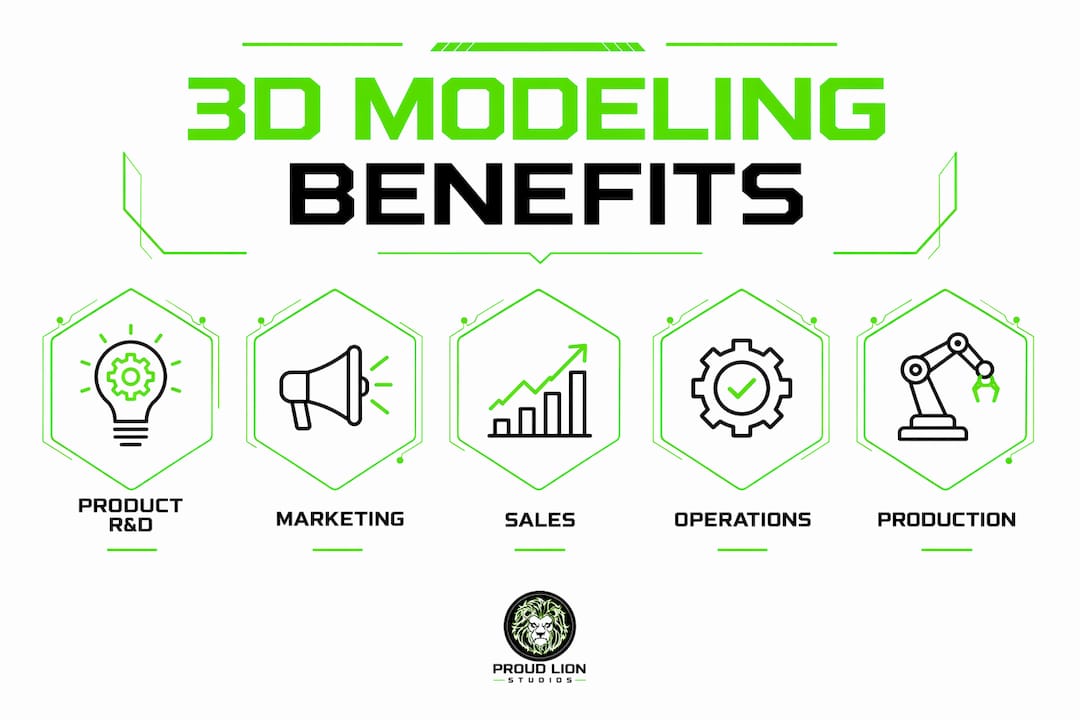
Marketing: A single high-fidelity model feeds product renders, 360-degree views, video ads, and AR previews without a photo studio. Marketing can promote a product before manufacturing even begins.
Sales: Product configurators let buyers specify options visually and in real time. The same session generates a structured BOM and order payload that feeds manufacturing systems directly, removing manual re-entry errors and compressing quote cycle time.

Operations: Replacing physical samples and studio shoots with 3D renders cuts sample-shipping costs and reduces Scope 3 emissions, which matters for sustainability reporting.
Assembly and production: Research published in Applied System Innovation found that 3D product models in assembly deliver the greatest value in accurate assignment of parts, tools, and work instructions, with that category rated over 50% more valuable than any other area by industry respondents.
| Business function | Benefit | Metric to track |
|---|---|---|
| Product / R&D | Fewer physical prototype iterations | Prototype count per product cycle |
| Marketing | Pre-production asset availability | Time from design freeze to campaign launch |
| Sales | Configurator-driven order accuracy | Quote cycle time; manual entry error rate |
| Operations | Reduced sample shipping and studio costs | Logistics spend; Scope 3 emissions |
| Assembly | Accurate work instructions | Takt time variability per station |
How does interactive 3D move the needle in commerce?
The conversion evidence is hard to ignore. Industry data cited by Vivid3D, including figures Shopify has shared, shows that interactive 3D product content drives very large conversion lifts and meaningfully longer session engagement compared to static imagery.
Return rates drop for the same reason: buyers who configure and inspect a product in 3D or AR before purchasing arrive with accurate expectations. Dimensional products, furniture, apparel, and industrial equipment all benefit because the buyer can verify fit, finish, and scale without touching the physical item.
Digital twins extend this logic beyond e-commerce. RD Magazine reports vendor-documented cost reductions up to ~32% in some cases when physical demos and logistics are replaced by interactive digital twin experiences. Sales engineers can walk a prospect through a complex machine virtually, without shipping a demo unit.
What configurators and AR add to buyer confidence:
- Real-time visual feedback on custom specifications reduces post-order surprises
- AR placement tools let buyers verify scale in their actual environment
- Configurator output ties directly to production data, so what the buyer sees is exactly what gets built
- Reduced back-and-forth between sales and engineering shortens deal cycles
How do you integrate 3D models into existing systems?
Scaling 3D across teams depends on process control. Version control and PLM/ERP integration are prerequisites, not afterthoughts. Without them, teams rebuild assets from scratch, governance breaks down, and the ROI case collapses.
Integration checklist:
- Define a single source of truth for master geometry (CAD file in PLM, not a shared drive).
- Establish a versioning protocol: semantic version numbers, change logs, and approval gates before any asset is published downstream.
- Map the CAD-to-PLM/ERP handoff: which fields transfer automatically, which require manual review, and who owns the sign-off.
- Connect the asset pipeline to your CMS or e-commerce platform via an asset CDN so marketing and sales always pull from the approved master.
- Set level-of-detail (LOD) standards for each output channel: engineering needs full-fidelity geometry; web AR needs a compressed mesh; game engines need LOD0 through LOD3.
- Document review workflows with named reviewers, SLA timelines, and escalation paths.
Pro Tip: Treat your 3D asset library as shared corporate infrastructure, not a project deliverable. A model built for engineering validation should also serve marketing renders, AR previews, training simulations, and synthetic AI data generation. That reuse is where total cost of ownership drops sharply.
Siloed implementations are the most common failure mode. When 3D lives only in R&D, the rest of the organization rebuilds equivalent assets independently, paying the creation cost multiple times. Governed, integrated pipelines eliminate that waste and make the digital twin a genuine corporate interface between engineering, sales, and buyers.
Which tools should your team actually use?
Tool choice matters less than process control, but the right tool for each pipeline stage prevents expensive rework. Here is how the major US-available platforms fit together:
- Autodesk (Fusion 360, Inventor, Maya): Best for engineering CAD, simulation, and manufacturing readiness. Fusion 360 integrates CAM and simulation in one environment. Inventor is the standard for mechanical assembly and BOM generation. Maya handles character and organic modeling for entertainment pipelines.
- Blender: Open-source and production-capable. The right choice for studios that need high-quality modeling, rigging, and rendering without per-seat licensing costs. Exports to glTF, FBX, OBJ, and USD, covering most downstream channels.
- Unity: The dominant real-time engine for interactive applications, mobile AR, and game development. Handles LOD management, asset bundles, and WebGL deployment. Strong for configurators and training simulations.
- Unreal Engine (Epic): AAA-quality rendering with Lumen and Nanite for photorealistic real-time visuals. The preferred engine for high-fidelity game production, virtual production, and enterprise visualization. Supports MetaHuman and large-scale environments.
- NVIDIA Omniverse: A USD-based collaboration platform that lets teams in different tools work on the same scene simultaneously. Critical for digital twin workflows where engineering, design, and simulation teams need a shared live environment.
- Sketchfab: The leading web-based 3D asset publishing and marketplace platform. Use it to embed interactive 3D on product pages, share assets with clients for review, and distribute to AR channels without a custom viewer.
| Tool | Primary role | Key format output |
|---|---|---|
| Autodesk Fusion / Inventor | Engineering CAD, simulation, BOM | STEP, IGES, F3D |
| Blender | Content creation, rendering, rigging | glTF, FBX, OBJ, USD |
| Unity | Real-time apps, AR, configurators | Asset bundles, WebGL |
| Unreal Engine | AAA games, enterprise visualization | USD, FBX, nanite mesh |
| NVIDIA Omniverse | Multi-tool collaboration, digital twins | USD (Universal Scene Description) |
| Sketchfab | Web publishing, AR, client review | glTF, USDZ |
How do you measure ROI from a 3D modeling program?
Primary KPIs to track:
- Conversion rate lift on product pages with interactive 3D vs. static images
- Return rate change for products with AR preview vs. without
- Time-to-market: weeks from design freeze to first marketing asset
- Quote cycle time: days from customer inquiry to approved order
- Cost-per-asset over its full lifetime across all channels it serves
Pilot-to-scale timeline:
- Weeks 1–2: Define scope. Pick one product line or use case. Identify baseline metrics.
- Weeks 3–6: Build one or two canonical assets. Establish file governance and review workflow.
- Weeks 7–12: Deploy to one channel (e-commerce, configurator, or AR). Measure against baseline.
- Months 4–6: Evaluate KPIs. If conversion or return-rate targets are met, expand to additional product lines and channels.
- Months 6–12: Integrate with PLM/ERP. Automate asset publishing. Scale governance to the full catalog.
Pro Tip: Calculate total cost of ownership by dividing asset creation cost by the number of channels it serves. A model used in engineering, marketing, AR, a game engine, and AI training data generation costs a fraction per use compared to a model built for a single purpose.
Gaming, AI, and blockchain: where 3D modeling pays off fastest
For teams building advanced digital products, 3D modeling is not just a design tool. It is the raw material for entire product categories.
Gaming: Reusable asset pipelines with proper LOD hierarchies are the difference between a scalable game and a performance disaster. AAA-quality game workflows require assets built to LOD0 through LOD3 standards, with clean UV maps and optimized polygon counts for each platform target. In-game monetization through cosmetic items and environments depends on the same governed pipeline that feeds engineering. The 3D modeling process for games covers version control and review cycles that apply equally to enterprise and entertainment contexts.
AI training data: Synthetic data generation from 3D scenes is one of the fastest-growing applications. A single environment model can render thousands of labeled training images across varied lighting, camera angles, and object configurations, at a fraction of the cost of real-world data collection. Simulation environments built in Unity or Unreal Engine feed reinforcement learning pipelines directly.
Blockchain and NFTs: 3D assets are the primary content layer for NFT marketplaces and tokenized ownership models.
A 3D asset built with provenance in mind, with documented authorship, version history, and export fidelity, is ready for tokenization the moment it leaves the pipeline. The blockchain record is only as trustworthy as the asset metadata behind it. Governance is not a compliance step; it is what makes the token valuable.
Connecting 3D assets to smart contract development and NFT and tokenization workflows requires that assets carry clean metadata: creator, version, license terms, and format specifications. That is a pipeline design decision, not an afterthought.
How do you start a 3D modeling program with low risk?
Pilot checklist:
- Define scope: one product line, one use case, one measurable outcome.
- Choose the use case with the clearest baseline metric (e.g., current return rate for a product category).
- Assemble a small cross-functional team: one engineer, one marketer, one IT owner for integration.
- Build one or two canonical assets to the full governance standard, not shortcuts.
- Measure baseline before deployment so you have a real before/after comparison.
- Deploy to a single channel and run for at least six weeks before drawing conclusions.
Vendor questions to ask before committing:
- What file formats do you deliver, and do they export cleanly to Unity, Unreal, and glTF for AR?
- How do you handle versioning and change requests after delivery?
- Can assets integrate with our PLM or ERP system, and what does that handoff look like?
- What are your SLAs for revision turnaround?
- Do you have experience with LOD optimization for real-time engines?
Minimum success criteria to scale: conversion rate improvement on the pilot product page, a measurable reduction in return rate or quote errors, and at least two downstream channels served by the same master asset.
Key Takeaways
3D modeling delivers its highest ROI when assets are governed, versioned, and reused across engineering, marketing, AR, gaming, and AI pipelines rather than built once for a single purpose.
| Point | Details |
|---|---|
| Reuse drives ROI | One governed asset serving multiple channels cuts cost-per-use dramatically versus single-purpose builds. |
| Integration is the prerequisite | Version control and PLM/ERP integration are required before scaling; siloed 3D stays an R&D expense. |
| Commerce impact is measurable | Interactive 3D and AR lift conversion rates and reduce return rates; track both against a pre-deployment baseline. |
| Gaming, AI, and blockchain need governed assets | LOD hierarchies, clean metadata, and provenance records are pipeline requirements, not optional polish. |
| Proud Lion Studios | Offers end-to-end 3D asset pipelines connected to blockchain tokenization, smart contracts, and game/AI integration. |
Why governed 3D infrastructure changes everything
Most organizations treat 3D modeling as a project expense. Build a model, use it once, archive it. That is the wrong frame entirely, and it is why so many 3D initiatives stall after the pilot.
The businesses that get outsized returns treat their 3D asset library the way a software team treats a codebase: versioned, reviewed, and redeployed. A model built for engineering validation should not sit idle while marketing commissions a separate render from a different vendor. That redundancy is pure waste, and it compounds across every product in the catalog.
The second lesson is about team alignment. The technical work of building a great 3D asset is straightforward compared to the organizational work of getting engineering, marketing, sales, and IT to agree on a single source of truth. Governance is a people problem before it is a technology problem. Start there.
Proud Lion Studios brings 3D, blockchain, and AI together
Your 3D asset pipeline should not stop at the render. Proud Lion Studios connects production-grade 3D modeling and animation to blockchain tokenization, smart contract deployment, and game or AI integration, so the same asset that drives your product configurator can also power an NFT marketplace or a synthetic training dataset.
Whether you are launching a gaming title that needs AAA-quality asset pipelines, building an AI product that requires simulation environments, or tokenizing physical products through a Web3 marketplace, Proud Lion Studios designs the full stack around your business outcome, not a template. Reach out to discuss a pilot engagement and get a technical evaluation of your current 3D workflow.
Useful sources and further reading
- How 3D Modeling Is Reshaping Product Design and Sales (Vivid3D): Conversion lift data, configurator BOM output, and interactive 3D commerce evidence.
- Digital Twin Beyond Engineering to Business Value (RD Magazine): Digital twin as a corporate interface; vendor-reported cost reduction figures.
- 4 Reasons 3D Modeling Software Is Important for Product Designers (Autodesk Fusion Blog): CAD workflow benefits, simulation, and process control guidance.
- Quantitative Model for the Value of 3D Product Model Use in Production (MDPI Applied System Innovation): Peer-reviewed quantitative value model for 3D in assembly and production processes.
- Benefits of 3D Modeling: 6 Ways It Helps Your Business (Impala Services): Logistics savings, sample-shipping reduction, and Web AR buyer confidence.
- The Role of 3D Modeling in Tech: 2026 Guide (Proud Lion Studios): Enterprise adoption context and technology stack guidance.