

TL;DR:
- Mobile apps provide offline access, rapid communication, and system integration that websites cannot match, ensuring operational continuity. They also establish a direct, valuable connection with customers through push notifications, personalization, and loyalty features, boosting engagement. Combining effective UX design with AI and platform integrations transforms business apps into strategic assets that drive loyalty and competitive advantage.
Most business owners assume mobile apps are expensive, complicated, or only relevant to large companies. That assumption is costing them real money. Understanding why use mobile apps for business means looking past the hype and examining what they actually do: reduce friction in your operations, give customers a direct line to you, and create touchpoints that websites and social media simply cannot match. This guide breaks down the concrete, measurable reasons your business needs an app, and what separates the ones that deliver results from the ones that collect digital dust.
Key Takeaways
| Point | Details |
|---|---|
| Offline access protects operations | Apps work without internet, preventing costly disruptions for field teams, logistics, and service staff. |
| Push notifications outperform email | App push notifications reach near 90% open rates, making them your most direct customer outreach tool. |
| Native UX drives retention | First-session design, feedback loops, and earned personalization determine whether users stick around. |
| AI transforms app behavior | AI-powered apps adapt to user behavior in real time, reducing support costs and increasing satisfaction. |
| Apps are strategic assets | Treat your app as a long-term business channel, not a one-time feature launch, to see lasting returns. |
Why use mobile apps for business operations
Business mobile applications solve one operational problem that websites never will: they work when your internet does not. Offline capability in mobile apps means your field service technician can access a customer's service history in a basement with no signal. Your delivery driver can capture a proof-of-delivery photo in a rural area and sync it later. Your inventory manager can run a stock count in a warehouse with a patchy Wi-Fi connection.

This is not a minor convenience. In industries like construction, logistics, and healthcare, a single interrupted workflow can delay an entire job. The importance of mobile apps in these contexts comes down to one word: continuity.
Beyond offline access, apps integrate directly with your existing systems in ways that browser-based tools cannot match:
- Automated task routing: Apps can trigger workflows automatically when a technician checks in, an order status changes, or an appointment is confirmed, reducing the manual coordination your team currently handles.
- System integration: A well-built app connects to your CRM, ERP, or inventory platform, keeping data consistent across departments without anyone re-entering information.
- Faster internal communication: Push notifications inside team-facing apps keep staff aligned on updates, schedule changes, and priority tasks without requiring a phone call or email chain.
- Reduced human error: When your team enters data directly into an app that pushes it to your database, you eliminate the transcription errors that paper-based or multi-step digital processes create.
Modern development tools have also made building these apps significantly faster. AI and no-code tools reduce time and resources needed while maintaining quality, meaning the technical barrier to getting an operational app built is lower than it was even three years ago.
Pro Tip: Before scoping any internal operations app, spend two hours interviewing your field staff about where their workday gets interrupted. The answers will define your app's most valuable features better than any planning document.
Customer engagement and retention through apps
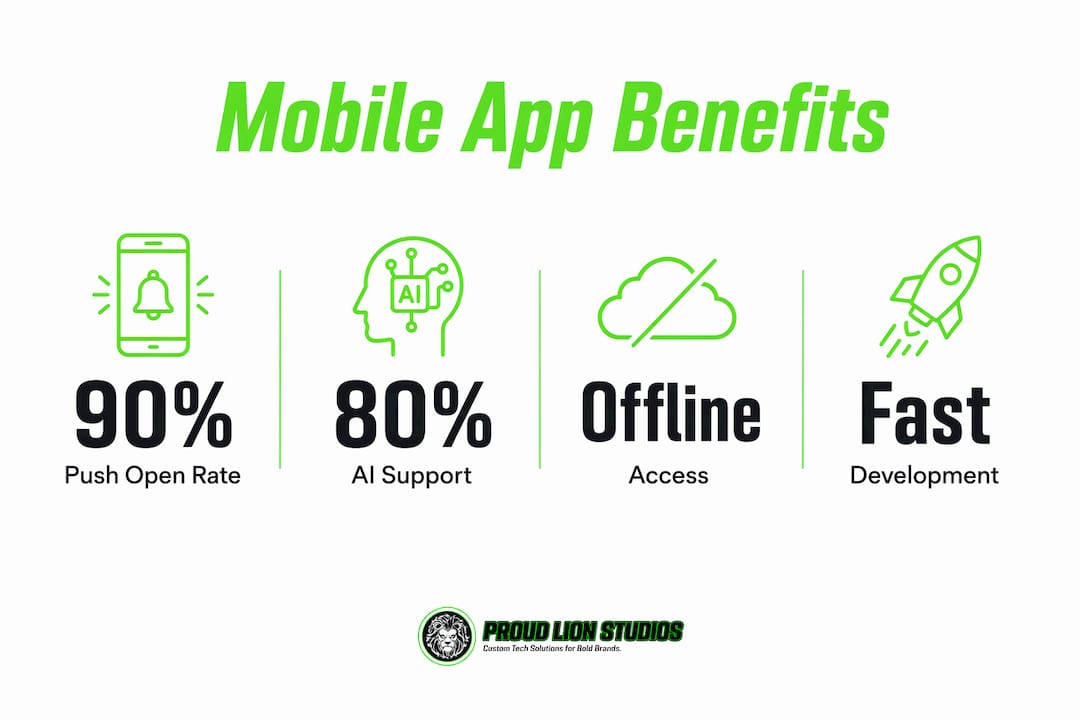
The most underestimated mobile app advantage is the direct line it creates between you and your customer. Email open rates hover around 20 to 30 percent on a good day. Organic social reach is unpredictable and controlled by algorithm changes you have no say in. Push notifications from a mobile app are different. Push notifications achieve open rates near 90%, making them the highest-performing outreach channel most businesses are not using.
But raw open rates are only part of the picture. What makes apps genuinely powerful for customer engagement is the combination of context and timing:
- Geofencing alerts let you send a personalized offer the moment a customer enters a specific area, like near your store or a competitor's location. The timing is what drives the conversion.
- Loyalty programs built into the app remove the friction of physical cards or website logins. Customers track their points, redeem rewards, and feel recognized, all without leaving your app.
- Personalized product recommendations based on purchase history turn a passive browsing experience into something that feels genuinely useful, not intrusive.
- Re-engagement sequences triggered by inactivity bring customers back without requiring manual outreach from your team.
What no one tells you about push notifications is that the open rate means nothing if the rest of the funnel is broken. Effective push notifications require deep linking back into the exact screen the user needs. If your notification says "Your cart is waiting" but dumps them on the homepage, you have wasted that 90% open rate.
An app sitting on your customer's home screen is a persistent business presence that no website or social media profile can replicate. It is the only channel where your brand icon is visible every time they unlock their phone. Adobe Business
The contrast with email and social media becomes obvious when you look at frequency. Email fatigue is real. Social feeds are crowded. An app that earns its place on a customer's phone by delivering genuine value creates a relationship that compounds over time.
UX design and native app advantages
The reason most business apps fail has nothing to do with the technology. It has everything to do with the experience in the first three minutes of use. Retention is determined inside the product experience by showing immediate value, providing clear guidance, limiting initial choices, and rewarding progress.
This is exactly what gaming apps have perfected, and it translates directly to business applications. When you load a well-designed game, you are not handed a 40-option menu. You are walked through one action, given immediate feedback that it worked, shown a small reward, and invited to take the next step. Business apps that follow this same pattern see dramatically higher adoption and usage rates.
Native apps (apps built specifically for iOS or Android rather than running in a browser) hold a structural advantage here. Native apps retain user state, cache data, and provide smoother experiences compared to mobile websites. The user stays logged in. Their preferences persist. The app loads faster. These technical advantages compound into a user experience that feels personal and frictionless, which is exactly the feeling that drives repeat use.
Pro Tip: Design your app's onboarding around one goal: get the user to their first "win" in under two minutes. That win might be viewing their order status, redeeming a point, or completing a booking. Speed to value is what determines whether they open the app again tomorrow.
Several design principles consistently separate apps that users return to from apps they delete:
- Progress indicators: Show users how far along they are in a task. Visible progress reduces abandonment.
- Immediate feedback: Every tap, form submission, or completed action should return a visual confirmation instantly. Silence creates doubt.
- Earned personalization: Show the user value before asking them to share data. Personalization that feels earned is welcomed. Personalization that feels assumed feels invasive.
- Minimal friction at key moments: Checkout, booking, and account creation are where users drop off. Native app features like saved payment methods and biometric login remove those barriers directly.
For managers evaluating mobile app innovation trends, UX quality is not a design preference. It is a business metric that shows up in retention rates, conversion percentages, and support ticket volume.
AI and platform integration in modern apps
The newest reason why businesses need apps goes beyond what apps have traditionally done. AI-powered mobile apps are no longer static interfaces that display information. AI-powered apps adapt in real time to user behavior, enabling smarter decisions and continuous improvement without requiring manual updates.
Here is what that looks like in practice. A customer support feature powered by an AI agent can handle 80 percent of routine inquiries without human intervention. A product recommendation engine learns from what users browse and buy, improving its suggestions with every interaction. An inventory management app flags reorder points before stock runs out by learning from historical patterns.
The business case becomes clearer when you compare traditional apps to AI-integrated ones:
| Capability | Traditional app | AI-integrated app |
|---|---|---|
| Customer support | Static FAQ pages | Conversational AI handling queries 24/7 |
| Product recommendations | Manual curation | Behavior-based real-time suggestions |
| Inventory management | Manual input required | Predictive alerts based on sales patterns |
| Personalization | Segment-based | Individual user-level adaptation |
| Development speed | Long build cycles | Faster delivery via AI-assisted tools |
Platform integration adds another layer of competitive advantage. Shopify-integrated apps reduce cart abandonment through persistent carts and one-tap checkout, letting smaller businesses compete with enterprise retailers on mobile. When your app connects to your inventory, order management, and payment processing in one system, you eliminate the coordination gaps that lose sales.
Consumers have already moved in this direction. 32% of adults now use AI chatbots for immediate information, matching their use of social media. Businesses that offer AI-enhanced mobile experiences are meeting customers where their expectations already are. Those that do not are asking customers to accept a slower, less responsive experience than they can get elsewhere.
For businesses evaluating startup growth strategies, integrating AI into your mobile app is no longer a future consideration. It is a present competitive decision.
My take on mobile apps as a business tool
I have watched businesses invest in apps and get nothing from them, and I have watched businesses transform their customer relationships through apps. The difference is never the technology. It is always the strategy behind it.
The most common mistake I see is treating an app launch as a finish line. You build it, submit it to the app stores, announce it on social media, and move on. But the first version of any app is a hypothesis. What actually creates value is what happens after launch: the usage data, the drop-off points, the features users ignore, and the workflows they create that you never anticipated.
In my experience, the businesses that get real returns from their apps commit to two things. First, they define one specific problem the app solves before a single line of code is written. Not five problems. One. Second, they treat the first three months post-launch as a learning period, not a victory lap. They watch where users stop, ask why, and fix it fast.
The impact of apps on business relationships is real, but it is not automatic. An app that earns trust by delivering consistent value creates loyalty that no email campaign or discount code can buy. That is the business case. Approach your app as a strategic asset that requires investment, attention, and iteration, and it will repay you far beyond its development cost.
— Amal
Build smarter with Proudlionstudios
If you have gotten to this point and are thinking about what your app would actually look like, Proudlionstudios builds exactly the kind of mobile applications this article describes.
The Dubai-based team at Proudlionstudios handles everything from concept and UX design through development, AI integration, and platform connections. Whether you need a customer-facing app with loyalty features, an internal operations tool, or an AI-powered support layer, the studio builds custom solutions without templated shortcuts. Their web and mobile development work covers businesses from startups to enterprises, and their blockchain development services are available for businesses that need secure, decentralized features built in from the start. Reach out to Proudlionstudios directly to discuss your project and get a clear picture of what building your app would actually involve.
FAQ
Why use mobile apps for business instead of a website?
A mobile app gives you offline access, push notification capability, and persistent user sessions that a website cannot replicate. These three features alone make apps more effective for both internal operations and customer retention.
How do push notifications improve customer engagement?
Push notifications achieve open rates near 90% and can be triggered by time, location, or user behavior. Combined with deep linking back to specific in-app screens, they are the most direct outreach channel available to businesses today.
What industries benefit most from business mobile applications?
Construction, logistics, healthcare, retail, and hospitality see the clearest operational gains because their staff work in the field, handle time-sensitive information, and need offline-first functionality to keep workflows moving.
How does AI improve a business mobile app?
AI enables real-time personalization, automated customer support, and predictive inventory management inside the app. These capabilities reduce manual workload and improve the user experience without requiring constant human oversight.
How much does it cost to build a business mobile app?
Costs vary based on complexity and platform, but modern development approaches using AI and pre-built components have significantly reduced both time and budget requirements compared to traditional builds. The best way to get an accurate number is a direct project consultation.