

TL;DR:
- Web3 security involves protecting decentralized applications and user assets from a rapidly evolving threat landscape. Maintaining security is a continuous organizational discipline crucial for long-term project survival and institutional trust. Best practices include layered defenses, continuous monitoring, and treating security as integral from the start.
Security in Web3 is the practice of protecting decentralized applications, smart contracts, and user assets against a threat landscape that is broader, faster, and more financially consequential than anything in traditional software. The importance of security in Web3 cannot be overstated: industry losses hit $4.3 billion in 2025, driven by AI-powered exploit scanners and attack methods that evolve faster than most teams can respond. Platforms like Immunefi, Hashlock, and Mugen have documented how the attack surface now extends well beyond smart contract code into operational workflows, frontend infrastructure, and human behavior. If you are building or managing a Web3 project, security is not a phase you complete. It is a discipline you maintain.
Why prioritize security in Web3 over other development concerns?
Web3 introduces a fundamentally different risk model compared to Web2. In traditional applications, a breach is serious but often reversible. In decentralized systems, transactions are immutable and asset custody sits with the user. That combination means a single exploit can permanently drain funds with no recourse.
The threat surface in Web3 is wider than most developers initially expect. Here is where the primary risks concentrate:
- Smart contract vulnerabilities: Logic errors, reentrancy bugs, and integer overflows remain common entry points, especially in contracts that have not undergone formal verification.
- Off-chain infrastructure: CI/CD pipelines, DNS configurations, and frontend layers are the weakest security link in many Web3 stacks, yet they receive the least scrutiny.
- Social engineering and key compromise: Attackers increasingly target the humans and signing keys behind protocols rather than the code itself.
- AI-powered exploit generation: Automated scanners now probe contracts for known vulnerability patterns at a speed no manual review can match.
The shift from Web2 to Web3 also shifts responsibility. Users hold their own keys, which means your security failures become their permanent losses. That accountability changes the ethical weight of every architectural decision you make.
Pro Tip: Treat your CI/CD pipeline and DNS configuration with the same rigor you apply to your smart contracts. A compromised frontend can redirect users to a malicious contract even when your on-chain code is flawless.

How has Web3 security evolved with AI and new attack vectors?
The most significant development in Web3 security over the past three years is the measurable improvement in defense outcomes, even as attack sophistication rises. DeFi losses from exploits fell 74% between 2022 and 2025, dropping from $2.62 billion to $680.3 million. The median loss per exploit also fell by 75% over the same period. That progress reflects better tooling, more mature audit practices, and the adoption of continuous monitoring rather than point-in-time reviews.
AI sits at the center of this arms race. Attackers use it to scan codebases for known vulnerability patterns at scale. Defenders use it for pattern recognition, anomaly detection, and triage. The net effect, according to Immunefi data, is that AI aids defenders more through faster identification of threats than it empowers attackers. That advantage only holds if your team actively uses these tools rather than relying on a single pre-launch audit.
"Security in Web3 is a continuous arms race augmented by AI. While AI aids attackers, it empowers defenders more through pattern recognition and triage." — Immunefi
The table below shows how the security posture of the DeFi sector has shifted:
| Metric | 2022 | 2025 |
|---|---|---|
| Total losses from exploits | $2.62 billion | $680.3 million |
| Change in median loss per exploit | Baseline | Down 75% |
| Primary driver of improvement | Audit-only approach | Continuous monitoring + AI tools |
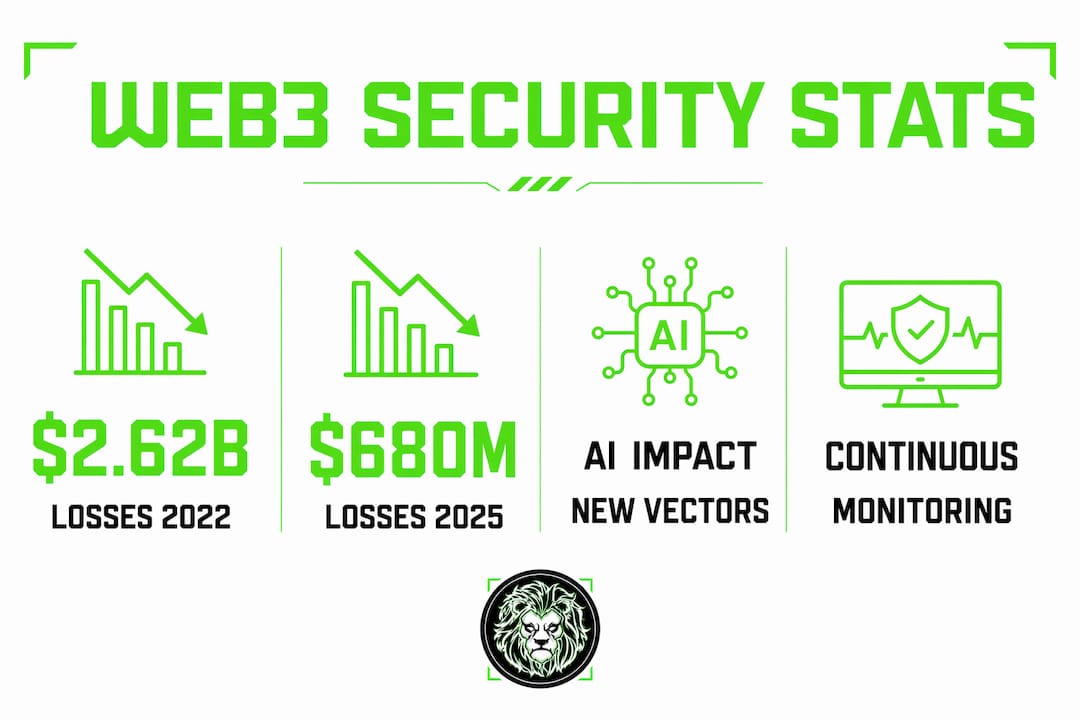
The lesson here is direct: one-time audits are necessary but not sufficient. The teams that reduced losses the most adopted lifecycle security, meaning monitoring, bug bounties, and attack simulations running in parallel with production.
What are the best practices for securing Web3 applications?
Securing a Web3 application requires layering multiple methods because no single security method catches all vulnerabilities. Each approach covers different blind spots. The following sequence reflects how mature teams structure their defenses.
- Commission a smart contract audit before launch. Use firms that combine manual review with automated tools. Audits from recognized providers catch logic errors and known vulnerability classes that automated scanners miss.
- Add fuzz testing and formal verification. Fuzz testing sends unexpected inputs to your contract to surface edge cases. Formal verification mathematically proves that contract behavior matches its specification.
- Secure your off-chain infrastructure. Implement DNSSEC to prevent DNS hijacking. Lock down your CI/CD pipeline with strict access controls and code signing. Audit your frontend dependencies regularly.
- Deploy multisig wallets for treasury and admin functions. Single-key control is a single point of failure. Multisig requires multiple approvals, which limits the damage from any one compromised key.
- Adopt threshold encryption for sensitive data. Threshold encryption eliminates single points of failure by requiring a minimum number of nodes to participate in decryption. Networks stay operational even when some nodes are compromised.
- Run a bug bounty program continuously. Platforms like Immunefi connect your protocol with independent researchers who are financially motivated to find what your internal team missed.
- Implement runtime monitoring and alerting. Set up on-chain and off-chain monitors that flag anomalous transaction patterns, unusual gas usage, or unexpected contract state changes in real time.
Pro Tip: Pair your bug bounty program with a public security disclosure policy. Researchers are far more likely to report vulnerabilities responsibly when they know the process is clear and the reward is fair.
Beyond these technical controls, verifiability is becoming the standard that separates credible protocols from those that ask users to simply trust them. Web3 security is shifting from trust-based to proof-based guarantees, meaning systems now allow independent parties to confirm correct behavior without relying on operator reputation. This matters because it removes the assumption that your infrastructure is honest. It proves it.
The comparison below shows how different security layers address different risk categories:
| Security layer | What it covers | What it misses |
|---|---|---|
| Smart contract audit | On-chain logic errors | Off-chain infrastructure, social engineering |
| Fuzz testing | Edge case inputs | Architectural design flaws |
| Bug bounty program | Unknown vulnerabilities from external researchers | Internal operational risks |
| Runtime monitoring | Live anomalies and active exploits | Pre-deployment code errors |
| Threshold encryption | Key compromise and node failures | Frontend and DNS attacks |
Why is security a core business risk, not just a technical concern?
Social engineering and compromised signing keys now cause more losses in Web3 than code bugs. That single fact reframes the entire conversation. Security is not a developer problem. It is an organizational problem that touches hiring, access management, communication protocols, and incident response.
The business consequences of a security failure in Web3 extend far beyond the immediate financial loss:
- Reputational damage: Users who lose funds do not return. They also warn others publicly, often on platforms like X (formerly Twitter) and Discord, where Web3 communities are most active.
- Regulatory exposure: Regulators in the UAE, EU, and US are increasingly scrutinizing Web3 projects that experience breaches, particularly those involving user funds.
- Institutional deal loss: Security maturity correlates directly with institutional partnership opportunities. Foundations that lack documented cybersecurity practices are losing deals to competitors that can demonstrate rigor.
- Project shutdown: Severe breaches in immutable environments often leave teams with no path to recovery, forcing protocol shutdowns and token collapses.
Incident response readiness strongly affects breach outcomes. Teams that test their response plans before a crisis occurs can contain damage in the first two hours. Teams that have never run a simulation face catastrophic losses because they are making decisions under pressure with no practiced playbook. Security, when treated as a business function rather than a technical checkbox, becomes a growth enabler. It is what allows you to pursue institutional capital, expand to regulated markets, and build user trust at scale.
Key takeaways
Security in Web3 is a continuous, organization-wide discipline that protects user assets, enables institutional growth, and determines long-term project survival.
| Point | Details |
|---|---|
| Security is foundational, not optional | Web3's immutable transactions mean losses from exploits are permanent and often unrecoverable. |
| Layer multiple defenses | Audits, fuzz testing, bug bounties, and runtime monitoring each cover different blind spots. |
| Off-chain risks are underestimated | CI/CD pipelines, DNS, and frontend layers are the most commonly exploited weak points. |
| Incident response must be practiced | Teams that simulate breaches before they happen contain damage far more effectively than those that do not. |
| Security drives institutional trust | Demonstrated cybersecurity maturity directly affects your ability to attract partners and institutional capital. |
Security is not a sprint: what I have learned building in Web3
I have watched teams spend months perfecting their smart contract logic, then lose everything through a compromised admin key or a phishing attack on a core team member. The code was clean. The people and processes around it were not.
The hardest mindset shift in Web3 security is accepting that your threat model includes your own team. Access controls, communication hygiene, and social engineering resistance are not HR concerns. They are security architecture. I have seen projects that passed multiple audits get drained because one person had unilateral signing authority and clicked the wrong link.
What actually works is treating security as a practiced capability rather than a documented policy. Run tabletop exercises. Simulate a breach before one happens. Bring your operations team into the conversation alongside your developers. The encrypted data exchange practices used in decentralized AI systems offer a useful model here: defense is built into the architecture from the start, not bolted on after the fact.
AI tools are genuinely useful for triage and pattern detection, but they require human judgment to act on findings. The teams I have seen succeed pair automated monitoring with clear escalation paths and decision authority. They also check their Web3 development checklist at every phase, not just at launch. Security culture is built through repetition, not documentation.
— Amal
Build on a foundation that takes security seriously from day one

Proud Lion Studios designs and builds blockchain applications with security integrated from the first line of architecture, not added as a final review. The team at Proud Lion Studios combines smart contract development with full-stack security practices, including audit coordination, off-chain infrastructure hardening, and continuous monitoring support. Whether you are launching a DeFi protocol, an NFT marketplace, or a custom DApp, Proud Lion Studios brings the technical depth and operational discipline that Web3 projects require to survive and scale. If you are ready to build with security as a foundation rather than an afterthought, explore Proud Lion Studios' blockchain development services and see how the team structures projects for long-term resilience.
FAQ
Why does Web3 security matter more than Web2 security?
Web3 transactions are immutable, meaning stolen or lost funds cannot be reversed. Users hold direct custody of their assets, so a single exploit can cause permanent, unrecoverable losses at scale.
What is the biggest security risk in Web3 right now?
Social engineering and compromised signing keys now cause more losses than smart contract bugs. Operational security, including access controls and human factor defenses, is the most underprepared area in most Web3 projects.
How often should Web3 projects run security audits?
Audits should occur before every major deployment, but they are not sufficient on their own. Continuous monitoring, bug bounty programs, and regular attack simulations are necessary to address threats that emerge after launch.
What is threshold encryption and why does it matter for Web3?
Threshold encryption requires a minimum number of nodes to participate before data can be decrypted, eliminating single points of failure. Even if some nodes are compromised, the network continues to operate securely.
How does security maturity affect institutional investment in Web3?
Institutional investors and partners now require demonstrated cybersecurity rigor before committing to Web3 projects. Foundations without documented security practices are losing deals to competitors that can prove their defenses are tested and operational.