

TL;DR:
- Choosing a UAE tech company provides access to a proactive digital ecosystem aligned with government AI and blockchain initiatives.
- It offers regulatory, infrastructure, and regional market advantages that offshore vendors cannot easily replicate, ensuring faster project deployment.
Not every tech company operating out of Dubai or Abu Dhabi is created equal, and that distinction matters enormously when you are making a vendor decision that could shape your next three to five years. The question of why choose a UAE tech company goes deeper than geography or favorable tax rates. The UAE has deliberately positioned itself as a sovereign digital economy, coordinating capital, regulation, talent, and infrastructure at a national level. That creates a genuinely different environment for tech vendors. And if you understand what that means practically, you can make a far better decision than the entrepreneur who simply Googled "best tech companies in Dubai."
Table of Contents
- Key Takeaways
- Why choose a UAE tech company: the ecosystem advantage
- Business and regulatory advantages
- Technology capabilities of UAE tech firms
- Practical steps for selecting a UAE tech company
- How UAE vendors compare to regional and global alternatives
- My honest take on choosing UAE tech partners
- Work with Proudlionstudios on your next UAE tech project
- FAQ
Key Takeaways
| Point | Details |
|---|---|
| UAE ecosystem speeds delivery | Embedded vendors reduce regulatory friction, getting your product to market faster than offshore alternatives. |
| Tax benefits require real substance | QFZP status is conditional. Verify your vendor has genuine operations before assuming tax advantages. |
| AI maturity is government-driven | UAE mandates Agentic AI adoption across ministries, raising the competency bar for local tech vendors. |
| Ecosystem access beats technical specs | Partners, capital access, and regulatory alignment often determine project success more than raw skill. |
| Comparison shopping is non-negotiable | UAE vendors vary widely. Free zone versus mainland presence, compliance record, and specialization all matter. |
Why choose a UAE tech company: the ecosystem advantage
Most conversations about the advantages of UAE technology companies start with taxes and stop there. That misses the more important story. The UAE has spent years coordinating policy, capital, infrastructure, and talent specifically to become a leading digital economy. This is not a passive regulatory environment. It is an active national project.
The country's ambition is clearly documented in its 2031 digital targets, which include sovereign AI infrastructure and advanced compute positioning. What that means for your vendor choice is that the best UAE tech firms are operating inside this push, not alongside it. They are building products and capabilities that align with government procurement priorities, public sector use cases, and regulatory frameworks that are actively being updated.
The physical infrastructure of this ecosystem matters too. Dubai Internet City, the Abu Dhabi Global Market, and the Dubai International Financial Centre are not just business addresses. They are concentrations of capital, talent, partner firms, and regulatory bodies that interact constantly. A tech company embedded in these environments has access to conversations, contracts, and connections that an offshore vendor simply does not.
"The UAE's proactive regulatory frameworks and innovation ecosystems create a uniquely fast and frictionless environment for tech startups and enterprises."
That frictionless quality is measurable. When your vendor already has relationships with the relevant authorities, the licensing body, and potential enterprise clients in the same postcode, your project moves faster. For entrepreneurs focused on speed, that is not a soft benefit. It is a structural one.
Business and regulatory advantages
Understanding the regulatory side of choosing tech firms in UAE requires precision. The headline that gets repeated too often is "0% corporate tax." The reality is more nuanced.
Free zone companies can only access 0% corporate tax if they qualify as a Qualifying Free Zone Person (QFZP). That status requires genuine substance: a real office, actual employees, and operating expenditure that is proportionate to the company's activities. A vendor that has a registration address in a free zone but runs its operations entirely offshore does not qualify, and losing QFZP status exposes the entire entity to a 9% tax rate on income above AED 375,000, plus potential compliance penalties.
That matters to you as a buyer because a vendor under unexpected tax pressure may cut corners elsewhere.
| Jurisdiction | Corporate Tax Rate | Notable Features |
|---|---|---|
| UAE (standard) | 9% | No withholding taxes, broad treaty network |
| UAE (QFZP qualified) | 0% | Conditional on substance and compliance |
| Saudi Arabia | 20% | Higher rate for foreign companies |
| Qatar | 10% | Limited treaty network compared to UAE |
| Oman / Kuwait | 15% | Less developed innovation ecosystems |
The UAE's 9% rate is the lowest standard corporate tax in the Gulf for foreign companies, and it sits alongside zero withholding taxes on dividends and interest. For a vendor selecting where to operate, UAE is clearly attractive. That attracts serious operators. But it also attracts superficial registrations.
Pro Tip: Before signing any contract with a UAE-based vendor, ask for their trade license, proof of physical office address, and confirmation of local team headcount. These three documents quickly separate genuine operations from letterbox entities.
The positive side of the regulatory picture is real. Fintech, AI, and blockchain companies have benefited from actively evolving regulatory support through the Abu Dhabi Global Market's RegLab and the Dubai Financial Services Authority's innovation testing programs. If your project sits at the intersection of any of these technologies, a well-connected UAE vendor can help you engage with regulators in ways that accelerate compliance rather than slow it down.
Technology capabilities of UAE tech firms
The UAE government announced plans to power 50% of government services using Agentic AI within two years, with 80,000 public employees being trained in Agentic AI tools across ministries. That is not a pilot program. It is a structural change to how the public sector operates.
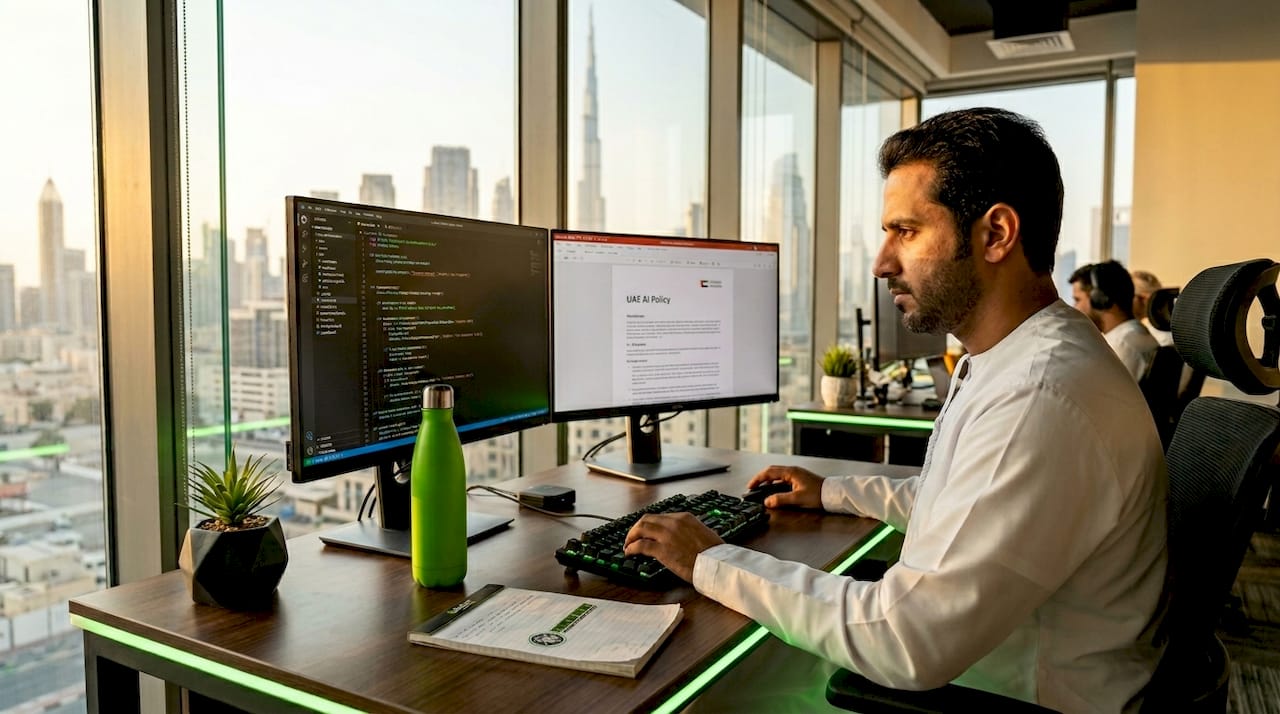
The implication for tech vendor capabilities is significant. Government agencies are now requiring vendors to demonstrate competency in governance, accountability frameworks, and service redesign around AI agents, not just model deployment. UAE vendors capable of meeting these requirements have developed skills that simply do not exist at the same density in most other markets.
Here is what that means in practical technology terms for entrepreneurs evaluating UAE tech companies:
- AI integration depth: UAE firms working on government contracts build real operational AI, not demo-layer features. That expertise transfers to enterprise client work.
- Blockchain maturity: Dubai's blockchain strategy has driven genuine production deployments across land registry, healthcare, and trade finance. Vendors operating here have battle-tested experience on blockchain apps transforming UAE businesses.
- Cloud and infrastructure alignment: The national focus on advanced compute means local vendors have better access to GPU resources and cloud partnerships aligned with UAE data sovereignty requirements.
- Regulatory fluency: A vendor that has shipped a product through ADGM's RegLab understands compliance in ways that can protect your project from costly rework later.
The UAE tech industry strengths are not theoretical. They have been built through production-scale deployments that required real technical maturity. When you compare this to offshore vendors who have never operated in a regulated AI or blockchain environment, the difference shows up quickly in a technical scoping conversation.
Practical steps for selecting a UAE tech company
Knowing the top reasons to choose UAE tech is useful. Knowing how to actually evaluate a specific vendor is what protects your investment. These are the criteria worth building into your process.
- Verify substance, not just registration. Confirm the vendor has a real team in the UAE. Ask for LinkedIn profiles of key technical staff, a physical office address you can verify, and references from previous UAE-based clients. This step eliminates letterbox entities immediately.
- Assess ecosystem integration. Ask which free zones, accelerators, or regulatory bodies the vendor has active relationships with. A vendor embedded in Dubai Internet City or DIFC's FinTech Hive operates with access that a mainland-only entity does not have.
- Evaluate AI and blockchain specialization specifically. Generic software houses are everywhere. The value of choosing a UAE tech firm comes from vendors who specialize in the technologies the UAE government is actively building into its infrastructure. Ask for case studies in AI agents, smart contracts, or mobile apps deployed for regional clients.
- Check their path-to-scale story. How has the vendor helped previous clients grow from UAE into GCC markets or internationally? Embedded providers in UAE ecosystems reduce the friction of launching and scaling across borders. If the vendor cannot describe this clearly, they likely do not have the connections to make it happen.
- Understand free zone versus mainland trade-offs. Free zone vendors may have restrictions on direct sales to UAE mainland clients without a local distributor arrangement. If your business model requires mainland contracts, clarify this before engagement. It affects project structure, billing, and timelines.
Pro Tip: Request a breakdown of the vendor's current active projects by sector. A firm that has shipped in healthcare, government, and fintech simultaneously is demonstrating genuine depth. A firm that has only worked in one vertical may lack the flexibility your project requires.
Common pitfalls here include choosing vendors purely on price, assuming all free zone firms share the same benefits, and failing to validate technical team credentials before signing. UAE tech companies comparison exercises that skip these steps tend to end in costly mid-project pivots.
How UAE vendors compare to regional and global alternatives
The UAE's competitive position becomes clearer when you put it next to real alternatives.
| Factor | UAE | Saudi Arabia | India-based offshore |
|---|---|---|---|
| Corporate tax rate | 9% (0% QFZP) | 20% | Varies, typically 25%+ |
| AI regulatory frameworks | Active, evolving | Early stage | Fragmented |
| Blockchain production deployments | Extensive | Limited | Case-by-case |
| GCC market access | Immediate | Saudi-focused | Requires local partner |
| Ecosystem speed | High | Moderate | Low to moderate |
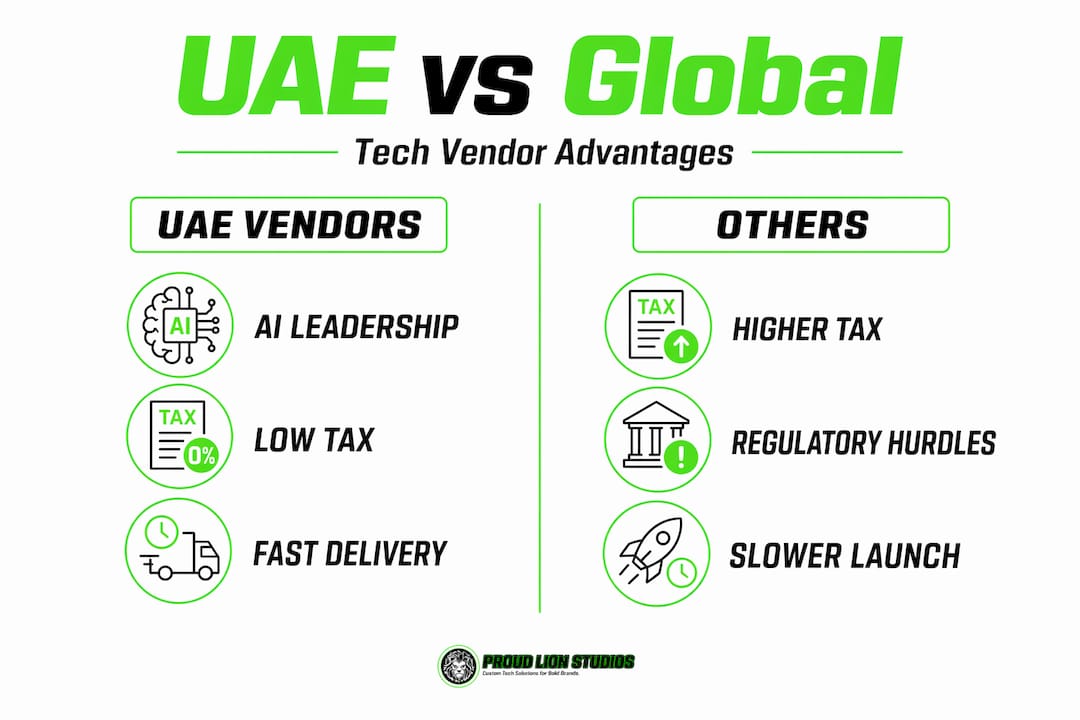
Several factors differentiate UAE vendors in ways that go beyond tax rates. Saudi Arabia's tech ecosystem is growing rapidly, particularly through Vision 2030 initiatives, but its regulatory frameworks for fintech and AI are earlier in development. India-based offshore vendors offer cost advantages but introduce time zone friction, communication gaps, and no inherent GCC market access.
The risk of "letterbox" UAE entities is real on both sides of this comparison. Some companies register in UAE free zones purely for tax or prestige reasons, while maintaining zero operational presence. These entities cannot offer the ecosystem advantages that make choosing a UAE tech partner genuinely valuable. A vendor with real substance in the UAE connects you to the national AI push, the regional capital networks, and the Web3 and blockchain licensing frameworks that exist nowhere else in the region at the same level of maturity.
What makes the UAE globally distinctive is not just any single advantage but the combination of sovereign AI investment, pragmatic tax policy, and a government that treats technology adoption as a national priority rather than a departmental function.
My honest take on choosing UAE tech partners
I have watched a lot of businesses make this decision, and I want to share what I have actually learned rather than what sounds good on a slide.
The biggest mistake I see is treating the UAE tech vendor decision like a feature comparison. Buyers focus on technology stack, pricing, and portfolio. Those matter, but they miss the thing that actually determines whether your project succeeds at pace: how deeply embedded is this vendor in the ecosystem that will make or break your launch?
Speed-to-market in the UAE is not about a faster development team. Project speed and success are determined more by ecosystem integration than technical capability. A vendor who can make one call to the right regulatory contact, or co-pitch a government tender with you, or introduce you to a regional investor in their network, is worth far more than a faster coder working in isolation.
I have also seen the QFZP tax story bite companies that did not do their homework. A vendor registered in a free zone with no real team is not a UAE tech company in any meaningful sense. The substance requirements are real and increasingly enforced. When that house of cards collapses, your project often collapses with it.
The genuinely exciting piece, and I do not say this lightly, is what Agentic AI adoption at the government level means for vendor maturity. The companies winning UAE government AI contracts are being forced to develop governance, operational transformation, and accountability frameworks that frankly do not exist at this level anywhere else in the world. If you can access that capability through a vendor relationship, you are getting something genuinely hard to find offshore.
Balance your enthusiasm with pragmatism. Verify substance. Ask the hard questions. Then move fast, because the window for getting ahead of competitors through UAE ecosystem access is real and it will not stay this open forever.
— Amal
Work with Proudlionstudios on your next UAE tech project
Proudlionstudios is a Dubai-based technology studio with a fully UAE-resident technical team, active across blockchain, AI automation, mobile development, and Web3 solutions. The studio has delivered production-scale projects across multiple countries, building everything from smart contract systems and NFT platforms to AI agent integrations and mobile applications for both startups and enterprises. Supported by grants from the Aptos Foundation, Proudlionstudios brings genuine ecosystem depth. If you want a tech partner with real substance in the UAE, deep specialization in blockchain development, and a portfolio that demonstrates delivery across regulated environments, explore what Proudlionstudios can build for your business.
FAQ
What makes UAE tech companies different from offshore vendors?
UAE tech companies offer direct access to the country's AI and blockchain regulatory ecosystems, GCC market relationships, and government-aligned infrastructure that offshore vendors cannot replicate. The best firms are embedded in innovation hubs that directly accelerate project delivery.
Is the 0% corporate tax in UAE free zones real?
It is real but conditional. Companies must qualify as a Qualifying Free Zone Person, which requires genuine substance including a physical office, local employees, and qualifying income. Without meeting these criteria, the standard 9% rate applies.
How do I verify a UAE tech vendor has real operations?
Request a trade license, proof of a physical UAE office address, and a list of local technical team members you can verify independently. Ask for references from previous UAE-based clients and review their active project portfolio for regional deployments.
Why does the UAE government's AI push matter for vendor selection?
The UAE government's mandate to run 50% of services using Agentic AI is forcing local vendors to develop governance and operational transformation skills that go far beyond basic AI model deployment. Choosing a vendor shaped by this environment gives you access to a higher standard of AI maturity.
How does UAE compare to Saudi Arabia for tech vendor selection?
UAE offers a lower standard corporate tax rate at 9% versus Saudi Arabia's 20% for foreign companies, a more mature blockchain regulatory framework, and deeper integration between government AI initiatives and the private tech sector, making it the stronger base for regional tech partnerships in 2026.