

TL;DR:
- Obtaining a VAARA License in Dubai is essential for blockchain businesses to operate legally and build market credibility. The application process involves two stages, requiring compliance with governance, capital, and AML/CFT policies, and can take 6 to 12 months if prepared thoroughly. Licensing categories vary, and choosing the correct one, along with ongoing adherence to regulatory requirements, significantly impacts growth and partnership opportunities.
Getting a VAARA License is one of the most consequential decisions a blockchain entrepreneur can make in the UAE. Dubai's Virtual Assets Regulatory Authority (VARA) has built one of the world's most structured frameworks for virtual asset service providers, and operating without this license exposes your business to serious legal and financial risk. The good news is that the process is far more navigable than most founders assume. This guide breaks down the VAARA License requirements, the application process, license categories, and what it actually takes to stay compliant once you're licensed.
Table of Contents
- Key takeaways
- VAARA License requirements and the regulatory framework
- The VAARA License application process, step by step
- Comparing VAARA License types and their business implications
- Practical compliance tips to maintain your VAARA License
- How a VAARA License drives business growth and credibility
- My honest take on the VAARA licensing journey
- How Proudlionstudios can support your VAARA journey
- FAQ
Key takeaways
| Point | Details |
|---|---|
| Two-stage application | The VAARA License process has an Initial Approval stage and a Full License stage with distinct requirements. |
| Multiple license categories | Broker-Dealer, Issuance, and Custody licenses each carry different capital and operational obligations. |
| Timeline expectations | The full licensing process averages 6 to 12 months depending on application quality. |
| Marketing restrictions apply | Promoting virtual asset services without approval can result in fines up to AED 500,000 per violation. |
| Local entity required | Only Dubai-incorporated entities qualify; foreign companies must set up a local structure first. |
VAARA License requirements and the regulatory framework
Dubai's Virtual Assets Regulatory Authority was established to regulate, supervise, and oversee virtual asset activities across the emirate. Any business that exchanges, transfers, stores, or facilitates virtual asset transactions for clients needs a VAARA License to operate legally in Dubai. This applies whether you're running a crypto exchange, a token issuance platform, or a custody service.
Who qualifies to apply
The VAARA License eligibility criteria center on corporate structure, governance, and financial standing. A Dubai-incorporated entity is required; foreign companies cannot apply directly. Free zones like DIFC and ADGM offer 100% foreign ownership and a simplified incorporation path, making them popular choices for international founders entering the Dubai market.
Beyond incorporation, VARA expects applicants to demonstrate:
- A clearly defined business model with specified virtual asset activities
- Adequate paid-up capital relative to the license category being sought
- Appointment of at least two Responsible Individuals (RIs) who are full-time employees and personally accountable for compliance
- A board and senior management team that meets VARA's fit and proper standards
- Documented AML/CFT policies, including a qualified Money Laundering Reporting Officer (MLRO)
The Responsible Individuals requirement is one of the most misunderstood aspects of VAARA licensing. These are not nominal positions. VARA expects RIs to be actively involved in day-to-day compliance decisions, and any change in RI status requires regulatory notification and approval.
Pro Tip: Before you submit a single document, map out your governance structure and confirm that your proposed RIs have clean regulatory histories. VARA will conduct background checks, and surprises at this stage can delay the entire process by months.
Comprehensive AML/CFT frameworks are non-negotiable. Your policies must cover KYC procedures, transaction monitoring systems, and a clear process for reporting suspicious activity. VARA reviews these policies in detail during the application review.
The VAARA License application process, step by step
The VAARA License application process follows a two-stage structure, and understanding both stages before you start saves significant time and money.

Stage 1: Initial Approval
The Initial Approval stage grants permission to prepare for operations but does not authorize you to conduct virtual asset activities. Before submitting to VARA, you must first obtain approval from Dubai's Department of Economy and Tourism (DET) or the relevant free zone authority. This step involves submitting foundational corporate documents and a description of your proposed business activities.
Once DET or free zone approval is secured, the VARA submission begins. Documents you will need at this stage include:
- Certificate of incorporation and constitutional documents
- Detailed business plan with financial projections
- AML/CFT policy framework and compliance manual
- CVs and background information for all proposed RIs and board members
- Technology and cybersecurity infrastructure overview
- Capital adequacy evidence matching your proposed license category
Stage 2: Full Virtual Asset Service Provider License
After Initial Approval, VARA reviews your full application package. This is where the two-stage licensing process becomes critical to understand. VARA may issue queries, request additional documentation, or require meetings with your RI team. Responding promptly and thoroughly to every VARA inquiry is the single biggest factor in keeping your timeline on track.
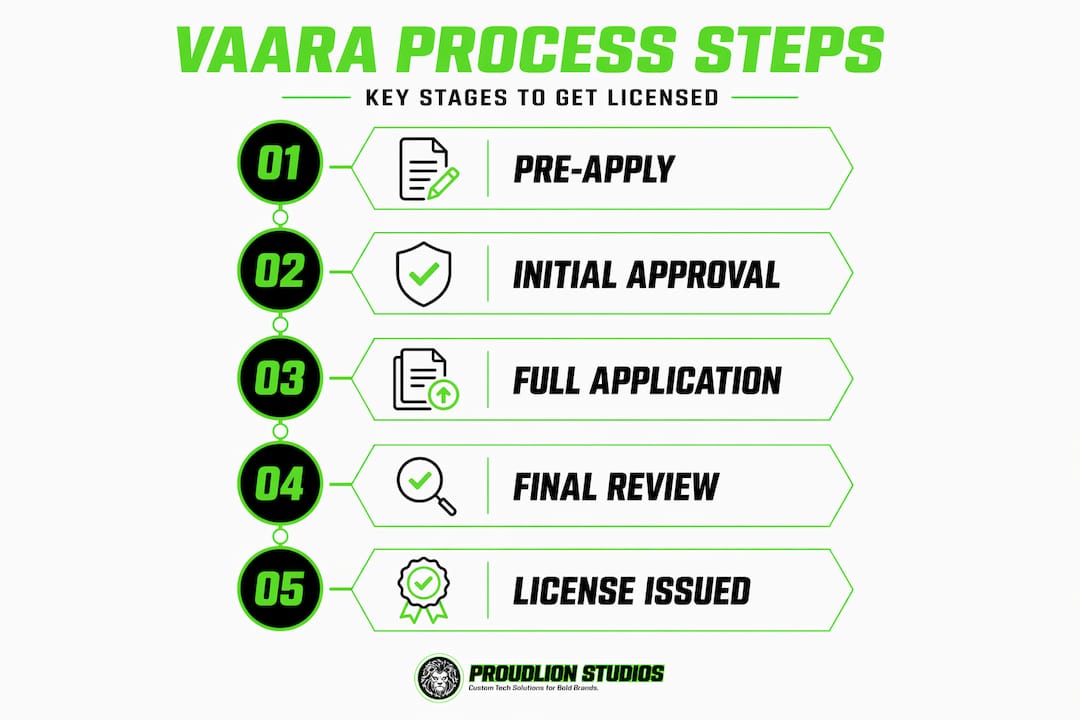
The table below summarizes key milestones and timing:
| Stage | Key Action | Typical Timeframe |
|---|---|---|
| Pre-application | Incorporate entity, appoint RIs, draft AML policies | 1 to 3 months |
| Initial Approval | Submit to DET or free zone, receive approval | 1 to 2 months |
| VARA Full Application | Submit full package, respond to queries | 4 to 8 months |
| License Issuance | Pay remaining fees, receive full license | 1 month |
VAARA License fees follow a split payment structure. Fifty percent is payable on application submission, with the remainder due before the license is formally issued. Exact fees vary by license type and the scope of activities you are applying to conduct.
Pro Tip: Treat every VARA query as a priority. Applicants who let queries sit unanswered for weeks routinely see their timelines stretch from 8 months to over a year. Assign a dedicated point of contact internally to manage all VARA correspondence.
Working with experienced VARA licensing specialists during the application stage reduces the risk of documentation errors that trigger back-and-forth with regulators.
Comparing VAARA License types and their business implications
Not all VAARA Licenses are the same, and choosing the wrong category at the outset forces a costly amendment process. VARA currently recognizes multiple license categories, each scoped to specific virtual asset activities.
| License Type | Core Activity | Key Capital Requirement |
|---|---|---|
| Broker-Dealer | Buying and selling virtual assets on behalf of clients | Varies by transaction volume |
| Issuance Services | Issuing and offering virtual assets to the public | AED 1,500,000 plus 2% of circulating supply |
| Custody Services | Holding and safeguarding client virtual assets | Defined minimum capital plus insurance |
| Exchange Services | Operating a virtual asset trading platform | Significant capital and technology requirements |
| Advisory Services | Providing virtual asset investment advice | Lower capital threshold, strict disclosure rules |
The Issuance license carries particularly strict obligations. Category 1 token issuers must hold paid-up capital of AED 1,500,000 plus 2% of the circulating supply value and maintain 100% reserve backing. This reflects the systemic risk that fiat-referenced virtual assets can pose to retail investors.
Choosing the right license comes down to three factors:
- What you actually do. If your platform lets users trade peer-to-peer, you likely need an Exchange license, not a Broker-Dealer license. The distinction matters legally.
- Your capital position. Custody and Issuance licenses demand more capital upfront. Founders who underestimate this requirement face delays when VARA asks for proof of funds.
- Your growth roadmap. If you plan to add services over time, applying for a broader license scope from the start avoids future amendment applications.
For blockchain projects exploring compliant token development, understanding which license category governs your token type before you build saves significant rework.
Practical compliance tips to maintain your VAARA License
Getting licensed is the beginning, not the finish line. VARA conducts ongoing supervision, and license holders face real consequences for compliance failures.
The most common areas where licensed businesses slip up:
- AML/CFT monitoring gaps. Your transaction monitoring system must be active and calibrated. VARA expects you to identify and escalate suspicious activity in real time, not retroactively.
- RI status changes. If a Responsible Individual resigns or changes roles, you must notify VARA immediately. Operating without the required number of approved RIs puts your license at risk.
- Record keeping. VARA requires detailed records of all client transactions, communications, and compliance decisions. Audits can request records going back several years.
- Marketing approvals. Every piece of promotional content about your virtual asset services must receive VARA sign-off before publication. Marketing without approval can trigger fines of up to AED 500,000 per violation. This includes social media posts, website copy, and paid advertising.
- Annual renewal obligations. VAARA License renewal requires submitting updated compliance reports, financial statements, and confirmation of continued fit and proper status for all RIs.
Pro Tip: Build a compliance calendar from day one. Map out every recurring obligation, including transaction monitoring reviews, RI status confirmations, and marketing approval workflows, so nothing falls through the cracks during busy growth periods.
How a VAARA License drives business growth and credibility
Beyond legal compliance, a VAARA License signals something concrete to your market. Institutional investors, banking partners, and enterprise clients in the UAE treat licensed status as a baseline requirement before they engage. Without it, you are simply not in the room for many of the most valuable deals.
Dubai's financial services ecosystem is tightly networked. Licensed VASPs gain access to banking relationships that are otherwise difficult to establish, because UAE banks apply enhanced due diligence to crypto businesses and favor those with regulatory standing. For blockchain-based startups looking to scale, this access can be the difference between growing locally and staying stuck at the early-stage level.
There is also a competitive dimension worth considering. As VARA continues to mature its framework in 2026, the gap between licensed and unlicensed operators is widening. Licensed businesses can market openly, partner with regulated financial institutions, and attract talent that wants to work within a compliant structure. Unlicensed competitors face increasing enforcement pressure, which means your compliance investment today translates into market share tomorrow.
My honest take on the VAARA licensing journey
I've worked alongside blockchain founders at various stages of the VAARA process, and the pattern I see most often is this: the entrepreneurs who struggle are the ones who treat licensing as a box to check rather than a foundation to build on.
The timeline surprises people. Most founders expect a 90-day turnaround and get frustrated when the process takes closer to nine months. But in my experience, that timeline is almost always a reflection of preparation quality, not bureaucratic slowness. Applicants who submit clean, complete packages with well-structured governance documentation consistently move faster.
What I've found genuinely surprising is how much VARA values transparency. If your business model has complexities or edge cases, disclosing them proactively in your application tends to go better than having VARA discover them through queries. Regulators are not looking for perfect businesses. They are looking for honest ones.
My advice to any founder starting this process: get your governance right before you touch the application forms. The license is a byproduct of having a well-run, compliance-first business. Build that first, and the paperwork follows naturally.
— Amal
How Proudlionstudios can support your VAARA journey

Proudlionstudios works directly with blockchain founders and Web3 teams navigating the technical and regulatory demands of the Dubai market. From building compliant smart contract architecture to preparing the technology documentation VARA requires during the application process, the team brings hands-on experience to every stage of your licensing journey. Whether you need blockchain development services aligned with VARA's technical standards or support building out your tokenization and DApp infrastructure, Proudlionstudios delivers solutions built for real regulatory environments, not theoretical ones. If you are serious about building in Dubai's virtual asset space, having a technically capable partner from day one is not optional.
FAQ
What is the VAARA License?
The VAARA License is an authorization issued by Dubai's Virtual Assets Regulatory Authority (VARA) that permits businesses to conduct regulated virtual asset activities, including exchange, custody, issuance, and brokerage services, within Dubai.
How long does the VAARA License application process take?
The full licensing process averages 6 to 12 months, depending on the quality of your application and how quickly you respond to VARA's queries.
Can a foreign company apply for a VAARA License directly?
No. A Dubai-incorporated entity is required to hold a VAARA License. Foreign companies must establish a local entity, typically through a free zone that allows 100% foreign ownership.
What are the VAARA License fees?
Fees vary by license type and activity scope. They are paid in two installments: 50% at application submission and the remaining 50% before the license is formally issued.
What happens if I market virtual asset services without a VAARA License?
Marketing virtual asset activities without VARA approval is prohibited and carries fines up to AED 500,000 per violation. All promotional materials must receive VARA sign-off before publication.