

TL;DR:
- Most founders mistakenly view token development as merely writing and deploying a smart contract. Dubai's complex regulatory environment requires simultaneous legal, technical, and governance efforts, emphasizing secure system design with explicit invariants and role-based permissions. Successful launches treat compliance and security as parallel tracks, embedding them from project inception to ensure rapid, compliant market entry.
Most founders assume token development is primarily a coding challenge. Write the smart contract, deploy it, done. But Dubai's regulatory and security landscape tells a very different story. Between VARA's licensing requirements, adversarial attack vectors, and integration benchmarks, launching a token here demands legal, technical, and governance workstreams running simultaneously. If you're building in the UAE, this guide gives you the complete picture.
Table of Contents
- What defines secure token development?
- Navigating VARA compliance in Dubai
- Security benchmarks and practical token integration
- Applying token development frameworks to Dubai startup projects
- Why Dubai token development is a startup sprint, not a marathon
- Scale your Dubai token project with expert development and compliance support
- Frequently asked questions
Key Takeaways
| Point | Details |
|---|---|
| Secure frameworks matter | Economic invariants and bounded permissions are vital for preventing abuse and ensuring token safety. |
| VARA compliance is complex | Dubai startups must align technical, legal, and distribution processes to meet VARA’s licensing requirements. |
| Benchmark integrations | Token contracts should be scored against security, simplicity, upgradeability, and automated conformance checks. |
| Parallel workstreams required | Success means syncing legal, technical, and testing efforts before launch to avoid delays and regulatory issues. |
What defines secure token development?
Security in token development is not about writing clean code. It's about designing systems that hold under pressure, including pressure from malicious actors, rogue insiders, and edge cases your team never anticipated.
Three principles form the foundation of a genuinely secure token:
- Economic invariants: Hard-coded rules that govern your token's behavior, such as a fixed supply cap, a fee ceiling, or a minimum reserve ratio. These cannot be overridden at runtime, regardless of who calls the contract.
- Permission boundaries: Explicit definitions of which roles can trigger which functions. Who can mint? Who can burn? Who can pause the contract or modify fees? These must be documented and enforced at the contract level.
- Adversarial test coverage: Testing that goes beyond confirming that normal transactions work. Your test suite must simulate attacks, privilege escalation attempts, upgrade exploits, and pause/resume abuse.
Expert guidance emphasizes designing explicit economic invariants plus constrained permission boundaries, rather than relying on a single admin key. A single admin key is one of the most common and dangerous patterns in token contracts. If that key is compromised, the entire token economy is at risk.
"Designing explicit economic invariants plus constrained permission boundaries (who can mint/burn/change fees/upgrade/price) is far safer than relying on a single admin key." — Safe Token Design Guide
Comparison of permission structures used by Dubai startups:
| Structure | Risk level | Flexibility | Recommended for |
|---|---|---|---|
| Single admin key | High | High | Not recommended |
| Multi-sig admin | Medium | Medium | Early-stage projects |
| Role-based access control | Low | High | Production tokens |
| DAO-governed parameters | Very low | Low | Mature protocols |
For Dubai founders building secure role-based token contracts, role-based access control (RBAC) is the practical sweet spot. It separates minting authority from fee-change authority from upgrade authority, so a breach in one role does not cascade across the entire system.
Pro Tip: When scoping your token contract, list every privileged function explicitly and assign it a named role. If you can't name who holds a role and why, that role shouldn't exist.
Projects like Tokenify demonstrate how these principles translate into real product architecture, where permission design is treated as a first-class engineering concern, not an afterthought.

Navigating VARA compliance in Dubai
Once you understand technical security, it's crucial to match these efforts to Dubai's unique VARA regulatory framework. The Virtual Assets Regulatory Authority governs all token issuance activity in Dubai, and its requirements go well beyond smart contract quality.
VARA compliance is not only about smart contracts. It requires regulatory classification, approvals, governance and AML/KYC alignment, auditable disclosures, and in many cases, use of licensed channels for distribution.
Here is the practical regulatory workflow for token issuance in Dubai:
- Obtain a VARA license before any issuance activity begins. The license type depends on your specific virtual asset activities.
- Submit a token-specific approval request to VARA. Each token requires its own prior approval, not just a blanket company license.
- Align with multiple VARA rulebooks covering governance, AML/CFT controls, technology standards, and market conduct.
- Prepare a mandatory whitepaper and a Risk Disclosure Statement that meets VARA's content and format requirements.
- Establish ongoing supervision infrastructure, including audit trails, reporting mechanisms, and compliance officer accountability.
- Engage a VARA-licensed Broker-Dealer for distribution, as direct issuance to retail investors is restricted in most cases.
"VARA's framework implies a parallel workstream of disclosure, governance, AML/CFT-aligned controls, and licensed distribution/placement paths, which directly affects engineering scope and release readiness."
Dubai vs. global token issuance standards:
| Requirement | Dubai (VARA) | EU (MiCA) | Singapore (MAS) |
|---|---|---|---|
| Pre-issuance license | Required | Required | Required |
| Per-token approval | Required | Varies | Varies |
| Whitepaper mandate | Yes | Yes | Yes |
| Licensed distributor | Often required | Not always | Not always |
| Ongoing audit/reporting | Yes | Yes | Yes |
This is why Dubai's blockchain innovation ecosystem is maturing faster than many other regions. The regulatory structure, while demanding, creates trust. Investors and enterprise partners in the UAE respond well to VARA-compliant projects because they know the scrutiny is real.
Pro Tip: Start your VARA compliance workstream at the same time as your smart contract development, not after. Legal approvals take weeks or months, and waiting until the code is done will delay your launch significantly.
For founders exploring how blockchain apps are transforming UAE businesses, understanding VARA's framework is the prerequisite to participating in that transformation. You can also reference the enterprise blockchain UAE guide for a broader view of how compliance fits into long-term blockchain strategy.
Security benchmarks and practical token integration
With regulatory compliance covered, startups should also benchmark their technical stack to prevent hidden vulnerabilities and costly integration errors.
Token integration is where many projects fail silently. The contract looks fine in testing, but once it connects to wallets, exchanges, or DeFi modules, edge cases surface that no one anticipated. A security checklist mindset prevents this.
Token integration work should be benchmarked against a security checklist: verify that the target token contract has a security review, avoid unnecessary complexity, check whether it is upgradeable, and use tooling such as Slither utilities to assess ERC conformance and generate property tests.
Key benchmarks every Dubai startup should apply:
- Security review: Has the contract been audited by an independent firm? Self-review is not sufficient for production tokens.
- Simplicity check: Every additional function is an additional attack surface. Remove anything that doesn't serve a direct business purpose.
- Upgradeability assessment: Upgradeable contracts offer flexibility but introduce proxy risks. If upgradeability is required, use a well-tested pattern and restrict upgrade authority tightly.
- ERC conformance testing: Use automated tools to verify that your token behaves exactly as the standard specifies. Deviations cause silent failures in wallets and exchanges.
- Property test generation: Tools like Slither's "slither-prop` generate test cases that probe invariant violations automatically.
Statistic callout: According to blockchain security research, over 60% of smart contract vulnerabilities discovered post-deployment could have been caught with automated static analysis tools during development. The cost of fixing a vulnerability after launch is orders of magnitude higher than catching it before.
For startups following a web3 security checklist, these integration benchmarks should be embedded into your development pipeline, not treated as a final gate before launch.
Your smart contract development services provider should be able to demonstrate that each of these checks has been performed and documented. If they can't show you the audit report, the Slither output, and the adversarial test results, the work isn't done.
Applying token development frameworks to Dubai startup projects
Synthesizing the security and compliance sections, here's how Dubai startups can practically launch and grow token projects with a structured framework.
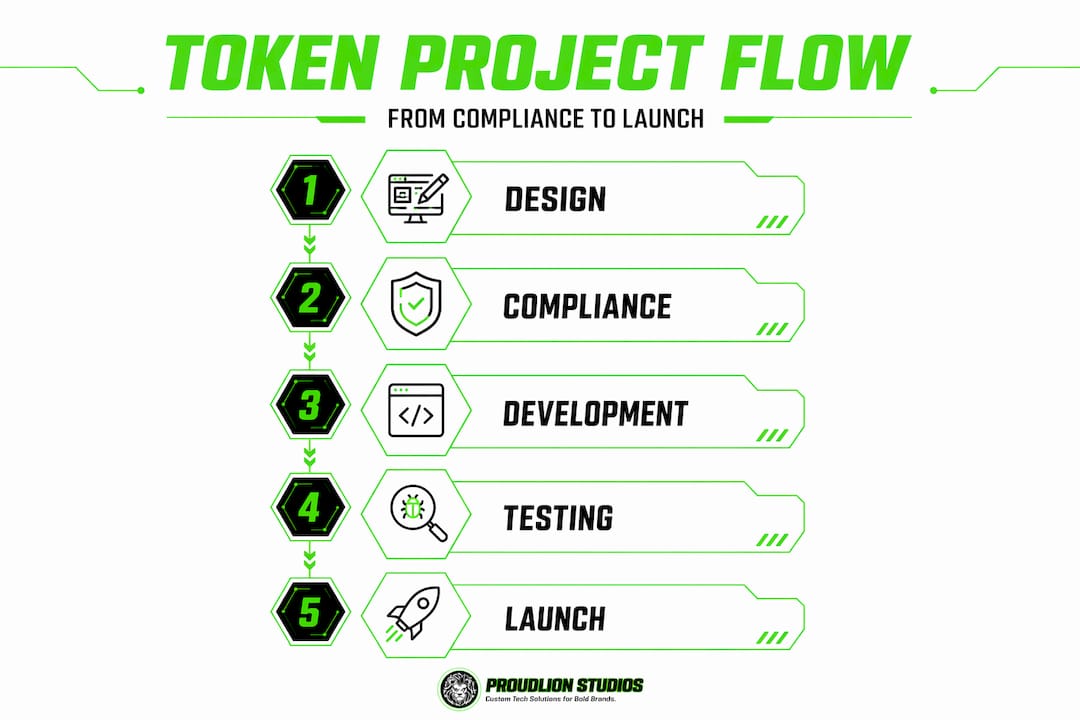
The most successful token launches we've seen share a common pattern: they treat legal, technical, and testing as three parallel tracks, not a sequential waterfall. Here is the actionable sequence:
- Define your token's economic model first. Before writing a single line of code, document your supply cap, fee structure, and any minting or burning rules. These become your explicit economic invariants.
- Map every privileged function to a named role. Use role-based permissions for mint, burn, fee changes, pausing, upgrades, and pricing. No function should be callable by an anonymous admin address.
- Start the VARA compliance workstream immediately. VARA's framework requires disclosure, governance, AML/CFT controls, and licensed distribution, all of which affect your engineering scope.
- Build adversarial test coverage from day one. Your test suite should include privilege escalation attempts, pause/resume abuse scenarios, and upgrade exploit simulations.
- Run automated security tools before any external audit. Slither and similar tools catch the low-hanging fruit so your audit budget focuses on complex logic.
- Engage a VARA-licensed Broker-Dealer early. Distribution planning affects your token's smart contract design, particularly around transfer restrictions and allowlists.
Checklist for Dubai startup token launches:
| Milestone | Technical | Legal | Testing |
|---|---|---|---|
| Economic model defined | Contract parameters set | Whitepaper drafted | Invariant tests written |
| Roles assigned | Governance docs prepared | AML/KYC integrated | Privilege tests written |
| Audit completed | VARA approval submitted | Risk disclosure filed | Adversarial suite passed |
| Integration tested | Broker-Dealer engaged | Ongoing reporting set up | Conformance verified |
For teams building on RWA and NFT frameworks, this parallel-track approach is especially critical. Real-world asset tokenization carries additional legal obligations around asset custody and investor classification that must be resolved before the token contract is finalized.
The founders who struggle most are those who treat compliance as a checkbox at the end. In Dubai, it's a design constraint from the beginning.
Why Dubai token development is a startup sprint, not a marathon
Here's a perspective that most token development guides won't give you: the conventional wisdom of "move slow, get everything perfect" is actually a liability in Dubai's market.
Dubai's regulatory and commercial environment moves fast. VARA updates its guidance regularly. Enterprise partners in the region expect production-ready products, not perpetual betas. And the window for first-mover advantage in specific token categories, whether that's real-world asset tokenization, loyalty tokens, or regulated DeFi, is narrower than founders realize.
The teams that succeed here are the ones who run legal, technical, and testing workstreams in parallel from day one, not sequentially. We've watched projects spend six months perfecting their smart contract only to discover that their intended distribution model doesn't comply with VARA's Broker-Dealer requirements. That's not a technical failure. It's a planning failure.
The crypto innovation in Dubai landscape rewards founders who treat compliance as a design input, not a final hurdle. The fastest launches aren't the ones with the most resources. They're the ones with the most integrated teams, where the legal advisor is in the same room as the smart contract engineer from week one.
Speed without structure is reckless. But structure without speed means someone else captures your market. The answer is parallel execution with clear ownership at every track.
Scale your Dubai token project with expert development and compliance support
Launching a token in Dubai requires more than a great idea and a capable developer. It demands a team that understands how security design, VARA compliance, and scalable architecture intersect in practice.
Proud Lion Studios works with Dubai startups and enterprises to deliver end-to-end token development that covers smart contract engineering, role-based security architecture, and regulatory alignment from day one. Our blockchain development services are built for founders who need production-ready results, not templated solutions. Whether you're building tokenization solutions for real-world assets or launching a utility token, our smart contract experts bring both technical depth and UAE market knowledge to every project. Reach out for a consultation and see how we've helped founders across the region launch with confidence.
Frequently asked questions
What are the main regulatory steps for issuing a token in Dubai?
You need a full VARA license, prior approval for each token, and compliance with governance, AML/KYC, auditable disclosures, and distribution via licensed channels.
How can startups ensure their token is secure and not vulnerable to admin abuse?
Set explicit economic invariants and use role-based permissions instead of a single admin key, and always perform adversarial tests before launch.
What tools are recommended for ERC token contract security checks?
Slither utilities like slither-check-erc and slither-prop are recommended for ERC conformance verification and automated property test generation.
Is distributing tokens directly allowed for Dubai startups?
Direct distribution is often restricted; tokens usually must be placed via a VARA-licensed Broker-Dealer, with a mandatory whitepaper and Risk Disclosure Statement.
What testing coverage should founders require before token launch?
Coverage must include adversarial and privilege and upgrade/pause edge cases, not just standard happy-path function calls.