
TL;DR:
- Blockchain is a decentralized ledger technology that enhances transparency and security across industries. It enables faster transactions, reduces fraud, and supports new business models like tokenization while embedding seamlessly into existing systems. Successful adoption depends on proper governance, regulatory compliance, and integrating blockchain as infrastructure rather than replacing traditional systems.
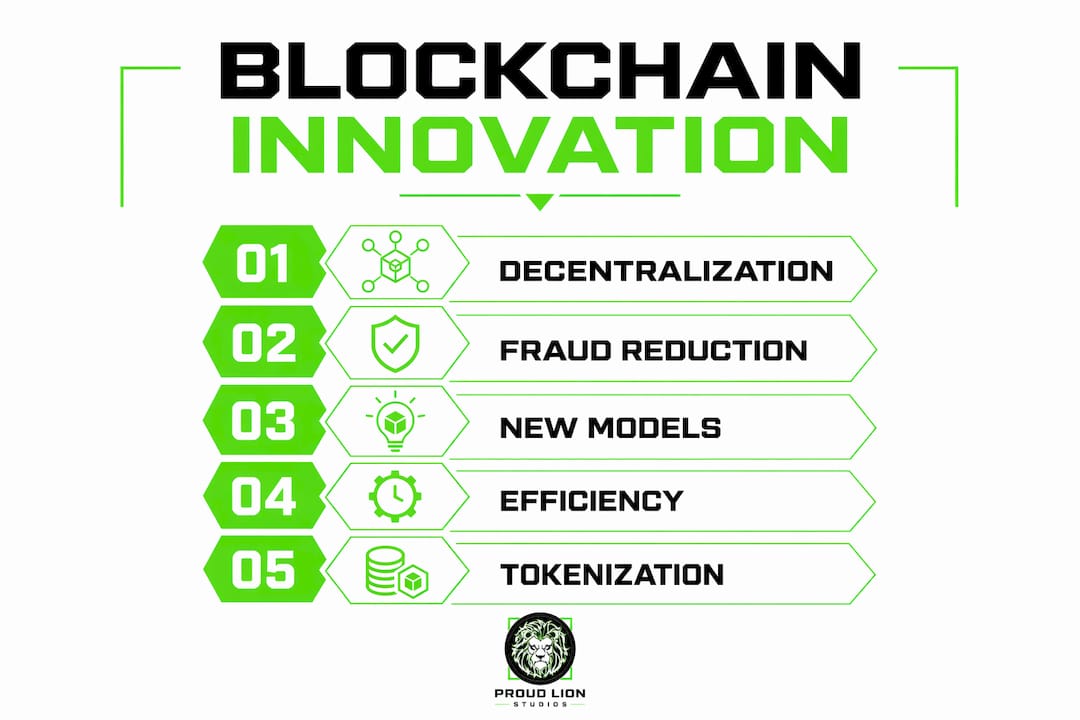
Blockchain is defined as a decentralized, distributed ledger technology that records transactions across multiple nodes, making data tamper-resistant and transparent by design. The role of blockchain in innovation goes far beyond cryptocurrency. It gives entrepreneurs and institutions a foundation for building systems where trust is automatic, not assumed. The UNDP's SDG Blockchain Accelerator has already delivered 46 pilot solutions, with 70% now embedded in active national programs. That number signals a shift from experimentation to real deployment. Blockchain is no longer a niche experiment. It is becoming core infrastructure for digital transformation across finance, supply chains, and public services.
How does blockchain drive innovation across industries?
Blockchain drives innovation by removing the need for a central authority to verify transactions. Traditional systems rely on intermediaries like banks, clearinghouses, or government registries. Blockchain replaces those intermediaries with cryptographic proof and distributed consensus. The result is faster, cheaper, and more auditable processes.
Three core features make blockchain a genuine engine for innovation:
- Decentralization. No single point of failure controls the network. This makes systems more resilient and removes gatekeepers who slow down or add cost to transactions.
- Immutable ledger. Once data is written to a blockchain, it cannot be altered without consensus from the network. This creates an auditable trail that reduces fraud and disputes.
- Smart contracts. These are self-executing programs stored on the blockchain that trigger actions automatically when conditions are met. A smart contract can release payment the moment goods are confirmed delivered, with no human intervention required.
Blockchain's decentralization and smart contracts reduce fraud risk and improve trust, security, and efficiency in financial systems. That finding reflects a broader truth: the technology's value is not just technical. It changes the governance model of entire industries.
Pro Tip: When evaluating blockchain for your project, ask whether trust is the core bottleneck. If your process fails because parties don't trust each other's data, blockchain solves that problem directly. If the bottleneck is speed or cost alone, a traditional database may serve you better.

Blockchain also enables new business models that were previously impossible. Tokenization, for example, converts real-world assets like real estate, equity, or art into digital tokens that can be traded on a blockchain. This opens markets that were once illiquid or accessible only to large institutions. For entrepreneurs, that is a direct path to new revenue structures and investor access.
What are the best real-world examples of blockchain innovation?
Concrete examples show how blockchain moves from theory to measurable impact. The most compelling cases come from finance, development, and asset markets.
-
Project Pangea. A consortium of 47 banks across South Korea and Europe reduced cross-border settlement from 48 hours to near-instant using stablecoins and blockchain middleware. The project targets a $150 billion trade corridor and uses payment-versus-payment atomic swaps. Banks do not need to hold cryptocurrency. The blockchain acts as a translator between existing Swift and ISO 20022 standards.
-
UNDP SDG Blockchain Accelerator. The UNDP program embedded blockchain pilot solutions into national and regional programs across developing economies. Twelve solutions are currently in real-world testing. This is not a lab project. These are live deployments inside government budgets and institutional frameworks.
-
Citi's Digital Depositary Receipt. Citi launched a product that lets clients invest in private companies via tokenized shares on the SIX Securities Depository blockchain ledger. Settlement is faster, liquidity improves, and voting controls remain intact. This is tokenization applied directly to private equity markets.
-
Supply chain transparency. Blockchain gives every participant in a supply chain a shared, verified record of goods movement. Manufacturers, logistics providers, and retailers all see the same data. Disputes over delivery, quality, or origin drop significantly because the record cannot be edited after the fact.
The table below summarizes the blockchain innovation impact across these sectors:
| Sector | Application | Key Outcome |
|---|---|---|
| Finance | Cross-border payments (Project Pangea) | Settlement reduced from 48 hours to near-instant |
| Public development | UNDP SDG Accelerator pilots | 70% of 46 solutions embedded in national programs |
| Capital markets | Citi Digital Depositary Receipt | Tokenized private equity with faster settlement |
| Supply chain | Shared ledger for goods tracking | Reduced disputes and improved transparency |
These examples share a common pattern. The most successful deployments treat blockchain as infrastructure that works alongside existing systems, not as a replacement that forces everyone to start over.
What challenges affect blockchain-driven innovation?
Blockchain adoption comes with real trade-offs. Understanding them upfront saves entrepreneurs from costly mistakes.
- Regulatory uncertainty. Most jurisdictions are still writing the rules for tokenized assets, smart contracts, and decentralized finance. Standardizing and building trust at scale are greater innovation barriers than the technology itself. Regulatory clarity is the missing piece in most markets.
- Short-term efficiency costs. Research on Chinese A-share listed firms from 2020 to 2024 found that blockchain innovation increases profitability and solvency but reduces operating efficiency in the short term due to resource costs. The technology pays off, but the transition period is expensive.
- Legacy system integration. Most enterprises run on infrastructure built decades ago. Replacing it is not realistic. The smarter path is middleware. Project Pangea proved this by integrating blockchain with Swift and ISO 20022 without forcing banks to overhaul their core systems.
- Governance and patent investment dynamics. Firms that focus heavily on patent quality in blockchain innovation face costly, long-term investment cycles before benefits mature. Increasing patent volume aids financial returns more reliably in the short term.
Pro Tip: Before committing to a blockchain build, map your existing tech stack and identify which components can stay. A middleware approach that connects blockchain to your current systems will almost always cost less and launch faster than a full rebuild.
The governance challenge is often underestimated. Blockchain networks require agreement among participants on rules, upgrades, and dispute resolution. Building that consensus takes time and political will, especially in multi-institution deployments. Entrepreneurs who plan for governance from day one avoid the most common failure mode in blockchain projects.
How can entrepreneurs practically use blockchain technology?
Practical blockchain adoption for entrepreneurs and innovators follows a clear pattern. The most successful builders focus on four areas.
- Start with tokenization or smart contracts. These two capabilities deliver the fastest return on investment. Tokenization opens new markets and liquidity pools. Smart contracts cut operational costs by automating processes that currently require manual verification or third-party oversight. Proud Lion Studios builds both, with services covering smart contract development and full tokenization infrastructure.
- Embed your solution in an existing institutional framework. The UNDP's experience shows that scaling blockchain innovations requires anchoring solutions within existing institutional budgets and programs with at least 12 months of operational runway. Isolated pilots die. Solutions embedded in real programs survive and scale.
- Prioritize regulatory compliance from the start. Build with the assumption that regulators will scrutinize your product. Choose blockchain platforms and legal structures that align with the jurisdictions where you operate. This is not a legal formality. It determines whether your product can scale or gets shut down.
- Use middleware to connect blockchain to legacy systems. You do not need to rebuild everything. The fintech software approach of layering blockchain over existing infrastructure is faster, cheaper, and far less disruptive to your operations.
Financial institutions should treat blockchain as a core technological capability, which requires workflow and governance re-engineering for maximum benefit. That principle applies equally to startups. The technology alone does not create value. The process redesign around it does. Entrepreneurs who understand this build products that last. Those who treat blockchain as a marketing feature build products that stall.
Key Takeaways
Blockchain's role in innovation is most powerful when it solves a trust problem, integrates with existing systems, and operates within a regulatory-compliant institutional framework.
| Point | Details |
|---|---|
| Trust is the core value | Blockchain removes the need for intermediaries by replacing them with cryptographic verification. |
| Middleware beats replacement | Project Pangea shows blockchain works best layered over existing standards like Swift and ISO 20022. |
| Institutional embedding scales | UNDP data shows 70% of pilot solutions succeed when anchored in national programs with long runways. |
| Short-term costs are real | Research confirms blockchain adoption reduces operating efficiency before profitability improves. |
| Tokenization opens new markets | Citi's Digital Depositary Receipt proves tokenized assets can reach private equity markets with better liquidity. |
Blockchain's real promise is still being underestimated
I have watched blockchain go through two full hype cycles, and the pattern is always the same. The technology gets credited for things it cannot do, then blamed for things that were never its fault. The actual problem is almost never the blockchain itself. It is the governance, the regulation, and the organizational change required to use it well.
What I find genuinely interesting right now is the middleware model. Project Pangea did not ask 47 banks to abandon Swift. It built a layer that made Swift work better. That is the insight most entrepreneurs miss. They come in wanting to replace existing systems, and they burn time and money on fights they cannot win. The builders who succeed treat blockchain as an addition, not a replacement.
The UNDP's SDG Accelerator work also changed how I think about scaling. The 12-month operational runway requirement is not bureaucratic caution. It is the minimum time needed for a new system to prove itself inside a real institution. Pilots that skip this step almost always fail to transition into production. If you are building for governments or large enterprises, plan for that timeline from the beginning.
The future of blockchain in innovation is not about one killer app. It is about blockchain becoming invisible infrastructure, the way TCP/IP is invisible today. You do not think about TCP/IP when you send an email. Eventually, you will not think about blockchain when you settle a payment or verify a credential. That is when the technology will have truly succeeded.
— Amal
Proud Lion Studios and blockchain-driven innovation
Proud Lion Studios works with startups and enterprises that are building on blockchain, not just talking about it. The Dubai-based studio covers the full development stack: smart contracts, tokenization, NFT marketplaces, Web3 applications, and AI-integrated workflows. Every project is built by a UAE-based technical team with a focus on real business outcomes, not templated solutions.
If you are an entrepreneur or innovator ready to move from concept to deployment, Proud Lion Studios offers blockchain development services built for projects that need to scale. The team also handles tokenization and DApp development for founders entering asset markets. Explore the blockchain for business guide to see how other startups and enterprises have structured their blockchain strategy before engaging a development partner.
FAQ
What is the role of blockchain in innovation?
Blockchain enables innovation by providing a decentralized, tamper-resistant ledger that removes the need for intermediaries and automates trust through smart contracts. Its core value is in industries where data integrity, transparency, and multi-party coordination are critical.
How does blockchain improve cross-border payments?
Project Pangea demonstrated that blockchain middleware can reduce cross-border settlement from 48 hours to near-instant by using stablecoins and atomic swaps while remaining compatible with existing Swift and ISO 20022 banking standards.
What are the biggest challenges in blockchain adoption?
Regulatory uncertainty, short-term operating efficiency costs, and legacy system integration are the three primary barriers. Research shows blockchain increases long-term profitability but reduces operating efficiency during the transition period.
How do startups scale blockchain innovations successfully?
The UNDP SDG Blockchain Accelerator found that solutions embedded in existing institutional programs with at least 12 months of operational runway are far more likely to transition from pilot to full deployment than standalone experiments.
What is tokenization and why does it matter for innovation?
Tokenization converts real-world assets like equity or real estate into digital tokens tradeable on a blockchain. Citi's Digital Depositary Receipt shows this model improves liquidity and settlement speed in markets that were previously slow and inaccessible to smaller investors.