

TL;DR:
- Turning innovative tech ideas into scalable products requires careful planning and technical expertise.
- Selecting the right tech stack based on clear goals reduces development time and costs.
- Continuous security audits and human oversight are crucial for long-term success and risk management.
Turning a bold tech concept into a live, scalable product is one of the hardest things a founder will ever do. You're racing against competitors, managing budget constraints, and navigating genuinely complex technical decisions about blockchain architecture, AI integration, and mobile performance, all at the same time. A misstep in any one of these areas can set your timeline back by months or cost you early users you can never recapture. The good news is that a systematic approach to selecting and using tech startup development services can convert those hurdles into real competitive advantages. This guide walks you through every critical step, from vision to launch, so you can move with clarity and confidence.
Table of Contents
- Defining your vision and choosing the right tech stack
- Step-by-step: Building your minimum viable product (MVP)
- Key pitfalls and how to avoid them
- Optimizing for security, scalability, and ongoing improvement
- Why blending AI efficiency with human expertise is the real secret
- Take your startup vision further with expert development services
- Frequently asked questions
Key Takeaways
| Point | Details |
|---|---|
| Clarify your vision | Starting with a precise use case and clear requirements sets the foundation for a successful tech build. |
| Map the right tech stack | Strategic platform choices—Ethereum L2, off-chain AI, mobile—save both time and money. |
| Don’t skip security | Mandatory audits and human code review are essential for secure, scalable blockchain and AI products. |
| Blend AI with expertise | AI tools boost productivity, but true innovation requires creative human insight and oversight. |
Defining your vision and choosing the right tech stack
To build a successful product, you must start with a clear understanding of your vision and the technology landscape. Before a single line of code is written, your most important job is to translate your business goals into technical requirements. This is where most early-stage startups stumble. They fall in love with a technology before confirming it actually solves their users' problem.
Start by writing down the core problem your product solves, who it solves it for, and what a successful outcome looks like in measurable terms. Only then should you map those goals to a technology layer.
Blockchain use cases vary enormously. DeFi platforms demand audit-grade smart contracts and often Layer 2 scaling. NFT marketplaces need gas-efficient minting flows. Supply chain products prioritize data integrity over transaction speed. Defining use cases and selecting the right blockchain platform, like Ethereum Layer 2, streamlines MVP development and reduces costs significantly.
AI integration sits on a spectrum. Off-chain compute (running models on your own infrastructure) gives you flexibility, while on-chain verification adds trust. For most startups, a hybrid approach makes sense. Resources for building your AI stack can help you understand which models, APIs, and infrastructure tools match your product goals.
Mobile and web layers are where users form their first impression. Prioritize time-to-value: how fast can a new user accomplish something meaningful? This single metric often determines whether they stay or leave.
Here is a quick comparison to guide your initial stack decision:
| Technology | Best startup fit | Typical complexity | Time-to-MVP |
|---|---|---|---|
| Blockchain | DeFi, NFT, payments, data integrity | High | 4–24 weeks |
| AI/ML | Automation, analytics, personalization | Medium–High | 6–16 weeks |
| Mobile/Web app | Consumer products, SaaS tools | Low–Medium | 2–12 weeks |
Key questions to answer before committing to a stack:
- Does your product require trustless transactions or just a database?
- Will AI improve user experience or is it a "nice to have"?
- What devices will your primary users rely on?
- Do you have budget for a security audit before launch?
You can also explore scalable web app options that blend blockchain and AI layers into a single coherent architecture.
Pro Tip: Document your tech stack decision with a one-page rationale. This becomes your north star when outside pressure pushes you toward scope creep.
Step-by-step: Building your minimum viable product (MVP)
Once you've mapped your goals and technical stack, you're ready to start building. A minimum viable product (MVP) is the smallest version of your product that delivers real value to real users. The goal is not perfection. It is validated learning.
Here is a practical roadmap for building a blockchain or AI-powered MVP:
- Define the core use case. Pick the one problem your MVP solves. Strip everything else out.
- Select your tech stack. Confirm platform, language, and third-party APIs based on your earlier analysis.
- Plan your architecture. Design for modularity. Modules that can be swapped out independently save you weeks later.
- Develop a working prototype. Build fast, but document every decision. Future-you will thank you.
- Run a security audit. For blockchain and AI stacks, this is not optional. It is the step that protects both your users and your investors.
- Conduct user testing. Get real people using it before you spend another dollar on features.
- Launch and measure. Ship, collect data, and prioritize your next sprint based on actual user behavior.
Time and cost expectations matter here. A basic blockchain MVP can be built in 4–8 weeks at $8K–$50K, while DeFi solutions are more expensive and time-consuming, often exceeding $150K.

| MVP type | Estimated cost | Estimated timeline |
|---|---|---|
| Standard web/mobile | $8K–$30K | 2–10 weeks |
| Blockchain (basic) | $8K–$50K | 4–8 weeks |
| AI-integrated product | $20K–$80K | 6–16 weeks |
| DeFi / advanced blockchain | $150K+ | 16–24 weeks |
For a deeper look at building across these tech layers, the AI and blockchain development guide and mobile app MVP essentials both offer practical frameworks.
Pro Tip: Build your audit into your project timeline from day one. Treating it as an afterthought almost always pushes your launch date back by two to four weeks.
Key pitfalls and how to avoid them
As you move through development, be proactive about avoiding mistakes that sabotage many startups. The most painful part about common development mistakes is that most of them are entirely predictable.
Security lapses are the most dangerous. A single vulnerability in a smart contract can drain liquidity pools or expose user data. The losses from preventable security failures in blockchain products run into billions annually. Independent audits are not a luxury.
AI can speed up software development by 20% or more, but human oversight is critical for security and code quality. Over-relying on AI-generated code without expert review is one of the fastest ways to ship a product with hidden bugs that only surface under load or attack.
"Startups that skip human QA in AI-assisted development pipelines are essentially trading short-term speed for long-term technical debt."
Here are the most common pitfalls and their fixes:
- No security audit before launch. Fix: Budget for an independent audit at the architecture stage, not the night before launch. Review security best practices early.
- Onboarding friction. Fix: Test your new-user flow with people who have never seen your product. Time how long it takes them to complete a core action.
- Monolithic architecture. Fix: Build modular from day one. Each component should be deployable independently.
- Skipping QA on AI-generated code. Fix: Treat AI output as a first draft, not a finished product. Every output needs a human review cycle.
- Ignoring edge cases for multi-tenant platforms. Fix: Map out all user roles and data access scenarios before you finalize your data model.
Browsing top AI developer tools can also help your team choose development aids that reduce risk rather than introduce it.
Also remember that AI-blockchain security issues require mandatory audits, and onboarding friction is one of the most common weak points in new digital products.
Pro Tip: Run a dedicated "break the product" session with your dev team before user testing. Actively try to crash, exploit, and confuse your own app.
Optimizing for security, scalability, and ongoing improvement
Staying ahead in the market requires more than just a great launch. Too many startups treat launch day as the finish line. It is actually the starting line for a continuous improvement cycle that determines whether your product stays relevant or gets replaced.
Here is what a mature post-launch optimization strategy looks like:
- Quarterly security audits. Threats evolve. Your audit schedule should too. Security audits for blockchain and AI stacks typically cost $50K–$150K but are essential for protecting investor trust and product integrity.
- Modular architecture reviews. Every six months, assess whether your modules are still the right size and separation. Coupling tends to creep in as teams grow.
- Continuous integration pipelines. Automate testing for every code push. Catch regressions before users do.
- Feature benchmarking. Regularly compare your product against the best alternatives in your market. Identify where you are ahead, and where you are falling behind.
| Optimization area | Recommended frequency | Key benefit |
|---|---|---|
| Security audit | Quarterly | Risk reduction |
| Architecture review | Every 6 months | Scalability |
| CI/CD pipeline update | Monthly | Release stability |
| Competitive benchmarking | Bi-annually | Product direction |
As your product matures, investing in AI-driven improvements can automate repetitive maintenance tasks and surface user behavior patterns you would otherwise miss. You should also evaluate which of the popular mobile development types best suit your evolving user base, especially as you expand into new markets.
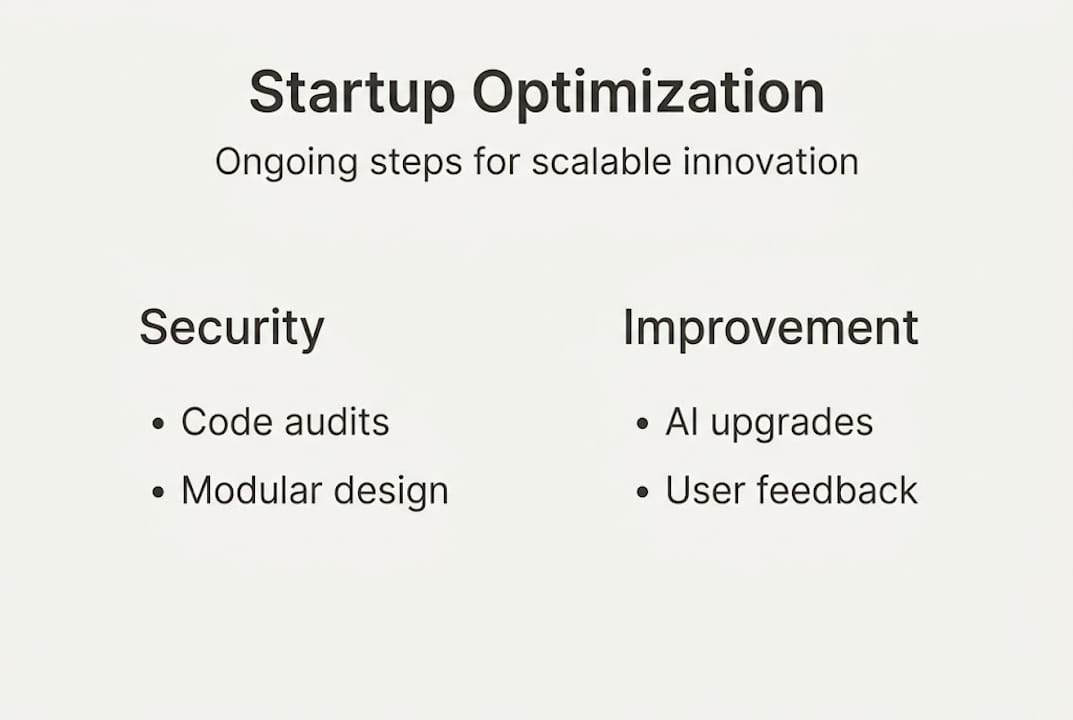
Scalability is not a one-time decision. It is a discipline you build into your team culture from the start.
Why blending AI efficiency with human expertise is the real secret
Here is an angle most articles skip: the startups that actually win are not the ones using the most AI tools. They are the ones who know exactly when to use AI and when to hand the controls back to a human expert.
AI accelerates development by 20%+, but human oversight remains essential in complex stacks like AI-blockchain. That is not a limitation of AI. It is a feature of great product teams.
AI excels at generating boilerplate, surfacing patterns in data, and accelerating routine tasks. It is genuinely transformative in those contexts. But decisions about user flow architecture, security model design, and audit response require creative, contextual human thinking that current AI tools cannot replicate reliably.
We have seen this pattern repeatedly: founders who lean too hard on AI tooling end up shipping fast but refactoring constantly. Founders who invest in expert human review upfront ship slower initially but scale faster and with fewer catastrophic incidents. The math consistently favors the human-guided approach in high-stakes environments like DeFi, health tech, and regulated data products.
Exploring innovations in AI development is worthwhile, but always with a clear-eyed view of where human judgment is irreplaceable. The next generation of breakout startups will be the ones who treat AI as a powerful collaborator, not a replacement for experienced engineers and designers.
Take your startup vision further with expert development services
Ready to move from plan to launch? The right partners make the difference between a product that stalls in development and one that ships on time, scales under pressure, and earns user trust from day one.
At Proud Lion Studios, we bring together world-class expertise across blockchain development services, AI agent solutions, and mobile app development under one roof, so your product vision never gets lost in translation between teams. Our UAE-based engineers work with you from concept through launch, building secure, modular, and scalable digital products tailored to your business goals. We do not use templates. Every solution is custom built for your specific context and users. If you are ready to build something that lasts, let's start the conversation.
Frequently asked questions
How long does it take to develop a blockchain or AI startup MVP?
A basic blockchain MVP typically takes 4–8 weeks, while advanced AI or DeFi projects may require 16–24 weeks depending on complexity and audit requirements.
What is the usual cost range for tech startup development services?
Startup MVPs can cost $8,000–$50,000, while enterprise blockchain or DeFi apps can reach $150,000–$500,000 or more based on scope and security needs.
What steps help ensure security in AI and blockchain startups?
Mandatory independent code audits, modular design, and human review of AI-generated code all improve security and reduce the risk of costly vulnerabilities after launch.
How can startups avoid delays and extra costs during development?
Define your vision and tech stack early, test every sprint with real users, and budget for security audits and refactoring before they become emergency expenses.