

Pick the platform category that matches your team and billing complexity: developer-first, percentage-priced tools for simple, dev-led SaaS; billing-first, flat-fee platforms for teams running frequent pricing experiments; enterprise monetization platforms for contracted, usage-heavy B2B revenue. That's the whole decision framework in one sentence, and most vendor comparisons make it more complicated than it needs to be.
Here's the shorthand: a small engineering team already on one payment gateway with a simple pricing plan should ship fast on a developer-first tool. A growth-stage SaaS company running A/B tests on pricing, adding usage tiers, or handing pricing control to non-engineers needs a billing-first platform built for that flexibility. A B2B company negotiating custom contracts, multi-year terms, or complex quote-to-cash workflows needs enterprise monetization software, full stop.
Before you evaluate a single vendor, confirm three internal facts. Skipping this step is why so many billing migrations run over budget.
- Your current payment gateway and whether switching it is even on the table
- Your monthly or annual recurring revenue band, since most platforms price around specific thresholds
- Your primary billing model today (flat subscription, usage-based, tiered, or a hybrid)
Pro Tip: If you can't answer all three questions in under five minutes, that's a signal your billing operations need documentation before they need new software.
Key Takeaways
The right subscription billing platform matches your team's engineering bandwidth and pricing complexity, and payment recovery through dunning delivers more measurable ROI than most feature comparisons suggest.
| Point | Details |
|---|---|
| Match category to stage | Developer-first for simple dev-led SaaS, billing-first for frequent pricing changes, enterprise for contracted B2B revenue. |
| Dunning drives revenue | Advanced retry logic and hosted update flows commonly recover an additional 4 to 8 percent of failed payments. |
| Revenue recognition matters early | Confirm whether ASC 606 compliant recognition is native or requires a separate accounting tool. |
| Implementation time varies widely | Developer-first setups can launch in 1 to 3 weeks; billing-first typically takes 4 to 8 weeks. |
| Confirm contract terms before signing | Ask about volume-based repricing at renewal and data export options if you switch platforms later. |
Table of Contents
- What Do Subscription Billing Platforms Actually Do?
- Core Evaluation Checklist: What to Ask Every Billing Vendor
- Which Billing Platform Category Fits Your Business Stage?
- Implementation and Migration: A Practical Action Plan
- How Proud Lion Studios Supports Subscription-Billing Projects
- How Flexible Are Billing Platform Contracts?
- How Different Businesses Actually Use These Platforms
- What Most Billing Advice Gets Wrong
- Sources
- FAQ
What Do Subscription Billing Platforms Actually Do?
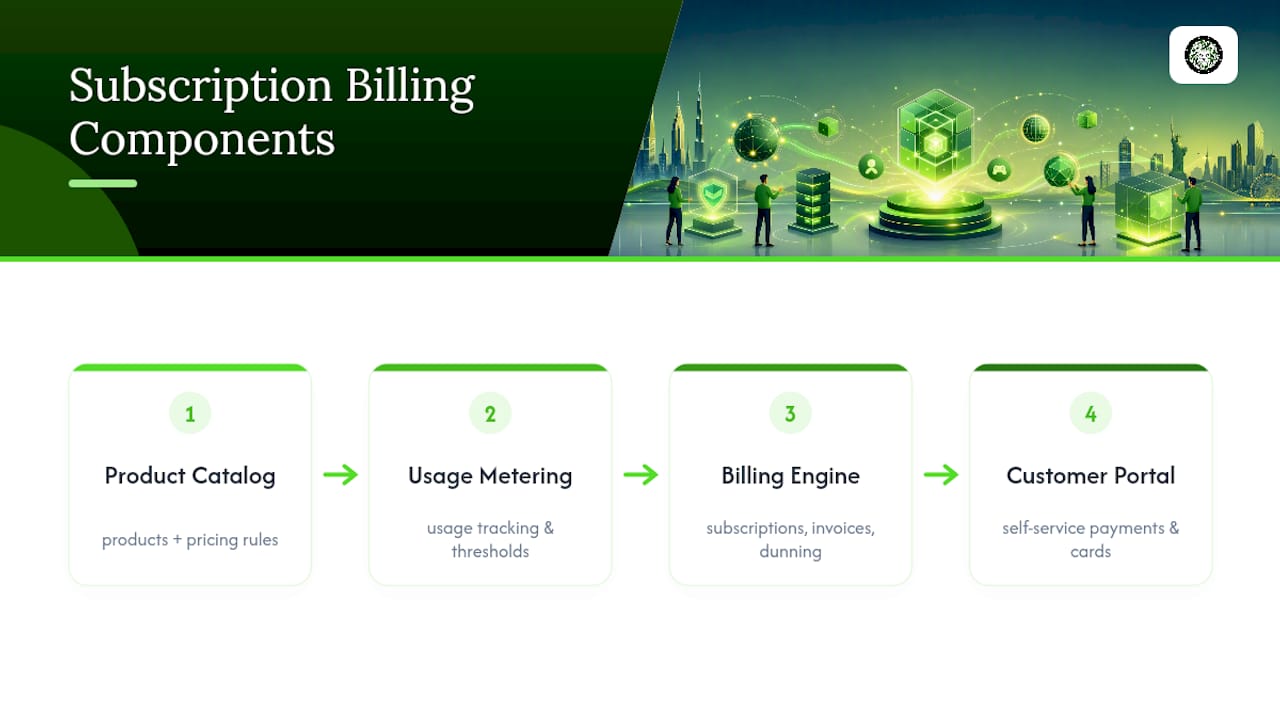
Subscription billing platforms manage the full lifecycle of recurring revenue: pricing configuration, invoice generation, payment collection, failed-payment recovery, and the accounting handoff that turns cash movement into recognized revenue. Gartner's market review of recurring billing applications treats this category as mission-critical infrastructure, not a nice-to-have add-on, precisely because billing errors compound fast when you're processing thousands of transactions a month.
Underneath the marketing language, every platform in this space is built around a handful of core objects. Products define what you sell. Prices attach specific amounts, currencies, and billing intervals to those products. Subscription objects track the relationship between a customer and a price over time, including trial periods, upgrades, downgrades, and cancellations. Get comfortable with this vocabulary early, because it's how you'll talk to every vendor's sales engineer.
Usage metering adds another layer for companies charging by consumption. If you bill per API call, per seat, or per gigabyte processed, the platform needs to ingest usage events, aggregate them against a billing period, and generate an invoice that matches what actually happened. This sounds simple until you're reconciling millions of events a day and a customer disputes their bill.
Invoices and customer portals round out the customer-facing side. A self-service portal lets customers update payment methods, view invoice history, and change plans without opening a support ticket. Gartner notes that vendors vary significantly on how polished these portals are, and that gap shows up directly in support ticket volume.

Then there's dunning and payment recovery, which matters more than almost any other feature on this list. Dunning is the automated process of retrying failed payments and prompting customers to update expired cards before you lose them to unintentional churn. According to Beancount's platform comparison, platforms with advanced dunning sequences and smart retry logic commonly recover an additional 4 to 8 percent of otherwise-lost revenue. On a company doing $2 million in annual recurring revenue, that's real money left on the table by a platform with weak retry logic, not a rounding error.
Revenue recognition is the part finance teams care about most and product teams often overlook. Under standards like ASC 606, you can't just recognize a $1,200 annual subscription payment the day it hits your bank account. You have to recognize it ratably over the service period, and if a customer upgrades mid-cycle, that recognition schedule has to adjust automatically. Platforms differ enormously here: some handle it natively, others require a separate revenue recognition tool bolted on top, and that difference alone can add weeks to your accounting close every month.
The features that separate a mediocre platform from a genuinely useful one aren't the ones you notice in a demo:
- Proration accuracy when customers upgrade, downgrade, or cancel mid-cycle
- Multi-currency support that doesn't force manual exchange-rate reconciliation
- Tax calculation that updates automatically as jurisdictions change their rules
- Audit trails that satisfy your accounting team during a close, not just a sales pitch
Core Evaluation Checklist: What to Ask Every Billing Vendor
Every vendor demo looks great. The questions below are the ones that surface the tradeoffs sales engineers would rather not volunteer.
1. Does it cover your actual billing models, including the edge cases?
Flat subscriptions are table stakes for every platform on the market. The real test is hybrid pricing: a base subscription fee plus usage overages, or tiered pricing that changes rates as volume crosses thresholds. Ask the vendor to walk through your specific pricing model, not a generic demo scenario. If they can't map your exact structure in the meeting, budget extra implementation time.
2. What's the payments readiness, really?
Check which payment service providers the platform supports natively, whether it handles the local payment methods your customers actually use (not just credit cards), and how multi-currency billing works operationally. G2's aggregated user reviews consistently flag payment method coverage and tax automation as the features buyers weigh most heavily during selection, more than flashy dashboard design.
3. How configurable is the dunning logic?
Ask specifically about retry schedules, whether you can customize email templates and timing per customer segment, and whether the platform offers a hosted page for customers to update expired cards without leaving your product. A platform with rigid, one-size-fits-all dunning will cost you recovered revenue every month it's live.
4. Does revenue recognition happen natively, or do you need a bolt-on?
This determines whether your accounting team spends two days or two weeks on monthly close. Ask for a specific walkthrough of how the platform handles a mid-cycle upgrade and how that revenue gets split across recognition periods. If the answer involves "you'd export to a spreadsheet," treat that as a real cost, not a footnote.
5. Who operates pricing changes day to day, and how often will that happen?
This is where many companies underestimate their own needs. If product managers or growth teams will run pricing experiments monthly, a platform that requires engineering tickets for every price change will quietly kill your experimentation cadence. Billing-first platforms exist largely to solve this problem by giving non-engineers a usable interface for pricing logic.
6. What's the security posture and support model?
Confirm PCI DSS compliance level, data residency options if you operate in regulated markets, and what support tier comes standard versus what requires an enterprise contract. A platform that only offers email support with a 48-hour response window is a liability once billing touches your core revenue.
Pro Tip: Bring a real invoice with your messiest historical edge case, a mid-cycle plan change with a partial refund, to every vendor demo. Watching a sales engineer improvise tells you more than any feature checklist.
Weigh these six questions against your team's actual bandwidth. A five-person engineering team evaluating enterprise quote-to-cash software is solving a problem it doesn't have yet, and a 200-person B2B company still running on a bare-bones developer tool is almost certainly leaking revenue through unhandled edge cases.
Which Billing Platform Category Fits Your Business Stage?
The category that fits your business isn't about company size alone. It's about the intersection of engineering bandwidth, pricing complexity, and how often that pricing needs to change.
Developer-first platforms for simple, dev-led SaaS
If you're already processing payments through Stripe and your pricing is a handful of flat monthly or annual plans, a developer-first billing layer is the fastest path to market. ChurnTools' comparison found Stripe Billing is often the default choice for developer-led teams under typical early-stage ARR thresholds, largely because it avoids a second vendor relationship and a second payment reconciliation process. Implementation for teams already on the underlying gateway can run 1 to 3 weeks, according to comparative guides tracking real deployments. The tradeoff is percentage-based pricing on top of standard processing fees, and a pricing configuration UI built for engineers, not for a growth marketer who wants to launch a new plan tier without filing a ticket.
Billing-first platforms for growth-stage pricing flexibility
Once your company starts running pricing experiments regularly, adding usage-based tiers, or needs finance to own revenue recognition without an engineer translating every change, a billing-first platform earns its flat-fee or tiered pricing. Online Store News' analysis documents how these platforms trade a higher baseline cost for deeper native support for complex pricing, multi-gateway orchestration, and built-in revenue recognition. Expect implementation timelines of 4 to 8 weeks for standard setups, longer if you're migrating years of subscription history. The payoff is real: product and growth teams get a usable interface for pricing changes, and finance stops waiting on engineering for every recognition schedule update.
Enterprise monetization for contracted B2B revenue
When your revenue depends on negotiated contracts, multi-year terms, complex approval workflows, and usage-heavy B2B pricing that doesn't fit a self-service checkout, you've outgrown both prior categories. Platforms like Zuora exemplify this class of quote-to-cash software, built to centralize contract billing, renewals, and finance automation across large organizations with dozens of sales reps generating custom quotes weekly. The CFO should insist on this category once manual contract billing starts eating more than a few days of finance time each month, since the cost of the platform is usually smaller than the cost of the errors it prevents.
When payment orchestration or a merchant of record makes more sense
High-volume B2C companies selling into many countries face a different problem entirely: payment method fragmentation and compliance burden that outweigh the benefits of managing billing logic yourself. In that scenario, payment orchestration or a merchant-of-record model can be the better fit, since it shifts local tax registration, compliance, and multi-provider routing onto a third party rather than your finance team. Proud Lion Studios has written more on evaluating orchestration platforms for enterprise merchants weighing this tradeoff.
Quick decision flow: if your billing logic fits on one page and you're already on a gateway, go developer-first. If pricing changes monthly and non-engineers need control, go billing-first. If contracts are custom and usage-heavy, go enterprise. If your real problem is payment method sprawl across dozens of countries, look at orchestration before you look at billing software at all.
Implementation and Migration: A Practical Action Plan
Moving billing systems touches finance, engineering, and customer support simultaneously, so a rushed migration creates problems that surface weeks after go-live. Here's the sequence that keeps risk manageable.

1. Run a discovery session with every stakeholder. Pull in finance, engineering, customer support, and whoever owns pricing decisions. Document every current billing edge case: grandfathered plans, manual discounts, annual contracts with mid-term upgrades. Define what success looks like: fewer failed payments, faster monthly close, or self-service pricing control.
2. Map your data before you migrate a single customer. Export existing subscription, invoice, and payment method data, then map each field to the new platform's schema. Proration handling deserves special attention here, since it's the single most common source of billing errors during migration.
3. Build a test calendar before touching production. Run a full billing cycle in a sandbox environment, including renewals, failed payments, and cancellations, before migrating live customers. Keep a documented rollback plan in case the new system produces incorrect invoices in week one.
4. Lock down integration points early. Confirm your payment gateway decision, since switching gateways mid-migration multiplies complexity. Set up tax automation rules for every jurisdiction you serve. Configure accounting exports so revenue recognition data flows into your general ledger without manual reformatting. Brand the customer portal so it doesn't feel like a foreign checkout experience. Teams handling payment integration work at this stage often find gateway and tax configuration eats more time than the billing platform setup itself.
5. Assign phase ownership explicitly. Engineering leads the technical integration and data migration. Finance owns revenue recognition validation and the accounting handoff. Customer support owns the communication plan for customers whose payment methods or invoice formats are changing.
Pro Tip: Migrate your smallest, lowest-risk customer segment first, even if it feels slow. The edge cases you find in week one with 50 accounts are far cheaper than finding them in month two with 5,000.
Timelines vary by category. A fast path, developer-first tool on an existing gateway, can go live in 1 to 3 weeks. A full billing-first integration with tax automation and revenue recognition typically runs 4 to 8 weeks, and enterprise quote-to-cash deployments often extend past that when custom contract workflows are involved, based on implementation timelines tracked across recent vendor deployments.
How Proud Lion Studios Supports Subscription-Billing Projects
Choosing the right billing category is only half the problem. Wiring it correctly into your product, your accounting stack, and your payment infrastructure is where most projects actually stall, and it's where Proud Lion Studios spends most of its engineering time on these engagements.
Our UAE-based technical team builds and integrates subscription billing systems end to end, including custom payment integration work covering both traditional gateways and crypto payment rails for companies exploring token-based or blockchain-native subscription models. We also handle the integrations that vendor documentation glosses over: connecting billing platforms to existing ERP and CRM systems, building multi-tenant architecture for SaaS companies serving multiple customer segments with different pricing logic, and custom revenue recognition pipelines when off-the-shelf exports don't match your accounting stack.
What that looks like in practice:
- Custom billing logic engineering when your pricing model doesn't map cleanly to a vendor's standard templates
- Payment gateway and crypto rail integration for hybrid or Web3-native subscription products
- ERP and CRM connections so billing data flows into the systems your finance team already trusts
- Multi-tenant SaaS architecture built for scale from day one, not retrofitted after growth forces the issue
Tailored integration work, not templated packages, is what turns a billing platform selection into a system that actually reduces monthly close time and failed-payment churn.
Proud Lion Studios brings this experience across a portfolio spanning multiple countries and industries. Our subscription billing service page covers the full scope of engagements we take on for founders and CTOs building or migrating billing infrastructure.
How Flexible Are Billing Platform Contracts?
Contract terms vary more than most buyers expect, and the fine print matters as much as the feature list. Developer-first tools typically run month-to-month with no long-term commitment, since their percentage-based pricing scales naturally with your revenue and doesn't require a locked contract to justify the vendor's cost structure.
Billing-first and enterprise platforms behave differently. Most require annual contracts, and many price in tiers based on transaction volume or number of active subscriptions, which means your costs can jump significantly the moment you cross a threshold. Ask every vendor directly what happens at renewal if your volume doubles, since some contracts lock in a rate while others reprice automatically.
Customization options also scale with contract tier. Entry-level plans usually offer standard templates for invoices, dunning emails, and customer portals. Enterprise contracts unlock white-labeling, custom SLAs, dedicated support contacts, and sometimes negotiated terms around data portability if you decide to migrate away later. That last point deserves attention before signing: ask how easy it is to export your full billing history if you switch platforms in two years. A vendor confident in their product won't hesitate to answer that question directly.
How Different Businesses Actually Use These Platforms
A ten-person B2B SaaS startup selling a single $99-a-month plan doesn't need the same billing infrastructure as a 500-person marketplace processing usage-based fees across 40 countries, and the platform category each one should choose reflects that gap directly.
Early-stage SaaS companies with simple, flat pricing plans typically get the most value from developer-first tools, since the implementation cost stays low and percentage-based pricing keeps expenses proportional to revenue while the company is still finding product-market fit. The tradeoff is real: pricing changes require an engineering ticket, which is fine at ten customers and painful at ten thousand.
Growth-stage SaaS companies running usage-based pricing or frequent plan experiments tend to migrate to billing-first platforms once a product or growth team needs to launch new tiers without waiting on engineering. This shift usually happens somewhere between the point where pricing changes monthly and the point where a spreadsheet can no longer track proration accurately.
B2B companies selling into enterprise accounts with negotiated contracts, multi-year terms, and custom discount structures consistently need quote-to-cash software once manual contract billing consumes meaningful finance headcount every month. High-volume B2C marketplaces facing payment method fragmentation across many countries often solve the problem with orchestration rather than a traditional billing engine, since compliance and local payment methods become the bottleneck long before pricing logic does.
What Most Billing Advice Gets Wrong
Most billing platform comparisons treat this as a feature checklist exercise: count the boxes each vendor checks, pick the one with the most checkmarks. That approach misses the two variables that actually determine ROI, payment recovery rates and implementation risk, and it explains why so many companies migrate platforms twice within three years.
The conventional advice to "pick based on your current ARR" is directionally right but dangerously incomplete. ARR tells you your revenue scale. It says nothing about whether your pricing changes monthly or annually, whether finance or engineering owns pricing decisions, or how exposed you are to failed-payment churn. A company at $500,000 ARR running constant pricing experiments needs different infrastructure than a company at the same revenue with three flat plans that haven't changed in two years.
If you take one thing from this guide, prioritize dunning configuration and revenue recognition handling before you compare dashboards. Those two capabilities compound quietly every month, long after the initial implementation decision is forgotten.
Sources
Vendor claims deserve independent verification before a procurement decision gets locked in. These sources give you a starting point beyond marketing pages.
- Recurring Billing Applications Reviews and Ratings — Gartner
- Stripe Billing vs Chargebee in 2026 (Real Test) — ChurnTools
- Stripe Billing vs Chargebee in 2026: Which subscription engine wins? — Online Store News
FAQ
What is the best subscription billing platform?
There's no single best platform. The right choice depends on your billing complexity and team structure: developer-first tools suit simple, dev-led SaaS, billing-first platforms suit teams needing frequent pricing control, and enterprise quote-to-cash software suits contracted B2B revenue.
What are examples of billing platforms?
Common categories include developer-first tools built on existing payment gateways, billing-first subscription management platforms with flat-fee pricing, and enterprise monetization or quote-to-cash software like Zuora for large-scale contract billing.
What are some examples of subscription-based platforms?
Subscription-based platforms span SaaS products billing monthly or annually, usage-based B2B services charging per API call or seat, and B2C content or membership platforms billing recurring flat fees. The billing infrastructure behind each varies based on pricing complexity.
What is subscription billing?
Subscription billing is the automated process of charging customers on a recurring schedule, managing plan changes, retrying failed payments through dunning, and recognizing that revenue correctly for accounting purposes.
How long does it take to implement a subscription billing platform?
Developer-first setups on an existing payment gateway typically launch in 1 to 3 weeks, while billing-first platforms with tax automation and revenue recognition usually take 4 to 8 weeks, longer for complex data migrations.
Recommended
- Subscription billing - Proud Lion Studios | App, Blockchain & Game Development Company in Dubai UAE
- Best Payment Orchestration Platforms for Enterprise Merchants in 2026
- Multi‑tenant setup - Proud Lion Studios | App, Blockchain & Game Development Company in Dubai UAE
- Cloud Cost Optimization: A Practical 2026 Playbook