

A payment orchestration platform centralizes routing, tokenization, and provider management so your team can increase authorization rates, cut processing costs, and launch new local payment methods faster. For most enterprise merchants and platforms in 2026, the shortlist comes down to five:
- Stripe — best for developer speed and global acquiring depth; AI-driven optimizations across 195+ countries and 135+ currencies make it the fastest path to market for most merchants.
- Adyen — best for enterprise scale and unified commerce; single-platform acquiring across card, wallet, and in-store rails with strong SLA commitments.
- Spreedly — best open, PSP-agnostic platform; token portability and connector-led architecture give merchants full control over their provider mix without lock-in.
- Checkout.com — best for cross-border payment solutions and high-volume card processing; granular routing controls and local acquiring in key growth markets.
- Rapyd — best for wallet and alternative payment method coverage; strong in markets where cards are not the primary rail.
Jump to the side-by-side comparison for a column-by-column breakdown, or skip directly to the buying checklist if you already know your shortlist and need selection criteria and implementation estimates.
Key Takeaways
Payment orchestration platforms increase authorization rates, reduce processing costs, and accelerate market entry by centralizing routing, tokenization, and provider management across multiple PSPs.
| Point | Details |
|---|---|
| PCI Level 1 is the baseline | Every vendor on your shortlist must hold PCI DSS Level 1 service provider status (highest certification under the global payment data security standard) before any other evaluation begins. |
| Token ownership determines lock-in | Merchant-controlled token vaults let you switch PSPs without re-tokenizing customers; PSP-owned vaults create switching costs. |
| Routing depth drives authorization lift | Dynamic routing by BIN, currency, and real-time acquirer performance recovers revenue that static single-PSP setups lose on soft declines. |
| Typical mid-market implementation timelines range from several weeks to a few months | Mid-market deployments take 6–12 weeks; enterprise migrations with multiple PSPs and reconciliation automation generally require several months. |
| Proud Lion Studios for custom integrations | When managed platforms don't cover your stack (on-chain rails, custom token vaults, bespoke connectors), Proud Lion Studios builds the integration layer. |
Table of Contents
- How do the leading payment orchestration platforms compare?
- Vendor profiles: who each platform actually fits
- How do you choose the right payment orchestration platform?
- What does a payment orchestration platform actually do?
- Implementation checklist for payment orchestration
- Real-world payment orchestration in practice
- The build-vs-buy question deserves a more honest answer
- Proud Lion Studios builds payment orchestration integrations that fit your stack
- Sources
How do the leading payment orchestration platforms compare?
The table below maps each platform against the buyer dimensions that matter most in an enterprise evaluation. US availability is confirmed for all seven vendors.
| Dimension | Stripe | Adyen | Checkout.com | Spreedly | Rapyd | BlueSnap | Solidgate |
|---|---|---|---|---|---|---|---|
| Best for | Developer-led merchants, SaaS platforms | Unified commerce, enterprise retail | High-volume cross-border card processing | PSP-agnostic orchestration, token portability | Wallets & alternative payments, emerging markets | B2B and subscription merchants | Subscription and gaming merchants |
| Pricing model | Interchange-plus or blended; public calculator | Interchange-plus; volume negotiated | Interchange-plus; negotiated at scale | Monthly platform fee + per-transaction; public tiers | Blended; volume negotiated | Interchange-plus; negotiated | Blended; negotiated |
| Global coverage | 195+ countries, 135+ currencies | 40+ acquiring countries | 55+ processing countries | Connector to 120+ PSPs | 100+ countries, 900+ payment methods | 100+ currencies | 50+ countries |
| Routing & failover | AI-optimized routing, smart retries | Intelligent routing, RevenueAccelerate | Dynamic routing, retry logic | Rules engine, smart routing, retries | Routing via unified API | Intelligent routing | Rules-based routing |
| Developer experience | Excellent; REST APIs, SDKs, sandbox | Good; REST APIs, test environment | Good; REST APIs, SDKs | Good; open API, connector library | Moderate; unified API | Good; REST APIs | Moderate; REST APIs |
| Tokenization | Stripe-managed tokens | Adyen-managed tokens | Checkout.com tokens | Merchant-owned token vault | Rapyd-managed | BlueSnap-managed | Solidgate-managed |
| Fraud tools | Stripe Radar (ML-based) | RevenueProtect | Fraud detection built-in | Third-party integrations | Built-in fraud screening | Built-in fraud tools | Built-in fraud tools |
| Reconciliation | Dashboard + API exports | Unified reporting | Reporting API | Reporting layer | Unified dashboard | Reporting dashboard | Reporting dashboard |
| Enterprise SLA / uptime | Published status page; high uptime target | Published; enterprise SLA negotiated | Published status page | Published status page | Published status page | Published status page | Published status page |
| PCI Level 1 | ✓ | ✓ | ✓ | ✓ | ✓ | ✓ | ✓ |
| US availability | ✓ | ✓ | ✓ | ✓ | ✓ | ✓ | ✓ |
Key signal: All seven vendors on this shortlist hold PCI DSS Level 1 service provider status (highest certification under the global payment data security standard), the highest certification tier under the global payment data security standard. Treat any orchestration vendor that cannot confirm this status as a disqualifying red flag.
Vendor profiles: who each platform actually fits
Stripe: fastest time to market for developer teams
Stripe's strength is the quality of its developer experience and the depth of its global acquiring network. Its AI-driven authorization optimizations and smart retry logic are production-ready out of the box, which means engineering teams spend less time on infrastructure and more time on product.
- 195+ countries, 135+ currencies, local acquiring in major markets
- Stripe Radar for ML-based fraud scoring, configurable rules
- Extensive SDK library (JavaScript, Python, Ruby, Go, Java, PHP, .NET)
- Stripe-managed tokenization; token portability requires planning
- Public pricing calculator; volume discounts negotiated directly
Best for: SaaS platforms, marketplaces, and merchants who want fast deployment and strong developer documentation. Stripe's ecosystem (Connect, Billing, Terminal) makes it particularly strong for embedded payment use cases.
Adyen: unified commerce at enterprise scale
Adyen operates its own acquiring infrastructure across 40+ countries, which gives it a direct line to card networks and tighter control over authorization data. Its RevenueAccelerate module applies network tokenization and dynamic routing to lift approval rates without additional engineering work.
- Single-platform acquiring: card, wallet, in-store, and online
- RevenueProtect for fraud management with configurable risk rules
- Interchange-plus pricing with full interchange data in reporting
- Enterprise SLA and dedicated support negotiated at contract stage
- Strong in Europe, North America, and APAC; growing in LATAM
Best for: Large retailers, travel companies, and platforms that need unified in-store and online reporting under one contract. Adyen's direct acquiring model reduces intermediary fees at high volumes.
Checkout.com: granular routing for high-volume card processing
Checkout.com's routing engine lets merchants define rules at the BIN, currency, and transaction-type level, which is useful when optimizing across multiple acquiring relationships. Its local acquiring footprint in the Middle East, Europe, and APAC covers markets where other platforms rely on third-party acquirers.
- Dynamic routing with BIN-level and currency-level rules
- 55+ processing countries with local acquiring in key markets
- Built-in 3DS2 and AVS handling
- REST APIs and SDKs; sandbox environment available
- Reporting API for reconciliation and analytics
Best for: High-volume merchants with complex cross-border payment solutions needs and teams that want fine-grained routing control without building a custom rules engine.
Spreedly: the open platform for token portability
Spreedly's architecture is explicitly PSP-agnostic. Tokens live in Spreedly's vault under merchant control, which means you can route the same card token to any connected PSP without re-tokenizing. That single capability eliminates the most common form of payment vendor lock-in.
- Connector library covering 120+ PSPs and payment methods
- Merchant-owned token vault; tokens are portable across providers
- Smart routing and retry logic configurable via rules engine
- Open API; integrates with existing fraud and analytics tools
- Monthly platform fee model; transparent public pricing tiers
Best for: Merchants who want to run multiple PSPs simultaneously, test new acquirers without customer friction, or migrate away from a single-provider dependency. Spreedly is the reference implementation for PSP-agnostic orchestration.
Rapyd: alternative payments and wallet coverage
Rapyd aggregates 900+ payment methods across 100+ countries through a single API, with particular depth in markets where bank transfers, e-wallets, and cash-based methods dominate. Its collect-store-disburse model also covers payouts, which matters for marketplace and gig-economy platforms.
- 900+ payment methods: wallets, bank transfers, cash, cards
- Payout capabilities alongside collection
- Built-in FX and local currency settlement
- Unified dashboard for multi-method reporting
- Moderate developer documentation compared to Stripe or Adyen
Best for: Platforms entering emerging markets where alternative payment methods are the primary rail, or marketplaces that need both collection and disbursement under one API.
BlueSnap: B2B and subscription billing focus
BlueSnap combines a payment gateway with subscription management and B2B invoicing, which reduces the number of vendors a subscription business needs to manage. Its intelligent routing and built-in tax compliance tools (VAT, sales tax) are differentiators for software companies selling globally.
- Subscription and recurring billing management built in
- Tax compliance tools for VAT and US sales tax
- 100+ currencies; local acquiring in key markets
- Intelligent routing across acquiring banks
- REST APIs and SDKs; good documentation
Best for: B2B SaaS and subscription businesses that want billing, tax, and payment processing consolidated in one platform.
Solidgate: gaming and subscription merchants
Solidgate targets subscription and gaming merchants with a focus on authorization rate optimization and chargeback management. Its rules-based routing and built-in anti-fraud tools are tuned for high-frequency, low-ticket transactions common in gaming and digital goods.
- Rules-based routing with authorization rate focus
- Built-in chargeback management and dispute automation
- Subscription lifecycle management
- 50+ countries; growing acquiring footprint
- REST APIs; moderate SDK coverage
Best for: Gaming companies, digital goods platforms, and subscription merchants with high transaction volumes and chargeback exposure.
How do you choose the right payment orchestration platform?
Selection criteria, ordered by priority
- Routing and failover depth — Can the platform route by BIN, currency, transaction type, and acquirer performance in real time? Does failover trigger automatically on a soft decline?
- Local acquiring coverage — Does the vendor acquire directly in your target markets, or does it rely on third-party acquirers that add a fee layer?
- Tokenization ownership — Who holds the token vault? Merchant-controlled tokens (as with Spreedly's open platform) prevent lock-in; PSP-controlled tokens create switching costs.
- Fraud and risk stack — Is fraud tooling built in, or does the platform integrate with your existing tools (Kount, Signifyd, Sift)?
- Reconciliation and reporting — Can you get transaction-level data via API for your own data warehouse, or are you limited to dashboard exports?
- SLAs and uptime — Is a contractual uptime commitment available? What is the incident response SLA?
- Data residency — For EU, UK, or regulated markets, where does cardholder data physically reside?
RFP questions to ask every vendor
- What is your published uptime over the last 12 months, and what is your contractual SLA?
- How does your routing engine handle a soft decline in real time? What is the average retry latency?
- Who owns the token vault, and can we migrate tokens to another provider without re-tokenizing customers?
- Which PSPs and acquirers are pre-built connectors available for today?
- What PCI DSS certification level do you hold, and can you provide your current Attestation of Compliance?
- How do you handle 3DS2 orchestration across multiple acquirers?
- What does your reconciliation data export look like, and what is the latency from transaction to report?
- What is the typical implementation timeline for a merchant at our transaction volume?
Red flags
- No published PCI Level 1 certification
- Token vault owned exclusively by the vendor with no portability path
- Routing rules that require vendor professional services to modify
- No sandbox or test environment for integration validation
- Pricing that bundles routing fees into a black-box blended rate
Implementation timeline and cost drivers
Most mid-market implementations run 6–12 weeks from signed contract to production traffic. Enterprise migrations with multiple PSPs, custom routing rules, and reconciliation automation typically run 3–6 months. Cost drivers include the number of PSP connectors to build or configure, tokenization migration scope, 3DS and fraud tool integration complexity, and reconciliation system changes. AI-driven routing and automated retry workflows, like those offered by platforms such as Yuno, can reduce ongoing engineering overhead once deployed, but the initial configuration still requires careful rules design.
Post-launch KPIs to track
- Authorization rate lift (baseline vs. post-orchestration, by market and card type)
- Decline recovery rate from retry and failover logic
- Cost per transaction (blended, by acquirer and payment method)
- Reconciliation variance (unmatched transactions as a percentage of volume)
What does a payment orchestration platform actually do?
A payment orchestration platform sits between your application and your PSPs, routing each transaction to the best available processor, handling retries on failure, and storing payment credentials in a central token vault. That single layer replaces point-to-point integrations with every acquirer and reduces your PCI scope by keeping raw card data out of your application servers.
Core building blocks
- PSP connectors / adapters — Pre-built integrations to acquirers, gateways, and alternative payment methods. The connector library size determines how quickly you can activate a new provider.
- Rules engine — The logic layer that decides which PSP handles each transaction. Rules can be static (always route Visa to Acquirer A) or dynamic (route based on real-time authorization rate data). AI-driven routing, as described by platforms like Yuno, shifts this from static configuration to continuous optimization.
- Token vault — Stores payment credentials (card numbers, bank account details) and returns a token your application uses instead. Spreedly's PSP-agnostic token vault is the clearest example of merchant-controlled tokenization that survives PSP changes.
- Retry and failover logic — On a soft decline or network timeout, the platform automatically retries with the same or a different PSP. Well-tuned retry logic recovers a meaningful share of revenue that would otherwise be lost.
- Reconciliation layer — Matches transaction records from your application, the PSP, and your bank settlement files. Discrepancies surface as exceptions for manual review.
- Reporting and telemetry — Real-time and batch reporting on authorization rates, fees, decline reasons, and settlement status. The best platforms expose this via API so you can pipe it into your own data warehouse.
- Webhooks and eventing — Asynchronous notifications for payment events (captured, refunded, disputed) that trigger downstream workflows in your order management or CRM systems.
For scalable fintech architectures, distributed transaction consistency is a parallel concern. Oracle's Transaction Manager for Microservices addresses XA and Saga patterns for microservice-based payment flows, while open-source tools like Narayana handle distributed transaction guarantees for Java-based systems. Large regulated institutions often deploy orchestration in hybrid or multicloud configurations; IBM Financial Transaction Manager supports SWIFT, ACH, and SEPA rails alongside alternative payment methods in exactly this pattern, with certified container deployments on platforms like Red Hat OpenShift.
For crypto and stablecoin rails, DFNS's transaction management system adds programmable policies and auditable workflows to on-chain payment orchestration, which pairs naturally with crypto payment integration work.
Security and PCI scope
PCI DSS governs how payment data must be stored, processed, and transmitted. A PCI Level 1 service provider certification is the highest tier and is the baseline expectation for any orchestration vendor handling card data at scale. When the orchestration platform holds the token vault, your application never touches raw card numbers, which reduces your PCI scope from SAQ D to SAQ A or A-EP depending on your integration model. Confirm token ownership and scope reduction in writing before signing a contract.
Pro Tip: Ask every vendor for their current Attestation of Compliance (AOC) document, not just a checkbox on a security page. The AOC names the specific services in scope and the date of the last assessment — two details that matter when your own compliance team reviews the vendor.
Implementation checklist for payment orchestration
Pre-project readiness
- Map every existing PSP integration: endpoint, token format, settlement currency, and reconciliation file format
- Define PCI scoping decision: will the orchestration layer own the token vault, or will you maintain a hybrid model?
- Assign stakeholder owners for payments, engineering, finance (reconciliation), and compliance
- Document reconciliation rules: how do you match a transaction ID from your application to a settlement record from the bank?
- Confirm data residency requirements for each target market
Technical integration steps
- Provision sandbox credentials for each PSP connector you plan to activate
- Implement tokenization: replace direct card collection with the orchestration platform's hosted fields or SDK
- Map webhooks from the orchestration platform to your order management and notification systems
- Configure routing rules: start with simple static rules, then layer in dynamic rules after you have baseline authorization rate data
- Instrument telemetry: pipe authorization rate, decline reason, and latency data to your analytics stack
- Run parallel processing on a canary traffic slice (typically 5–10% of volume) before full cutover
Representative test cases
- Failed authorization recovery: trigger a soft decline and confirm retry fires within the configured latency window
- AVS and 3DS2 flows: test address verification and strong customer authentication across each acquirer
- Partial capture and refund: confirm settlement amounts reconcile correctly for partial transactions
- Dispute simulation: trigger a chargeback and verify the dispute notification webhook fires and routes correctly
Staged rollout plan
Start with a single market or payment method, validate authorization rates and reconciliation accuracy for two weeks, then expand to additional markets in phases. Never cut over all volume simultaneously. AI-driven automation can help monitor routing performance in real time during rollout, flagging anomalies before they affect a significant share of transactions.
Pro Tip: The most common reconciliation pitfall in orchestration migrations is a mismatch between the transaction ID your application generates and the reference ID the PSP returns. Map these ID fields explicitly before go-live, and build a daily reconciliation job that surfaces unmatched records as exceptions on day one — not after your first month-end close.
Real-world payment orchestration in practice
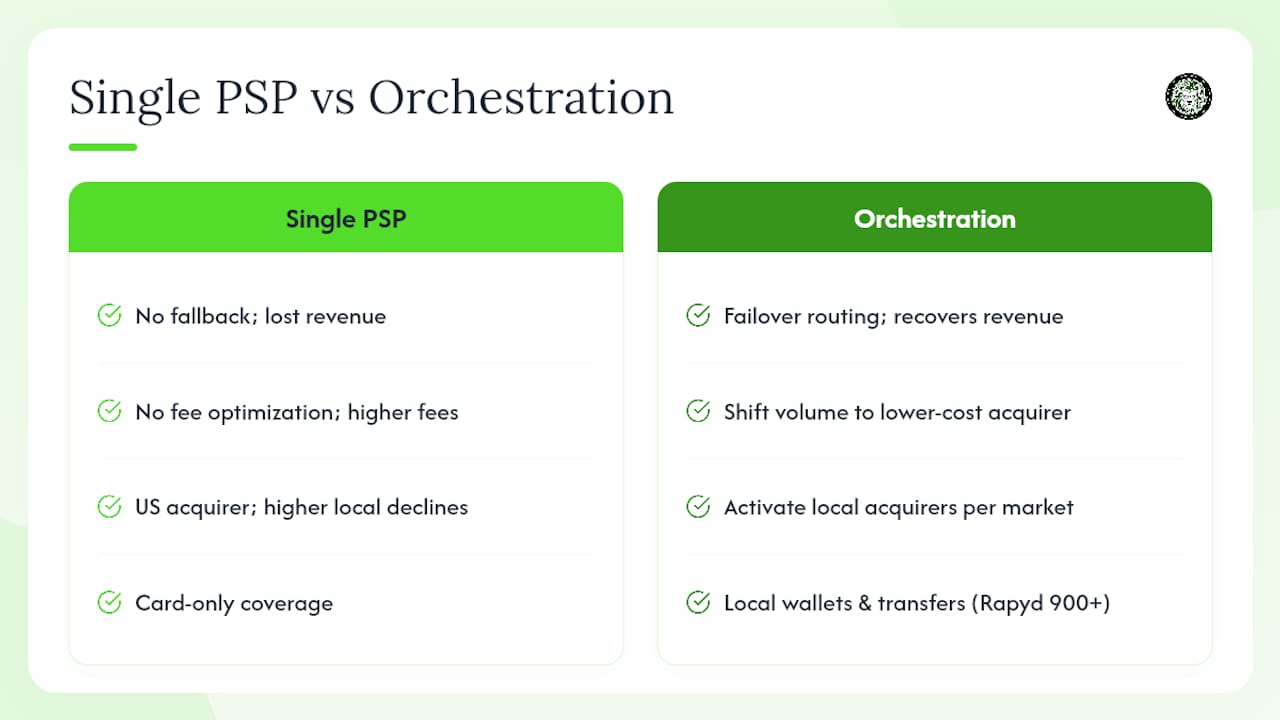
The clearest illustration of orchestration value comes from merchants who moved from a single-PSP model to a multi-acquirer setup. A subscription platform running all volume through one acquirer has no fallback when that acquirer experiences a degraded authorization rate. After adding a second acquirer and configuring failover routing, the same platform typically sees a measurable recovery of previously lost revenue on soft declines, plus a reduction in processing fees as volume shifts to the lower-cost acquirer for eligible transaction types.
For cross-border merchants, the gain is different. A US-based marketplace expanding into Southeast Asia faces a choice: route all transactions through a US acquirer (higher decline rates on local cards) or activate a local acquirer in each market. Orchestration makes the second option operationally feasible without rebuilding the checkout stack. Rapyd's 900+ payment method coverage is a practical example of this: a single API integration gives access to local wallets and bank transfer methods that a card-only acquirer cannot serve.
AI in e-commerce is accelerating this further. Platforms that apply machine learning to routing decisions can shift traffic dynamically based on real-time authorization rate signals rather than static rules, which means the routing layer improves continuously without manual reconfiguration. Gr4vy's no-code orchestration approach takes this further for merchants who want rapid PSP activation without deep engineering investment: a workflow builder lets non-technical teams configure routing logic and activate new payment methods without a code deployment.
For enterprise deployments, FreedomPay's framing of orchestration as a consolidation layer that increases scalability across rails and use cases reflects what large retailers actually experience: fewer reconciliation exceptions, a single reporting view across all channels, and faster onboarding of new payment methods as market conditions change.
The build-vs-buy question deserves a more honest answer
Most articles on payment orchestration treat the build-vs-buy question as settled: buy a managed platform, always. The reality is more nuanced, and the conventional wisdom underestimates two specific scenarios where a custom or studio-led integration is the stronger choice.
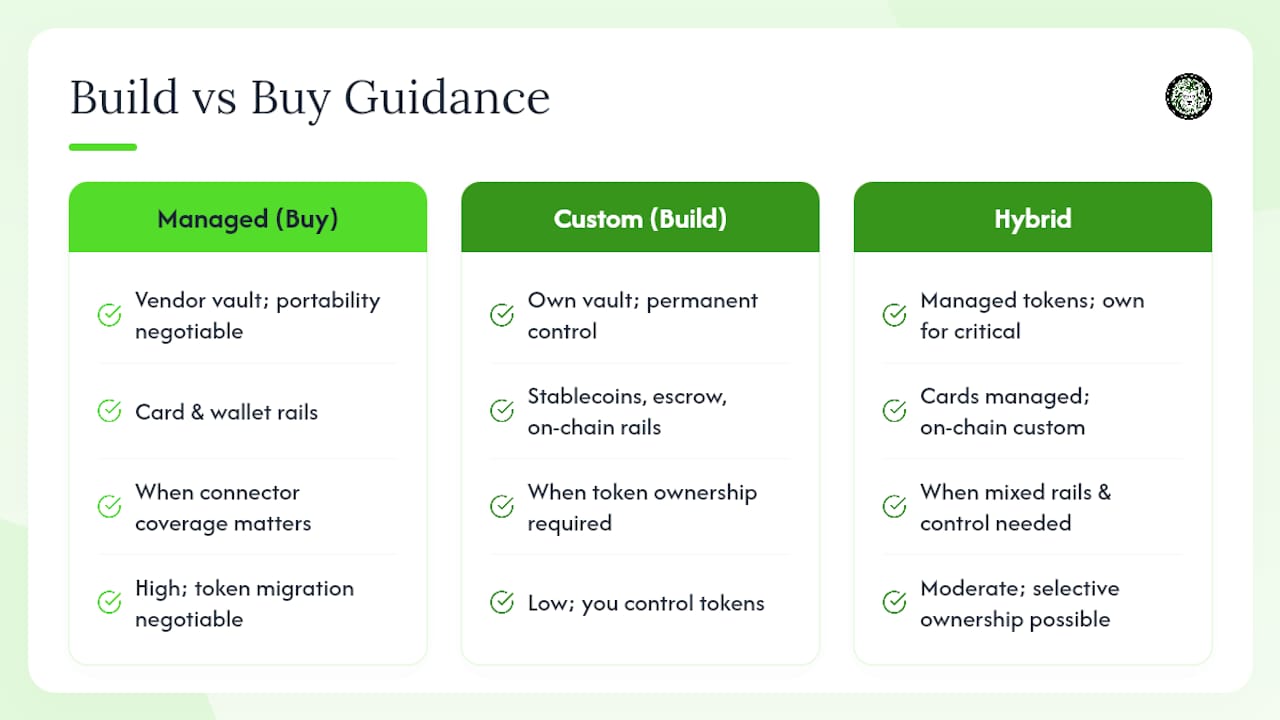
The first is token ownership. Every managed orchestration platform stores tokens in its own vault by default. Spreedly is the notable exception, but even there, the token format is Spreedly's. If you ever need to migrate to a different orchestration layer, token portability is a negotiation, not a given. A custom token vault, built to your own schema and hosted in your own infrastructure, gives you permanent control over your most valuable payment asset: the stored credentials of your existing customers. The total cost of ownership looks higher on a spreadsheet, but the switching cost of being locked into a vendor's token format is rarely modeled honestly.
The second is regulated or on-chain payment rails. If your orchestration layer needs to handle stablecoin settlements, programmable escrow, or on-chain disbursements alongside traditional card rails, no managed platform covers that stack today. A studio-led integration that connects a traditional orchestration layer to smart contract logic is the only realistic path. That is not a niche use case in 2026; it is the direction that cross-border B2B payments are moving.
The right answer is usually a hybrid: use a managed platform for card and wallet rails where the connector library and compliance overhead justify the cost, and build custom logic for the rails where no managed solution exists or where token ownership is non-negotiable.
Proud Lion Studios builds payment orchestration integrations that fit your stack
Proud Lion Studios delivers end-to-end payment integration and orchestration implementation for startups and enterprise teams who need a custom fit rather than a templated setup. Where managed platforms stop, we start: custom PSP connectors, merchant-controlled token vaults, smart contract payment logic, and reconciliation automation built to your data model.

Our integration practice covers requirements analysis and PCI scoping, PSP endpoint integrations, tokenization architecture, QA and staged rollout management, and ongoing reconciliation and monitoring automation. For projects that include on-chain rails or tokenized assets, our mobile app development) and blockchain teams work alongside the payments layer from day one. If your orchestration project includes crypto rails or stablecoin settlement, our team can scope that alongside traditional card integration in a single engagement. Contact Proud Lion Studios to scope your integration project and get a tailored delivery plan.
Sources
Use these links when validating claims, writing RFPs, or reviewing technical specifications.
Compliance and standards (start here for security and regulatory validation):
- Pcisecuritystandards
- IBM Financial Transaction Manager
- Global Payments Orchestration Platform | Spreedly
- Payment Orchestration Platform for Enterprises | Gr4vy
Vendor documentation (use for integration planning and RFP technical questions):
Industry context (use for framing and feature benchmarking):