

For most DTC and growth-stage brands, Shopify (Plus where needed) is the faster, lower cost choice. Adobe Commerce, formerly known as Magento, remains the stronger choice for businesses that need deep server-level customization, multi-storefront catalogs, or enterprise B2B quoting workflows. The rest comes down to trade-offs in cost, talent, and how much engineering effort you want to own.
TL;DR:
- Shopify's predictable monthly costs and fast deployment make it ideal for small to mid-sized brands aiming for rapid growth and straightforward operations.
- Adobe Commerce offers deep customization and complex multi-warehouse management, but requires significant technical expertise and higher ongoing maintenance costs.
- Performance at scale favors Shopify’s managed infrastructure for handling traffic spikes without manual intervention, while Adobe Commerce’s efficiency depends on skilled infrastructure tuning.
- The quality and stability of extensions are more consistent on Shopify, whereas Adobe Commerce’s reliance on third-party plugins can introduce upgrade risks.
- Migrating from Magento to Shopify demands careful URL mapping, structured data transfer, and extended testing to protect SEO and preserve customer data.
Table of Contents
- Shopify or Magento: A Quick Decision Matrix
- How Do Shopify and Magento Differ in Architecture and Features?
- What Does Shopify vs Magento Cost Over Time?
- Which Platform Performs Better at Scale?
- Which Platform Has Better Customization and Developer Support?
- Does Shopify or Magento Handle B2B and Multi-Storefront Needs Better?
- How Do You Protect SEO During a Magento to Shopify Migration?
- Shopify vs Magento: How to Score Your Own Decision
- What We've Learned Advising Clients on Shopify vs Magento
- Need a Migration or Custom Build Instead of a Platform Debate?
- Sources
- FAQ
Shopify or Magento: A Quick Decision Matrix
Choosing between these two platforms is less about which one is "better" and more about which one matches your operating model. Shopify runs as hosted software, meaning Proud Lion Studios and every other development partner works within a managed environment rather than a server you control. Adobe Commerce gives you the keys to the engine room, along with the maintenance bill that comes with it.
That hosted versus self-hosted split drives almost every other decision. Shopify handles patching, uptime, and PCI compliance behind the scenes, so your team spends time on merchandising and growth instead of server logs. Adobe Commerce demands a technical team (in-house or agency) that can manage infrastructure, security patches, and custom code across releases.
Cost bands separate the platforms sharply too. Shopify Plus starts at a predictable monthly or revenue-based fee, while Adobe Commerce Cloud licensing alone can run into six figures annually before you add implementation. Talent availability follows the same pattern: Shopify's Liquid and Hydrogen developer pool is deep and growing, while Adobe Commerce specialists are scarcer and command higher rates as demand for their skills outpaces supply.
Here's how the two platforms map to common merchant profiles:
- DTC and growth-stage brands: Shopify (Plus at scale) wins on speed to market, predictable costs, and a checkout built for conversion.
- Mid-market B2B sellers with straightforward wholesale needs: Shopify's native B2B tools now cover most requirements without add-ons.
- Enterprise merchants with complex catalogs, multi-warehouse logic, or deep ERP dependency: Adobe Commerce still holds the technical edge.
How Do Shopify and Magento Differ in Architecture and Features?
The core Shopify vs Magento comparison starts with how each platform is built, because architecture determines what you can realistically ship and how fast.
Shopify is a fully hosted SaaS product. You don't manage servers, and you don't touch the core codebase. Adobe Commerce is open-source at its base, with a managed Commerce Cloud tier that adds hosting but keeps you responsible for a huge share of the technical decisions. That single distinction shapes everything from launch timelines to who you need on payroll.
Headless commerce narrows the functional gap between the two. Shopify's Hydrogen framework, paired with the Storefront API, lets you build a fully custom front end while keeping Shopify's checkout, inventory, and payments underneath. Adobe Commerce has long supported headless through its GraphQL layer, and it remains the more flexible option when your front end needs to pull from multiple backend systems simultaneously, not just the storefront.
Checkout extensibility is where merchants often get surprised. Shopify's checkout is famously fast and conversion-optimized, but customizing it beyond what checkout UI extensions allow generally requires Shopify Plus. Adobe Commerce gives you full control over the checkout flow at the code level, for better or worse, since that flexibility is also where a lot of technical debt accumulates over time.
A few functional differences worth flagging directly:
- Shopify includes native multi-currency, Shop Pay, and fraud protection out of the box.
- Adobe Commerce requires more third-party or custom integration for equivalent payment orchestration, though it offers finer control over each step.
- Multi-store management is native to both, but Adobe Commerce's shared catalog structure is built for far more complex product hierarchies.
Native services versus third-party dependence is the real trade-off here. Shopify bundles more out of the box, which reduces vendor sprawl; Adobe Commerce depends more heavily on extensions and integrations, which increases both flexibility and maintenance surface area.
What Does Shopify vs Magento Cost Over Time?
Sticker price is the easiest number to compare and the least useful one, because total cost of ownership is where most budgets get blown.
Shopify Plus starts at roughly $2,300 per month or 0.25% of revenue, whichever is greater, with hosting, security, and infrastructure included. Adobe Commerce licensing for Commerce Cloud typically runs $40,000 to $120,000 per year before you factor in a systems integrator, and that range widens fast for complex enterprise builds.
Implementation is where the real gap opens up. A standard Shopify Plus build with a custom theme and app integrations commonly lands well under six figures for launch. Adobe Commerce implementations, especially anything touching custom B2B logic or ERP connections, frequently push into six figures before the store even goes live.
Pro Tip: Budget for developer retainers as an ongoing line item, not a one-time cost. Magento stores in particular need continuous patching and extension maintenance, and skipping that work is how sites end up vulnerable and slow within a year.
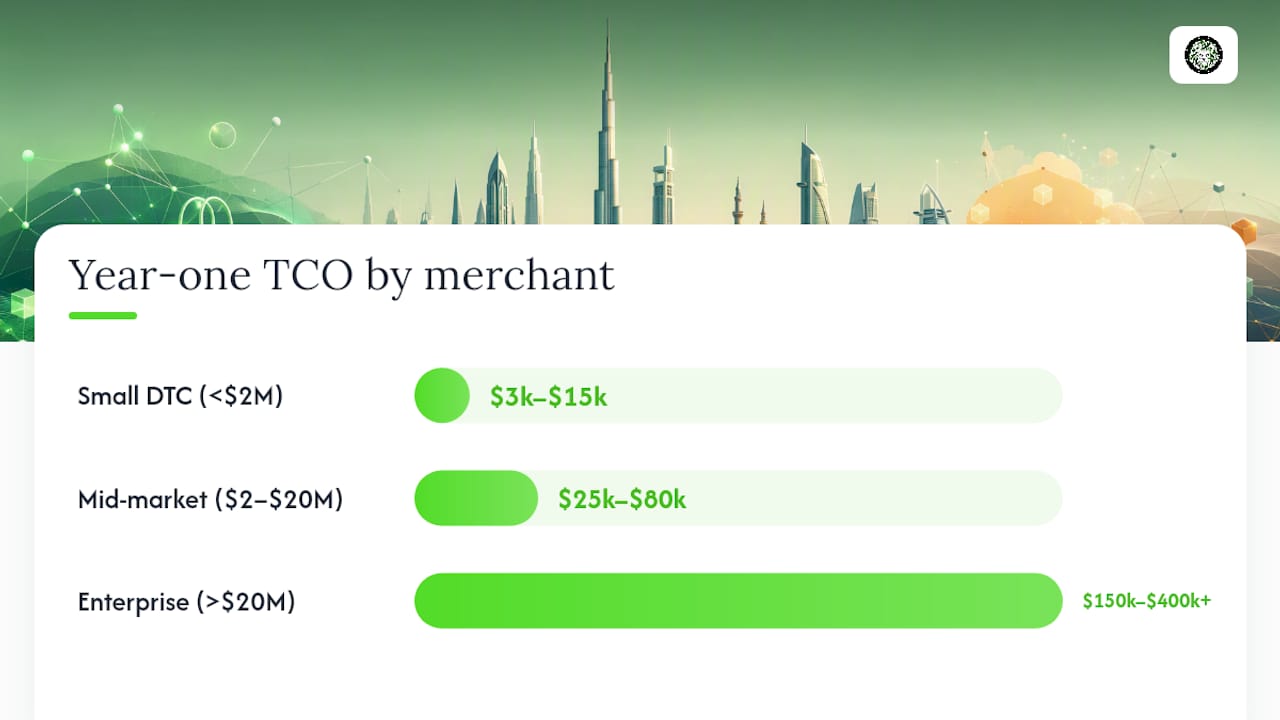
Rough year-one TCO bands by merchant profile:
- Small DTC brand (under $2M GMV): Shopify, roughly $3,000 to $15,000 in setup plus monthly Basic or Shopify plan fees.
- Mid-market growth brand ($2M to $20M GMV): Shopify Plus, commonly $25,000 to $80,000 in first-year implementation and platform costs combined.
- Enterprise ($20M+ GMV, complex B2B or catalog needs): Adobe Commerce Cloud, often $150,000 to $400,000+ in year one once licensing, implementation, and systems integrator fees are combined.
Ongoing costs diverge just as much. Shopify's app subscriptions and Plus fees are predictable line items you can forecast a year out. Adobe Commerce's ongoing costs, hosting, security patching, developer retainers, and extension licensing, tend to fluctuate more and require a dedicated technical owner to manage well.
Which Platform Performs Better at Scale?
Performance under load is where a lot of platform decisions get tested for real, usually during a flash sale nobody planned for.
Shopify's managed infrastructure gives every merchant, regardless of size, the same baseline scaling advantage. Shopify handles CDN distribution, traffic spikes, and server capacity automatically, which is why so many high-volume drops run on the platform without a dedicated ops team standing by. The limit is customization: you're working within Shopify's performance ceiling, not building your own.
Adobe Commerce performance depends almost entirely on how well the hosting and caching layers are engineered. A well-tuned Adobe Commerce Cloud deployment can perform excellently, but that outcome requires skilled infrastructure work. A poorly tuned one will show it immediately in Core Web Vitals scores, particularly Largest Contentful Paint on product pages loaded with third-party scripts.
Operational practices differ accordingly:
- Shopify merchants rarely think about patching, backups, or incident response since Shopify's team handles it centrally.
- Adobe Commerce merchants need a defined patch cadence, backup strategy, and incident response plan, usually owned by an agency or in-house DevOps resource.
- Peak-day readiness (Black Friday, product drops) is largely automatic on Shopify and requires deliberate load testing on Adobe Commerce.
The practical takeaway according to industry comparisons is that Shopify delivers a higher performance floor with a lower ceiling, while Adobe Commerce offers a higher ceiling that depends entirely on how much engineering investment you put in.
Which Platform Has Better Customization and Developer Support?
Every merchant thinks they need unlimited customization until they see what it costs to maintain.
Shopify's app ecosystem covers an enormous range of use cases, from subscriptions to loyalty programs to advanced shipping logic, and quality is generally consistent because Shopify reviews apps before they hit the store. Adobe Exchange lists thousands of extensions too, but quality and compatibility vary widely across Commerce patch levels, and an extension that worked fine on one version can break on the next.
That variability translates directly into upgrade risk. Adobe Commerce upgrades sometimes require re-testing every custom extension and theme component, which is a real project, not a weekend task. Shopify's SaaS model removes that risk almost entirely since Shopify manages version upgrades centrally.
Talent availability tips the scale further toward Shopify for most teams. Liquid, React, and Hydrogen developers are widely available and increasingly affordable, while PHP and Magento-specific specialists are becoming scarcer and pricier as fewer new developers enter that ecosystem. Headless architecture shifts this calculation somewhat: if you're building a custom front end regardless of backend, the hiring pool broadens to any strong React or Vue developer, narrowing the platform-specific skills gap considerably.
Does Shopify or Magento Handle B2B and Multi-Storefront Needs Better?
B2B used to be the clearest reason to choose Magento outright. That's no longer automatic.
Shopify's native B2B rails, company accounts, net payment terms, and custom price lists, are now built into Shopify Plus, which has reduced the need for third-party B2B platforms for merchants with straightforward wholesale requirements. If your B2B model is a defined set of accounts with tiered pricing, Shopify handles it without custom development.
Where Adobe Commerce keeps its edge is catalog complexity. Configurable products with dozens of variants, layered pricing rules by customer group, and multi-warehouse inventory logic are native strengths of the platform. Adobe Commerce still dominates when businesses require multi-tier B2B quote workflows and deep ERP integrations that need to sync inventory, pricing, and customer data across many storefronts simultaneously.
Multi-store models exist on both platforms, but the shared-catalog trade-offs differ. Shopify's multi-store setups (via Markets or separate store instances) work well for regional variants of a single catalog. Adobe Commerce's shared catalog architecture is built for genuinely different product sets across brands or regions under one operational umbrella, which remains the better technical fit for complex distributors and manufacturers.
How Do You Protect SEO During a Magento to Shopify Migration?
Replatforming is where most of the real risk lives, and Google doesn't forgive a sloppy migration.
The safest sequence follows a strict order: migrate products first (including metafields), then customers, then historical orders. Shopify's own migration guide recommends this sequencing because getting it out of order tends to break customer order history and loyalty data.
- Audit your current URL structure and export a full sitemap before touching anything.
- Map every Magento URL to its Shopify equivalent and build a 1:1 redirect file, since URL structures change during migration and unmapped pages lose their ranking signals.
- Migrate products and metafields, then customers (preserving password hashes where the tool supports it), then orders, attached as metafields or migrated with a tool like Matrixify.
- Upload and test your redirect map in a staging environment before launch, not after.
- Resubmit your sitemap in Google Search Console and monitor crawl errors closely for the first six weeks post-launch.
For small catalogs, a migration app can handle most of this. For medium and large catalogs, agencies increasingly recommend a migration partner rather than a self-serve app, since bulk redirect management and structured data mapping at scale is easy to get wrong.
Pro Tip: Never launch a replatformed store on a Friday. Give yourself a full business week to catch redirect gaps and crawl errors while your team, and your migration partner, is actually available to fix them.
Shopify vs Magento: How to Score Your Own Decision
Rather than asking "Shopify or Magento" in the abstract, run your business through a short diagnostic.
Answer these questions honestly before you commit to either platform:
- What is your annual GMV, and is it likely to grow past $20 million in the next three years?
- How complex is your catalog: simple SKUs, or configurable products with layered pricing and multi-warehouse inventory?
- What's your launch timeline, and do you have in-house developers who know PHP, Liquid, or React?
- Do you depend on a specific ERP or legacy system that needs deep, custom integration?
- What's your realistic first-year budget, including implementation and the ongoing maintenance most teams underestimate?
| Diagnostic answer | Points toward |
|---|---|
| GMV under $20M, simple to moderate catalog | Shopify or Shopify Plus |
| GMV over $20M, complex multi-warehouse catalog | Adobe Commerce |
| Tight launch timeline, lean team | Shopify |
| Heavy ERP dependency, multi-tier B2B quoting | Adobe Commerce or custom build |
| Budget under $80,000 for year one | Shopify or Shopify Plus |
If your answers split evenly across both columns, that's usually a sign you need a hybrid or fully custom approach rather than forcing your business model onto either platform's defaults.
What We've Learned Advising Clients on Shopify vs Magento
Most merchants walk into this decision already convinced of an answer, and half the time it's the wrong one for their actual business. The pattern we see most often at Proud Lion Studios is a brand outgrowing Shopify's defaults because of one specific bottleneck, usually ERP sync or a wholesale pricing structure, not because Shopify is somehow inadequate as a platform.
Our discovery process focuses on that bottleneck first: what exactly is the platform failing to do, and is the fix a native feature, an integration, or genuinely custom development? We recommend a custom build or managed replatform only when the business case clears the cost of maintaining it, since custom development only pays off when the standard platform's ceiling is the actual constraint on revenue.
Our team operates from a UAE-based location, which means recommendations are informed by engineers experienced in building and maintaining these systems.
— Amal
Need a Migration or Custom Build Instead of a Platform Debate?
If you've read this far, you already know Shopify and Adobe Commerce solve different problems, and sometimes neither one solves yours cleanly out of the box. Proud Lion Studios builds the layer in between: migrations that protect your SEO, ERP and CRM integrations that make either platform actually work with your operations, and headless or composable storefronts when neither platform's stock front end fits your brand.

A typical engagement starts with a discovery call to scope your catalog complexity, ERP dependencies, and timeline, followed by a fixed estimate rather than an open-ended hourly quote. Our web applications and business websites service covers custom platform builds and migrations, starting from $8,000 for a professional business site or from $25,000 for a fully custom web application with backend and admin panel. For businesses that need deeper backend connectivity, our CRM and ERP integration work with AI-driven automation handles the plumbing that off-the-shelf apps can't. Book a discovery call to scope your migration or custom build before you commit to either platform's defaults.
Sources
This comparison drew on current industry analysis of platform pricing, migration mechanics, and performance benchmarks, including Ecommerce Times's Shopify vs Adobe Commerce breakdown, Shopify's own migration guide, Atwix's platform selection guide, and Ecommerce Times's migration walkthrough. For merchants weighing Shopify-specific SEO tactics post-migration, Baby Love Growth's Shopify SEO resources offer additional tactical detail.
- Shopify vs. Magento (Adobe Commerce) in 2026: Which Platform Wins? – Ecommerce Times
- Magento to Shopify Migration: The Complete Guide (2026) - Shopify
FAQ
Who Is Shopify's Biggest Competitor?
Adobe Commerce (Magento) remains Shopify's most direct competitor for merchants needing deep customization or complex B2B workflows, though Shopify has closed much of that gap with native B2B features. BigCommerce and headless-first platforms also compete for mid-market merchants, but the core Shopify vs Magento comparison still defines most platform decisions above $2 million in GMV.
Does Anyone Still Use Magento?
Yes, Adobe Commerce still powers a substantial share of enterprise and complex B2B stores, particularly those with multi-warehouse inventory or deep ERP dependencies. That said, migration activity toward Shopify has accelerated as Commerce infrastructure and specialist talent costs continue rising.
What Are the Disadvantages of Magento?
Adobe Commerce requires significant ongoing engineering investment: licensing alone can run $40,000 to $120,000 per year, and extension compatibility often breaks during version upgrades. Talent scarcity for Magento-specific developers is also raising both hiring costs and project timelines.
What Are the Top 3 Ecommerce Platforms?
Shopify and Adobe Commerce (Magento) consistently rank among the top platforms for growth and enterprise merchants, with BigCommerce often cited as a third major option for mid-market sellers. The right choice depends far more on your catalog complexity and budget than on general market rankings.
Is Shopify or Magento Better for a Growing DTC Brand?
Shopify, and Shopify Plus once you scale past roughly $2 million in GMV, is generally the better fit for DTC brands prioritizing speed to market and predictable costs. Adobe Commerce only becomes worth the added complexity if your catalog or B2B requirements genuinely outgrow what Shopify's native features and app ecosystem can handle.