

If you're a startup, an entry-level gateway like Telr or PayTabs gets you live in days without an acquiring bank. Growing SMEs need BNPL and multi-currency support baked in. Enterprises should negotiate direct with an acquiring bank for lower rates, and subscription or B2B sellers need tokenization and recurring billing built into the API from day one. Use the sections below to confirm your category, then follow the onboarding checklist to go live.
TL;DR:
- Entry-level gateways offer quick setup for startups but come with higher transaction fees compared to negotiated enterprise rates.
- High-volume businesses benefit from acquirer-linked platforms that provide lower rates but require longer onboarding times and a direct bank relationship.
- Comparing gateways should focus on fees, supported payment methods, integration complexity, security features, and reporting capabilities rather than price alone.
- Onboarding for UAE gateways varies from days for self-serve options to weeks for enterprise solutions, emphasizing early testing of webhooks and settlement processes.
- Proper integration involves automating reconciliation, testing refund and webhook flows before launch, and including VAT costs to avoid surprises.
Table of Contents
- Which Payment Gateway Fits Your Business Type?
- What Criteria Should You Use to Compare Gateways?
- How Much Does a Payment Gateway Actually Cost in the UAE?
- How Long Does Payment Gateway Onboarding Take in the UAE?
- What Security and Compliance Checks Matter Most in the UAE?
- When Should You Hire an Integration Partner Instead of DIY?
- What Does a Real UAE Gateway Integration Look Like?
- Why the Standard Gateway Advice Misses the Point
- Get Your Payment Integration Built Right the First Time
- Sources
- FAQ
Which Payment Gateway Fits Your Business Type?
The UAE gateway market splits into four practical tiers, and picking the wrong one costs you either money or months.
Entry-level, self-serve gateways get a store accepting cards within days. No acquiring bank relationship required, plugins for Shopify and WooCommerce ready out of the box, and pricing that's simple to understand. The tradeoff is a higher per-transaction rate than you'd get with a negotiated enterprise contract, since these platforms absorb the acquiring risk themselves.
Growth and SME platforms sit a level up. They add BNPL partnerships (Tabby is now standard across most UAE gateways), stronger multi-currency handling, and more developer flexibility. Telr is a clear example: plugin integrations for common shopping carts, social payment links, and a built-in Tabby partnership that lets SMEs offer installment payments without a separate integration.
Enterprise and acquirer-linked platforms trade onboarding speed for lower long-term cost. These require a direct relationship with a UAE acquiring bank, which extends setup time but unlocks negotiated per-transaction rates that matter once you're processing serious volume. N-Genius Online fits here, with a unified checkout spanning card networks, Apple Pay, Google Pay, and alternative payment methods in one integration.
API-first platforms serve engineering-led teams building custom checkout flows, marketplaces, or complex subscription logic. If your business model needs split payments, custom fraud rules, or a checkout experience that doesn't look like a template, this is your category regardless of your revenue size.
- Startup with limited dev resources: entry-level, self-serve gateway
- SME wanting BNPL and local wallet coverage: growth/SME platform
- High-volume enterprise chasing better rates: acquirer-linked platform
- Subscription, marketplace, or B2B seller: API-first platform
What Criteria Should You Use to Compare Gateways?
Comparing UAE gateways on price alone is how merchants end up locked into a bad contract. Run every shortlisted provider through the same six-point checklist before signing anything.
- Pricing structure. List every fee component separately: setup fee, per-transaction rate, monthly minimum, refund fee, chargeback fee, and FX margin on cross-border transactions. A gateway quoting a low headline rate but charging for refunds and chargebacks can cost more than a straightforward flat-rate competitor once you normalize for your actual transaction mix.
- Settlement and acquiring bank requirements. Confirm whether the provider needs a UAE acquiring bank relationship. If it does, expect a longer underwriting process, but also better long-term pricing once volume justifies negotiation.
- Supported payment methods. Cards are table stakes. Check for Apple Pay, Google Pay, Samsung Pay, and BNPL providers like Tabby and Tamara, alongside local bank transfer rails your UAE customers actually use.
- Integration complexity. A plugin-based setup gets a WooCommerce store live in an afternoon. An API-first integration takes longer but gives you control over checkout UX, webhook handling, and custom business logic that plugins can't touch.
- Security and fraud controls. Confirm PCI-DSS compliance level, 3D Secure (3DS) support, tokenization for stored cards, and whether fraud scoring is included or a paid add-on.
- Reporting and VAT-ready exports. Your accountant needs clean, exportable transaction data that already separates gross revenue, fees, and VAT. Providers that only offer a dashboard with no export function create manual reconciliation work every single month.
Pro Tip: Ask every shortlisted provider for a sample settlement report before you sign. If the format doesn't map cleanly to your accounting software, you'll be paying a bookkeeper to fix that gap every month for the life of the contract.
Multiple market guides confirm this split consistently: enterprise providers require acquiring bank relationships and offer negotiated rates that self-serve platforms simply can't match at lower volumes.
How Much Does a Payment Gateway Actually Cost in the UAE?
Every gateway fee in the UAE carries 5% VAT on top of the quoted rate, and that detail gets left out of most pricing pages.
Here's how the math plays out across three realistic monthly processing volumes, using a representative blended rate of 2.5% plus AED 1 per transaction (actual rates vary by provider and negotiated volume):
- AED 10,000/month volume: roughly AED 250 in processing fees, plus AED 12.50 VAT, landing near AED 262.50 total.
- AED 50,000/month volume: roughly AED 1,250 in processing fees, plus AED 62.50 VAT, landing near AED 1,312.50 total.
- AED 250,000/month volume: roughly AED 6,250 in processing fees, plus AED 312.50 VAT, landing near AED 6,562.50 total, though at this volume most merchants can negotiate a lower per-transaction rate.
Once monthly volume crosses roughly AED 200,000 to AED 250,000, it's usually worth calling your provider to renegotiate the rate rather than accepting the standard published pricing.
Watch for non-obvious charges that don't show up in the headline rate: refund fees (some providers still charge their transaction fee even when you refund the customer), chargeback fees that stack on top of the disputed amount, and FX margins on any transaction settled in a currency other than AED. A merchant processing significant cross-border volume in multiple currencies benefits from a regulated multi-currency platform like Hubpay, which is ADGM-regulated and built specifically to simplify FX and virtual IBAN handling for UAE businesses scaling internationally.
How Long Does Payment Gateway Onboarding Take in the UAE?
Onboarding timelines diverge sharply depending on which gateway category you pick, and underestimating this is the single most common planning mistake UAE merchants make.
- Confirm business eligibility first. Mainland trade licenses and free zone licenses face different underwriting paths. Some acquiring banks restrict which free zone entities they'll onboard, so confirm this before you invest engineering time.
- Expect days for self-serve, weeks for enterprise. Self-serve platforms can go live within days of document submission, while acquirer-linked enterprise onboarding typically runs two to four weeks or longer, driven by underwriting and bank compliance review.
- Work through the developer checklist before launch. Sandbox environment access, API key provisioning, webhook endpoint testing, tokenization setup, and confirming your PCI scope reduction strategy (using the gateway's hosted fields rather than handling raw card data yourself).
- Lock in operational details before go-live. Settlement schedule (daily vs weekly), reconciliation process, and how transaction data exports into your accounting system.
Pro Tip: Test your webhook endpoint against the sandbox environment for at least a full week before launch. Sandbox and production webhooks often fire on slightly different timing, and that gap is where reconciliation errors start.
What Security and Compliance Checks Matter Most in the UAE?
A gateway's marketing page will claim security compliance. Your job is to verify it before you build anything on top of it.
- Ask for the provider's current PCI-DSS compliance level and certificate, not just a badge on their website.
- Confirm 3D Secure (3DS) is enabled by default on card transactions, since this shifts fraud liability away from your business.
- Expect underwriting delays if you operate in a restricted category (adult content, gambling-adjacent, high-risk goods), and plan your launch timeline around that reality rather than against it.
- Require tokenization for any stored card data, so raw card numbers never touch your own servers.
- Check whether fraud scoring and velocity checks are included in the base price or billed as an add-on.
- Verify the provider's support SLA and whether local UAE-based, Arabic and English support is available, not just an offshore ticket queue.
When Should You Hire an Integration Partner Instead of DIY?
Some checkout builds are genuinely a weekend plugin install. Others aren't, and pretending otherwise costs more in rework than it would have cost to hire it out correctly the first time.
You need a partner when you're building a marketplace with split payouts, a subscription product with complex billing logic, BNPL integration across multiple providers, cross-border payouts to vendors or freelancers, or a custom checkout UX that a template simply can't deliver.
A competent integration partner should deliver tokenization handled correctly from day one, reliable webhook processing with retry logic, automated reconciliation instead of manual spreadsheet matching, and a documented support SLA you can hold them to.
- Self-serve DIY: live in days, near-zero cost, limited to standard checkout flows
- Managed integration: typically weeks, real cost, but built for the complex flows DIY simply can't handle
What Does a Real UAE Gateway Integration Look Like?
One UAE ecommerce merchant Proud Lion Studios worked with had already signed with an acquiring bank, but their sandbox webhooks fired in a different sequence than production, breaking their order confirmation logic during the first week of testing. Rebuilding the webhook handler to be sequence-agnostic and adding automated reconciliation cut post-launch payment support tickets and got the store live on schedule.
The recurring pitfalls across UAE integrations: settlement currency mismatches when a provider settles in USD instead of AED, sandbox-to-production webhook timing differences catching teams off guard, and free-zone license restrictions that some acquiring banks won't underwrite.
The practical fixes: automate reconciliation from day one, run full refund flow tests before launch, and build the 5% VAT into your cost model before you quote pricing to your own customers.
Why the Standard Gateway Advice Misses the Point
Most gateway comparison content ranks providers by feature checklists as if every UAE merchant needs the same thing. They don't. A startup selling AED 8,000 a month in candles has nothing in common with a subscription SaaS business processing recurring B2B billing, yet both get pointed to the same "top 5" list.
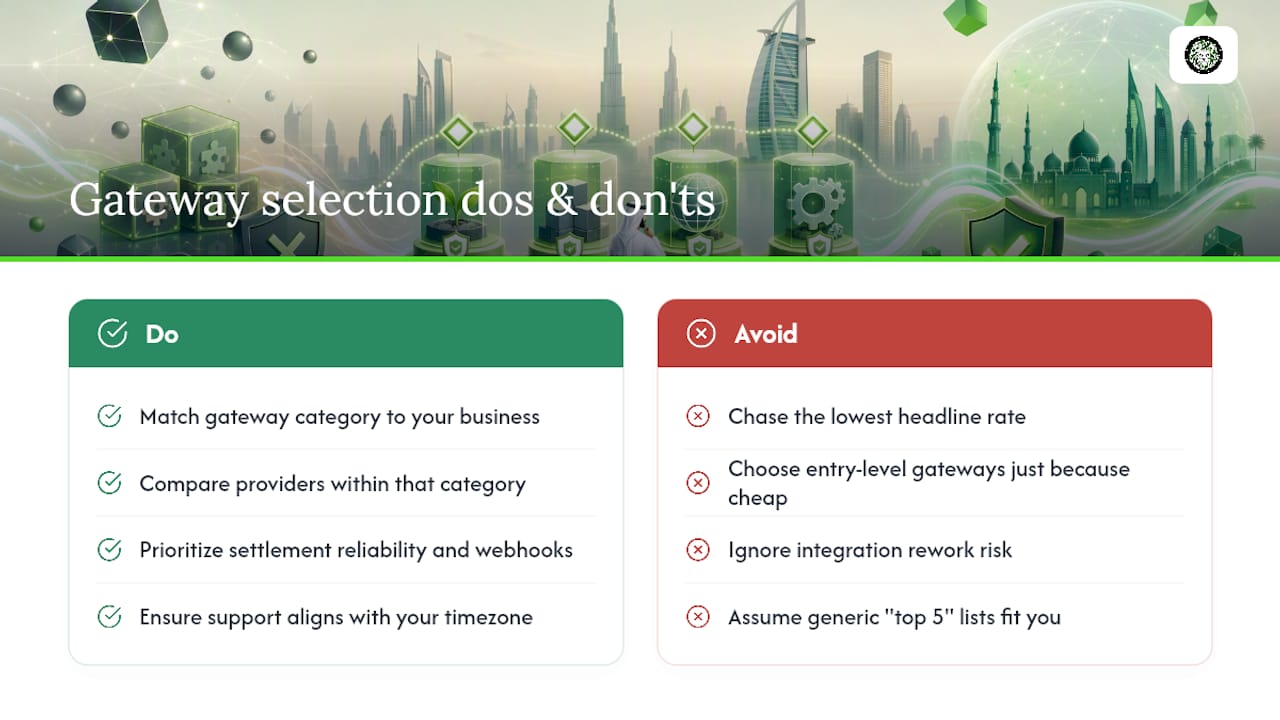
The advice that actually holds up: match the gateway category to your business profile first, then compare providers within that category. A founder who picks an entry-level gateway because it's cheap, then discovers eighteen months later that scaling requires ripping out the integration for an acquirer-linked platform, has paid twice for the same problem. MENA fintech funding hit $644 million in 2024, and that capital is flowing into features like Arabic-native checkout and deeper BNPL partnerships that make the "right category first" decision even more consequential now than it was two years ago.
What's overrated: chasing the absolute lowest headline rate. What's underrated: settlement reliability, webhook consistency, and whether your provider's support team actually answers in a timezone that matches yours.
— Amal
Get Your Payment Integration Built Right the First Time
Comparing gateway categories tells you which door to walk through. Getting the integration built without settlement mismatches, broken webhooks, or a checkout UX that turns customers away is a different job entirely, and it's the one Proud Lion Studios does for UAE merchants directly.

Proud Lion Studios is the UAE-based alternative to guessing your way through gateway documentation alone. The team builds payment integration work covering tokenization, BNPL provider connections, mobile checkout flows, and reconciliation automation, backed by real UAE market experience including projects like GlobalPay, a fiat on/off ramp built for cross-border settlement. Whether you're wiring up Apple Pay and Google Pay for a mobile storefront (worth reviewing this wallet adoption guidance for conversion tips) or building tokenized payment flows for a blockchain-based product with tokenization services, the studio scopes the technical work upfront so there are no surprises mid-build. Book a technical scoping call to map out what your specific integration actually requires before you commit engineering hours to it.
Sources
- N-Genius Online: Payment Gateway in UAE | Network International
- Telr | Accept Payments Online | Payment Gateway Provider in UAE.
- Multi-Currency Business Account UAE | Global Payments | Hubpay
FAQ
What are the top payment gateways for UAE businesses?
The strongest options split by business profile: self-serve platforms like Telr for startups, unified enterprise checkouts like N-Genius Online for high-volume merchants, and regulated multi-currency platforms like Hubpay for cross-border sellers.
Which payment method is best in the UAE?
Cards remain dominant, but Apple Pay, Google Pay, and BNPL providers like Tabby now account for a growing share of checkout completions, making a gateway that supports all three essential for conversion.
Is Razorpay available in the UAE?
Razorpay is primarily built for the Indian market and isn't a standard option for UAE merchants; local alternatives with UAE acquiring bank relationships and AED settlement are the practical choice.
Which online payment app is best in Dubai?
It depends on your business type: a growth-stage Dubai retailer typically does best with a gateway offering built-in BNPL and Apple Pay support, while a subscription business needs strong recurring billing and tokenization in the API.
Does a UAE gateway need an acquiring bank relationship?
Only enterprise and acquirer-linked platforms require this directly; self-serve and most SME-focused gateways handle the acquiring relationship on the merchant's behalf, trading a slightly higher rate for faster onboarding.