
TL;DR:
- Custom software aligns precisely with your unique processes, offering better scalability and competitive advantage than off-the-shelf solutions. Although initially more costly, well-planned custom development reduces long-term expenses and supports seamless integration while maintaining full data ownership. Success depends on clear outcomes, agile iteration, ongoing maintenance planning, and designing for future growth.
Most businesses assume off-the-shelf software is the practical default. It's fast to deploy, predictable in cost, and somebody else handles the updates. That logic holds right up until your operations grow complex enough that the software starts working against you instead of for you. Understanding why choose custom development isn't about rejecting ready-made tools entirely. It's about recognizing when your processes, your data, and your competitive position demand something built specifically for you.
Table of Contents
- Key takeaways
- Why choose custom development over off-the-shelf software
- Key advantages of custom development for startups and businesses
- Common challenges and misconceptions about custom development
- How to evaluate if custom development is right for you
- Steps to successfully launch a custom software project
- My honest take on the custom development decision
- How Proudlionstudios helps you build what no vendor sells
- FAQ
Key takeaways
| Point | Details |
|---|---|
| Custom software fits your workflows | Off-the-shelf tools force process adaptation; custom software adapts to you. |
| Long-term ROI often justifies the cost | Initial investment is higher, but total ownership costs over five years favor well-planned custom builds. |
| Scalability is built in by design | Custom solutions grow with your business without forcing expensive platform migrations. |
| Competitive differentiation matters | Software capability now defines which businesses lead their markets in 2026. |
| Evaluation criteria are specific | Match custom development decisions to your process uniqueness, compliance needs, and growth ambitions. |
Why choose custom development over off-the-shelf software
Custom software development means building a digital product from scratch, or from modular components, specifically to serve your business's processes, users, and goals. The development team works directly with your stakeholders to define requirements, build iteratively, and deliver something no competitor can buy from the same vendor catalog.
Off-the-shelf software, by contrast, is built for a broad, generic audience. Think of it like buying a suit off the rack versus having one tailored. The rack suit fits most people acceptably well. The tailored suit fits one person perfectly. When your business operates with standard workflows and common needs, the rack suit works fine. When your operations are specific, regulated, or differentiated, the tailored option stops being a luxury and starts being a necessity.
Here's what typically separates the two options:
- Customization depth: Off-the-shelf products offer limited configuration. Custom software is built around your exact specifications.
- Integration control: With custom builds, you own the API layer and can connect to any existing internal system without paying for middleware workarounds.
- Licensing model: SaaS products charge per user, per seat, or per module. Custom software carries a one-time build cost plus ongoing maintenance.
- Vendor dependence: Off-the-shelf means accepting a vendor's roadmap, pricing changes, and discontinuation risks. Custom means you own the code.
- Feature relevance: SaaS often introduces feature bloat and missing critical functionality while locking you into their ecosystem.
Key advantages of custom development for startups and businesses
The tailored software advantages go well beyond simply having something unique. They compound over time and across every layer of your operations.
-
Workflows stay yours. When software is built around your processes, your team doesn't waste time adapting how they work to fit a tool's limitations. A logistics startup with complex routing logic or a fintech platform with proprietary risk scoring cannot afford to bolt those onto a generic SaaS interface.
-
Integration is native, not patched. Custom application development lets you connect to your CRM, ERP, legacy databases, and third-party APIs from day one without brittle middleware layers. Custom apps support full integration with legacy systems and enable performance and security requirements off-the-shelf products cannot meet.
-
Data stays under your control. Regulatory environments in fintech, healthcare, and government procurement require that sensitive data never leave a defined jurisdiction. Custom solutions give you full data ownership and sovereignty, which no SaaS vendor contract can fully replicate.
-
Competitive differentiation compounds. According to a 2026 Forbes analysis, software capability now defines which companies lead their markets. Businesses that build internal software capability aligned with their unique operations develop advantages competitors cannot simply purchase.
-
Long-term cost works in your favor. Yes, custom builds cost more upfront. But 65% of total software costs occur post-deployment through maintenance, updates, and integrations. A well-scoped custom build avoids paying for features you don't use while preventing the expensive migrations forced by vendor changes.
Pro Tip: When calculating whether custom software is worth it, don't compare build cost to subscription cost alone. Compare the total five-year cost including integration workarounds, productivity losses from poor fit, and per-seat license scaling as your team grows.
Common challenges and misconceptions about custom development
Most hesitation around custom development comes from three persistent myths worth addressing directly.
The first is cost. The perception is that custom software is prohibitively expensive. The reality is more nuanced. AI-assisted development has reduced initial build costs significantly, though total ownership over five years still requires planning. The comparison that matters isn't "build cost vs. month-one SaaS subscription." It's build cost versus five years of licensing, plus the cost of every workaround you implement when the off-the-shelf tool doesn't fit.

The second myth is timeline. Teams worry that custom software takes too long. Agile development changes this significantly. Modern iterative builds deliver functional software within weeks for core features, with full platforms rolling out over months rather than years. The key is defining your minimum viable product clearly rather than trying to build everything at once.
The third concern is maintenance. This one deserves the most honest treatment:
- Custom software does require dedicated maintenance resources. Part-time or shared engineering resources lead to degradation and increased technical risk over time.
- Compliance-heavy domains require continuous updates. Regulatory revisions and integrations are resource-intensive and often underestimated.
- The solution isn't to avoid custom software. It's to plan for maintenance as part of the original investment decision, not as an afterthought.
Pro Tip: Before any custom project starts, define a post-launch maintenance budget of roughly 15 to 20 percent of the original build cost per year. Teams that skip this step end up with software that works well at launch and degrades quietly for two years before someone notices.
Off-the-shelf failures are real too. A fast-growing marketplace startup that deploys a generic e-commerce platform may hit scaling limits within 18 months, forcing a full rebuild at far greater cost than an original custom build would have required.
How to evaluate if custom development is right for you
The decision to invest in custom application development isn't binary. The right framework looks at several dimensions together.
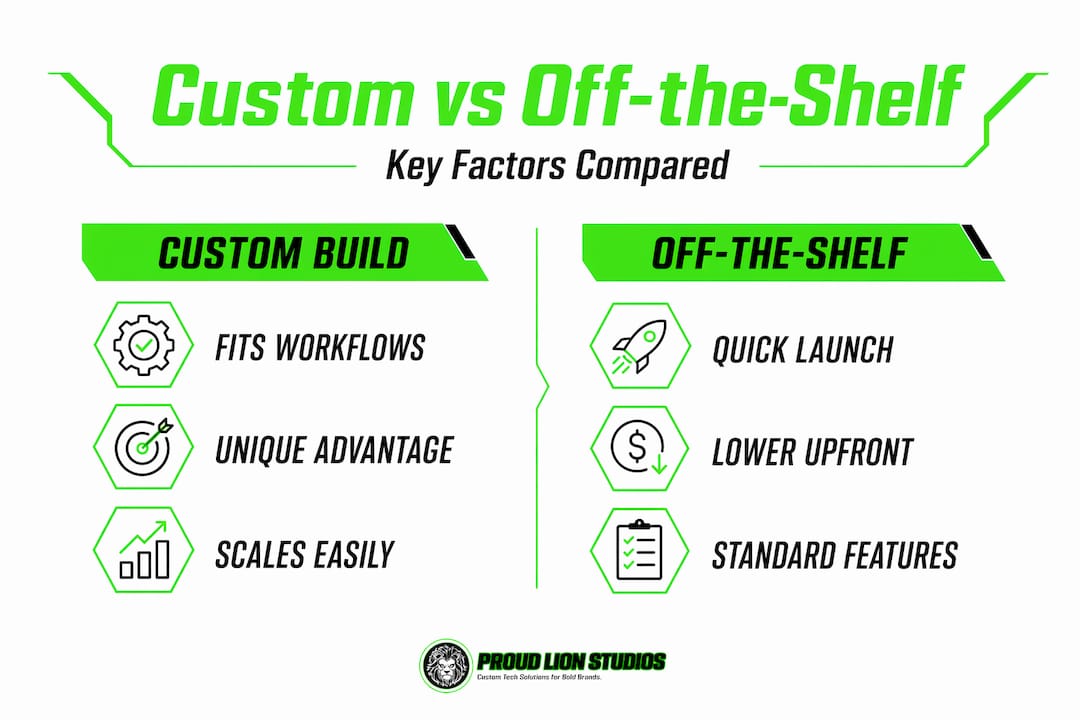
| Evaluation criterion | Favor custom development | Favor off-the-shelf |
|---|---|---|
| Business process uniqueness | Highly differentiated workflows | Standard industry workflows |
| Scalability requirements | Aggressive growth, unpredictable scale | Stable, predictable team size |
| Integration complexity | Multiple legacy or proprietary systems | Modern SaaS-friendly stack |
| Data sovereignty and compliance | Strict regulatory requirements | Standard data residency acceptable |
| Internal engineering capacity | Dedicated team available or hireable | No in-house technical resources |
| Budget horizon | Multi-year ROI perspective | Short-term cost minimization |
The most important signal is process uniqueness. If your business operates in a way that creates genuine competitive value, and that way of operating cannot be replicated inside a generic tool, custom software development for startups becomes a strategic investment rather than a technical expense.
Ask yourself one pointed question: if your competitor bought the same off-the-shelf tool tomorrow, would your operational advantage disappear? If the answer is yes, you have a strong case for building.
Steps to successfully launch a custom software project
Starting a custom development project well determines most of what happens after. These steps don't guarantee success, but skipping them almost guarantees problems.
-
Define outcomes, not features. Custom development decisions must center on business outcomes and cost-timing-benefit tradeoffs. Start with the business result you need, then work backward to the features required to achieve it.
-
Choose your development partner carefully. The right studio or engineering team understands your industry, asks hard questions about your requirements, and pushes back when scope creep appears. A team that says yes to everything is not your ally.
-
Commit to agile iteration. Build in short sprints. Review working software every two to four weeks. Adjust based on real usage, not theoretical requirements. Agile methodology applied well reduces wasted build time dramatically.
-
Invest in requirement gathering upfront. The most expensive bugs are the ones baked into the original specification. One week spent documenting workflows, edge cases, and integration requirements saves months of rework.
-
Plan the post-launch phase before launch. Agree on a support and maintenance contract before the final build begins. Establish monitoring, update cycles, and who handles incidents. Teams that treat launch as the finish line discover that maintenance is actually where most of the cost lives.
-
Build with scalability as a design constraint. Not a nice-to-have. Architect for the user load and feature set you expect in three years, not the minimum viable state at launch.
My honest take on the custom development decision
I've watched a lot of startups approach this decision backwards. They start with a budget constraint, pick the cheapest tool that seems close enough, and then spend the next two years engineering workarounds for everything the tool doesn't do. By year three, they've spent more on patching than a proper build would have cost.
What I've learned from working across technology projects is that the companies that win with custom software treat it as a strategic digital product, not a one-time project. They staff it properly, they fund maintenance, and they align every feature decision to a business outcome. The Forbes insight that software capability defines market winners resonates because I've seen it. The businesses ahead of their markets in 2026 are the ones that built something their competitors cannot replicate.
My honest advice: don't ask "can we afford to build custom?" Ask "can we afford to let a vendor's generic roadmap dictate our competitive capabilities?" That reframe changes the math.
— Amal
How Proudlionstudios helps you build what no vendor sells
If you've worked through the evaluation above and recognized that your business needs something built specifically for your operations, the next step is finding a team that treats your outcome as the actual deliverable.
Proudlionstudios is a Dubai-based technology studio that builds exactly this kind of software. The team covers mobile app development for iOS and Android, blockchain development including smart contracts and NFT marketplaces, AI automation, and full-stack web platforms. Every project starts with a deep requirements process and ends with a maintenance plan. No templated packages. No off-the-shelf shortcuts dressed up as custom work.
With a UAE-based technical team and a client portfolio spanning multiple countries, Proudlionstudios has the depth to handle regulated industries, complex integrations, and aggressive scaling requirements. Reach out to explore what scalable startup development looks like when it's designed around your business from day one.
FAQ
What is the main reason to choose custom development?
Custom development aligns software directly with your unique business workflows, which off-the-shelf tools cannot do without forcing expensive process compromises. Businesses with differentiated operations gain the most from this alignment.
Is custom development worth the higher upfront cost?
Yes, when evaluated over a five-year horizon. 65% of software costs occur post-deployment, meaning well-planned custom builds often cost less in total than a decade of licensing fees plus integration workarounds.
How long does custom software development typically take?
With agile methodology, core functionality can be delivered within weeks and full platforms within a few months. Timeline depends heavily on scope definition and how clearly outcomes are specified before build begins.
When should a startup choose off-the-shelf software instead?
When your workflows match a standard industry pattern, your team is small and stable, and speed to market matters more than differentiation. Off-the-shelf works well as a starting point until your operations outgrow its limits.
What is the biggest risk in custom software development?
Underestimating post-launch maintenance. Dedicated engineering resources are required for long-term success. Projects that treat launch as the endpoint typically see software quality degrade within 12 to 18 months.
Recommended
- What is custom software? A 2026 guide for startups
- Blockchain Development - Proud Lion Studios | App, Blockchain & Game Development Company in Dubai UAE
- Web Applications & Business Websites - Proud Lion Studios | App, Blockchain & Game Development Company in Dubai UAE
- Grow Your Business with Tech Solutions - Proud Lion Studios