

TL;DR:
- AI excels in automating repetitive tasks and analyzing large datasets but requires human oversight.
- Successful AI adoption involves careful planning, data cleaning, pilot testing, and realistic ROI assessment.
- Challenges include data quality, talent shortages, and ethical risks that need ongoing management.
Most business leaders assume AI is a plug-and-play upgrade. Buy a tool, flip a switch, watch costs drop. The reality is sharply different. Ricoh, a global technology company, found that initial payroll costs tripled when it first deployed AI for HR processes before eventually reaching break-even. That story is more common than the headlines suggest. This guide cuts through the noise to give decision-makers a clear picture of what AI actually delivers, where it struggles, and how to build a strategy that holds up in the real world.
Table of Contents
- Understanding the role of AI in modern business
- Efficiency and automation: Where AI makes a difference
- Challenges and risks: Data, talent, and ethics
- Practical frameworks for evaluating AI in your business
- Why the hype around AI in business often misses the mark
- Explore AI-powered solutions for your business
- Frequently asked questions
Key Takeaways
| Point | Details |
|---|---|
| Hybrid AI-human teams | Most businesses benefit from combining AI automation with skilled human oversight for best results. |
| Implementation challenges | High upfront costs, data quality issues, and talent gaps must be planned for to ensure successful AI adoption. |
| Practical evaluation frameworks | Structured models help leaders assess costs, scalability, and readiness before adopting AI solutions. |
| Ethics and oversight | Integrating ethical review and continuous human monitoring is crucial for safe and effective use of AI. |
| Business impact | AI can unlock efficiency and automation but only with deliberate, context-driven strategies. |
Understanding the role of AI in modern business
AI is not a single product. It is a category of technologies including machine learning, natural language processing, computer vision, and predictive analytics. Each one solves a specific type of problem. Treating AI as a generic fix-all is one of the most expensive mistakes a business can make.
Where AI genuinely excels is in three areas: automating repetitive processes, surfacing patterns in large datasets, and personalizing customer interactions at scale. A logistics company using AI to optimize delivery routes is a good example. The system processes thousands of variables in seconds, something no human team could match. But someone still needs to set the rules, validate the outputs, and handle exceptions.
That last point matters more than most vendors will tell you. Hybrid human-AI teams have become the standard model precisely because AI talent is scarce and the systems themselves require constant oversight. You are not replacing your team. You are reshaping how they work.
"The organizations that win with AI are not the ones that automate the most. They are the ones that figure out where human judgment is irreplaceable and protect it."
Here is a quick comparison of what AI handles well versus where human oversight remains critical:
| Task type | AI strength | Human role |
|---|---|---|
| Data processing | High speed, high volume | Validate outputs and set rules |
| Customer service | 24/7 availability, consistency | Handle escalations and edge cases |
| Predictive analytics | Pattern detection at scale | Interpret context and act on insights |
| Creative strategy | Assist with drafts and options | Final judgment and brand alignment |
Common misconceptions that trip up decision-makers include:
- AI is cheap to implement. Upfront costs for integration, data preparation, and staff training are consistently higher than projected.
- AI works out of the box. Most tools require significant customization to fit your specific workflows.
- Results are immediate. Most implementations take 6 to 18 months before measurable ROI appears.
- You do not need technical staff. Even low-code AI tools require someone who understands the underlying logic.
Understanding the future of AI in business starts with accepting these realities, not the marketing version of them.
Efficiency and automation: Where AI makes a difference
Let's be specific. AI-driven automation is not about replacing every human task. It is about eliminating the tasks that drain time without adding judgment or creativity. Think data entry, invoice processing, appointment scheduling, and first-line customer support. These are high-volume, low-variance tasks where AI consistently outperforms manual processes.
Here is a snapshot of real-world efficiency gains across common business functions:
| Business function | AI application | Reported efficiency gain |
|---|---|---|
| Payroll processing | Automated calculations and compliance checks | Up to 80% time reduction |
| Customer support | AI chatbots for tier-1 queries | 40-60% ticket deflection |
| Inventory management | Demand forecasting models | 20-30% reduction in overstock |
| Predictive maintenance | Sensor data analysis | 25-35% reduction in downtime |
The numbers are real, but they come with a condition. The Ricoh case is instructive here. Payroll costs initially tripled because the company needed additional staff to manage the transition, clean data, and troubleshoot the new system. Break-even came later. That is not a failure story. It is an honest one.
Successful automation follows a predictable pattern:
- Identify the right processes. Start with tasks that are high-frequency, rule-based, and well-documented.
- Clean your data first. AI performs only as well as the data it learns from. Garbage in, garbage out.
- Run a pilot before scaling. Test the system on a limited scope before rolling it out company-wide.
- Train your team in parallel. Staff need to understand what the AI is doing and why, not just how to use the interface.
- Measure against a baseline. Define your success metrics before launch, not after.
Pro Tip: Do not automate a broken process. If the workflow is inefficient before AI, the AI will just make the inefficiency faster. Fix the process first, then automate it.
For teams building or upgrading digital products, understanding AI in software development is increasingly relevant, especially as AI-assisted coding and testing tools become standard in 2026.
Challenges and risks: Data, talent, and ethics
Efficiency gains are real. So are the obstacles. The businesses that struggle most with AI adoption are usually the ones that underestimated what it takes to get there.

Data quality, talent shortages, and ethical concerns consistently rank as the top barriers to scaling AI. Each one deserves a direct look.
Data quality is the foundation everything else rests on. AI models trained on incomplete, biased, or outdated data produce unreliable outputs. In a customer-facing context, that means bad recommendations, incorrect pricing, or discriminatory filtering. Cleaning and maintaining quality data is an ongoing operational cost, not a one-time fix.
Talent shortages are acute. Demand for machine learning engineers, data scientists, and AI product managers far outpaces supply. Many mid-sized businesses cannot compete with large tech firms on salary. The practical response is to invest in upskilling existing staff and partner with specialized vendors rather than trying to build an in-house AI team from scratch.
Ethical risks are often treated as a compliance checkbox. They should not be. Bias in hiring algorithms, opaque decision-making in credit scoring, and privacy violations in customer data handling are all real risks with legal and reputational consequences.
"Trustworthy AI is not a feature. It is a prerequisite for sustainable deployment in any customer-facing or regulated environment."
Here are the key risk areas and how to address them:
- Bias in training data: Audit datasets regularly and use diverse data sources.
- Lack of transparency: Choose AI tools that offer explainability features, especially for decisions affecting customers.
- Privacy exposure: Ensure compliance with applicable data protection regulations before any deployment.
- Over-reliance on automation: Keep humans in the loop for high-stakes decisions.
Pro Tip: Before selecting any AI vendor, ask them directly how their system handles edge cases and what happens when the model is wrong. The quality of that answer tells you a lot.
For a deeper look at the principles that should guide responsible deployment, the discussion around AI ethics in business is worth your time. And if customer communication is part of your AI roadmap, reviewing purpose-built AI chat solutions can help you evaluate what responsible deployment looks like in practice.
Practical frameworks for evaluating AI in your business
Knowing the risks is useful. Having a structured way to evaluate whether a specific AI investment makes sense for your business is better.
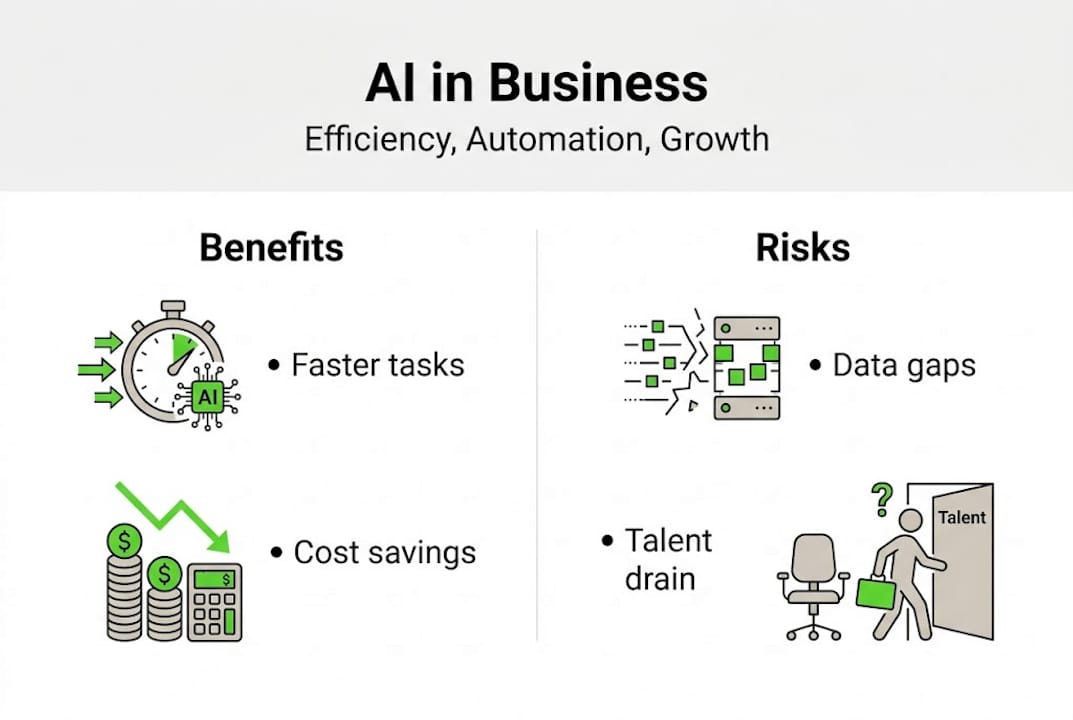
AI projects require careful cost-benefit analysis and ongoing human oversight. That means building evaluation into your process before you commit budget, not after.
Use this five-step framework to assess any AI initiative:
- Assess readiness. Do you have the data infrastructure, technical staff, and leadership buy-in to support this project? If two of those three are missing, the project is not ready.
- Define the problem precisely. Vague goals produce vague results. "Improve customer experience" is not a goal. "Reduce first-response time from 4 hours to 30 minutes" is.
- Model the ROI honestly. Include implementation costs, training time, ongoing maintenance, and the cost of potential errors. Most ROI projections undercount these.
- Plan for human oversight. Identify who owns the AI outputs and what the escalation path looks like when the system gets it wrong.
- Design a phased rollout. Start with one department or use case. Measure, adjust, then scale.
Pro Tip: Build a "break-even timeline" into your business case. If the project cannot reach break-even within a defined period given realistic assumptions, it is worth reconsidering the scope.
Here is a quick reference table for pre-adoption evaluation:
| Evaluation area | Key question | Red flag |
|---|---|---|
| Data readiness | Is your data clean, labeled, and accessible? | Siloed or inconsistent data sources |
| Team alignment | Does your team understand the change? | Resistance without a change management plan |
| Vendor reliability | Does the vendor have proven case studies? | Vague promises without measurable outcomes |
| Scalability | Can the solution grow with your business? | Rigid pricing or architecture |
| Ethical review | Has bias and privacy been assessed? | No documented review process |
For specific use cases, exploring AI benefits for mobile apps or reviewing AI agent examples can help you map abstract frameworks to concrete solutions.
Why the hype around AI in business often misses the mark
Here is what the popular narrative consistently skips: most AI success stories are the result of years of groundwork, not a single deployment decision. The companies that look effortlessly ahead of the curve usually spent 18 to 36 months cleaning data, training staff, and running quiet pilots before anything was worth publicizing.
Many businesses overestimate AI's immediate impact while overlooking integration complexity. The result is a cycle of hype, disappointment, and abandoned projects. That is not an AI problem. It is a planning problem.
From our perspective working with startups and enterprises across multiple industries, the organizations that get the most out of AI are not the most aggressive adopters. They are the most deliberate ones. They ask harder questions before signing contracts. They invest in their people as much as their tools. They treat AI as a capability to build, not a product to buy.
The hybrid approach is not a compromise. It is the actual best practice. Contextual judgment, ethical oversight, and creative problem solving are human strengths that no current AI system reliably replicates. Protecting those capabilities while automating the rest is the real strategy. For a grounded view of where responsibility fits into this picture, ethical AI perspectives offer a useful counterweight to the hype.
Explore AI-powered solutions for your business
If this guide has clarified where AI fits in your roadmap, the next step is finding the right partners to build it with you.

At Proud Lion Studios, we work with startups and enterprises to design and deploy AI solutions that are built around your actual business needs, not generic templates. From AI agents for business that automate complex workflows to mobile app development with AI-driven personalization and blockchain development services for secure, scalable infrastructure, our UAE-based team brings technical depth and real-world experience to every project. Reach out to explore what a tailored AI strategy looks like for your business.
Frequently asked questions
What are the main benefits of using AI in business?
AI improves operational efficiency, automates repetitive processes, and enables businesses to scale operations with fewer errors and faster turnaround times across key functions.
What are the biggest challenges when implementing AI?
Data quality, talent shortages, and ethical risks such as bias and privacy exposure are the most common barriers, alongside higher-than-expected upfront costs.
How should leaders evaluate the ROI of an AI project?
Build a realistic model that includes implementation, training, and maintenance costs, then set a defined break-even timeline. Careful cost-benefit analysis and ongoing human oversight are essential to keeping the project on track.
Can AI replace human teams entirely?
Hybrid human-AI teams remain the standard because AI lacks the contextual judgment and creative problem solving that high-stakes decisions require. Automation handles volume; humans handle nuance.