

Pick onshore when you need real-time collaboration, airtight legal protections, or you're building something regulated or IP-critical. Pick offshore when the spec is stable and cost is the main constraint. Pick nearshore when you need most of both without paying full onshore rates. In practice, the strongest teams rarely choose just one. They blend an onshore or nearshore lead with offshore capacity to control quality without paying premium rates for every hour of code written.
TL;DR:
- Offshore development can reduce labor costs by up to 70 percent, but hidden costs from rework and management often narrow this advantage significantly.
- Communication gaps grow quickly once time-zone overlap drops below four hours, causing reliance on asynchronous work that can lead to misunderstandings and delays.
- Successful projects depend more on clear ownership, scope management, and fast issue resolution than on the geographic or cost model used.
- Long-term maintenance benefits are stronger with blended models that combine local or nearshore leadership with offshore capacity, ensuring knowledge retention.
- A thorough internal product owner responsible for scope, governance, and communication is the most critical factor for project success across all delivery models.
Table of Contents
- Onshore vs Offshore Development: What Each Model Actually Means
- Onshore Vs Offshore Development: Comparing Cost, Talent, and Risk
- How Do You Choose Between Onshore, Nearshore, and Offshore?
- Staff Augmentation, Project Outsourcing, and Blended Delivery Models
- What a Real Total Cost of Ownership Comparison Looks Like
- How Proud Lion Studios Approaches Hybrid Delivery
- Onshore vs Offshore Development: Risks You Cannot Scope Away
- Why Cultural Differences Shape Project Outcomes More Than People Expect
- Real Patterns Behind Onshore and Offshore Success and Failure
- Long-Term Scalability: What Happens After Launch
- What the Data Actually Supports, and What Gets Overstated
- Get a Hybrid Delivery Partner Built for This Exact Tradeoff
- Sources
- FAQ
Onshore vs Offshore Development: What Each Model Actually Means
The terms onshore, nearshore, and offshore describe distance, but distance is really a proxy for something else: how much friction gets added to every conversation your team has with the people building your product.
Onshore development means hiring a team in your own country. You get the same working hours, the same legal system, and usually no language barrier. It costs the most per hour, but it also carries the least coordination overhead.
Nearshore development means hiring in a nearby country, typically within a few time zones. A US company working with a team in Mexico or Argentina, or a UAE company working with a team in Eastern Europe, both fit the nearshore label.
Offshore development means hiring engineers in a distant country, usually to cut labor costs. Offshore development typically means hiring engineers in another country to build your product, and staff augmentation models under this umbrella can embed those engineers directly into your existing team to reduce translation layers between what you want and what gets built.
The variable that actually separates nearshore from offshore isn't geography on a map. It's overlap on a clock. Industry convention treats a development partner more than roughly four time zones away as offshore rather than nearshore, because once the overlap window shrinks below about four hours, real-time collaboration starts breaking down.
Here's what that overlap difference looks like in practice:
- Onshore (0 time zone gap): Daily standups happen live. A blocked engineer gets an answer in minutes, not the next morning.
- Nearshore (1 to 4 hour gap): Most of the workday overlaps. You can still run live standups and pair-program through tricky bugs.
- Offshore (5+ hour gap): Overlap shrinks to an hour or two, or disappears entirely. Communication shifts to async messages, and a misunderstood requirement can cost a full day before anyone notices.
That last point is the one most buyers underestimate going in. A missed nuance in a Slack message at 5 p.m. your time might not get resolved until the next morning theirs, and by then the wrong feature has already been half built.
Onshore Vs Offshore Development: Comparing Cost, Talent, and Risk
Cost is the headline number everyone leads with, but it's the least useful one on its own. Headline offshore rates run significantly cheaper than onshore equivalents, yet that gap narrows once you add rework, extra management time, and the cost of a missed deadline. A $40 hourly rate that requires three rounds of rework because a requirement got lost in translation isn't actually cheaper than a $95 hourly rate that gets it right the first time.
Statistic to sit with: offshore rates can undercut onshore by up to 70 percent on paper, but that number assumes flawless requirements, zero rework, and no added management hours, assumptions that rarely survive contact with a real project.
Time-zone overlap changes your daily cadence more than most scoping documents account for. With four or more hours of overlap, you can still run live reviews and catch problems the same day. Below that, you're relying on detailed written specs to carry the weight that a two-minute conversation would have handled onshore. Offshore, nearshore, and onshore labels describe distance, not skill, and most delivery failures trace back to communication gaps rather than coding ability.
Talent depth varies by market, not by model. Some offshore hubs have enormous benches of mid-level engineers but thinner availability of senior architects, which is one reason offshore custom software development historically concentrated in India, China, and Eastern Europe, where cost advantages built entire outsourcing industries around specific skill tiers.
IP protection and data residency deserve real scrutiny before you sign anything. Contract enforceability differs sharply by jurisdiction, and a well-written IP clause is only as good as the court that can enforce it. UAE-based buyers should note that outsourcing governance is an active regulatory area, not a settled one.
Quick fit summary:
- Onshore: regulated industries, IP-sensitive builds, evolving requirements.
- Nearshore: collaboration-heavy projects on a tighter budget than onshore allows.
- Offshore: stable, well-documented specs where cost is the primary lever.
How Do You Choose Between Onshore, Nearshore, and Offshore?
Three questions do most of the work here, and they matter more than any rate card.
- How volatile is your requirement? If your product spec will change weekly based on user feedback or market shifts, you need tight, fast feedback loops. That points toward onshore or nearshore. A fixed, well-documented scope tolerates offshore distance much better.
- How much regulatory or IP risk are you carrying? Healthcare data, financial infrastructure, or a novel invention you plan to patent all raise the cost of a legal misstep. Higher risk pulls you toward onshore, or at minimum toward a jurisdiction with enforceable, familiar contract law.
- How much internal capacity do you have to manage a vendor? Offshore and even nearshore relationships need someone on your side who owns the product, runs weekly check-ins, and catches drift early. Many outsourcing engagements fail specifically because the buyer lacks a clear scope or an internal lead to manage delivery, not because the offshore engineers were incapable.
Once you have honest answers to those three, run any shortlisted vendor through a basic checklist before signing:
- Ask for a signed contract with explicit IP assignment clauses, not a template.
- Confirm data security practices in writing, including where data physically sits.
- Request two or three references you can actually call, not just testimonials on their site.
- Review sample work in a similar domain, not just a generic portfolio.
- Agree on a communication plan (weekly demos, async standups, escalation path) before day one.
- Set concrete SLAs for response time and defect resolution.
Red flags worth walking away from: vendors who resist a paid discovery sprint, who can't name the specific engineers on your project, or who push back on reference calls. A partner confident in their work will welcome all three.
Pro Tip: Run a two-week paid pilot before committing to a full engagement, regardless of model. It costs a fraction of a failed three-month contract and tells you more about a vendor's real communication habits than any sales call ever will.
Staff Augmentation, Project Outsourcing, and Blended Delivery Models
The engagement model you choose matters almost as much as the geography. Two dominant patterns exist, plus a hybrid that experienced buyers increasingly prefer.
Staff augmentation embeds outside engineers directly into your existing team, reporting to your product owner and following your processes. This model works well when you already have strong internal leadership and just need more hands. It reduces translation layers because your own team, not an outside project manager, owns the requirements.
Project outsourcing, sometimes called the factory model, hands an entire feature or product to an external team that manages its own process and reports on milestones. This suits buyers who lack the bandwidth to manage day-to-day engineering decisions, but it tends to fail when the buyer still expects direct access to individual engineers, a mismatch of expectations that shows up fast once the contract starts.
Blended models put an onshore or nearshore lead in charge of architecture and product decisions, then route well-specified build work to offshore capacity. This pattern shows up repeatedly among teams that get outsourcing right: an onshore or nearshore lead who owns core decisions, paired with offshore engineers executing clearly scoped work, tends to produce fewer rework cycles than a fully offshore or fully outsourced setup.
- Staff augmentation: best when you have strong internal product ownership already.
- Project outsourcing: best for well-bounded, one-off builds with minimal ongoing iteration.
- Blended delivery: best when you need both cost control and architectural consistency over time.
What a Real Total Cost of Ownership Comparison Looks Like
Take a hypothetical mid-sized product build of around 1,000 development hours. At a blended offshore rate significantly lower than onshore rates, the raw labor cost is substantially less. On paper, offshore looks like a notable cost saving.
Now layer in reality. Offshore engagements commonly carry rework and management overhead that headline rates don't include. A conservative estimate adds some percentage in rework hours from communication gaps, plus the cost of a dedicated internal project lead managing the relationship. That pushes the realistic offshore total higher, still below onshore, but less drastically than the headline rate suggests.
Statistic to sit with: a 20 percent rework buffer on a $35,000 offshore build adds $7,000 before you've even counted internal management time, and that buffer grows fast on projects with shifting requirements.
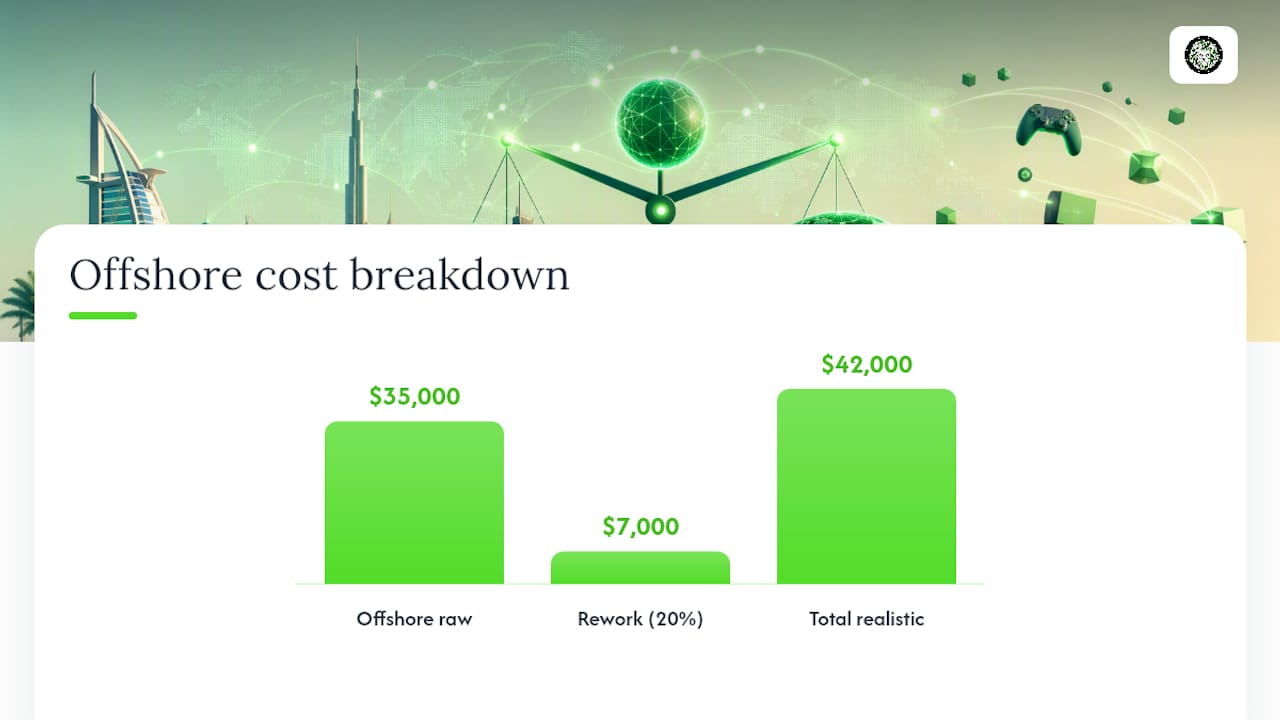
The sensitivity runs both directions. A well-scoped, stable spec and strong vendor governance can keep offshore rework near the low end of that range. A volatile spec, weak internal ownership, or a vendor with thin senior talent can push it well past 30 percent, at which point onshore or a blended model often wins on total cost, not just on speed.
How Proud Lion Studios Approaches Hybrid Delivery
The technical team works fully within the UAE, providing services across blockchain, mobile app development, AI agents, and process automation for clients spanning multiple countries. That geography matters for a specific reason: UAE-based clients get onshore-level overlap and legal familiarity, without giving up access to specialized blockchain and AI talent.
The pattern that works best isn't picking one model and forcing every project into it. It's putting an experienced lead on architecture and product decisions, then scaling build capacity up or down as the roadmap demands.
For readers evaluating a partner, the practical next step is a scoped discovery call: define the requirement volatility, name an internal product owner, and price a small pilot before committing to a full build.
Onshore vs Offshore Development: Risks You Cannot Scope Away
Every model carries risk, but the risks aren't identical. Onshore risk concentrates around cost. You'll pay more per hour, and if your internal team overscopes the project, that premium compounds fast with no cheaper fallback to fall back on.
Offshore risk concentrates around communication and enforceability. A misread requirement can survive multiple sprints before anyone catches it, especially with limited time-zone overlap. Contract enforcement is also harder across borders. If a vendor disappears or delivers work that infringes on IP protections, pursuing legal remedy in a foreign jurisdiction is slower and costlier than doing so at home.
Both models share a subtler risk: vendor turnover. Offshore firms with thin staffing pools sometimes rotate engineers off your project mid-build to serve a higher-paying client, leaving you with a ramp-up period nobody budgeted for. Onshore firms are not immune, but a smaller, more accountable talent pool and direct legal recourse make that scenario less common and easier to address quickly.
The common thread across nearly every failure story isn't the country on the map. It's the absence of a documented process for catching drift early, whether that's a missed requirement, a quality issue, or a staffing change nobody flagged in time. Buyers who build that documentation and communication cadence in from day one avoid most of what makes headlines as an "offshore horror story."
Why Cultural Differences Shape Project Outcomes More Than People Expect
Cultural friction rarely shows up as an obvious conflict. It shows up as silence, and that silence is expensive.
Many cultures place high value on avoiding direct disagreement with a client or manager. An engineer who privately doubts a requirement but doesn't feel comfortable pushing back may simply build what was asked, even when they suspect it's wrong. That dynamic can exist onshore too, but it's more common in offshore relationships where hierarchy, language nuance, or unfamiliarity with your company's norms discourage candor.
The fix isn't lecturing a vendor about communication styles. It's building structure that surfaces disagreement before it becomes a shipped bug: short daily check-ins instead of long weekly ones, written requirements paired with a quick verbal walkthrough, and explicit permission, stated early and often, for any engineer to flag a concern without waiting for a formal review.
Working hour norms differ too. A team accustomed to strict nine-to-five boundaries may interpret an urgent late-day message very differently than a team used to flexible hours. Neither approach is wrong, but mismatched expectations around responsiveness create friction that has nothing to do with skill.
The teams that navigate this well usually invest in a short onboarding period focused purely on working norms, not technical requirements, before the first sprint starts. It's a small time cost that prevents a much larger trust cost down the road.
Real Patterns Behind Onshore and Offshore Success and Failure
Success stories share a common shape: a well-documented spec, a named internal owner, and a partner given clear boundaries around what "done" means before work started. Failure stories share a different common shape, and it isn't usually about coding quality.
A frequent failure pattern looks like this: a company signs with an offshore vendor purely on price, hands over a loose product brief, and assumes the vendor will fill in the gaps the way an experienced onshore hire might. Weeks later, the delivered feature technically matches the brief but misses the actual intent, because nobody clarified the ambiguous parts in real time. Buyers who lack a clear scope or an internal lead to manage vendor delivery are the ones who tend to see this outcome, regardless of how skilled the offshore engineers were individually.
A frequent success pattern flips that structure. A nearshore or onshore lead owns the architecture and reviews work daily, offshore engineers handle clearly bounded implementation tasks, and ambiguity gets resolved through a quick call rather than a guess. The build ships close to on time because misunderstandings get caught in hours, not weeks.
The dividing line isn't the country the engineers work from. It's whether ambiguity has a fast path to resolution, and whether someone on the buyer's side is actually watching for it.
Long-Term Scalability: What Happens After Launch
Launch day is the easy part. What happens eighteen months later, when the original spec is long gone and the product has grown three feature sets past what anyone originally scoped, is where the model you chose really gets tested.
Onshore teams tend to retain institutional knowledge more reliably, largely because turnover is lower and legal employment structures create more durable relationships between engineer and company. That matters enormously for maintenance, since the person who understands why a system was built a certain way is often the fastest person to fix it when it breaks.
Offshore relationships built purely on a factory outsourcing model can struggle here. If the vendor rotates staff between projects, the engineers who understand your codebase's history may not be the ones maintaining it a year later, and rebuilding that context costs real time and money.
Blended models tend to age best. An onshore or nearshore lead who has owned the architecture from day one carries that institutional knowledge forward, even as offshore build capacity flexes up or down with demand. That structure also scales more predictably: adding capacity means adding offshore engineers under an already-established governance pattern, rather than renegotiating an entire outsourcing relationship from scratch. A custom development approach built for long-term ownership tends to outperform a one-off outsourced build precisely because someone stays accountable for the system's evolution, not just its initial delivery.
What the Data Actually Supports, and What Gets Overstated
The conventional wisdom treats this as a binary choice, onshore for quality, offshore for savings, and that framing undersells how most successful teams actually operate. The research points somewhere more specific: the model matters less than whether someone owns the architecture and whether ambiguity has a fast path to resolution. A cheap offshore rate with no internal ownership consistently costs more than a fairly priced hybrid arrangement with clear governance.
Where conventional advice falls short is in treating cost comparisons as static. A 40 to 70 percent headline savings figure assumes a stable spec and flawless communication, conditions that rarely survive an actual product roadmap. The real number that matters is the rework rate, and that number is far more controllable than most buyers realize.
If there's one priority to act on first, it's this: name an internal product owner before you sign anything, regardless of which model you choose. Everything else, the time-zone math, the contract clauses, the pilot sprint, works better once that single decision is made.
— Amal
Get a Hybrid Delivery Partner Built for This Exact Tradeoff
If the comparison above left you leaning toward a blended approach, that's the model built around every day. Instead of choosing between a distant offshore factory and an expensive local-only team, you get a UAE-based technical team leading architecture and product decisions, with the flexibility to scale build capacity for blockchain, mobile, and AI-driven work without the coordination gaps that sink fully offshore engagements.

Custom software, Web3 and smart contract engineering, mobile apps, and AI automation tools are delivered for startups and enterprises that need real ownership over their product, not just a vendor filling tickets. Modern developer tooling, including platforms like AmmarAI, increasingly helps distributed teams close the coordination gaps that used to make offshore-only builds risky.
If you're weighing your next build against the tradeoffs covered here, start with a discovery call to scope the project and price a pilot. Explore Proud Lion Studios' blockchain development services to see what a hybrid-led engagement looks like for your specific requirements.
Sources
- Offshore vs. Onshore Software Development | CodeStringers
- Offshore custom software development — Wikipedia
- UAE technology outsourcing guide — The Legal 500
FAQ
What Is the Difference Between Onshore and Offshore?
Onshore means hiring a development team in your own country with full time-zone overlap and shared legal jurisdiction. Offshore means hiring in a distant country, usually to reduce hourly rates, at the cost of overlap and, often, contract enforceability.
What Does Offshore Development Mean?
Offshore development means hiring engineers in another country, typically one with lower labor costs, to build or maintain your software. It commonly comes paired with staff augmentation or project outsourcing as the delivery structure.
What Is Offshore and Onshore in IT?
In IT, onshore refers to development work done by a team based in your own country, while offshore refers to development work done by a team based in a distant country, usually chosen for cost advantages over collaboration ease.
What Does an "Onshore Project" Mean?
An onshore project is a software or IT engagement staffed entirely by a team working in the client's own country, which preserves full time-zone overlap and keeps the engagement under familiar legal and regulatory jurisdiction.
Is Nearshore Always Cheaper Than Onshore?
Nearshore rates typically fall between onshore and offshore, giving most of the collaboration benefit of onshore work at a lower cost, which is why it's a common choice for collaboration-heavy projects on tighter budgets.