
A multi-agent system (MAS) is a collection of autonomous software or physical agents that perceive a shared environment, pursue individual or collective goals, and coordinate through explicit communication to solve problems no single agent handles efficiently. Google Cloud defines MAS as multiple autonomous, interacting agents in a shared environment and recommends orchestration and standard communication protocols for practical deployments. The core strengths are scalability, resilience, and modularity. The core trade-offs are coordination complexity and testing overhead.
If you are deciding whether MAS fits your problem, here are three concrete signals:
- Robotics swarms: Dozens of warehouse robots divide pick-and-place tasks, reroute around failures, and finish orders faster than any single-controller design could manage.
- Distributed automation: Separate agents handle data ingestion, validation, transformation, and reporting in parallel, each with a bounded scope and a clear handoff contract.
- LLM-based ensembles: A root model spawns specialized subagents for research, drafting, and fact-checking, then aggregates their outputs into a single verified response.
A 2025 coordination survey on arXiv identifies coordination as the central MAS problem and flags hybrid hierarchical/decentralized coordination, human-MAS coordination, and LLM-based agent teams as the most active research directions right now. If your system fits any of the three patterns above, read on.
Key Takeaways
Multi-agent systems deliver scalability, resilience, and modularity for problems that can be decomposed into specialized agent roles, but they require explicit coordination protocols, bounded agent contexts, and production-grade observability to succeed.
| Point | Details |
|---|---|
| Coordination is the core problem | Design your communication protocol and Coordination Sessions before writing agent logic. |
| Architecture drives trade-offs | Centralized patterns are easiest to audit; decentralized and hierarchical patterns scale better under load. |
| CTDE is the standard MARL pattern | Centralized training with decentralized execution gives agents global information during training and local execution at runtime. |
| Bounded contexts prevent failures | Isolate each sub-agent's task data; shared mutable state is the leading cause of production MAS bugs. |
| Proud Lion Studios builds end-to-end | From agent role design and MARL pipelines to blockchain coordination layers and mobile operator interfaces. |
Table of Contents
- What makes up a multi-agent system?
- How do you choose the right MAS architecture?
- How do agents coordinate, compete, and produce emergent behavior?
- Which algorithms power multi-agent coordination?
- Where are multi-agent systems already working?
- What tools do engineers use to build MAS?
- What engineering practices keep MAS testable and maintainable?
- How do you build your first MAS prototype?
- What challenges should you plan for in production MAS?
- What we have learned building MAS in production
- How Proud Lion Studios builds agent systems for your business
- Sources
What makes up a multi-agent system?
Every MAS is assembled from six building blocks. Getting these right before writing a single line of code saves weeks of rework.
Agents
An agent is an autonomous entity with an internal state, a goal or objective function, a policy for choosing actions, and the ability to act without continuous human direction. Agents can be pure software processes, physical robots, or LLM-powered reasoning modules. The key design decision is how much autonomy each agent holds: a fully autonomous agent acts on its own judgment; a semi-autonomous agent escalates edge cases to a human or an orchestrator. For more on how individual agents are structured, the AI agents explainer from Proud Lion Studios covers the internal architecture in depth.
Environment
The environment is everything the agents act on and within. Specify it along three axes: observability (can an agent see the full state or only a partial view?), resources (shared, exclusive, or contested?), and constraints (physical laws, API rate limits, regulatory rules). A partially observable environment almost always requires agents to maintain belief states and share observations, which directly shapes your communication design.
Communication channels and protocols
Agents exchange information through message passing, shared memory, or blackboard architectures. Google Cloud recommends FIPA ACL and JSON/XML over HTTP or MQTT as practical starting points. FIPA ACL structures messages with performatives (inform, request, propose, accept) that make intent explicit. MQTT suits high-frequency, low-latency telemetry between physical agents. HTTP/REST works well for loosely coupled software agents where latency is not the binding constraint.
Sensors and actuators
Sensors feed agents their perception of the environment: camera feeds, database queries, API responses, or sensor arrays. Actuators are how agents change the environment: motor commands, API calls, database writes, or messages to other agents. Signal latency matters here. A perception pipeline that adds 200ms of delay is fine for a document-processing agent but fatal for a real-time trading agent.
Goals and policies
Each agent needs a clearly specified goal (what it is optimizing for) and a policy (how it selects actions given its current state and observations). Goals can be individual, shared, or conflicting. Misaligned goals between agents are one of the most common sources of emergent failures in production MAS.
Human and external system interfaces
Most production MAS need an operator console for monitoring and override, plus API endpoints for integration with upstream data sources and downstream consumers. Design these interfaces before the agent logic, not after. They define the observability surface your team will rely on when something goes wrong.
Pro Tip: Specify the communication protocol and message schema before you write agent logic. Retrofitting a protocol onto agents that already share mutable state is the single most expensive refactor in MAS development.
How do you choose the right MAS architecture?
Architecture choice drives everything downstream: latency, fault tolerance, governance overhead, and how easily you can add or remove agents. The five patterns below cover most production scenarios.
Centralized orchestration
One orchestrator holds the global plan and dispatches tasks to worker agents. This is the easiest pattern to reason about and debug. The orchestrator is also a single point of failure and a throughput bottleneck at scale. Use it when you need strict ordering guarantees or when a human needs a single control point.
Decentralized coordination
Agents negotiate directly with peers, with no central authority. This pattern is fault-tolerant and scales horizontally, but coordination logic is distributed across every agent, making it harder to audit. Use it for large swarms where the orchestrator would become a bottleneck, or where network partitions are likely.
Hierarchical and hybrid
A hierarchy layers orchestrators: a top-level planner breaks goals into subgoals, mid-level coordinators manage clusters of agents, and leaf agents execute tasks. Hybrid designs combine a lightweight central planner with decentralized execution at the leaf level. This is the pattern the 2025 arXiv survey highlights as the most promising direction for production MAS.
Holonic structures
Holons are agents that can act as individuals or as a collective. A team of delivery robots might form a holon that negotiates as a single entity with a warehouse management system, then decompose back into individuals for execution. Holonic structures handle dynamic role assignment well but add significant design complexity.
Coalitions and teams
Agents form temporary coalitions to tackle tasks that exceed any single agent's capability, then dissolve when the task is complete. Coalition formation requires a mechanism for agents to advertise capabilities, evaluate partners, and agree on a joint plan, typically through auction or contract-net protocols.
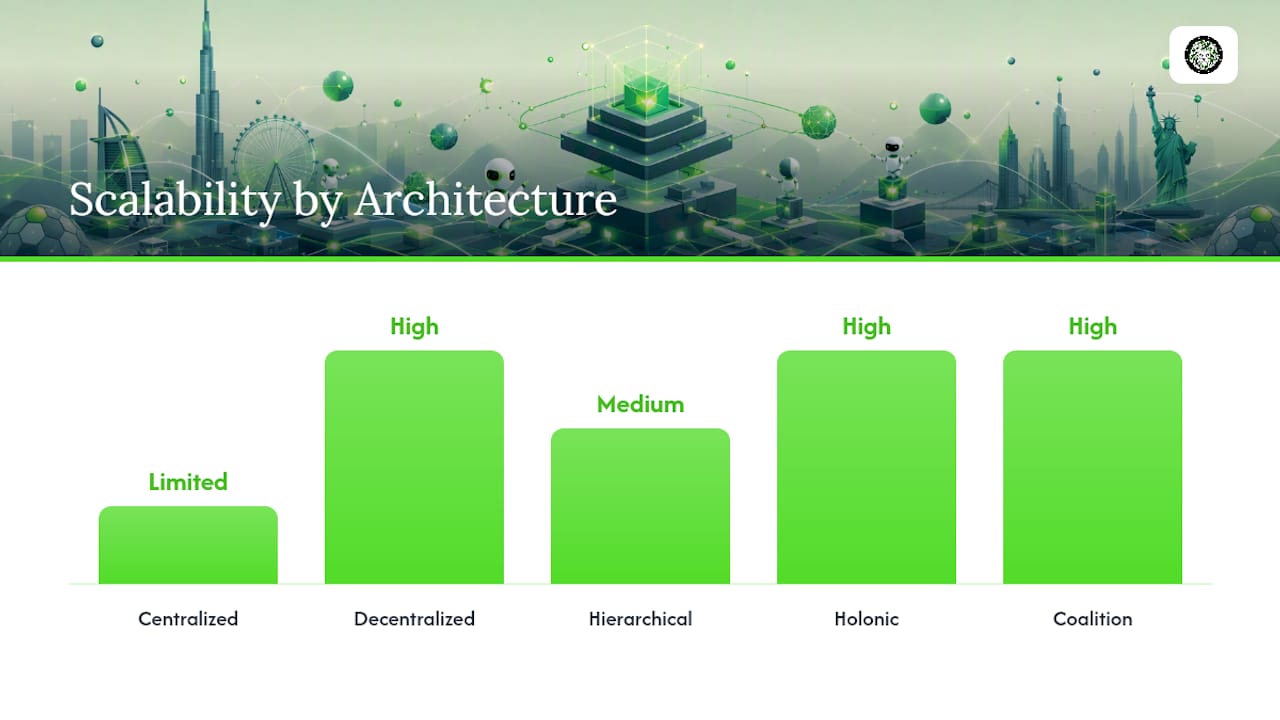
| Architecture | Latency | Scalability | Fault Tolerance | Governance Complexity |
|---|---|---|---|---|
| Centralized | Low | Limited | Low | Low |
| Decentralized | Variable | High | High | High |
| Hierarchical | Medium | Medium | Medium | Medium |
| Holonic | Medium | High | High | Very High |
| Coalition | Variable | High | Medium | High |
The MAAI framework published in Electronic Markets adds a useful lens: it layers MAS from foundation models at the base through perception/action, dynamic orchestration, agent-integrated workflows, and interaction interfaces at the top. Mapping your system to these five layers before picking an architecture pattern helps surface governance and observability gaps early.
Practical guidance for architecture selection:
- Latency-sensitive systems (real-time trading, robotics control loops): prefer decentralized or hierarchical with thin orchestration layers.
- Safety-critical systems (medical devices, autonomous vehicles): prefer centralized or hierarchical with explicit override paths and auditable logs.
- Scale-driven systems (large-scale data pipelines, swarm robotics): prefer decentralized or holonic with coalition formation.
How do agents coordinate, compete, and produce emergent behavior?
Coordination is where MAS either earn their complexity cost or collapse under it. The Alan Turing Institute frames coordination, communication, and incentive alignment as the three core technical problems in MAS research.
Coordination primitives
The building blocks of agent coordination are:
- Signals: Broadcast state updates that any agent can observe (ambient, non-binding).
- Proposals and contracts: Structured offers that require explicit acceptance before binding either party.
- Auctions: Competitive allocation mechanisms where agents bid for tasks or resources; the contract-net protocol is the classic MAS implementation.
- Quorum and voting: Consensus mechanisms where a threshold of agents must agree before a collective action is taken.
Behavioral patterns
- Leader-follower: One agent sets direction; others track and adapt. Simple but brittle if the leader fails.
- Stigmergy: Agents communicate indirectly through environment modifications, as ants do with pheromone trails. Scales well; produces emergent path optimization without explicit messaging.
- Consensus: Agents iteratively share and average beliefs until they converge on a shared state estimate. Common in distributed sensor fusion.
- Role-based delegation: Agents are assigned or self-select roles (planner, executor, monitor) based on capability or availability.
Emergent behavior and failure modes
Emergence is the system-level behavior that arises from local agent interactions, not from any central design. Positive emergence includes efficient task allocation and adaptive routing. Negative emergence includes unintended clustering (agents pile onto the same resource), oscillation (agents repeatedly reverse decisions), and starvation (low-priority agents never get resources).
Pro Tip: The MACP open standard mandates explicit, bounded Coordination Sessions and separates ambient signals from binding sessions. Adopt this separation from day one. Ambient signals inform; binding sessions commit. Mixing the two is the most common source of state drift in production MAS.
Which algorithms power multi-agent coordination?
Algorithm selection depends on whether your problem is primarily a learning problem, a planning problem, or an optimization problem.
Multi-agent reinforcement learning (MARL)
MARL trains agents to maximize cumulative reward through environment interaction. The dominant engineering pattern is centralized training with decentralized execution (CTDE): agents share a joint critic during training (giving each agent global information) but execute using only local observations at runtime. Common MARL algorithms include MADDPG (continuous action spaces), QMIX (cooperative tasks with factored value functions), and MAPPO (proximal policy optimization extended to multi-agent settings).
Use MARL when:
- The optimal policy cannot be specified by hand.
- The environment is dynamic and agents must adapt.
- You have a simulation environment to generate training data safely.
Game-theoretic methods
Game theory provides solution concepts (Nash equilibrium, correlated equilibrium, Pareto optimality) and mechanism design tools for aligning agent incentives. Auction mechanisms and contract-net protocols are direct applications. Use game-theoretic methods when agents have competing objectives and you need provable incentive guarantees, such as in automated trading or resource allocation.
Planning and search
Distributed planning decomposes a global plan into agent-specific subplans and coordinates their execution. Distributed Constraint Optimization Problems (DCOPs) formalize this as a constraint satisfaction problem across agents. Use planning methods when the environment is relatively static and the optimal action sequence can be computed offline or with short lookahead.
When to use which approach
- Rules-based policies: Use when the domain is well-understood, the state space is small, and you need predictable, auditable behavior.
- Optimization (DCOPs, linear programming): Use when the problem has a clear objective function and constraints that can be formalized.
- Learning (MARL): Use when the environment is too complex or dynamic for hand-crafted rules.
Evaluation metrics
Assess MAS algorithm performance on: system-level cumulative reward, per-agent fairness (Jain's fairness index), robustness to agent failures, sample efficiency (training steps to convergence), and coordination latency (time from task assignment to completion).
Where are multi-agent systems already working?
Theory earns its keep in production. Here are the domains where MAS patterns are delivering measurable results.
- Warehouse robotics: Fleets of autonomous mobile robots coordinate pick paths, avoid collisions, and rebalance load across zones using decentralized coordination with a thin central traffic manager. The Alan Turing Institute cites multi-robot factories as a primary MAS application area.
- Autonomous vehicles: Each vehicle is an agent perceiving its local environment; V2V (vehicle-to-vehicle) communication enables cooperative lane merging and intersection negotiation without a central traffic controller.
- Automated trading: Specialized agents handle market data ingestion, signal generation, order routing, and risk monitoring in parallel. Latency is the binding constraint; agents communicate over shared memory rather than network sockets.
- LLM-based agent ensembles: A root model spawns subagents for research, drafting, and verification. OpenAI's multi-agent API provides primitives like
spawn_agent,send_message, andwait_agentfor exactly this pattern, with a recommended default concurrency of three subagents for most workloads. - Smart grid management: Agents representing generation, storage, and consumption nodes negotiate energy dispatch in real time, balancing supply and demand without a central dispatcher.
- Conversational AI platforms: Multi-agent architectures power AI chat and conversational solutions where routing agents, knowledge agents, and response agents collaborate to handle complex user queries. Real-world deployments in decentralized networks are also advancing, as seen in Roam's agent architecture across decentralized infrastructure.
For a broader catalog of agent patterns mapped to specific domains, the examples of AI agents guide covers decision criteria for selecting the right pattern per use case.
What tools do engineers use to build MAS?
The toolchain for MAS development spans agent frameworks, MARL libraries, message transports, and simulation environments.
Frameworks and runtimes
- LangGraph: Python-based graph execution framework for LLM agent workflows; supports stateful, cyclical agent graphs with built-in persistence and human-in-the-loop nodes.
- AutoGen (Microsoft): Multi-agent conversation framework where agents are defined as conversable entities; supports group chat, nested chats, and tool use.
- CrewAI: Role-based multi-agent orchestration with explicit task delegation and sequential or parallel execution modes.
- Ray RLlib: Distributed MARL library built on Ray; supports MADDPG, QMIX, MAPPO, and custom multi-agent environments at scale.
- PettingZoo: Standard Python API for multi-agent environments, analogous to Gymnasium for single-agent RL; widely used for MARL research and benchmarking.
Simulation environments
- CARLA: Open-source autonomous driving simulator with multi-agent vehicle and pedestrian support; physics-accurate and sensor-rich.
- StarCraft II (PySC2): Large-scale multi-agent benchmark used to develop and test MARL algorithms under partial observability and competitive dynamics.
- NetLogo: Agent-based modeling platform for social and biological simulations; excellent for prototyping stigmergic and emergent behaviors.
- Gazebo / ROS 2: Standard robotics simulation stack for multi-robot coordination; integrates with physical hardware for sim-to-real transfer.
Message transports
MQTT handles high-frequency telemetry between physical agents. Apache Kafka suits event-driven MAS with durable, replayable message logs. gRPC works well for low-latency RPC between software agents in the same data center.
| Tool | Language | Distributed | Simulation | Primary Use Case |
|---|---|---|---|---|
| LangGraph | Python | Partial | No | LLM agent workflows |
| AutoGen | Python | Partial | No | Conversational MAS |
| Ray RLlib | Python | Yes | Via PettingZoo | MARL training at scale |
| PettingZoo | Python | No | Yes | MARL benchmarking |
| NetLogo | NetLogo | No | Yes | Agent-based modeling |
| Gazebo/ROS 2 | C++/Python | Yes | Yes | Multi-robot systems |
For a hands-on walkthrough of setting up an agent development environment, the custom AI agent development guide covers implementation and deployment patterns in detail.
What engineering practices keep MAS testable and maintainable?
MAS fail in production not because the algorithms are wrong but because the engineering discipline around them is insufficient. These practices close that gap.
Design checklist
- Define agent boundaries: each agent owns exactly one responsibility and one data scope.
- Specify failure modes: what does each agent do when its upstream source is unavailable, returns malformed data, or times out?
- Design observability first: every agent emits structured logs with a correlation ID that traces a task across the full agent graph.
- Define replayability: can you replay a coordination session from logs to reproduce a bug? If not, you cannot debug production failures.
- Specify governance policies: who can add, remove, or modify an agent in production, and what approval is required?
Testing strategy
- Unit tests: Test each agent's decision logic in isolation with mocked inputs and outputs.
- Integration tests: Run two or more agents against simulated peers to verify protocol compliance and message schema correctness.
- Chaos tests: Randomly kill agents, inject malformed messages, and introduce network delays to verify that the system degrades gracefully rather than catastrophically.
- Load tests: Run the full agent graph at 2x and 5x expected message volume to identify coordination bottlenecks before they appear in production.
Monitoring and metrics
Track these signals in production: system-level task completion rate, per-agent error rate, coordination latency (time from task dispatch to result aggregation), message queue depth, and agent restart frequency. Set alerts on coordination latency and queue depth; these are the earliest indicators of emergent coordination failures.
Deployment and isolation
Deploy agents as independent services with separate resource quotas. OpenAI's multi-agent documentation recommends bounded per-agent contexts to prevent context interference, where one agent's task data bleeds into another's reasoning. Isolate each sub-agent's task data at the deployment boundary, not just in code. Use feature flags to enable or disable individual agents without redeploying the full system.
The MACP standard enforces a clean separation between ambient signals and binding Coordination Sessions, which makes audit logs tractable and simplifies compliance reviews.
How do you build your first MAS prototype?
A small team can move from concept to a working prototype in a focused two-week sprint using this sequence.
Step-by-step roadmap
- Define the problem spec. Write one sentence: "Agent A does X, Agent B does Y, and the system succeeds when Z." If you cannot write this sentence, you are not ready to build.
- Assign agent roles. List every agent, its single responsibility, its inputs, and its outputs. No agent should have more than one primary responsibility at the prototype stage.
- Design the communication protocol. Choose a message transport (HTTP/REST for simplicity, MQTT for telemetry). Define your message schema in JSON. Specify which messages are ambient signals and which are binding coordination requests.
- Build and test agents in isolation. Write unit tests for each agent before connecting them. A passing unit test suite is your checkpoint before integration.
- Connect agents in simulation. Use PettingZoo, NetLogo, or a simple Python event loop to run agents against each other. Log every message with a correlation ID.
- Define validation metrics. Before running the simulation, specify what "passing" looks like: task completion rate above a threshold, coordination latency below a ceiling, zero unhandled exceptions.
- Run chaos tests. Kill one agent mid-task. Inject a malformed message. Verify the system recovers or fails gracefully.
- Deploy with isolation. Package each agent as a separate container. Use environment variables for configuration; never hardcode agent addresses.
Pseudo-code: spawn, dispatch, and aggregate
# Root orchestrator pattern
root_agent = Agent(role="orchestrator")

subagents = [
    root_agent.spawn_agent(role="researcher", context=task_context),
    root_agent.spawn_agent(role="drafter",    context=task_context),
    root_agent.spawn_agent(role="verifier",   context=task_context),
]

results = root_agent.wait_all(subagents, timeout=30)
final_output = root_agent.aggregate(results)
This pattern maps directly to OpenAI's multi-agent primitives (spawn_agent, send_message, wait_agent). Keep concurrent subagents at a moderate number for most prototype workloads; add more only after profiling shows the bottleneck is agent count, not coordination overhead.
What passing looks like in early tests
- Task completion rate: above 95% under normal load.
- Coordination latency: within 2x of single-agent baseline for the same task.
- Zero silent failures: every agent error surfaces in the log with a correlation ID.
Pro Tip: Enforce bounded coordination sessions from the first prototype. Give each sub-agent its own isolated context and task data. Shared mutable state between agents is the fastest path to bugs that are impossible to reproduce in testing but appear constantly in production.
For a deeper hands-on walkthrough, the custom AI agent tutorial covers building a full agent from scratch with working code examples.
What challenges should you plan for in production MAS?
Building a prototype is straightforward. Keeping a MAS reliable, fair, and secure at production scale is where the hard problems live.
- Scalability and communication bottlenecks. Message volume grows quadratically with agent count in fully connected topologies. Mitigate with sparse communication graphs, gossip protocols, or hierarchical aggregation layers that reduce the number of direct agent-to-agent connections.
- Heterogeneity. Real production MAS often mix agents running different models, on different hardware, with different latency profiles. Define a common interface contract (message schema, timeout expectations, error codes) that every agent must satisfy regardless of its internal implementation.
- Evaluation and reproducibility. MARL-based MAS are notoriously hard to reproduce across runs due to non-stationarity: each agent's policy changes as other agents learn, shifting the environment every other agent perceives. Fix random seeds, log hyperparameters, and version your simulation environments alongside your model checkpoints.
- Security and trust. A malicious or compromised agent can inject false signals, manipulate auctions, or corrupt shared state. Mitigate with signed messages, agent authentication, rate limiting on coordination requests, and anomaly detection on per-agent behavior. The MAAI framework in Electronic Markets explicitly flags socio-technical governance as a requirement for production MAAI deployments, not an afterthought.
- Human-MAS coordination. As MAS take on more autonomous decision-making, the interface between human operators and agent teams becomes a safety-critical design problem. Build explicit override paths, escalation thresholds, and human-readable audit logs into the architecture from the start.
- LLM-based MAS governance. LLM agents introduce non-determinism, prompt injection risks, and context window constraints that traditional MAS theory does not address. The 2025 arXiv coordination survey identifies LLM-based MAS as a key open research direction precisely because existing coordination theory does not fully transfer to probabilistic, token-limited agents.
- On-chain coordination patterns. When MAS coordinate through verifiable, on-chain mechanisms, smart contract development becomes part of the agent engineering stack, adding auditability but also gas cost and latency constraints that must be factored into the coordination design. Industry partnerships like Agentum and Delphi AI are actively advancing this frontier.
What we have learned building MAS in production
The gap between a working MAS prototype and a production-grade system is almost always a governance and observability gap, not an algorithm gap. The teams that struggle most are those that spend the first sprint perfecting agent logic and the last sprint scrambling to add logging, override paths, and failure recovery. The teams that ship reliably invert that order: they design the observability surface and the coordination protocol first, then fill in the agent logic.
At Proud Lion Studios, we have seen this pattern across AI agent automation engagements: the clients who arrive with a clear problem decomposition and a defined success metric move from prototype to production in weeks. Those who arrive with a vague "make it agentic" mandate spend months discovering that the hard problem was never the AI, it was the coordination contract and the failure mode specification.
The most underrated investment in any MAS project is the chaos test suite. Run it before you demo. Run it before you deploy. The emergent failures it surfaces will be the ones your users would have found first.
How Proud Lion Studios builds agent systems for your business
If you are ready to move from prototype to production, Proud Lion Studios brings end-to-end agent engineering capability to your project.
We design and build custom MAS architectures, from LLM-based agent ensembles for document and data workflows to multi-robot coordination systems and on-chain agent governance layers. Our services cover agent role design, communication protocol specification, MARL training pipelines, observability infrastructure, and full deployment on your cloud or on-premise environment. For projects that require verifiable coordination or tokenized incentive mechanisms, our blockchain development services integrate directly with the agent engineering stack. For teams that need a mobile operator interface for their MAS, our mobile app development team) builds the control and monitoring layer alongside the agent backend.
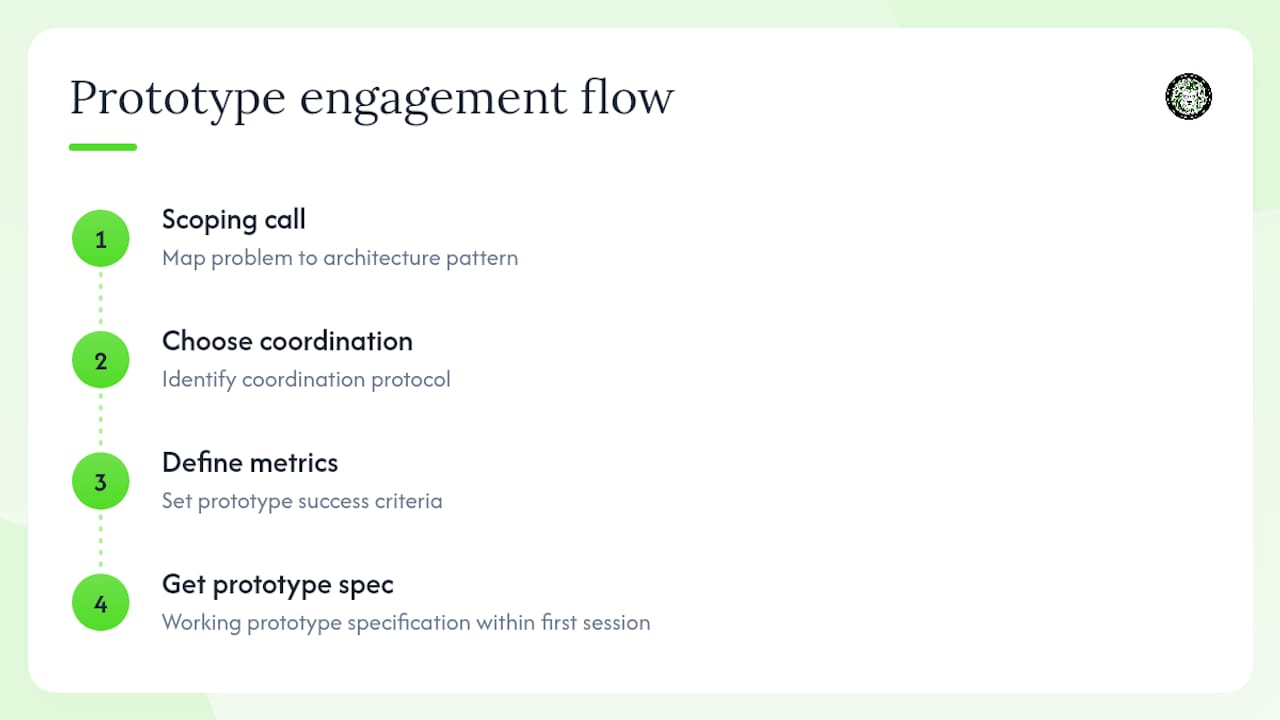
The fastest way to start is a scoping call where we map your problem to an architecture pattern, identify the coordination protocol, and define the prototype success metrics. Reach out to Proud Lion Studios to book that call and get a working prototype specification within the first session.
Sources
These sources back the claims in this guide and give you the depth to go further on any subtopic.
- Multi-Agent Coordination across Diverse Applications: A Survey (arXiv)
- What is a multi-agent system in AI? | Google Cloud
- Multi-agent systems | The Alan Turing Institute