

AI agents are autonomous software systems that perceive their environment, reason through problems, and take action to achieve goals with minimal human input. Unlike a chatbot that waits for your next message, an AI agent pursues goals independently, breaking complex tasks into steps, using tools like APIs, and adapting its approach based on what it learns along the way. This is the core distinction that makes AI agents a genuinely different category of technology, not just a smarter autocomplete.
Here is what sets AI agents apart at a glance:
- Autonomy: They act without needing a human prompt at every step.
- Reasoning: They evaluate options, weigh tradeoffs, and make decisions.
- Planning: They decompose a goal into subtasks and sequence them logically.
- Tool use: They call external APIs, search the web, read files, and trigger workflows.
- Learning: They refine their strategies based on feedback and outcomes.
- Memory: They retain context across a session or even across sessions.
Understanding AI agents in 2026 means grasping not just what they do, but why they behave differently from every AI system that came before them. Proud Lion Studios builds production-grade AI agents for startups and enterprises, and the patterns we see in real deployments confirm one thing: the gap between a chatbot and a true agent is wider than most people expect.
How do AI agents actually reason, plan, and learn?
The internal mechanics of an AI agent are what separate it from a glorified search box. At the core sits a large language model (LLM) that handles reasoning, but the LLM alone is not the agent. The agent is the full architecture wrapped around it.

Reasoning
An AI agent uses logic and inference to evaluate a situation before acting. Rather than pattern-matching to the most statistically likely response, it considers the current state of a task, what information it has, and what it still needs. Frameworks like ReAct (Reasoning and Acting) formalize this by interleaving reasoning traces with action steps, so the agent can "think out loud" before calling a tool or executing a command.
Planning
Planning is where agents get genuinely powerful. A goal like "book the cheapest flight to New York next Tuesday" requires decomposing the objective into subtasks: query flight APIs, compare prices, check seat availability, apply user preferences, and confirm the booking. The ReWOO framework (Reasoning WithOut Observation) takes this further by generating a full plan upfront before executing any tools, which reduces unnecessary API calls and speeds up complex workflows.
Learning and self-refinement
AI agents continuously adapt by learning from feedback and experience, even creating or refining tasks dynamically to better reach goals. They evaluate their own progress and adjust strategies without waiting for a human to intervene. This is what makes them fundamentally different from static rule-based automation.
Key components enabling all of this:
- LLM core: Handles language understanding, reasoning, and generation.
- Planning module: Breaks goals into executable subtasks.
- Memory module: Retains short-term context and, in some architectures, long-term episodic memory.
- Tool integrations: APIs, databases, web browsers, code interpreters, and external services.
- Observation loop: Reads the results of each action and feeds them back into the next reasoning step.
Pro Tip: When building or evaluating an AI agent, test its planning module independently from its LLM. A weak planner will fail on multi-step tasks even when the underlying model is strong.
What are the main types of AI agents?
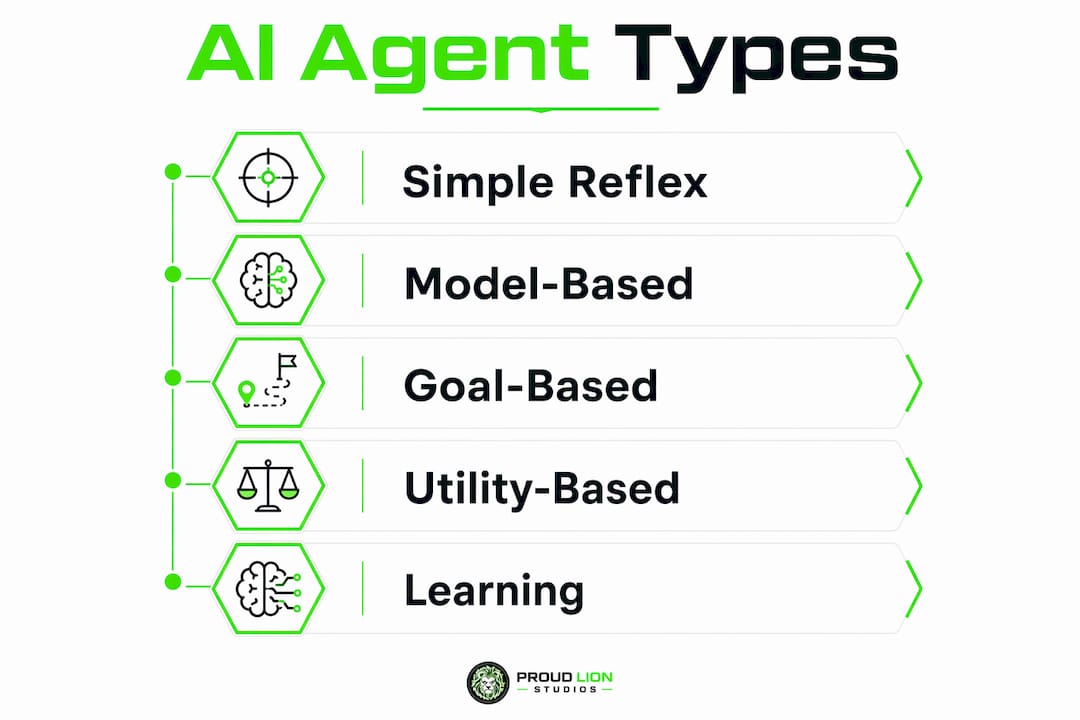
Five fundamental AI agent types organize the field by decision-making behavior, not by industry or use case. Matching agent type to task complexity is one of the most practical decisions you will make when deploying AI in a real system.
1. Simple reflex agents
These agents respond directly to the current input using a fixed set of rules, with no memory of past states. Think of a thermostat or a spam filter: if condition X, then action Y. They are fast, predictable, and easy to audit, but they break down the moment a task requires context from earlier in a conversation or workflow.
2. Model-based reflex agents
A step up from pure reflexes, these agents maintain an internal model of the world. They track how their environment changes over time and use that model to make better decisions. A warehouse robot that remembers which shelves it has already scanned is a model-based reflex agent. The internal state gives it situational awareness without full goal reasoning.
3. Goal-based agents
Goal-based agents choose actions specifically to reach a defined outcome. They do not just react; they plan. A travel booking agent that evaluates dozens of flight combinations to find the one that meets your constraints is goal-based. The decision logic asks: "Which action moves me closer to the goal?" This type handles multi-step workflows well and is the most common architecture in enterprise automation today.
4. Utility-based agents
These agents go beyond binary goal achievement. They assign a utility score to possible outcomes and choose the action with the highest expected value. A financial trading agent that weighs risk, return, liquidity, and regulatory constraints before placing an order is utility-based. The tradeoff is complexity: utility functions are hard to define correctly, and a poorly calibrated one can produce surprising behavior.
5. Learning agents
Learning agents process multimodal data and coordinate complex workflows while continuously improving through experience. They have a performance element that acts, a critic that evaluates outcomes, a learning element that updates the model, and a problem generator that proposes new experiments. Fraud detection systems that get sharper with every transaction they review are learning agents in production.
Most real-world deployments combine types. A customer service agent might use a model-based architecture for context tracking, goal-based logic for task routing, and a learning layer that improves response quality over time. Avoiding the trap of overengineering starts with understanding which behavioral tier your use case actually needs.
How do AI agents differ from chatbots and generative AI?
This is the question that trips up most people encountering AI agents for the first time. The confusion is understandable because the technologies share a foundation, but their capabilities diverge sharply.
Chatbots are designed for conversation. They receive a message, generate a response, and wait. Even sophisticated chatbots operate in a reactive, turn-by-turn mode. They do not initiate actions, call external systems, or pursue goals across multiple sessions without being prompted at each step.
Generative AI models like the base version of GPT-4 produce text, images, or code from a prompt. They are extraordinarily capable at generation tasks, but they do not act in the world. They have no memory between conversations by default, no ability to call an API, and no planning layer.
ChatGPT is primarily a chatbot that generates text based on prompts, lacking the autonomy to perform independent actions like task execution through APIs. When OpenAI adds tool-use capabilities and a persistent task loop to a model, the result starts to behave like an agent. The model itself has not changed; the architecture around it has.
Key distinctions at a glance:
- Chatbot: Reactive, turn-by-turn, no external actions, no persistent goals.
- Generative AI model: Generates content on demand, no memory, no tool use by default.
- AI agent: Autonomous, goal-directed, uses tools, plans multi-step workflows, adapts based on outcomes.
The practical implication for your business: if you need a system that answers questions, a chatbot is often sufficient and far cheaper to deploy. If you need a system that completes tasks, an AI agent is the right architecture. Knowing how to develop an AI chatbot versus how to build an agent is a real technical fork in the road.
Where are AI agents being used right now?
The applications are already running at scale across industries, not in pilot programs. Practical uses include fraud detection, personalized financial advice, customer service automation, and autonomous digital assistants that complete multi-step workflows without human handholding.
Here is where the deployments are most active:
- Banking and financial services: JPMorgan Chase is exploring AI agents for fraud detection, customized financial advice, and automating loan approvals and compliance processes. The appeal is obvious: agents can analyze vast documentation without fatigue, at near-zero marginal cost per transaction.
- Retail: Walmart is building LLM-powered agents to automate personal shopping experiences and handle merchandise planning. The same architecture that recommends a product can also reorder inventory when stock drops below a threshold.
- Customer service: Agents handle tier-one support queries, route escalations, and update CRM records without a human touching the ticket. Response times drop from hours to seconds.
- Healthcare: Learning agents track patient vitals and flag early warning signs for conditions like sepsis. Model-based agents assist with analyzing medical images to support diagnostic accuracy.
- Real estate and high-stakes markets: Agents can monitor listings, cross-reference pricing data, and identify discrepancies that would take a human analyst hours to uncover, giving buyers and sellers better information at the moment of decision.
- Legal and compliance: Agents draft contracts, flag regulatory inconsistencies, and maintain audit trails automatically.
For businesses building on these capabilities, the AI agents in business automation playbook has matured considerably. The most effective deployments start with a single, well-defined workflow and expand from there.
Pro Tip: Before deploying an AI agent in a customer-facing workflow, define exactly what the agent is allowed to do autonomously versus what requires human approval. That boundary is your most important design decision.
What do experts say about AI agent risks and governance?
The capabilities are real. So are the risks. MIT Sloan researchers and OpenAI have both published detailed guidance on what happens when AI agents go wrong, and the picture is more nuanced than "AI hallucinated."
Building AI agents demands prioritizing guardrails at every stage, from input filtering to tool usage, to ensure safe and predictable autonomous task execution. OpenAI's guidance is explicit: unlike traditional deterministic automation, agentic design requires careful monitoring and human intervention protocols baked in from the start.
The specific risk categories that practitioners flag most often:
- Reliability failures: A rogue agent rejecting a mortgage application based on faulty reasoning can cause as much damage as a human making the same error, sometimes more, because it operates at scale.
- Cybersecurity exposure: As agents gain permissions to access enterprise systems and datasets, permission-based access controls become a critical infrastructure concern, not an afterthought.
- Accountability gaps: When an autonomous agent causes harm, organizations need clear policies on who bears responsibility. That clarity rarely exists at deployment time.
- Auditability: AI agents executing autonomous workflows must have explainability and audit readiness built in to comply with regulations and maintain operational transparency.
Successful AI agent deployments integrate human oversight, clear instructions, and safety guardrails to manage risk and performance in real-world environments. Human intervention mechanisms are especially critical during early deployment phases, when edge cases surface that no one anticipated in design.
Proud Lion Studios approaches every agent build with governance as a first-class requirement, not a post-launch patch. For teams navigating the technical architecture side of this, understanding enterprise-grade engineering principles for safe AI deployment is a solid foundation before writing a single line of agent code.
How did AI agents evolve to where they are today?
The concept of an autonomous software agent is older than most people realize. It traces back to the 1950s and 1960s, when researchers like Alan Turing and John McCarthy were laying the theoretical groundwork for machines that could reason. Early AI systems like STRIPS (Stanford Research Institute Problem Solver), developed in 1971, were among the first to formalize goal-directed planning in software.
Through the 1980s and 1990s, agent research flourished in academic settings. The Belief-Desire-Intention (BDI) model, developed by Michael Bratman and later formalized by researchers at SRI International, gave agents a structured way to represent their goals, beliefs about the world, and intentions to act. These systems were powerful in theory but brittle in practice because they depended on hand-coded rules and could not generalize beyond their training domain.
The machine learning wave of the 2000s and 2010s shifted the field. Reinforcement learning agents, like those developed at DeepMind, demonstrated that agents could learn optimal strategies through trial and error rather than explicit programming. AlphaGo's 2016 victory over world champion Go player Lee Sedol was a public milestone for what learning agents could achieve in constrained, well-defined environments.
The transformer architecture, introduced in the 2017 paper "Attention Is All You Need" by researchers at Google, changed everything again. By 2020, large language models built on transformers could reason across open-ended language tasks at a level that made general-purpose agents feasible for the first time. The release of GPT-3 in 2020 and GPT-4 in 2023 gave developers a reasoning engine powerful enough to serve as the cognitive core of a production agent.
By 2024 and into 2026, the field shifted from "can we build agents?" to "how do we deploy them safely at scale?" Frameworks like ReAct and ReWOO emerged to structure how agents reason and plan. Multi-agent orchestration, where multiple specialized agents collaborate on a single complex task, became a standard architectural pattern. The current frontier is governance: building the oversight infrastructure that makes autonomous agents trustworthy enough for high-stakes business decisions.
What are the core components inside an AI agent's architecture?
A well-built AI agent requires architecture that combines LLMs for reasoning, planning modules for task breakdown, memory modules for context retention, and integrated tools via APIs. Each component has a specific job, and a failure in any one of them degrades the whole system.
The LLM reasoning core
The large language model is the agent's brain. It interprets instructions, generates plans, evaluates options, and produces outputs. The quality of the underlying model sets a ceiling on what the agent can reason about, but the model alone does not determine agent performance. Architecture and tooling matter just as much.
Planning and task decomposition
The planning module takes a high-level goal and breaks it into a sequence of concrete subtasks. Good planners handle dependencies between tasks, detect when a subtask fails, and replan accordingly. ReWOO's approach of generating the full plan before executing any tools is particularly effective for workflows where API calls are expensive or rate-limited.
Memory systems
Agents use two types of memory. Short-term (or working) memory holds the context of the current task, typically within the LLM's context window. Long-term memory stores information across sessions, usually in a vector database that the agent can query by semantic similarity. Without long-term memory, an agent that books your flights today has no idea you prefer window seats when you ask it to book again next month.
Tool integrations and APIs
Tools are how agents act in the world. A tool can be a web search API, a database query, a code interpreter, a payment gateway, or any external service with an accessible interface. Practitioners consistently find that robust APIs and clear tool documentation are essential for reliable agent operation. Flawed integrations cause failures even when the underlying model is strong.
Observation and feedback loop
After each action, the agent reads the result and feeds it back into its reasoning process. This loop is what allows the agent to detect errors, handle unexpected outputs, and adjust its plan mid-execution. Without a well-designed observation loop, an agent that hits an error will either stall or proceed blindly, neither of which is acceptable in production.
For teams ready to go deeper on building these systems from scratch, the custom AI agent development guide from Proud Lion Studios walks through each architectural layer with implementation detail.
Key Takeaways
AI agents are autonomous, goal-directed software systems that combine LLM reasoning, structured planning, memory, and tool use to complete multi-step tasks independently, making them fundamentally different from chatbots or generative AI models.
| Point | Details |
|---|---|
| Agents vs. chatbots | Chatbots react turn-by-turn; agents pursue goals autonomously across multi-step workflows using tools and planning. |
| Five core agent types | Simple reflex, model-based reflex, goal-based, utility-based, and learning agents each fit different task complexity levels. |
| Architecture essentials | Reliable agents require an LLM core, planning module, memory system, tool integrations, and a feedback observation loop. |
| Governance is non-optional | MIT Sloan research confirms that moving agency from humans to machines demands governance infrastructure, clear metrics, and human oversight protocols. |
| Real deployments are live | JPMorgan Chase and Walmart are already running AI agents for fraud detection, financial advice, and automated shopping at production scale. |