
TL;DR:
- Full stack development covers all technical layers necessary for creating scalable digital products including frontend, backend, infrastructure, and APIs.
- Phased modernization and modular architectures are essential for reliable, scalable, and maintainable systems, especially in blockchain and AI projects.
- Addressing non-functional requirements like security, performance, and reliability from the start prevents costly failures and ensures successful product deployment.
Most people hear "full stack development" and picture a team building a website with a contact form and a product page. That framing undersells the reality by an enormous margin. Full stack development is the backbone of every serious digital product, from decentralized finance platforms running on Ethereum to AI-powered automation tools processing millions of transactions daily. If your startup or enterprise is planning to build something in blockchain, AI, or custom software, understanding what full stack development services actually cover, and how to use them strategically, is not optional. It is the difference between shipping a scalable product and rebuilding from scratch a year later.
Table of Contents
- What are full stack development services?
- Phased modernization frameworks: From infrastructure to user experience
- Addressing non-functional requirements: Security, performance, and reliability
- Applying full stack strategies for blockchain, AI, and custom solutions
- Why modularity and phased deployment are the unsung heroes of scalable innovation
- Empower your next project with full stack experts
- Frequently asked questions
Key Takeaways
| Point | Details |
|---|---|
| Phased modernization wins | Using phased frameworks enables seamless transitions and minimizes risks for legacy and innovative systems. |
| Non-functional focus matters | Addressing security and performance early avoids major pitfalls and ensures scalable, reliable solutions. |
| Modularity drives innovation | Modular software designs boost flexibility, maintainability, and facilitate rapid tech adaptation. |
| Tailoring to blockchain/AI | Custom full stack approaches unlock unique capabilities for emerging technologies like blockchain and AI. |
What are full stack development services?
Full stack development services cover every technical layer a digital product needs to function. That means frontend (what users see and interact with), backend (the server logic and databases), infrastructure (cloud hosting, deployment pipelines, and scalability tools), and API layers (the bridges connecting your services and third-party platforms). This is not just website building. It is engineering the entire system that powers your product.
For companies working on scalable enterprise software, this scope matters enormously. A blockchain DApp (decentralized application) needs smart contract logic on the backend, a responsive frontend for users, cloud infrastructure to keep it running reliably, and APIs to connect it to oracles, wallets, and exchanges. Remove any one of these layers and you have an incomplete product.
Here is what full stack development services typically include for tech-focused companies:
- Frontend development: React, Next.js, Vue.js, and mobile frameworks like Flutter or React Native for user-facing interfaces
- Backend development: Node.js, Python, Go, or Rust for server logic, AI model integration, and blockchain node management
- Infrastructure: Kubernetes for container orchestration, CI/CD pipelines for continuous deployment, and cloud platforms like AWS or Google Cloud
- Database architecture: PostgreSQL for relational data, MongoDB for flexible NoSQL structures, Elasticsearch for fast search and analytics
- API layer: RESTful APIs, GraphQL, and gRPC for microservices communication
- Blockchain-specific layers: Smart contract development, on-chain data indexing, and wallet integration
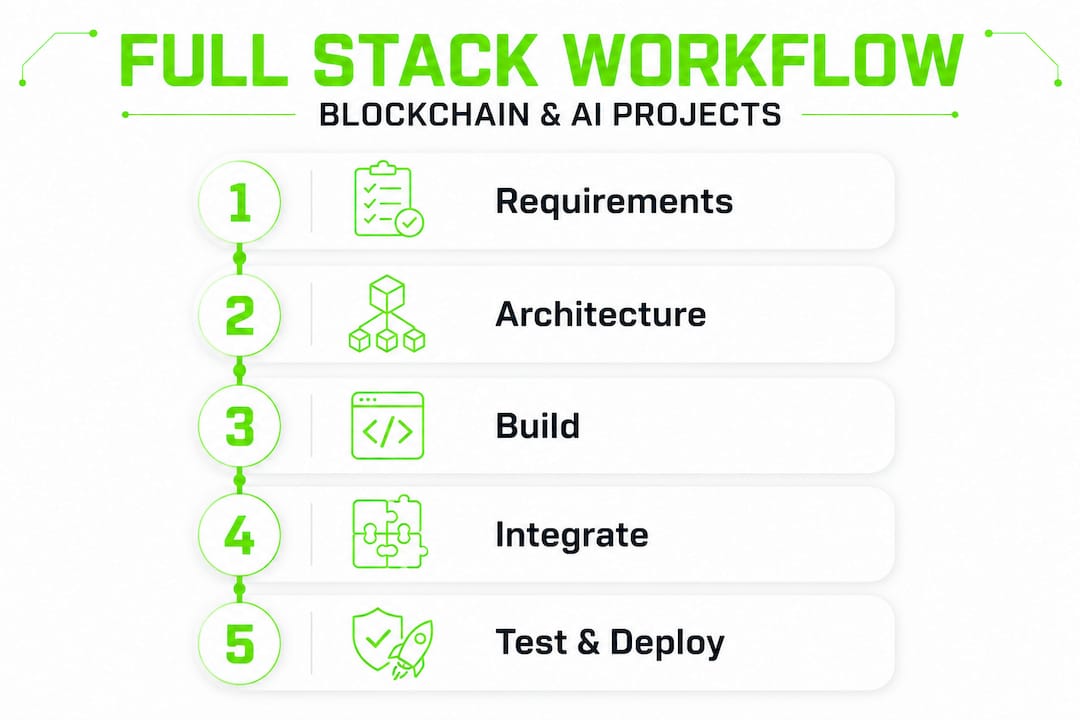
One of the most critical concepts in modern full stack services is the phased approach. According to Bilarna's framework, phased modernization follows a specific sequence: infrastructure first using Kubernetes and CI/CD pipelines, then the data layer using change data capture (CDC) and migrations from PostgreSQL to Elasticsearch, then API development with microservices and gRPC, then frontend rebuild with Next.js and React, and finally a zero-downtime cutover. This sequence exists because each layer depends on the one below it. Building the frontend before your infrastructure is stable is like laying carpet before the foundation is set.
Phased modernization frameworks: From infrastructure to user experience
Understanding service scope is foundational, but choosing a suitable modernization framework is equally vital. The biggest mistake companies make when modernizing or building from scratch is trying to do everything simultaneously. That approach creates bottlenecks, dependency conflicts, and costly rework.
A structured framework prevents these problems. Here is a step-by-step breakdown of how phased modernization should work:
- Infrastructure foundation: Deploy containerization with Kubernetes, set up CI/CD pipelines through services like CI/CD analytics services, and establish monitoring tools. This creates a stable base for everything else.
- Data layer migration: Use CDC (change data capture) to migrate live data without interrupting operations. Move from legacy databases to modern solutions like Elasticsearch for faster querying.
- API development: Build microservices and implement gRPC for high-performance inter-service communication. This decouples your system components so teams can work independently.
- Frontend rebuild: Replace legacy interfaces with modern frameworks like Next.js and React, optimized for performance and user experience.
- Zero-downtime cutover: Switch traffic from old to new systems incrementally, using feature flags and load balancers to avoid any service disruption.
The comparison table below shows how traditional monolithic approaches stack up against a modern, phased full stack methodology:
| Criteria | Traditional monolithic approach | Modern phased full stack approach |
|---|---|---|
| Deployment speed | Weeks per release | Hours per release with CI/CD |
| Scalability | Vertical scaling only | Horizontal scaling with Kubernetes |
| Failure isolation | Entire system affected | Only the failing service is isolated |
| Team autonomy | One team for all layers | Separate teams per service |
| Data migration | High-risk, manual process | CDC-based, low-risk migration |
| Frontend flexibility | Tightly coupled to backend | Independent frontend deployment |
The tech startup innovation landscape demands this kind of disciplined, layered thinking. Startups that skip infrastructure setup and jump straight to building features often find themselves replatforming six months later, burning time and investor capital.
Pro Tip: Never start a modernization project without locking down your infrastructure and CI/CD pipelines first. Teams that reverse this order consistently spend 30 to 40 percent more time on rework than those who follow a phased sequence.
Addressing non-functional requirements: Security, performance, and reliability
Beyond frameworks, attention to deeper quality factors can prevent costly failures. Non-functional requirements (NFRs) are the invisible pillars of any digital product. They are not features your users explicitly ask for, but the moment you fail to deliver on them, those users leave and they rarely come back.
The most commonly neglected NFRs are performance, security, and reliability. Research from the a16z AI software stack report identifies these as critical edge cases: neglecting performance and security benchmarks, operating without staging environments, and running inadequate test coverage. The solutions are explicit performance metrics defined before development starts, automated testing pipelines, and modular architectures that isolate failures.
Here is what that looks like in practice:
- Performance: Set concrete targets, such as API response times under 200 milliseconds, page load under 2.5 seconds, and uptime above 99.9 percent. These become acceptance criteria in your sprint process.
- Security: Implement role-based access control (RBAC), end-to-end encryption, smart contract audits for blockchain layers, and regular penetration testing. The Web3 security checklist is a practical starting point for projects on decentralized platforms.
- Reliability: Use redundant deployments across multiple cloud availability zones, implement health checks, and set up automated rollback procedures for failed deployments.
- Testing: Run unit tests, integration tests, and end-to-end tests at every CI/CD stage. A staging environment that mirrors production is non-negotiable.
"The most expensive bug is the one you find after launch. The second most expensive is the one you find without a staging environment." This is a hard lesson that many fast-moving startups learn after a costly production incident.
The future of web development increasingly depends on these NFRs being baked into the development process from day one, not patched in after the fact. AI-driven applications, for example, add a layer of complexity because model inference latency can directly affect user experience. You cannot discover that your AI inference endpoint takes 4 seconds per request during your launch demo.
Pro Tip: Create a non-functional requirements document before writing your first line of code. Define specific, measurable targets for security, performance, and uptime, and assign ownership to specific team members for each.
Applying full stack strategies for blockchain, AI, and custom solutions
With major requirements in mind, here is how tailored strategies can deliver value for advanced technologies. Full stack development is not one-size-fits-all, especially when you are building for blockchain, AI, or highly customized software requirements.
For blockchain projects, the full stack approach means integrating on-chain logic with off-chain infrastructure. Smart contracts handle trust and automation on-chain. Off-chain services manage data indexing (using tools like The Graph), user authentication, and frontend rendering. A decentralized application development team needs to understand both worlds simultaneously. A team that only knows Solidity but cannot build a reliable backend indexing service cannot ship a complete product.

For AI solutions, full stack development connects machine learning models to real products. This means building data pipelines that feed models, APIs that serve predictions, and frontends that display results in ways users can act on. The entire stack must account for model versioning, retraining pipelines, and monitoring for model drift (when model accuracy degrades over time because real-world data changes).
Here is a comparison of custom versus standardized solutions for these contexts:
| Factor | Custom full stack solution | Standardized or template-based solution |
|---|---|---|
| Fit for purpose | Precisely aligned to business logic | Generic, requires workarounds |
| Time to market | Longer initially | Faster initially |
| Long-term scalability | High, designed for your growth | Limited by template constraints |
| Blockchain compatibility | Native integration | Often requires costly adapters |
| AI model integration | Direct, with optimized APIs | Dependent on third-party tools |
| Total cost of ownership | Lower over 3 to 5 years | Higher due to licensing and limitations |
The pattern for successful digital transformation projects follows a clear sequence:
- Define business outcomes first. What does success look like in measurable terms?
- Map the full stack layers required to achieve those outcomes.
- Use phased approaches to legacy modernization: infrastructure, data, APIs, frontend, cutover.
- Integrate NFRs as acceptance criteria from sprint one.
- Audit security layers, especially for blockchain and AI, before going live.
- Deploy incrementally using automated testing and modular architectures to reduce risk.
The future of app development belongs to companies that treat their full stack as a strategic asset, not just a technical detail. The companies winning in blockchain and AI right now are not necessarily the ones with the best ideas. They are the ones with the best execution across every layer of their stack.
Why modularity and phased deployment are the unsung heroes of scalable innovation
Let us step back and consider what most guides miss about building robust systems: the true value of modularity and phased rollout. Most articles talk about technology choices. React versus Vue. Kubernetes versus bare metal. Solidity versus Rust. These are important decisions. But they are secondary to a more fundamental architectural choice that determines whether your system can actually grow and adapt.
That choice is whether you build as a monolith or as modular components from the start.
Here is the contrarian view: the instinct to ship quickly as a monolith is rational for week-one prototypes. But many teams never escape the monolith. They add feature after feature to the same codebase, the same database, the same deployment unit. Then, 18 months later, every change requires touching every part of the system. A bug in the payment module breaks the notification service. An AI model update requires a full redeploy of the entire product.
The companies that succeed at scale are those that design for modularity early, even imperfectly. You do not need perfect microservices from day one. You need logical separation between your core domains. The payments domain should not share a database table with the user profile domain. Your blockchain transaction service should be deployable independently of your frontend.
The a16z AI software stack research makes this clear: lack of modular architectures is one of the core reasons engineering teams fail to meet performance and security requirements. You cannot isolate a security failure in a monolith. You cannot scale just the AI inference layer if it is tangled with your user management code.
Phased deployment compounds these benefits. When you can deploy individual components independently, you can test changes with real traffic at small scale before rolling out fully. You can roll back a specific service without reverting your entire product. This is not just about technical elegance. It directly reduces business risk.
The advice that most technical guides skip is this: invest heavily in modular software architectures before you feel the pain of not having them. The pain arrives suddenly, usually at the worst possible moment, and the cost of retrofitting modularity into a mature monolith is several times higher than building it right the first time. We have seen this play out across projects in DeFi, gaming, and AI automation. The teams that win are the ones who treat architecture as a product decision, not a technical afterthought.
Empower your next project with full stack experts
If you are building in blockchain, AI, or custom software, the gap between a good idea and a successful product is almost always in execution across the full stack. Knowing the frameworks is step one. Working with a team that has built these systems across multiple industries and technology layers is what actually ships products.
At Proud Lion Studios, our UAE-based technical team specializes in exactly this kind of end-to-end delivery. Whether you need expert blockchain development services for smart contracts and DeFi platforms, tailored NFT and tokenization services for real-world asset markets, or immersive multiplayer game development built on scalable infrastructure, we design every solution from the ground up to match your specific business goals. No templates. No guesswork. Just engineered products built to grow with you.
Frequently asked questions
What makes full stack development critical for blockchain and AI projects?
Full stack development integrates backend, frontend, and infrastructure into a unified system, ensuring seamless deployment and scalability for advanced technologies. For blockchain and AI specifically, phased modernization across all layers is what enables reliable, production-grade products rather than fragile prototypes.
How can startups ensure their full stack projects meet performance and security benchmarks?
Startups should define explicit performance and security metrics before development begins, then enforce them through automated testing at every CI/CD stage. Research confirms that modular architectures and explicit benchmarks are the most effective tools for preventing costly failures in production.
What is zero-downtime cutover and why is it important?
Zero-downtime cutover is the process of migrating a system from old infrastructure to new without any interruption to live users or business operations. It is a critical final stage in phased legacy modernization because even a brief outage during a major upgrade can cost significant revenue and user trust.
How do modular architectures impact scalability and maintainability?
Modular architectures allow individual components to scale independently and be updated without affecting the rest of the system. This directly lowers maintenance risk and creates the technical foundation for rapid innovation, especially as your product requirements evolve over time. According to guidance on automated testing and modular design, modularity is one of the most important decisions a development team can make early in a project.