
TL;DR:
- Full-stack development involves building both the user interface and server components of a web application within a single workflow. It relies on skills in front-end design, back-end logic, database management, and deployment, making it essential for rapid product delivery. Mastery of ownership across all layers is the key skill that distinguishes successful full-stack developers in 2026.
Full-stack development is the practice of building both the front-end user interface and the back-end server, database, and API components of a web application within a single, unified workflow. According to MongoDB, this discipline integrates client-side interactivity, server processing, API design, and database structure into one complete product lifecycle. That scope is what separates full-stack web development from narrower specializations. Technologies like React, Node.js, and TypeScript have become the standard toolkit for production-grade full-stack work in 2026. For individuals learning to code and for businesses planning a digital product, understanding what full-stack development is determines how you hire, how you build, and how fast you ship.
What is full-stack development in terms of skills and tools?
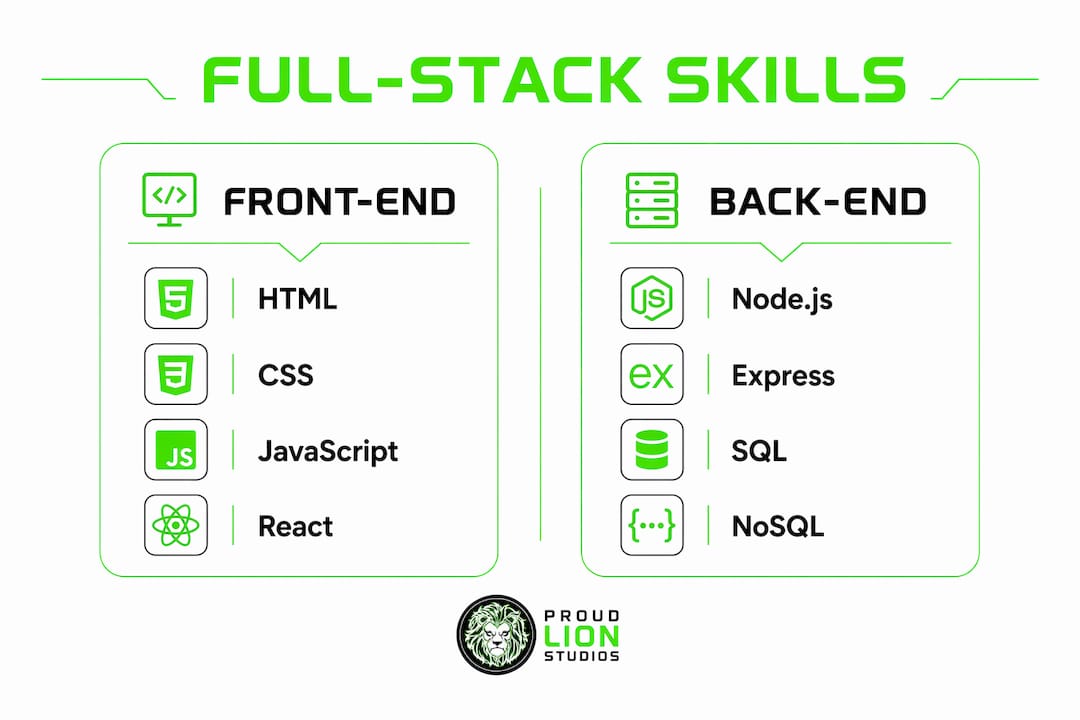
Full-stack developers work across two distinct layers of every application. The front end is everything a user sees and touches. The back end is everything that runs behind the scenes to make the product work.
Front-end skills
The front end relies on HTML, CSS, and JavaScript as its foundation. React dominates front-end adoption at 44.7% across production projects. That number reflects how thoroughly React has displaced older frameworks like Angular and jQuery in new builds. Next.js extends React with server-side rendering and static site generation, which matters for SEO and page load performance. TypeScript adds type safety to JavaScript, catching errors before they reach production.
Back-end skills
Node.js and Express handle server logic and API routing for most JavaScript-based stacks. A full-stack developer designs REST or GraphQL APIs, manages authentication flows using tools like JWT or OAuth, and controls how data moves between the client and the database. Understanding HTTP methods, status codes, and request validation is non-negotiable at this layer.

Database knowledge
SQL databases like PostgreSQL and MySQL handle structured, relational data. NoSQL options like MongoDB suit document-based or rapidly changing data models. Full-stack developers write queries, manage transactions, and think about indexing from day one. Poor database design is the most common source of performance problems in production applications.
Emerging expectations in 2026
DevOps practices and containerization with Docker are now core expectations for full-stack roles, not optional extras. Continuous integration pipelines, cloud deployment on AWS or Vercel, and basic infrastructure knowledge separate mid-level developers from senior ones. AI integration, including calling large language model APIs and building AI-assisted features, is also becoming a standard part of the full-stack toolkit.
Pro Tip: Deep proficiency in one stack such as Next.js, Tailwind CSS, and PostgreSQL beats shallow familiarity with ten frameworks. Employers and clients want evidence of shipped, production-grade work, not a long list of logos on a resume.
How does full-stack compare to front-end and back-end specialization?
Full-stack versus back-end is one of the most common points of confusion for businesses hiring developers. Each role has a distinct scope, and choosing the wrong one for a project creates gaps that slow delivery.
| Role | Scope | Strengths | Best fit |
|---|---|---|---|
| Front-end specialist | UI, UX, browser performance | Deep design-to-code precision | Large teams with dedicated designers |
| Back-end specialist | Server logic, APIs, databases | Complex system architecture | Data-heavy or high-traffic platforms |
| Full-stack developer | Both layers plus deployment | End-to-end ownership, faster iteration | Startups, MVPs, small product teams |
Front-end specialists produce polished, pixel-accurate interfaces. They know CSS animation, accessibility standards, and browser compatibility at a depth most full-stack developers do not match. Back-end specialists design systems that handle millions of requests, manage complex data pipelines, and build the kind of infrastructure that powers platforms like Stripe or Twilio.
Full-stack developers trade some of that depth for breadth. The real advantage is communication. A full-stack developer understands both sides of a technical conversation, which means fewer misunderstandings between design and engineering. Top developers show architectural thinking by understanding how back-end constraints directly shape front-end user experience. That connection is what makes full-stack roles so valuable in fast-moving teams.
Companies building a product from scratch with a small team almost always benefit from a full-stack developer. Companies scaling a mature platform with millions of users typically need specialists. The decision is not about which role is better. It is about what the product stage demands.
What are the practical benefits of full-stack development for businesses?
Full-stack development reduces the number of handoffs between teams. Every handoff is a potential delay, a miscommunication, or a gap in accountability. When one developer owns the front end, the back end, and the deployment pipeline, the product moves faster.
Startups rely on full-stack developers to improve agility and cut bottlenecks between specialized teams. That versatility supports cohesive product ownership and faster iteration cycles. A startup building an MVP does not need three separate specialists. It needs one person who can wire up a database, build an API, render a UI, and push the whole thing to production in a single sprint.
The practical benefits for businesses include:
- Faster time to market. One developer can take a feature from database schema to live UI without waiting on another team.
- Lower coordination costs. Fewer people in the chain means fewer meetings, fewer tickets, and fewer misaligned assumptions.
- Clearer ownership. When one developer owns the full feature, accountability is unambiguous.
- Easier debugging. A full-stack developer can trace a bug from the database query through the API response to the UI render without handing off a ticket.
- More flexible hiring. For early-stage companies, one strong full-stack hire covers ground that would otherwise require two or three specialists.
For enterprises, full-stack developers serve a different purpose. They act as connective tissue between specialized teams, translating requirements between product managers, designers, and back-end engineers. Full-stack development is essential for startups seeking agility and also valuable in large companies for cohesive ownership across complex products.
Tech stacks favored in production-grade projects include Next.js with PostgreSQL and Prisma for web applications, React Native with Node.js for cross-platform mobile apps, and Python with FastAPI for AI-integrated back ends. Each of these combinations reflects a deliberate choice about performance, developer experience, and deployment simplicity.
Pro Tip: When evaluating a full-stack developer for your project, ask to see a deployed application, not just a GitHub repository. A live product proves the developer can handle environment configuration, deployment pipelines, and real-world performance, not just write clean code locally.
What does a full-stack development career look like in 2026?
Full-stack developers command strong salaries globally. Monthly compensation ranges from roughly $9,500 to $19,000 USD depending on region, experience, and the complexity of the systems involved. That range reflects how much the market values developers who can own an entire product rather than one layer of it.
The skills that push developers toward the top of that range include:
- System-level thinking. Senior full-stack developers understand how database query performance affects API response times and how API latency affects perceived UI speed.
- Architectural decision-making. Choosing between a monolith and a microservices architecture, or between SQL and NoSQL, requires judgment that comes from shipping real products.
- Cross-team communication. Full-stack developers bridge design, product management, and back-end teams for smoother project delivery. This soft skill is what separates developers who get promoted from those who stay individual contributors.
- Deployment fluency. Knowing how to configure a production server, set up environment variables, and monitor application health is now a baseline expectation.
For beginners, the clearest path to proficiency runs through one focused stack. Learn JavaScript thoroughly, then add React for the front end and Node.js for the back end. Build and deploy three real projects. Then add TypeScript and a SQL database. The full-stack mindset is less about knowing many languages and more about owning the complete product journey from idea to live application.
AI and DevOps are reshaping what full-stack roles look like. Developers who can integrate AI APIs, write infrastructure-as-code, and manage cloud deployments are in a different tier from those who only write application code. Reviewing software developer interview questions for 2026 reveals how much these expectations have shifted toward system design and deployment knowledge.
Key Takeaways
Full-stack development is the most direct path to end-to-end product ownership, combining front-end, back-end, and deployment skills into a single, high-value role.
| Point | Details |
|---|---|
| Full-stack scope | Covers front-end UI, back-end server logic, database design, and deployment in one role. |
| Core 2026 stack | React, Next.js, TypeScript, Node.js, and PostgreSQL define production-grade full-stack work. |
| Business advantage | Full-stack developers reduce handoffs, speed up iteration, and clarify ownership on small teams. |
| Career value | Monthly salaries range from $9,500 to $19,000 USD, rewarding system-level thinking and deployment fluency. |
| Learning strategy | Deep mastery of one stack and three deployed projects outperforms broad but shallow tech familiarity. |
Why end-to-end ownership is the real skill
The framing that trips up most developers and most hiring managers is treating full-stack development as a list of technologies. It is not. The technologies are just the tools. The actual skill is ownership.
I have watched developers with impressive resumes struggle on real projects because they could write React components but had no idea how their API was deployed or why their database queries were slow under load. They knew the front end. They knew the back end. But they had never thought about the two layers as one connected system.
The developers who stand out are the ones who can sit with a blank project and make every decision from database schema to deployment pipeline to UI state management. That requires architectural thinking that connects back-end constraints with front-end UX. It also requires the humility to know when a problem is big enough to need a specialist.
My honest advice: do not spread yourself across five frameworks before you have shipped one real product. Pick Next.js and PostgreSQL. Build something that real users can access. Then learn Docker. Then add TypeScript if you have not already. The sequence matters more than the speed.
AI is not replacing full-stack developers. It is raising the floor of what a single developer can build alone. That is good news for anyone willing to learn how to use it well. The developers who treat AI tools as a productivity layer rather than a shortcut will be the ones building the most interesting products in the next five years.
— Amal
Proud Lion Studios builds full-stack products that go beyond the browser
Proud Lion Studios works with startups and enterprises that need more than a standard web application. The Dubai-based studio combines full-stack web development with blockchain development services, AI automation, and mobile app engineering to deliver products that operate across Web2 and Web3 environments.
If your project involves smart contracts, NFT marketplaces, AI-integrated features, or cross-platform mobile apps, Proud Lion Studios builds each solution from the ground up with a UAE-based technical team. The studio does not use templated packages. Every product is built to the specific requirements of the client's business and technical context. Reach out to Proud Lion Studios directly to discuss what your project needs.
FAQ
What is full-stack development in simple terms?
Full-stack development is the process of building both the visible front end and the server-side back end of a web application. A full-stack developer handles the complete product from database to user interface.
What does a full-stack developer do day to day?
A full-stack developer writes front-end code, designs and maintains APIs, manages databases, and deploys applications to production environments. They often act as the primary technical owner of a feature or product.
How does full-stack differ from back-end development?
Back-end development focuses exclusively on server logic, databases, and APIs. Full-stack development covers those areas plus the front-end UI and often the deployment pipeline.
How long does it take to become a full-stack developer?
Most developers reach a working level of full-stack proficiency within one to two years of focused practice, provided they build and deploy real projects rather than only completing tutorials.
What are the most in-demand full-stack developer skills in 2026?
React, TypeScript, Node.js, PostgreSQL, and Docker are the core skills employers seek. Familiarity with AI API integration and cloud deployment platforms like AWS or Vercel is increasingly expected at the mid-to-senior level.