

Many developers believe Web3 development means simply connecting a smart contract to a React frontend. This misconception leads to failed projects and wasted resources. The reality is far more complex and nuanced. Web3 in 2026 demands full stack expertise, enterprise grade architecture, and deep understanding of blockchain economics. This guide clarifies what Web3 truly involves, explores common pitfalls, and provides actionable frameworks for building scalable decentralized applications. You'll gain expert insights into transaction economics, protocol value creation, and practical development strategies that separate successful Web3 ventures from abandoned experiments.
Table of Contents
- Understanding What Web3 Really Is
- Common Pitfalls And Full Stack Challenges In Web3 Development
- Economics Of Web3 In 2026: Transaction Costs, Protocol Value, And Monetization
- Applying Web3 Concepts: Building Maintainable, Scalable Decentralized Applications
- Explore Professional Web3 Development Solutions
- Frequently Asked Questions About Web3
Key takeaways
| Point | Details |
|---|---|
| Web3 is a full stack ecosystem | It integrates blockchain technology with modern web development practices, not just smart contracts. |
| Most failures happen at the edges | Poor integration and infrastructure gaps cause more problems than smart contract bugs. |
| Transaction costs dropped 90% | By 2025, fees decreased substantially, enabling sustainable blockchain monetization. |
| Enterprise architecture is essential | Successful applications require robust systems beyond simple decentralized frontends. |
| User fees signal protocol value | Understanding fee based value creation is critical for viable Web3 business strategies. |
Understanding what Web3 really is
Web3 represents a decentralized web paradigm that combines blockchain based smart contracts with comprehensive web applications. The key innovation lies in full stack integration of blockchain technology with modern frontend and backend systems. The secret to building scalable, maintainable decentralized applications involves creating a harmonious ecosystem where blockchain seamlessly integrates with contemporary web development practices.
More than just a smart contract, Web3 applications need seamless coordination between on chain code and user experiences. This requires developers to master both blockchain specific technologies and traditional web development skills. The convergence creates unique challenges but also unprecedented opportunities for innovation.
Foundational principles define the Web3 landscape:
- Decentralization distributes control across network participants rather than centralizing authority
- User ownership gives individuals direct control over their data and digital assets
- Permissionless protocols allow anyone to participate without gatekeepers or intermediaries
- Interoperability enables different blockchain networks and applications to communicate effectively
Modern Web3 stacks utilize scalable architectures that overcome early hackathon style minimalism. These sophisticated systems integrate multiple layers of technology, from consensus mechanisms to user interface design. Understanding future web development trends helps developers position their projects for long term success.
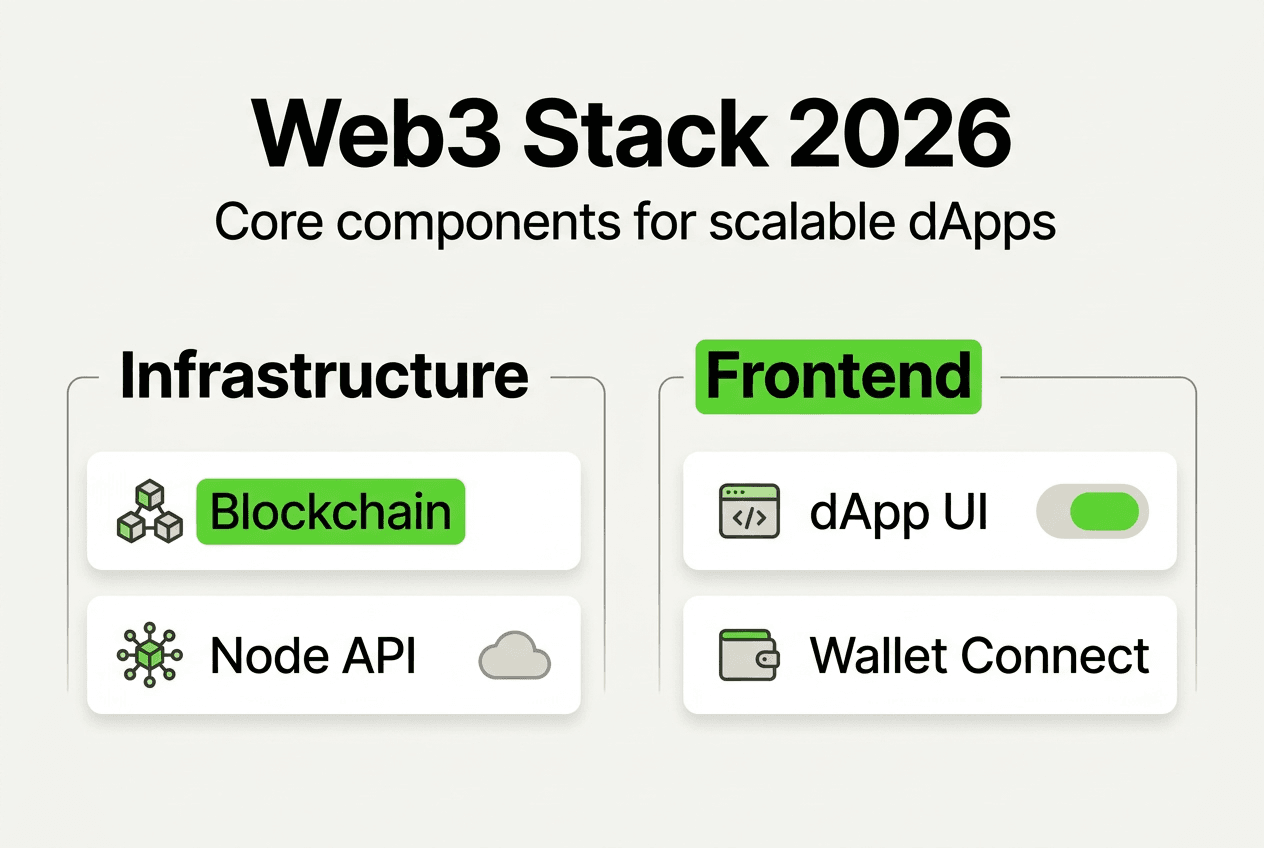
The Web3 blockchain digital revolution transforms how we think about application architecture. Traditional centralized servers give way to distributed networks. Database queries become blockchain reads. User authentication evolves into wallet connections. Each component requires careful consideration and expert implementation.
Common pitfalls and full stack challenges in Web3 development
Most Web3 failures don't start in the smart contract, they start at the edges. This critical insight reveals why many promising projects collapse despite having technically sound blockchain code. The real challenges emerge from integration gaps, infrastructure weaknesses, and ecosystem fragmentation.
Web3 failures commonly stem from several interconnected issues. Developers underestimate the complexity of handling business logic across distributed systems. They struggle with scaling for real users who expect instant responses, not 15 second block times. Maintaining robust frontend and backend interactions becomes exponentially harder when blockchain introduces new failure modes.
Full stack architecture maturity distinguishes enterprise grade Web3 applications from simple proof of concept demos. Professional smart contract development represents just one piece of a much larger puzzle. You also need reliable indexing services, efficient caching layers, responsive user interfaces, and comprehensive error handling.
Security in Web3 extends far beyond smart contracts to encompass the entire user ecosystem. Common vulnerabilities include:
- Frontend attacks exploiting wallet connection flows and transaction signing interfaces
- API vulnerabilities in off chain services that index or relay blockchain data
- Oracle manipulation where external data feeds provide incorrect information to smart contracts
- Social engineering targeting users unfamiliar with Web3 security best practices
The complexity multiplies when integrating with traditional systems. Web applications and business websites often need to bridge Web2 and Web3 paradigms. This creates additional attack surfaces and architectural challenges. Many teams lack experience navigating regulatory requirements, particularly in jurisdictions with evolving crypto frameworks requiring auditing and licensing compliance.

Pro Tip: Plan your architecture holistically from day one and anticipate edge case failures before they occur in production. Infrastructure mistakes that seem minor during development become critical bottlenecks at scale.
Successful Web3 deployments require teams with diverse expertise spanning blockchain development, traditional software engineering, security auditing, and user experience design. The intersection of these disciplines creates unique challenges but also opportunities for innovation.
Economics of Web3 in 2026: transaction costs, protocol value, and monetization
Optimization efforts reduced blockchain transaction costs by approximately 90% by 2025, drastically changing the economic landscape. This transformation enables business models previously impossible due to prohibitive fees. Applications can now support microtransactions, frequent user interactions, and complex multi step workflows.
Lower fees enable broader user adoption and sustainable monetization strategies in Web3 applications. When transaction costs consumed significant portions of transaction value, only high value transfers made economic sense. Today's efficient networks support everyday use cases from social media interactions to gaming transactions.
User paid fees remain the clearest signal of protocol value creation, though context is key. This metric reveals genuine demand and willingness to pay for network services. However, interpreting fee data requires understanding network effects, subsidy programs, and competitive dynamics.
| Economic Metric | 2024 Baseline | 2026 Status | Impact on Developers | | --- | --- | --- | | Average Transaction Fee | $2.50 | $0.25 | Enables microtransaction business models | | Protocol Revenue Model | Primarily token appreciation | Diversified fee capture | Sustainable monetization strategies | | User Acquisition Cost | High due to friction | Reduced by 60% | Broader addressable market | | Network Throughput | 50 TPS average | 500+ TPS average | Supports real time applications |
Web3 businesses now converge growth in asset value creation with investability opportunities. Protocols generate revenue through transaction fees, demonstrate product market fit through user growth, and create sustainable economic models. This convergence attracts traditional investors previously skeptical of pure token speculation.
Understanding future web development economics helps position your project competitively. Fee structures, incentive mechanisms, and value capture strategies directly impact long term viability. Projects must balance user affordability with protocol sustainability.
Pro Tip: Align your strategy with emerging fee models and protocol economics to build viable Web3 products that generate real revenue, not just speculative token value. Consider implementing crypto payment integration to capture diverse revenue streams.
The shift toward sustainable economics transforms Web3 from experimental technology to production ready infrastructure. Developers can now build applications with clear paths to profitability and long term growth.
Applying Web3 concepts: building maintainable, scalable decentralized applications
Successful Web3 applications require robust full stack architecture combining smart contracts, APIs, and polished frontends. Many developers still think Web3 development means throwing together a smart contract, connecting it to a basic React frontend, and calling it a day. This approach might work for hackathons, but it falls apart when handling real users, complex business logic, and enterprise level requirements.
Avoid minimal hackathon models and build for scalability, maintainability, and real user needs. Production applications demand comprehensive testing, monitoring, error handling, and performance optimization. Each component must work reliably under stress and gracefully handle edge cases.
| Architecture Aspect | Hackathon Style | Enterprise Grade |
|---|---|---|
| Smart Contract Design | Single monolithic contract | Modular, upgradeable contract system |
| Frontend Integration | Direct RPC calls from browser | Dedicated API layer with caching |
| Data Indexing | Query blockchain directly | Specialized indexing service (The Graph, custom) |
| Error Handling | Basic try/catch blocks | Comprehensive monitoring and alerting |
| Testing Coverage | Manual testing only | Automated unit, integration, and E2E tests |
| Deployment Process | Manual deployment | CI/CD pipeline with staging environments |
Step by step guide for Web3 application development phases:
- Architecture planning involves defining smart contract interfaces, selecting appropriate blockchain networks, designing off chain infrastructure, and mapping user flows across decentralized and centralized components.
- Development and deployment require implementing thoroughly tested smart contracts, building responsive frontends with wallet integration, creating robust backend services for indexing and caching, and establishing secure deployment pipelines.
- Testing and auditing demand comprehensive smart contract security audits, load testing infrastructure under realistic conditions, penetration testing of all user facing interfaces, and validating economic models through simulation.
- Scaling and optimization focus on implementing layer 2 solutions where appropriate, optimizing gas costs through contract refinement, enhancing user experience with progressive loading and caching, and monitoring performance metrics continuously.
- Maintenance and iteration include establishing monitoring for on chain and off chain systems, planning upgrade paths for smart contracts and infrastructure, gathering user feedback to guide feature development, and staying current with evolving blockchain technology.
Considerations for integration with legacy systems require careful API design, data synchronization strategies, and hybrid architectures. Security layers must protect against both traditional web vulnerabilities and blockchain specific attack vectors. User experience optimization becomes critical as mainstream adoption demands interfaces comparable to Web2 applications.
Professional blockchain development services help navigate these complexities. Expert smart contract development ensures your foundation remains secure and efficient. Real world examples like the Jungle Vault staking dApp demonstrate production ready implementations.
Explore professional Web3 development solutions
Building on the comprehensive frameworks and insights shared throughout this guide, you're now equipped to understand what separates successful Web3 projects from failed experiments. Translating this knowledge into production ready applications requires expertise across blockchain development, full stack architecture, and evolving protocol economics.
Proud Lion Studios offers end to end Web3 development expertise from smart contracts to full stack solutions. Our Dubai based team delivers scalable, secure architectures tailored to enterprise and startup needs. We specialize in blockchain development that avoids common pitfalls through proven methodologies and comprehensive testing.
Benefit from specialized services including NFT marketplaces, decentralized applications, and Web3 games built on modern architecture principles. Our approach emphasizes real business outcomes over templated solutions, ensuring your Web3 project delivers genuine value.
Pro Tip: Partnering with experienced providers helps avoid the infrastructure mistakes and integration challenges that derail many Web3 projects, accelerating your time to market while ensuring enterprise grade quality.
Frequently asked questions about Web3
What technical skills are essential for Web3 development in 2026?
Web3 developers need proficiency in Solidity or Rust for smart contracts, JavaScript/TypeScript for frontend development, and understanding of blockchain fundamentals including consensus mechanisms and cryptography. Backend skills for API development, database management, and DevOps practices remain equally important. Security awareness spanning both traditional web vulnerabilities and blockchain specific attack vectors is critical.
How does Web3 differ from traditional web applications in terms of architecture?
Web3 applications distribute state and logic across blockchain networks rather than centralizing them on servers. User authentication relies on cryptographic wallets instead of passwords. Data storage combines on chain records with off chain databases. Transaction finality introduces latency considerations absent in traditional applications. These architectural differences require fundamentally different design patterns and development approaches.
What are the most common reasons Web3 projects fail and how can they be avoided?
Projects fail primarily due to poor full stack integration, inadequate security measures, unsustainable economics, and underestimating infrastructure complexity. Avoid these pitfalls through comprehensive architecture planning, professional security audits, realistic economic modeling, and building with enterprise grade practices from the start. Professional smart contract development services help ensure your foundation remains solid.
How have transaction fees changed recently and why does it matter for developers?
Transaction fees dropped approximately 90% by 2025 through network optimizations and layer 2 scaling solutions. This dramatic reduction enables business models previously impossible due to prohibitive costs, including microtransactions, frequent user interactions, and complex multi step workflows. Lower fees directly expand your addressable market and viable use cases.
Which tools or platforms are recommended for building scalable Web3 applications?
Hardhat and Foundry lead smart contract development frameworks. The Graph provides decentralized indexing for blockchain data. Alchemy and Infura offer reliable node infrastructure. React and Next.js dominate frontend development. Ethers.js and Web3.js enable blockchain interactions. Layer 2 solutions like Arbitrum and Optimism improve scalability. Choose tools based on your specific requirements, team expertise, and target blockchain networks.