

What is a smart contract?
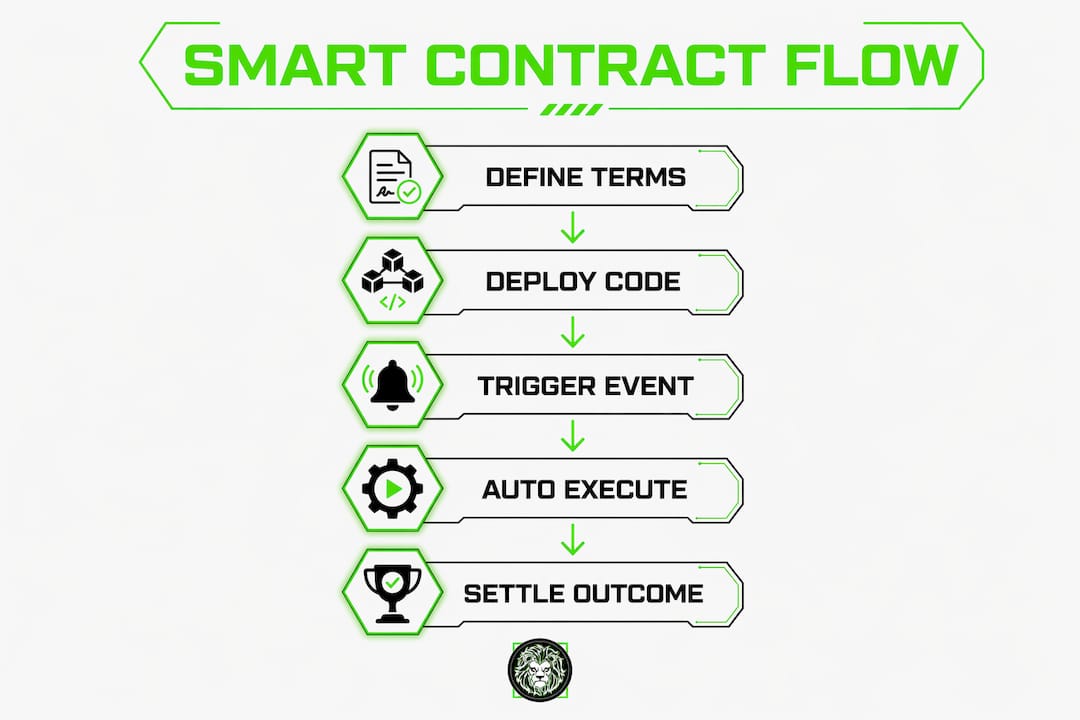
A smart contract is a self-executing program stored on a blockchain that automatically enforces the terms of an agreement when predefined conditions are met. No bank, lawyer, or third party needed. The code runs, the conditions trigger, and the outcome is locked in.
The US National Institute of Standards and Technology describes a smart contract as a "collection of code and data that is deployed using cryptographically signed transactions on the blockchain network." That definition captures the core idea: logic lives on-chain, not in a filing cabinet.
Every smart contract shares a few foundational elements:
- Code: The rules of the agreement written in a programming language the blockchain can execute
- Conditions: Predefined triggers that tell the contract when to act
- Automation: Execution happens without human intervention once conditions are satisfied
- Consensus: The blockchain network validates every transaction, making outcomes tamper-proof
- Immutability: Once deployed, the contract code cannot be altered
Nick Szabo coined the term "smart contract" in 1994, envisioning digital marketplaces where automatic processes replace trusted intermediaries. Ethereum turned that vision into reality after its 2015 launch, and the concept has expanded across dozens of blockchain platforms since.
How smart contracts work on blockchain networks

Deploying a smart contract means sending a transaction to the blockchain that contains the compiled contract code. That transaction gets included in a block, the network validates it through consensus, and the contract goes live at a permanent on-chain address. From that point forward, anyone can interact with it by sending transactions that trigger its logic.
The execution flow looks like this:
- A user or another contract sends a transaction to the smart contract's address
- The network's nodes run the contract code independently and reach consensus on the result
- If conditions are met, the contract executes: tokens transfer, data updates, or another contract gets called
- The outcome is recorded permanently on-chain, visible to anyone
Ethereum is the dominant platform for smart contracts, but Binance Smart Chain, Solana, and Aptos also support them. The programming language depends on the platform. Solidity is purpose-built for Ethereum; Rust powers contracts on Solana; Move is used in the Aptos and Sui ecosystems. Each language reflects the architecture and security priorities of its platform.
A simple example: a freelancer and a client agree that payment releases automatically when the client confirms delivery on-chain. The smart contract holds the funds in escrow. Once the client submits confirmation, the code executes and transfers the payment. No invoice chasing, no payment delays.
Pro Tip: Before deploying any contract, test it thoroughly on a testnet like Ethereum's Sepolia. Real money is at stake on mainnet, and bugs are permanent.
Why smart contracts deliver real advantages
The efficiency gains from removing intermediaries are immediate and concrete. Traditional contracts require lawyers to draft them, banks to process payments, and courts to enforce them. Smart contracts compress all three into code.
Key benefits include:
- Transparency: Contract code is publicly visible on-chain, so any party can verify the rules before agreeing
- Automation: Execution is instant and requires no manual processing once conditions trigger
- Security: Blockchain consensus and cryptography protect contract state from unauthorized changes
- Cost reduction: Eliminating middlemen cuts transaction fees and administrative overhead
- Accuracy: Code executes exactly as written, removing the ambiguity that human interpretation introduces
- Speed: Settlements that take days through traditional finance can complete in seconds on-chain
Ethereum's documentation makes a sharp point here: "Two judges might interpret a contract differently, which could lead to inconsistent decisions and unequal outcomes. Smart contracts remove this possibility." Given the same inputs, a smart contract always produces the same output. That determinism is what makes them trustworthy at scale.
Where smart contracts are already changing industries
Smart contracts power some of the most active sectors in Web3, and their reach extends well beyond cryptocurrency trading.
- Decentralized finance (DeFi): Lending protocols issue loans, collect interest, and liquidate collateral automatically, all without a bank. Platforms like Aave and Uniswap run entirely on smart contracts.
- Insurance: Parametric insurance products pay out automatically when verifiable data (a flight delay, a weather event) meets the policy threshold, cutting claims processing from weeks to minutes.
- Supply chain: Contracts release payments to suppliers when shipment milestones are confirmed on-chain, reducing disputes and manual reconciliation.
- Real estate: Tokenized property ownership and automated escrow reduce closing timelines and open fractional ownership to smaller investors.
- Gaming and NFTs: Smart contracts govern in-game asset ownership, royalty payments to creators on secondary sales, and provably fair game mechanics.
- Peer-to-peer agreements: Two parties can encode any bilateral agreement directly in code, removing the need for a trusted escrow agent.
"Smart contracts enable decentralized finance applications like loans, insurance, and supply chain logistics through automated rules enforcement on blockchains. By design, they eliminate intermediaries and increase transaction transparency." — Coinbase
The NFT market is a clear illustration of smart contracts at work. Every time an NFT sells on a secondary market, the creator's royalty percentage is calculated and transferred automatically by the contract. No royalty collection agency, no invoice, no delay.
Security risks and how to protect your smart contracts

Smart contracts are immutable once deployed to mainnet. There are no rollbacks, no hotfixes, and no customer support line. A vulnerability in live code can drain funds before anyone notices, and the losses are permanent. The OWASP Smart Contract Top 10 catalogs the most common failure modes, including reentrancy attacks, access control flaws, and oracle manipulation.
Common vulnerabilities to know:
- Reentrancy: A malicious contract repeatedly calls back into a vulnerable function before the first execution completes, draining funds
- Access control failures: Functions that should be restricted to admins are left open to any caller
- Oracle manipulation: Contracts that rely on external price feeds can be exploited when those feeds are manipulated
- Integer overflow/underflow: Arithmetic errors that produce unexpected values, though modern Solidity versions handle this automatically
- Unchecked return values: Ignoring whether an external call succeeded can leave contracts in a broken state
The smart contract audit process
A smart contract audit is a structured security review designed to catch these issues before deployment. The process follows a defined sequence:
- Scoping: Define exactly which contracts, commits, and dependencies are under review. Poor scoping is the most common reason audits miss live vulnerabilities.
- Architecture review: Auditors map the protocol's design, trust boundaries, and external dependencies before touching the code.
- Manual code review: Experienced engineers read the code line by line, modeling protocol invariants and simulating attacks. Manual review dominates because automated tools cannot fully understand business logic.
- Automated analysis: Tools like Slither, Mythril, and Echidna surface known vulnerability patterns and edge cases at scale.
- Reporting: Findings are classified by severity: Critical, High, Medium, Low, and Informational, each with affected code lines and recommended fixes.
- Remediation and verification: Developers fix the issues, and auditors verify the fixes before the final report is issued.
Audits reduce risk substantially, but an audit report reflects code at a point in time and cannot prevent post-deployment attacks, admin key compromises, or unauthorized upgrades. A layered security strategy pairs audits with bug bounty programs, runtime monitoring, and circuit breakers that can pause contracts if anomalies appear. You can explore the full security picture in Proud Lion Studios' blockchain security guide.
Limitations and challenges you should know
Smart contracts are powerful, but they come with real constraints that every builder and user should understand before committing to them.
Code is law, for better and worse. Once deployed, a contract executes exactly as written. If the code has a flaw or the business requirements change, there is no simple way to update it. Upgradeable contract patterns exist, but they introduce their own complexity and new attack surfaces.
Garbage in, garbage out. Smart contracts can only act on data they can access on-chain. When they need real-world information (an asset price, a sports score, a weather reading), they rely on oracles. Oracles are external data feeds, and they represent a trust assumption that the contract itself cannot verify.
Legal enforceability is unsettled. A smart contract is not automatically a legally binding agreement. Wikipedia's analysis notes that smart contracts and smart legal contracts are distinct: only the latter carries the elements required for court enforcement. Regulatory clarity varies widely across jurisdictions.
Scalability and cost. On congested networks, gas fees can make simple contract interactions expensive. Layer 2 solutions and alternative chains address this, but they fragment liquidity and add integration complexity.
User error is irreversible. Sending funds to the wrong contract address or approving a malicious contract is permanent. There is no undo button, and no institution to call for a reversal.
Understanding these constraints is not a reason to avoid smart contracts. It is a reason to build them carefully, audit them thoroughly, and deploy them with a clear-eyed view of what the technology can and cannot do. Teams building on Web3 smart contract platforms need that perspective from day one.
Ready to build with smart contracts?
Proud Lion Studios designs and deploys production-grade smart contracts for startups and enterprises across DeFi, NFT platforms, tokenization, and beyond. Our UAE-based technical team brings hands-on experience across Ethereum, Aptos, and EVM-compatible chains, with security-first development built into every engagement.

Whether you need a single contract audited or a full blockchain development engagement from architecture to mainnet, we build for real outcomes, not templates. Explore our smart contract development services and let's talk about what you're building.
Key Takeaways
Smart contracts are self-executing blockchain programs that automate agreements, eliminate intermediaries, and produce tamper-proof outcomes, but they require careful development and security review to deploy safely.
| Point | Details |
|---|---|
| Core definition | A smart contract is code on a blockchain that executes automatically when predefined conditions are met. |
| Immutability risk | Once deployed to mainnet, contract code cannot be changed, making pre-deployment audits critical. |
| Audit process | Audits follow six stages: scoping, architecture review, manual review, automated analysis, reporting, and fix verification. |
| Layered security | Audits alone are not enough; bug bounties, runtime monitoring, and circuit breakers are also required. |
| Real-world reach | Smart contracts power DeFi lending, NFT royalties, parametric insurance, supply chain payments, and tokenized real estate. |