

Most startups and enterprises assume off-the-shelf software is enough until they hit scaling walls. Custom software built with AI, blockchain, and mobile technologies solves the exact problems your business faces, not generic ones. When you integrate these emerging technologies correctly, you unlock competitive advantages impossible with packaged solutions. This guide walks you through what custom software truly means in 2026, how AI and blockchain enhance it, common pitfalls to avoid, and proven strategies to achieve measurable ROI. You'll learn why 78% of enterprises now deploy AI in at least one function and how smaller projects consistently outperform larger ones in returns.
Table of Contents
- What Is Custom Software And Why Does It Matter For Your Business?
- Harnessing AI, Blockchain, And Mobile Technologies In Custom Software
- Challenges And Best Practices For Successful Custom Software Projects In 2026
- Applying Custom Software Solutions To Scale Your Startup Or Enterprise
- Explore Custom Software Development Services For AI, Blockchain, And Mobile
- What Is The Typical Timeline For Developing Custom Software With AI And Blockchain?
- How Does Human-In-The-Loop Governance Improve Custom Software Success?
- What Are The Main Challenges When Combining AI With Blockchain In Custom Software?
- Can Smaller Startups Achieve High ROI With Limited Budgets On Custom Software?
Key takeaways
| Point | Details |
|---|---|
| Custom software delivers tailored solutions | Built specifically for your business needs using AI, blockchain, and mobile tech to solve unique challenges. |
| AI accelerates development cycles | Writing and testing code is only 25-35% of development time; AI speeds planning, design, and deployment phases. |
| Blockchain market grows rapidly | Expected to surpass $393B by 2030 but requires clear use cases to avoid failure. |
| Human-in-the-loop governance is critical | Reduces critical incidents by 4.2× and boosts success rates to 73% when properly implemented. |
| Smaller budgets achieve higher ROI | Projects under €15K deliver 2.1× higher returns and break even within 8 months on median. |
What is custom software and why does it matter for your business?
Custom software is code built uniquely to meet your specific business requirements, workflows, and goals. Unlike off-the-shelf products designed for broad audiences, custom solutions address your exact pain points. You get features that align perfectly with how your team operates, not generic functionality you'll never use.
Off-the-shelf software forces you to adapt your processes to fit the tool. Custom software does the opposite: the tool adapts to you. This flexibility becomes critical as your business scales and your needs evolve. You can modify, expand, and integrate custom software without vendor limitations or costly workarounds.
The competitive advantage is real. When your software handles workflows competitors can't replicate, you operate faster and smarter. Custom solutions integrate seamlessly with your existing systems, eliminating data silos and manual handoffs. This integration matters especially when you're combining emerging technologies like AI, blockchain, and mobile platforms.
AI in software development transforms how quickly you can build and deploy custom solutions. Writing and testing code accounts for only 25-35% of total development time; AI accelerates all other phases. Planning, design, testing, and deployment all speed up when AI handles repetitive tasks, generates boilerplate code, and catches bugs early.
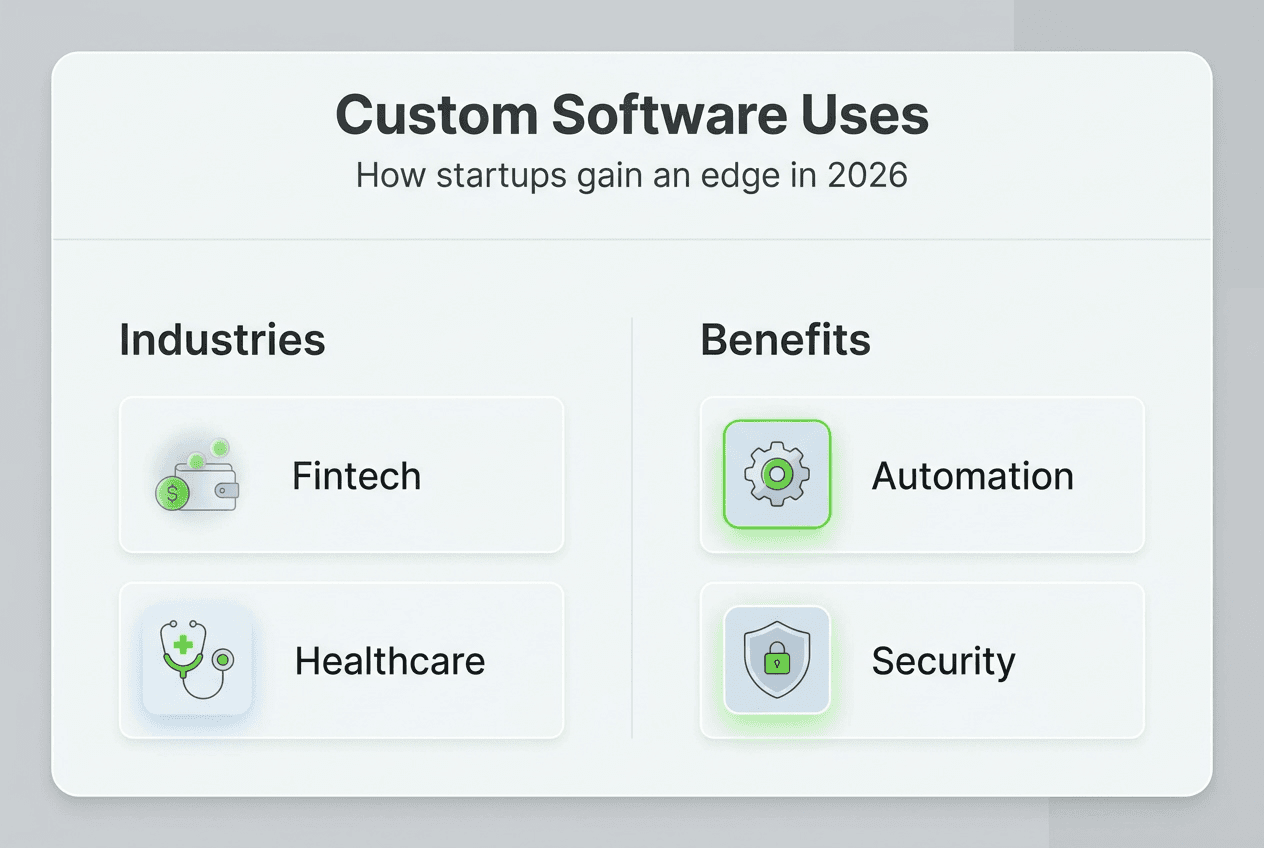
Industries from fintech to healthcare to logistics benefit from custom software. Financial services use it for fraud detection and compliance automation. Healthcare organizations build patient management systems with AI diagnostics. Supply chain companies deploy blockchain for transparent tracking. Mobile apps give field teams real-time access to data and workflows.
Pro Tip: Start by mapping your three biggest operational bottlenecks. Custom software delivers the highest ROI when it solves concrete, measurable problems rather than vague efficiency goals.
Harnessing AI, blockchain, and mobile technologies in custom software
AI capabilities in custom software go far beyond chatbots. You can automate decision-making processes, predict customer behavior, optimize resource allocation, and surface insights from massive datasets. Machine learning models improve over time as they process more of your business data. Natural language processing lets users interact with systems conversationally instead of navigating complex interfaces.

The ROI enhancement from AI is substantial. 78% of enterprises use AI in at least one function, and those deployments typically show measurable returns within months. AI reduces manual work, catches errors humans miss, and scales expertise across your organization. You can deploy AI agents to handle customer inquiries, process documents, or monitor systems 24/7 without adding headcount.
Blockchain brings security, decentralization, and transparency to custom software. Every transaction or data change gets recorded immutably, creating an audit trail no single party can alter. Smart contracts execute automatically when conditions are met, eliminating intermediaries and reducing settlement times. Decentralized architectures mean no single point of failure or control.
The blockchain market is expected to surpass $393B by 2030, driven by use cases in supply chain, finance, healthcare, and identity management. Tokenization lets you represent physical or digital assets on-chain, enabling fractional ownership and instant transfers. Blockchain development services help you navigate the technical complexity and regulatory landscape.
Mobile technology makes your custom software accessible anywhere, anytime. Field workers, remote teams, and customers all interact with your systems through smartphones and tablets. Real-time data synchronization keeps everyone working with current information. Push notifications alert users instantly to important events or required actions.
Mobile app development integrates seamlessly with backend AI and blockchain systems. Your mobile interface becomes the front door to powerful functionality running in the cloud or on-chain. Offline capabilities let users work without connectivity, syncing changes when they reconnect.
| Technology | Primary Benefits | Common Challenges |
|---|---|---|
| AI | Automation, predictive insights, 24/7 availability | Data quality requirements, model training costs, bias risks |
| Blockchain | Immutability, transparency, decentralization | High computational costs, transaction latency, regulatory uncertainty |
| Mobile | Accessibility, real-time updates, location awareness | Platform fragmentation, security concerns, battery/performance constraints |
Hybrid architectures solve the computational and latency issues when combining AI with blockchain. You run intensive AI processing off-chain where it's fast and cheap, then record results or decisions on-chain for immutability and transparency. This separation lets you leverage both technologies' strengths without their weaknesses canceling out benefits.
AI conversational solutions can query blockchain data and present it conversationally to users who don't understand technical blockchain concepts. The AI layer translates complex on-chain information into natural language, making blockchain-powered systems accessible to non-technical stakeholders. Check the latest blockchain market report for adoption trends across industries.
Pro Tip: Don't combine technologies just because you can. Each should solve a specific business problem. AI for automation and insights, blockchain for trust and transparency, mobile for accessibility. If a technology doesn't address a real need, leave it out.
Challenges and best practices for successful custom software projects in 2026
Project failure rates remain high when businesses rush into AI and blockchain without clear use cases. A significant percentage of AI and blockchain projects fail due to unclear business cases and technical overcomplication. Teams get excited about cutting-edge technology and build solutions searching for problems. This backwards approach wastes budgets and demoralizes stakeholders.
Technical complexity escalates quickly when you combine multiple emerging technologies. AI models need quality training data, ongoing monitoring, and regular retraining. Blockchain networks require consensus mechanisms, node management, and gas fee optimization. Mobile apps must work across iOS and Android with different capabilities and constraints. Managing all three simultaneously overwhelms teams without proper architecture and governance.
High costs derail projects when businesses underestimate total ownership expenses. Initial development is just the start. You need ongoing infrastructure, model training, security audits, compliance monitoring, and user support. Cloud compute costs for AI training can spike unexpectedly. Blockchain transaction fees fluctuate with network congestion. Mobile app stores charge fees and require regular updates.
Validate business needs before selecting technology. Start with the problem you're solving and the metrics that prove success. Map current workflows and identify specific bottlenecks. Quantify the cost of those bottlenecks in time, money, or customer satisfaction. Only then evaluate which technologies address those validated needs most effectively.
Hybrid architectures manage computational and latency issues by separating concerns. Keep AI processing off-chain where you can leverage powerful GPUs and fast storage. Record AI decisions or model hashes on-chain for auditability without paying for expensive on-chain computation. Use mobile apps as the user interface layer that talks to both AI services and blockchain networks through APIs.
Human-in-the-loop governance emerges as a critical success factor. Human-in-the-loop governance reduces critical incidents by 4.2× and boosts AI project success rate to 73%. This approach keeps humans reviewing AI outputs, approving high-stakes decisions, and correcting mistakes before they compound. You maintain accountability while still gaining AI efficiency.
"The most successful AI deployments in 2026 combine automation with human oversight. Systems that run fully autonomous create risk; systems that require human approval for every action lose efficiency. The sweet spot is selective human review of high-impact or uncertain decisions."
Training investment directly correlates with project success. Your team needs to understand how AI models work, when to trust their outputs, and how to improve them. Blockchain concepts like wallets, private keys, and smart contracts confuse non-technical users. Mobile development requires knowledge of platform-specific guidelines and capabilities. Budget time and money for comprehensive training.
Modular architecture improves ROI and deployment speed. Break your custom software into independent components that communicate through well-defined interfaces. You can develop, test, and deploy each module separately. This approach reduces risk because failures stay contained. You can also reuse modules across projects, accelerating future development.
Follow these steps to avoid common pitfalls:
- Document clear success metrics before writing any code
- Start with a small pilot that proves value in weeks, not months
- Involve end users throughout design and testing phases
- Plan for ongoing costs including infrastructure, training, and support
- Implement human-in-the-loop governance from day one
- Use hybrid architectures to optimize cost and performance
- Build modular systems that can evolve as needs change
Building AI and blockchain apps requires balancing innovation with pragmatism. The AI-blockchain failure analysis shows that successful teams focus relentlessly on business outcomes rather than technical sophistication.
Applying custom software solutions to scale your startup or enterprise
Identifying pain points starts with honest conversations across your organization. Talk to frontline employees who deal with broken processes daily. Review customer complaints for patterns indicating system failures. Analyze where manual work creates bottlenecks or errors. Quantify the cost of each pain point in dollars, hours, or lost opportunities.
Defining clear use cases transforms vague problems into specific requirements. A use case describes who does what, when, and why. It includes the current state, desired future state, and measurable success criteria. Good use cases are concrete enough that developers can design solutions and stakeholders can evaluate whether those solutions actually work.
Securing budget requires demonstrating ROI potential with data. Show executives how similar companies achieved returns from comparable investments. Calculate the cost of not solving the problem: revenue lost, customers churned, or competitive ground ceded. Present a phased approach where initial small investments prove value before larger commitments.
Balancing small pilots versus large-scale deployments affects both risk and reward. Small pilots cost less, deploy faster, and let you learn cheaply. They prove concepts and build organizational confidence. Large deployments deliver bigger impact but carry more risk if assumptions prove wrong. The data shows smaller initial budgets achieve 2.1× higher ROI because teams stay focused on core value.
Leveraging hybrid AI-blockchain architectures means designing systems where each technology does what it does best. Run AI models on scalable cloud infrastructure with GPUs and fast storage. Store AI decisions or model versions on blockchain for transparency and auditability. Let mobile apps provide the user interface that hides technical complexity behind intuitive interactions.
AI agents solutions can automate complex workflows that previously required human judgment. These agents monitor systems, process information, make decisions within defined parameters, and escalate edge cases to humans. Smart contract development ensures business rules execute automatically and transparently without intermediaries.
Human-in-the-loop during deployment means planning for human oversight before problems emerge. Identify which AI decisions carry high stakes or uncertainty. Route those decisions to human reviewers with context about why the AI made its recommendation. Track when humans override AI and use that data to improve models. This governance structure prevents catastrophic errors while maintaining efficiency gains.
Key performance indicators to monitor include:
- Time saved per process or transaction
- Error rates before and after deployment
- User adoption and satisfaction scores
- Cost per transaction or operation
- Revenue impact from improved capabilities
- Customer retention or acquisition changes
| Metric | Baseline | Target | Timeline | | --- | --- | --- | | Process completion time | 45 minutes | 5 minutes | 3 months | | Error rate | 8% | Under 1% | 6 months | | User adoption | N/A | 80% active users | 4 months | | Cost per transaction | $12 | Under $2 | 8 months |
Projects with smaller initial budgets achieve 2.1× higher ROI and deployments break even within 8 months on median. This happens because smaller projects stay focused on specific, measurable outcomes. They avoid scope creep and feature bloat that plague larger initiatives. Teams can iterate quickly based on real user feedback instead of theoretical requirements.
Pro Tip: Set up automated monitoring dashboards from day one. Track your KPIs in real time so you can spot problems or opportunities immediately. Monthly manual reports arrive too late to course correct effectively.
Explore custom software development services for AI, blockchain, and mobile
You've learned how custom software with AI, blockchain, and mobile technologies solves real business challenges. Now you need a partner who can turn these concepts into working systems. Proud Lion Studios specializes in building exactly these cutting-edge solutions for startups and enterprises ready to scale.

Our team handles everything from blockchain development services including tokenization and DeFi platforms to smart contract development that automates your business logic transparently. We build mobile app development services) that connect seamlessly to AI and blockchain backends. Our fully UAE-based technical team has delivered solutions across multiple countries, backed by Aptos Foundation funding. We focus on measurable business outcomes, not templated packages. Reach out to discuss how custom software can solve your specific challenges and deliver ROI within months.
What is the typical timeline for developing custom software with AI and blockchain?
What is the typical timeline for developing custom software with AI and blockchain?
Typical SME AI deployment takes a median of 94 days from project start to production. AI tools and proper planning accelerate this timeline significantly compared to traditional development. Blockchain integration timing varies based on complexity, often coordinated with AI layers to optimize the hybrid architecture.
How does human-in-the-loop governance improve custom software success?
Human-in-the-loop governance cuts critical incidents by 4.2× compared to fully autonomous systems. It appears in 88.5% of the most successful AI projects because it ensures continuous human oversight. This approach lets humans correct AI errors and improve outcomes before mistakes compound into serious problems.
What are the main challenges when combining AI with blockchain in custom software?
High computational costs for AI training and blockchain transaction latency create the biggest technical hurdles. You need hybrid architectures that separate AI processing from blockchain verification to manage these constraints. Many projects fail due to unclear business use cases rather than technical limitations, so validate your needs first.
Can smaller startups achieve high ROI with limited budgets on custom software?
Smaller projects under €15K achieve 2.1× higher ROI than larger initiatives because they stay focused on core value. Well-executed projects reach a median ROI of 347% within 8 months. The key is starting with a specific, measurable problem and proving value quickly before expanding scope.
Recommended
- Mobile apps in tech: startup growth strategies for 2026 - Proud Lion Studios
- Mobile apps in tech: startup growth strategies for 2026 - Software & Web3 Development in Dubai | Proud Lion Studios
- Building the Future of Apps Development - Proud Lion Studios
- Dezvoltare software cu integrare AI pentru afaceri | Devrika
- Cos'è la Sicurezza Software: Guida Completa 2025 - Security Hub