

You've probably heard blockchain described as a universal solution or dismissed as mere hype. The reality is far more nuanced. Blockchain development is about building decentralized systems that solve specific multi-party trust problems, not replacing every database. This guide explains what blockchain development actually entails, the core components and methodologies you need to know, the security challenges you'll face, and where enterprises are seeing real value. Whether you're evaluating blockchain for your startup or planning an enterprise implementation, you'll gain clarity on when blockchain makes sense and how to approach development systematically.
Table of Contents
- Key takeaways
- What is blockchain development and core components
- Step-by-step blockchain development methodology
- Common challenges and security considerations in blockchain development
- Practical enterprise use cases and performance benchmarks
- Explore expert blockchain development services
- What programming languages are most used in blockchain development?
- How long does it typically take to develop a blockchain project?
- What are the biggest security risks in blockchain development?
- When is blockchain recommended over traditional databases?
Key Takeaways
| Point | Details |
|---|---|
| Platform choice | The platform you pick shapes your development approach and tradeoffs between decentralization, speed, and governance, with Ethereum Solidity, Hyperledger Fabric Go, and Solana Rust serving different use cases. |
| Multi party trust | Blockchain development is most valuable where multiple parties require shared tamper proof data, not as a replacement for traditional databases when a single trusted entity suffices. |
| Structured methodology | A phased approach that validates use cases, develops, audits, tests, deploys, and governs prevents costly rewrites and failed deployments. |
| Security testing | Prioritize security and edge case testing and choose a suitable platform whether permissioned or public to meet your trust and regulatory needs. |
| Enterprise value | Enterprises leverage blockchain for supply chain traceability, payment efficiencies, and automated contracts to reduce intermediaries and speed settlements. |
What is blockchain development and core components
Blockchain development involves building decentralized applications, smart contracts, and distributed ledgers using specialized platforms and languages. Unlike traditional software, blockchain systems distribute trust across networks rather than concentrating it in centralized servers. This fundamental shift requires developers to think differently about data integrity, consensus, and system architecture.
The platform you choose shapes your entire development approach. Ethereum dominates smart contract development with Solidity as its primary language, offering a mature ecosystem of tools and libraries. Hyperledger Fabric uses Go and targets permissioned enterprise environments where known participants need shared ledgers. Solana leverages Rust for high-throughput applications requiring thousands of transactions per second. Each platform makes different tradeoffs between decentralization, speed, and governance models.
Core technical concepts define how blockchain systems operate:
- Consensus mechanisms validate transactions without central authority, including Proof of Stake for energy efficiency, Proof of Work for maximum security, and Practical Byzantine Fault Tolerance for permissioned networks
- Smart contracts execute business logic automatically when conditions are met, eliminating intermediaries and reducing settlement times from days to seconds
- On-chain architecture stores critical data immutably on the blockchain while off-chain systems handle high-volume operations and sensitive information
- Hybrid data management balances transparency requirements with scalability constraints by strategically choosing what lives on-chain versus traditional databases
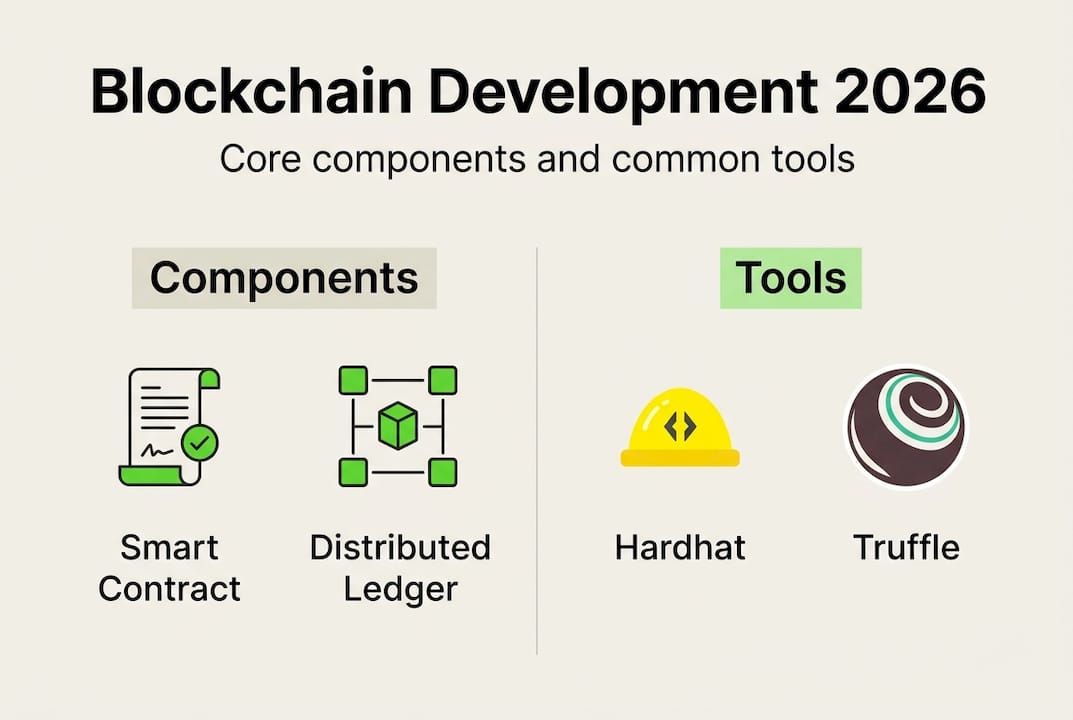
Developers rely on specialized tools to build and test blockchain applications. Hardhat and Truffle provide local development environments for writing and debugging smart contracts. Alchemy offers node infrastructure so you don't need to run your own blockchain nodes. These tools abstract complexity while giving you control over deployment and testing workflows.
Pro Tip: Master one blockchain platform deeply before expanding to others. The concepts transfer, but each ecosystem has unique idioms and security patterns that take months to internalize.
The programming languages matter more than in traditional development. Solidity's syntax resembles JavaScript but includes blockchain-specific features like gas optimization and state management. Rust prevents entire categories of bugs through its ownership system, making it ideal for high-stakes financial applications. Go's simplicity and concurrency support make it perfect for enterprise blockchain networks handling complex business workflows.
Step-by-step blockchain development methodology
Successful blockchain application development follows a systematic approach that validates assumptions before committing resources. Skipping phases leads to costly rewrites or failed deployments. Here's how experienced teams structure blockchain projects:
-
Validate the use case by identifying whether multiple parties genuinely need shared, tamper-proof data. If a single trusted entity can manage the system, traditional databases offer better performance and lower costs. Focus on scenarios where participants distrust each other but need to transact.
-
Choose between public and permissioned platforms based on your transparency and control requirements. Public blockchains like Ethereum maximize decentralization but expose all transaction data. Permissioned networks like Hyperledger Fabric restrict access to known participants, enabling privacy while maintaining auditability.
-
Design architecture that balances on-chain immutability with off-chain scalability. Store only critical data like ownership transfers and contract state on the blockchain. Move high-frequency operations, large files, and sensitive information to traditional databases with cryptographic links to on-chain records.
-
Develop and audit smart contracts using security-focused tools. Write contracts in your chosen language, then run static analyzers like Slither and Mythril to catch vulnerabilities. Professional audits from specialized firms cost $20,000 to $100,000 but prevent exploits that could drain millions.
-
Conduct extensive testing beyond normal quality assurance. Fuzzing tools generate thousands of random inputs to find edge cases. Formal verification mathematically proves contract behavior matches specifications. Test on testnets with real network conditions before mainnet deployment.
-
Deploy with a shadow launch that runs the blockchain system parallel to existing processes. Monitor for discrepancies between old and new systems. Gradually shift traffic as confidence builds, maintaining rollback capability for the first 30 days.
-
Implement governance and monitoring mechanisms for ongoing management. Smart contracts are immutable by default, so plan upgrade paths using proxy patterns. Set up alerts for unusual transaction patterns, gas price spikes, and security events.
Timelines vary dramatically by scope. A proof of concept demonstrating technical feasibility typically requires 3 months with a small team. Enterprise deployments handling real business processes take 9 to 12 months due to integration complexity, regulatory review, and stakeholder coordination. Budget additional time for user training and change management.
Pro Tip: Start with a minimum viable blockchain that solves one specific pain point. Expand functionality based on real usage patterns rather than theoretical requirements. Early users provide invaluable feedback that shapes your roadmap.
Understanding decentralized apps helps you architect systems that leverage blockchain's strengths while mitigating its limitations. The best implementations feel seamless to end users who may not even realize they're interacting with blockchain technology.

Common challenges and security considerations in blockchain development
Blockchain-specific vulnerabilities require defensive coding practices that go beyond traditional security. Smart contracts handle valuable assets and cannot be easily patched after deployment. A single bug can drain millions in minutes, as numerous high-profile hacks have demonstrated.
Critical vulnerabilities every developer must understand:
- Reentrancy attacks exploit contract callbacks by recursively calling functions before state updates complete, allowing attackers to withdraw funds multiple times
- Timestamp manipulation occurs when miners adjust block timestamps within allowed ranges to influence time-dependent contract logic
- Unbounded arrays grow without limits until transactions exceed gas limits and fail, freezing contract functionality
- Chain reorganizations happen when competing blocks cause recent transactions to revert, creating double-spend opportunities
- Oracle failures introduce single points of failure when contracts depend on external data feeds, requiring multi-oracle consensus
- Miner Extractable Value enables front-running by reordering transactions to profit from price movements before user trades execute
- Gas griefing uses unbounded loops to consume excessive gas, making contracts too expensive to use
- Immutability traps lock broken logic forever unless you implement proxy patterns for upgradeability from the start
Security best practices form the foundation of production blockchain systems. Never trust user input, even from other contracts. Validate all parameters, check for integer overflows, and fail safely when assumptions break. Use established libraries like OpenZeppelin rather than writing security-critical code from scratch. Their contracts have been battle-tested across thousands of deployments.
Formal verification mathematically proves your contract behaves correctly under all possible inputs. Tools like Certora and K Framework model contract logic and verify properties like "total supply never changes" or "only owners can withdraw." While expensive and time-consuming, formal verification catches subtle bugs that slip past traditional testing.
Pro Tip: Implement circuit breakers that pause contract functionality when anomalies are detected. A simple pause mechanism controlled by a multisig wallet lets you stop attacks in progress while you coordinate a response.
Continuous monitoring after deployment catches attacks before they cause catastrophic damage. Set up alerts for unusual transaction patterns, rapid fund movements, and failed transaction spikes. Monitor gas prices to detect when your contracts become too expensive to use. Track competitor exploits to identify vulnerabilities in similar code patterns.
Governance mechanisms determine how you handle bugs discovered post-deployment. Proxy patterns let you upgrade contract logic while preserving state and addresses. Multisig wallets require multiple parties to approve sensitive operations. Time locks delay critical changes, giving users time to exit if they disagree with governance decisions. These mechanisms balance security with adaptability in an immutable environment.
Understanding blockchain security helps you build systems that withstand attacks while remaining usable and maintainable over time.
Practical enterprise use cases and performance benchmarks
Enterprises are deploying blockchain where it solves specific multi-party trust problems with measurable ROI. The most successful implementations focus on narrow use cases with clear value propositions rather than trying to decentralize everything.
Supply chain traceability demonstrates blockchain's power to create shared truth across distrustful parties. Walmart reduced invoice disputes from 70% to under 1% by putting supply chain data on blockchain. Every participant sees the same information in real time, eliminating discrepancies from manual data entry and delayed updates. Manufacturers track components from raw materials through finished products, proving authenticity and enabling rapid recalls when defects are discovered.
Payment processing costs drop dramatically with blockchain rails. Traditional SaaS payment processing charges 5% in fees through multiple intermediaries. Blockchain payment solutions using Polygon reduce fees to 0.1% by eliminating middlemen. International transfers settle in minutes rather than days, improving cash flow for businesses operating across borders.
Key enterprise applications gaining traction:
- Manufacturing anti-counterfeiting systems embed unique identifiers on blockchain, letting customers verify product authenticity by scanning codes
- Agricultural product tracking records temperature, location, and handling throughout logistics chains, reducing spoilage and ensuring food safety
- Insurance claims processing automates payouts when predefined conditions are met, cutting settlement times from weeks to hours
- Trade finance digitizes letters of credit and bills of lading, reducing fraud and accelerating international commerce
Performance benchmarks reveal significant differences between platforms. Hyperledger Fabric achieves 3,500 transactions per second in permissioned enterprise environments by eliminating mining and using known validators. Ethereum processes 15 to 30 transactions per second on mainnet but reaches thousands on Layer 2 solutions. Solana handles over 2,000 transactions per second with sub-second finality, making it viable for consumer applications.
| Platform | TPS | Consensus | Primary Use Case |
|---|---|---|---|
| Hyperledger Fabric | 3,500+ | PBFT | Enterprise supply chain, finance |
| Ethereum | 15-30 (mainnet) | Proof of Stake | Public dApps, DeFi, NFTs |
| Solana | 2,000+ | Proof of History | High-frequency trading, gaming |
| Polygon | 7,000+ | Proof of Stake | Scalable Ethereum applications |
Gas cost management becomes critical on public blockchains where every operation costs money. Optimize contract code to minimize storage writes, the most expensive operations. Batch transactions when possible to amortize fixed costs across multiple operations. Use Layer 2 solutions for high-frequency activities while settling final state on mainnet for security.
Pro Tip: Evaluate whether you actually need blockchain before committing to the complexity. If your use case works with a traditional database and API, start there. Add blockchain only when you've proven that multiple parties need shared, tamper-proof data without a trusted central authority.
Exploring crypto payment integration reveals practical ways startups and enterprises can leverage blockchain for immediate business value without building complex dApps from scratch.
Explore expert blockchain development services
Building production blockchain systems requires specialized expertise across smart contract security, distributed systems, and platform-specific best practices. Proud Lion Studios brings deep blockchain development experience to startups and enterprises implementing decentralized solutions. Our Dubai-based team has delivered projects across multiple platforms, from Ethereum smart contracts to Hyperledger enterprise networks.
We provide end-to-end smart contract development services including architecture design, security audits, and deployment support. Our developers specialize in Solidity, Rust, and Go, with proven experience building secure, gas-optimized contracts for DeFi, NFT marketplaces, and enterprise applications. Every contract undergoes rigorous testing and professional security review before mainnet deployment.
For businesses integrating blockchain payments, our crypto payment integration services connect your existing systems to blockchain rails. We handle the technical complexity while you focus on your core business, providing APIs that abstract blockchain interactions into familiar payment flows.
What programming languages are most used in blockchain development?
Solidity dominates Ethereum smart contract development with its JavaScript-like syntax and mature tooling ecosystem. The language includes blockchain-specific features like gas optimization keywords and state management primitives. Most Ethereum developers start with Solidity due to extensive documentation and community support.
Rust powers Solana development and is gaining adoption for its memory safety guarantees that prevent entire categories of bugs. The ownership system catches errors at compile time rather than runtime, crucial for financial applications handling valuable assets. Rust's learning curve is steep but pays dividends in production reliability.
Go serves as the primary language for Hyperledger Fabric and other permissioned blockchain platforms targeting enterprise environments. Its simplicity, strong concurrency support, and fast compilation make it ideal for business networks requiring complex workflows. Visit our blockchain development page to learn how we leverage these languages for client projects.
How long does it typically take to develop a blockchain project?
Proof-of-concept projects demonstrating technical feasibility usually require around 3 months with a focused team. This timeline includes use case validation, platform selection, basic smart contract development, and testnet deployment. POCs prove that blockchain solves your specific problem before committing to full production.
Enterprise deployments take 9 to 12 months due to integration complexity, security requirements, and governance setup. You need time for professional audits, extensive testing, regulatory review, and stakeholder coordination. Budget additional months for user training and gradual rollout alongside existing systems.
What are the biggest security risks in blockchain development?
Reentrancy attacks, oracle failures, chain reorganizations, and gas griefing represent major vulnerability categories that have caused millions in losses. Reentrancy exploits callback mechanisms to drain funds before state updates complete. Oracle failures create single points of failure when contracts depend on external data feeds without redundancy.
Thorough security audits, formal verification, and extensive testing help mitigate these risks effectively. Professional auditors bring experience from reviewing thousands of contracts and know where bugs hide. Formal verification mathematically proves critical properties hold under all conditions. Combined with comprehensive testing and monitoring, these practices dramatically reduce exploit risk.
When is blockchain recommended over traditional databases?
Blockchain makes sense when multiple distrustful parties need shared, tamper-proof data without designating a trusted central authority. Supply chains with competing companies, financial systems spanning jurisdictions, and marketplaces connecting strangers all benefit from blockchain's transparency and immutability. The technology creates trust through cryptography and consensus rather than institutional reputation.
If a single trusted party can manage the data, traditional databases offer better performance, lower costs, and simpler operations. Centralized systems process thousands more transactions per second, cost less to run, and are easier to debug and maintain. Choose blockchain only when decentralization itself provides business value, not because the technology seems innovative.