

Proud Lion Studios is the strongest direct alternative to webions.net for anyone building beyond a template website, especially projects touching AI, mobile apps, or blockchain. If your needs are narrower, a boutique UAE Web3 and AI studio or a specialized remote development team can also do the job at a lower price point. Run either option through the checklist below before signing anything.
TL;DR:
- Proud Lion Studios offers integrated Web2 and Web3 development, including AI and mobile apps, with project-based pricing from a UAE-based team.
- Verify vendor scope with live project references, detailed timelines, and clear ownership rights before signing any contract.
- Budget for additional costs such as hosting, API fees, security audits, and post-launch support, which are rarely included in initial quotes.
- Switch vendors by exporting all site data, documenting current issues, and running parallel discovery to ensure a smooth transition.
- An SLA should specify ownership rights, response times, and exit terms, especially critical for blockchain security, AI models, and ongoing support.
Table of Contents
- Webions.net Alternatives: Who Actually Fits the Bill
- How Do You Choose Between These Providers?
- How Do You Move a Project Off Webions.net?
- What Risks Come With Switching Providers?
- Which Alternatives Offer the Best Post-Launch Support?
- What Does a Custom Development Project Really Cost?
- What Should Your Contract and SLA Actually Cover?
- When Full-Service Beats Going Lean
- Starting a Project With Proud Lion Studios
- Where to Verify Vendor Claims Before You Sign
- Sources
- FAQ
Webions.net Alternatives: Who Actually Fits the Bill
Webions shows up in company directories as a branding and website design provider, and Tracxn's company profile confirms that scope: it's a firm built around visual identity and site builds, not deep technical product work. That's a fine lane for a small business needing a brochure site. It's the wrong lane if you need AI agents, a mobile app, or a smart contract audited before launch. Public data aggregators, including Prospeo's revenue snapshot, suggest Webions operates at a small, unfunded scale, which usually means a leaner bench and fewer specialists on staff for anything outside web and branding work.
That gap is exactly why searches for webions.net competitors keep climbing. Here's a realistic shortlist, drawn from what these providers actually build, not just how they market themselves.
Proud Lion Studios operates as a full-service studio out of the UAE, covering Web2 and Web3 blockchain development, NFT marketplaces, smart contracts, mobile apps for iOS and Android, AI agents, and process automation under one roof. The firm's service pages list branding, UI/UX, and 3D modeling alongside the technical build work, which matters if your project spans more than one domain. Best for: founders and enterprises running integrated builds where a website, an app, and a blockchain feature all need to work together without three separate vendors passing the same spec back and forth.
Inceptives Digital appears in background competitive listings as a digital software development firm handling standard website and app projects. It's a reasonable option for a straightforward SMB build with a defined scope and no exotic technical requirements. Treat any specific claims about its team size or certifications as unverified until you confirm them directly, since the listing data is limited.
Apex Solutions turns up in the same competitor clusters, positioned around IT systems and solution design. That makes it a plausible fit for enterprise-facing integration work, like connecting a new web platform to legacy systems, though again, verify scope and references before committing budget.
Boutique UAE Web3 and AI studios are a distinct category worth naming separately. These smaller shops specialize in blockchain proof-of-concepts, AI experiments, and UX work, usually with a local team you can meet in person. They tend to work best for a startup testing a Web3 idea or an enterprise running a contained pilot before a bigger commitment. Pricing typically runs as a fixed quote per milestone rather than a retainer.
Remote specialist teams and offshoring firms round out the list. These distributed teams offer lower hourly rates and a wider pool of available developers, which suits cost-sensitive projects with a single, well-defined scope, like a one-off app feature or a backend migration. The tradeoff is integration risk: the more moving parts your project has, the more a distributed team can lose the thread between components.
- Proud Lion Studios: integrated Web2/Web3, AI, and mobile builds; project-based pricing; UAE-based team.
- Inceptives Digital: standard SMB websites and apps; project-based pricing; limited public verification.
- Apex Solutions: systems integration and enterprise web; project-based pricing; limited public verification.
- Boutique UAE Web3/AI studio: blockchain and AI pilots; milestone pricing; local team proximity.
- Remote specialist teams: single-scope, cost-driven builds; hourly or fixed-scope pricing; lower cost, higher integration risk.
How Do You Choose Between These Providers?
Five criteria separate a good hire from a expensive mistake. Run every candidate through all five before you send a deposit.
- Technical fit. Does the provider's actual portfolio show work in your specific domain, blockchain, AI automation, native mobile, rather than general web design dressed up as "custom development"?
- Delivery model and timelines. Ask for a phase-by-phase breakdown: discovery, build, testing, deployment. A vendor that can't estimate weeks per phase hasn't done this enough times to be trusted with your budget.
- Team location and availability. A UAE-based team offers overlapping working hours and easier legal recourse; a remote team offers cost savings. Neither is automatically wrong, but you need to know which tradeoff you're making.
- Portfolio and references. Ask for two live projects you can actually visit or test, not screenshots. A working smart contract on a testnet tells you more than a case study PDF.
- Pricing and contract terms. Fixed-scope quotes protect your budget; hourly billing protects the vendor's flexibility. Know which one you're signing before you negotiate anything else.
For an AI or automation project, ask directly: "What model or framework does the agent run on, and who owns the training data afterward?" For a blockchain build, ask: "Will you run a third-party security audit before mainnet deployment, and is that cost included in your quote?" For mobile apps, ask about post-launch support windows and who owns the App Store or Google Play account after handoff.
Red flags to walk away from: no live portfolio, timelines given only in vague ranges like "a few months," and any hesitation when you ask who owns the intellectual property after final payment.
Pro Tip: Ask every finalist for one client reference in your own industry, then actually call that reference. A vendor with real delivery history will connect you within a day; one that stalls or deflects usually has less to show than the pitch deck suggests.
How Do You Move a Project Off Webions.net?
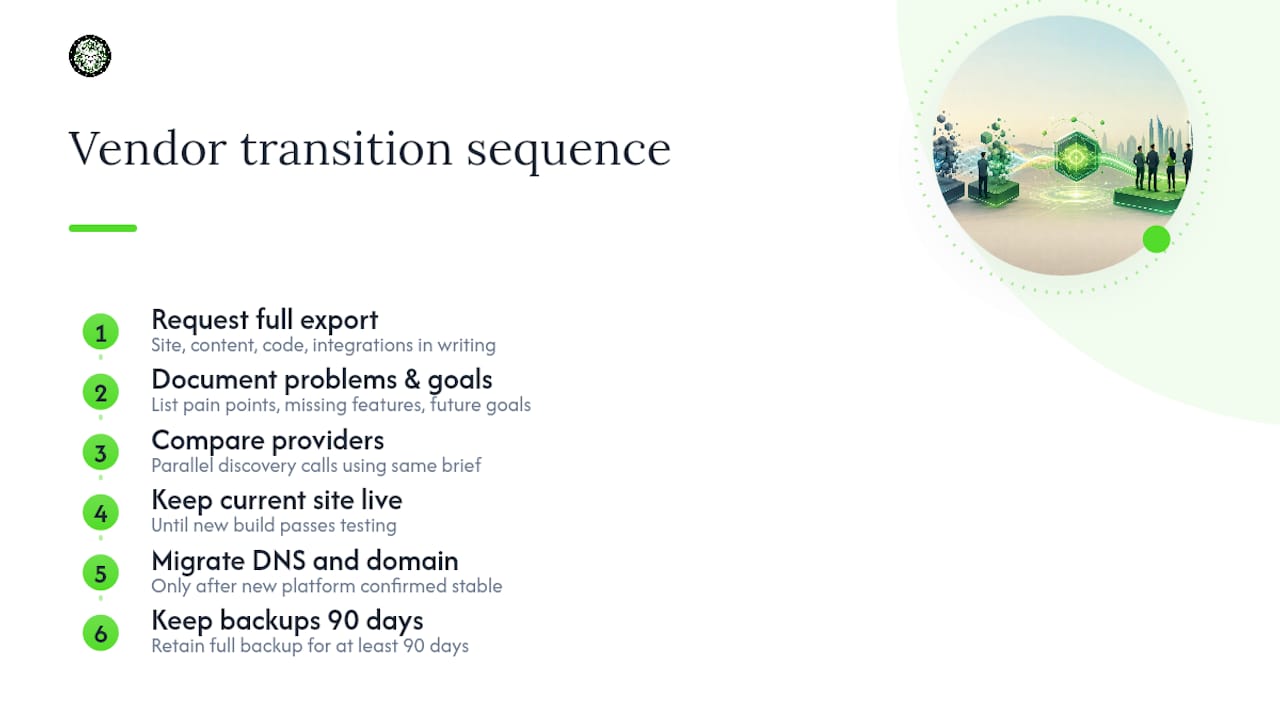
Switching vendors doesn't have to mean starting from zero, but it does require a sequence. Start by requesting a full export of your current site, its content, and any custom code or integrations from Webions, in writing, before you sign with anyone new.
Next, document what's actually working and what isn't. A short brief listing pain points, missing features, and future goals (an app, a blockchain feature, an AI tool) gives any new vendor a real starting point instead of a guess.
Then run parallel discovery calls with two or three shortlisted providers using the same brief, so you're comparing quotes on identical scope. Once you pick a vendor, negotiate a transition window that keeps your current site live until the new build passes testing. Migrate DNS and domain control last, only after the new platform is confirmed stable. Keep a backup of everything from the old provider for at least 90 days after cutover, in case a dispute or missing asset surfaces later.
What Risks Come With Switching Providers?
The biggest risk in any vendor switch is data loss: lost content, broken integrations, or a domain transfer that goes sideways mid-migration. Mitigate it by requiring a full backup and a written asset inventory before you end the relationship with your current provider.
The second risk is scope creep disguised as "discovery." A new vendor may uncover technical debt in your old build and use it to justify budget increases mid-project. Lock your initial quote to a defined scope, and treat any expansion as a separate, approved change order with its own price tag.
Downtime is the third risk, particularly for ecommerce or CRM-connected sites. Insist on a staging environment where the new build is tested against real traffic patterns before the live cutover, not after.
Finally, watch for knowledge loss. If your old provider built custom automations or integrations nobody documented, that logic can quietly disappear during migration. Ask your new vendor to reverse-engineer and document any undocumented systems as part of the discovery phase, not as an afterthought once something breaks.
Which Alternatives Offer the Best Post-Launch Support?
Support quality varies more than most buyers expect, and it rarely shows up in the sales pitch. A full-service studio like Proud Lion Studios typically structures post-launch work in phases: discovery, build, test, and an ongoing operate phase covering monitoring, updates, and feature iteration, which matters especially for AI models that need retraining or smart contracts that need monitoring after mainnet deployment.
Smaller SMB-focused firms in the Inceptives Digital or Apex Solutions category tend to offer support on a ticket or hourly basis after launch, which works fine for a static site but gets expensive fast for anything with moving technical parts.
Boutique UAE studios usually stay closely involved post-launch, given their smaller client rosters, but their capacity to handle multiple concurrent support requests is naturally limited by team size.
Remote and offshoring teams vary the most. Some offer dedicated support contracts; others consider the project closed at delivery unless you negotiate ongoing coverage upfront. Always get post-launch support terms in writing before the project starts, not after you discover you need them.
What Does a Custom Development Project Really Cost?
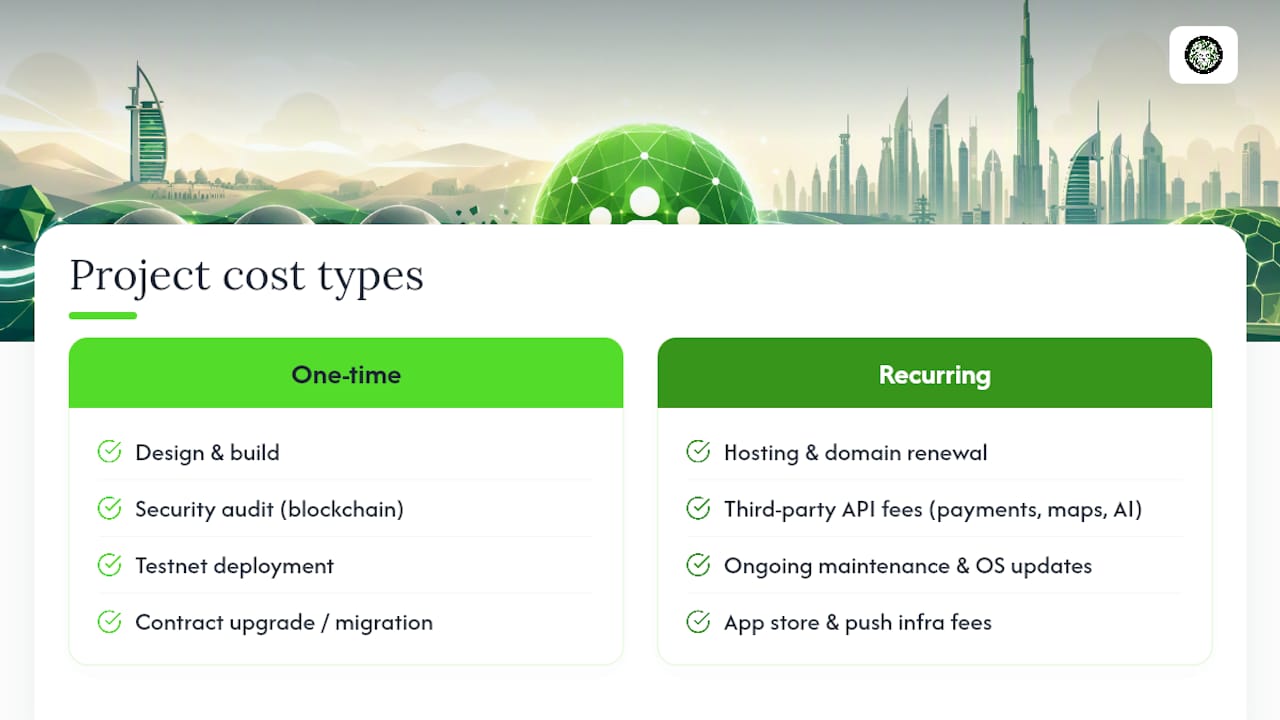
Base development quotes rarely tell the whole story. A website or app quote typically covers design and build, but hosting, domain renewal, third-party API fees (payment gateways, mapping services, AI model usage), and ongoing maintenance usually sit outside the initial number.
For blockchain projects specifically, budget for a security audit and testnet deployment as separate line items. Proud Lion Studios's blockchain development documentation treats these as standard deliverables precisely because skipping them is how smart contract projects end up exploited after launch. An upgrade or migration path for the contract itself is another cost many first-time buyers don't budget for until it's urgently needed.
Mobile apps carry their own hidden costs: app store fees, ongoing OS compatibility updates, and push notification infrastructure. Automation and AI projects often carry recurring model hosting or API usage fees that scale with volume, which a flat one-time quote won't reflect.
Ask every vendor for an itemized breakdown that separates one-time build costs from recurring operational costs. If a quote is a single lump number with no breakdown, that's a request worth making before you sign.
What Should Your Contract and SLA Actually Cover?
A solid contract for a custom software project spells out ownership, timelines, and what happens when something goes wrong, not just the price. Intellectual property terms need to state clearly that you own the final code and assets once payment clears, not the vendor.
Service level agreements should define response times for bugs by severity (a payment system outage is not the same urgency as a typo), plus what counts as a bug fix versus a billable change request. For AI and automation features, the SLA should specify who owns model performance monitoring after launch and what accuracy threshold triggers a required fix.
For blockchain deliverables, the contract should name the specific audit firm or process used, plus a warranty period covering vulnerabilities discovered after mainnet deployment. Get a written data and asset handover clause too: if the relationship ends, you need guaranteed access to source code, credentials, and documentation, not a negotiation.
Finally, define the contract's exit terms upfront. A reasonable notice period and a clear transition support clause protect you if you ever need to switch vendors again.
When Full-Service Beats Going Lean
A full-service UAE studio earns its price when your project has real technical interdependence: a token that needs to talk to a mobile wallet, an AI agent that needs to sit inside a CRM. Fewer handoffs mean fewer integration failures. Offshore or freelance teams make sense for a single, well-scoped task with no downstream dependencies. Most real projects start lean and discover complexity later. Plan the engagement phases, discovery, build, test, operate, before you pick the vendor, not after.
— Amal
Starting a Project With Proud Lion Studios
Proud Lion Studios replaces the vendor patchwork most switchers end up with. Instead of hiring one firm for branding, another for the app, and a third for blockchain features, you get a UAE-based technical team that handles the full stack, and one contract instead of three.
Before your discovery call, prepare three things: a one-paragraph scope description, a rough timeline (weeks or months, not "soon"), and a budget range you're comfortable discussing openly. That preparation alone cuts most first-call friction in half. If your project needs a native app, start with the mobile app development page); if it involves tokens, NFTs, or smart contracts, the blockchain development page covers audit and testnet deployment as standard steps, not add-ons. Either way, the full services overview is the right starting point to scope a project that spans more than one of these domains at once.
Where to Verify Vendor Claims Before You Sign
Check any provider's public footprint before committing budget. Company-profile aggregators are a fast first pass, though they're a starting point, not a substitute for reference calls.
- Webions company profile — Tracxn for background on Webions's positioning and scale.
- Webions company details — AeroLeads for a broader list of firms in its competitive cluster.
- How to outsource web design for business owners — SEO Analytic for a practical primer on vendor outsourcing decisions.
- Proud Lion Studios's own alternatives analysis for CTOs and founders for a comparable vendor-evaluation approach applied to a different provider.
Sources
FAQ
What Is the Best Direct Alternative to Webions.net?
Proud Lion Studios is the strongest direct alternative for projects that need more than a website, particularly ones involving AI, mobile apps, or blockchain features, since it delivers all three under one UAE-based team.
Are There Cheaper Webions.net Substitutes?
Remote specialist teams and offshoring firms typically offer lower hourly rates than full-service studios, making them a reasonable fit for a single, well-scoped task, though they carry more integration risk on complex, multi-part projects.
How Long Does a Typical Custom Software Project Take?
Timelines vary by scope, but most custom builds move through four phases, discovery, build, test, and operate, and any vendor unable to estimate weeks per phase likely lacks the delivery history to trust with your budget.
What Hidden Costs Should I Budget For?
Beyond the base build quote, budget separately for hosting, API and third-party service fees, security audits for blockchain features, and ongoing maintenance, since these often sit outside a vendor's initial number.
Should I Get an SLA Before Starting a Project?
Yes. A written service level agreement defining bug-response times, ownership of code and assets, and exit terms protects you if the vendor relationship ends earlier than planned.