

You've heard the buzz about Web3, but maybe you're skeptical it's just hype wrapped in jargon. Many founders share this confusion, dismissing blockchain as too complex or unnecessary. Yet beneath the noise lies genuine transformative potential: decentralization that shifts control to users, new business models enabled by smart contracts, and ownership structures impossible in Web2. This guide cuts through the confusion to deliver clear, actionable insights on what Web3 really is, how its technology stack works, which startups are scaling successfully, and the strategic moves you need to avoid common pitfalls and leverage blockchain for real competitive advantage.
Table of Contents
- Key Takeaways
- What is Web3 and why it matters for startups
- The core Web3 stack: layers and infrastructure
- Empirical insights: Web3 market growth and startup success benchmarks
- Common pitfalls and expert best practices for Web3 startups
- How startups can leverage Web3 technologies strategically
- How Proud Lion Studios can help your Web3 startup thrive
- FAQ
Key Takeaways
| Point | Details |
|---|---|
| Web3 paradigm shift | Web3 moves control from platforms to participants through decentralization and smart contracts enabling trusted, permissionless interactions and new business models. |
| Core stack layers | The Web3 stack runs across Protocol, Infrastructure, Applications, and Access layers and each plays a distinct role that startups must map to their product. |
| Startup advantages | Startups can build trustless systems, unlock new revenue through tokenization, and enable global reach without traditional gatekeepers. |
| Strategic cautions | Plan for tradeoffs in protocol choice and infrastructure costs, avoid hype by focusing on real value, and architect for composability and governance from day one. |
What is Web3 and why it matters for startups
Web3 represents a fundamental shift from the centralized platforms dominating Web2. In Web2, tech giants control user data, monetize attention, and dictate platform rules. Users can read and write content, but they don't own it. Web3 is a decentralized internet evolution using blockchain for user ownership of data and assets, enabling a read-write-own model where participants control their digital identity, assets, and interactions without intermediaries.
Decentralization means no single entity holds the keys. Smart contracts execute agreements automatically based on code, creating trustless environments where parties transact without needing to trust each other or a middleman. This architecture unlocks new business models: token economies that align incentives, NFT marketplaces that give creators direct revenue, and DeFi protocols that eliminate traditional financial gatekeepers.
For startups, Web3 offers distinct advantages. You can build transparent systems where users verify operations on public blockchains, reducing fraud and increasing trust. You can design composable applications that integrate with existing protocols, accelerating development. You can tap into global liquidity and user bases without geographic restrictions or legacy banking infrastructure.
"Web3 is not just a technology upgrade. It's a paradigm shift that redistributes power from platforms to participants, enabling startups to compete on innovation rather than scale."
Core benefits for startups include:
- Trustless interaction: Smart contracts enforce rules without intermediaries, cutting costs and delays.
- New revenue models: Tokenization creates novel incentive structures and fundraising mechanisms.
- User ownership: Customers own their data and assets, fostering loyalty and network effects.
- Global reach: Borderless infrastructure enables instant international transactions and collaboration.
Understanding these fundamentals positions you to evaluate whether Web3 fits your startup's vision and how to architect solutions that deliver real value, not just buzzword compliance.
The core Web3 stack: layers and infrastructure
Web3's architecture is modular, built in layers that each serve distinct functions. Grasping this stack helps you identify where your startup fits and which components you need to integrate. The Web3 stack comprises four primary layers: Protocol, Infrastructure, Applications, and Access.
Protocol Layer forms the foundation. This includes blockchains like Ethereum, Solana, and Aptos that provide consensus mechanisms, transaction validation, and immutable ledgers. Startups building on these protocols inherit security and decentralization but must understand trade-offs like transaction speed, cost, and finality.

Infrastructure Layer delivers essential services: wallets for key management, oracles that feed external data to smart contracts, indexing services for querying blockchain state, and storage solutions like IPFS for decentralized file hosting. Tools like Infura and Alchemy provide RPC endpoints so you don't run your own nodes.
Application Layer is where user-facing products live: decentralized apps (dApps), DeFi protocols, NFT marketplaces, and DAOs. These applications compose infrastructure and protocol primitives into complete experiences. Your startup likely operates here, building features that solve real problems using Web3 rails.
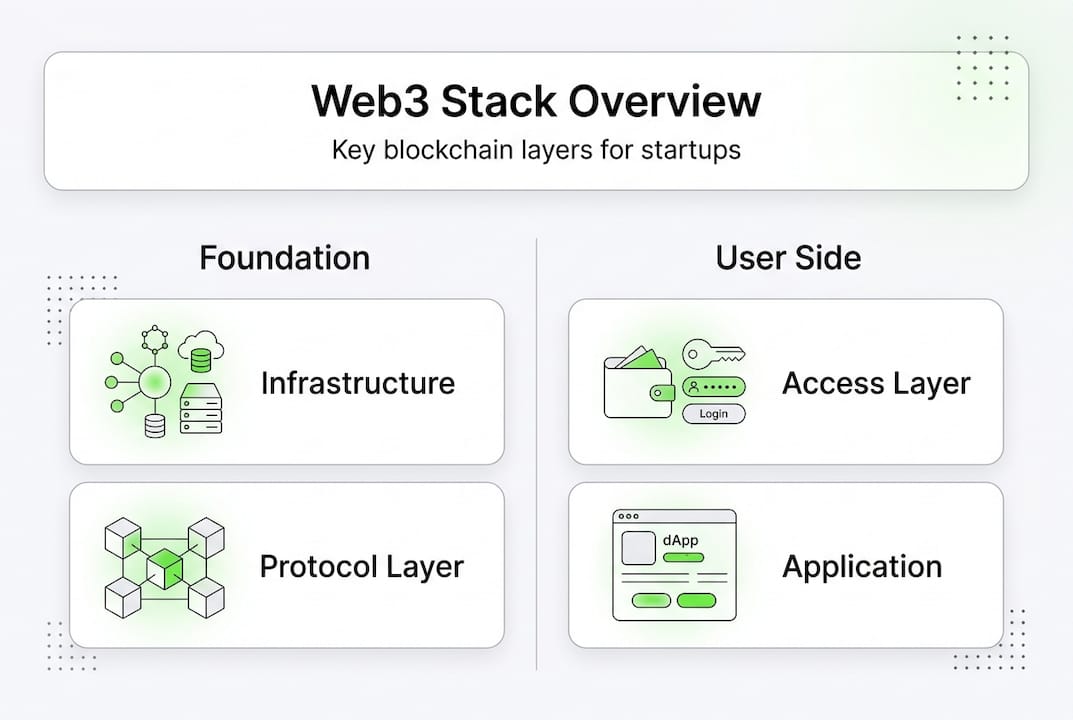
Access Layer includes interfaces like MetaMask, WalletConnect, and browser extensions that let users interact with dApps, sign transactions, and manage assets. Seamless access is critical for adoption, as poor UX at this layer drives users away.
| Stack Layer | Role | Startup Touchpoints |
|---|---|---|
| Protocol | Consensus, ledger, smart contract execution | Choose blockchain based on speed, cost, ecosystem |
| Infrastructure | Wallets, oracles, indexing, storage | Integrate APIs for data feeds, use hosted nodes |
| Applications | dApps, DeFi, NFTs, DAOs | Build your product, compose existing protocols |
| Access | Wallets, browser extensions | Optimize onboarding, support multiple wallets |
Integration follows a typical sequence:
- Select a protocol aligned with your performance and cost requirements.
- Leverage infrastructure services to avoid reinventing the wheel (use Chainlink for oracles, The Graph for indexing).
- Develop your application using frameworks like Hardhat or thirdweb to streamline smart contract deployment.
- Optimize access by supporting popular wallets and minimizing transaction friction.
Pro Tip: Prioritize modular infrastructure that lets you swap components as the ecosystem evolves. Avoid vendor lock-in by using open standards and interoperable tools, ensuring your stack remains flexible as better solutions emerge.
Empirical insights: Web3 market growth and startup success benchmarks
Data paints a compelling picture of Web3's trajectory and the opportunities for startups willing to navigate its volatility. MYRIAD scaled to 415,000 users in 30 days using thirdweb's infrastructure, demonstrating that rapid user acquisition is achievable with the right technical foundation. Monad's sharded archive handles over 10,000 transactions per second, proving that performance bottlenecks can be overcome with innovative architecture.
Financial metrics reveal sustained interest despite market cycles. DeFi total value locked (TVL) reached $225 billion in 2025, showing institutional and retail confidence in decentralized finance. Web3 venture capital funding totaled $34.94 billion in 2025, indicating investors continue backing promising projects even after the 2022 bear market.
| Metric | Value | Implication for Startups |
|---|---|---|
| MYRIAD user growth | 415K in 30 days | Rapid scaling possible with modular tools |
| Monad TPS | 10,000+ | High throughput achievable, reducing congestion |
| DeFi TVL 2025 | $225B | Strong liquidity and user engagement in DeFi |
| VC funding 2025 | $34.94B | Capital available for credible Web3 startups |
Sector-specific trends highlight where startups should focus:
- DeFi: Maintains dominant TVL and daily active users, with lending, DEXs, and derivatives leading.
- Gaming: Blockchain games attract users seeking true asset ownership and play-to-earn models.
- Real-world assets (RWA): Tokenization of real estate, commodities, and securities is gaining regulatory clarity and institutional adoption.
- Infrastructure: Tools that improve developer experience and reduce onboarding friction see consistent demand.
"Despite bear markets, sectors delivering real utility like DeFi and gaming show enduring user growth and transaction volume, proving Web3's value beyond speculation."
These benchmarks underscore that success hinges on solving genuine problems, not riding hype. Startups that future-proof their products by focusing on utility, scalability, and user experience position themselves to capture growth as the ecosystem matures.
Common pitfalls and expert best practices for Web3 startups
Many Web3 projects stumble on predictable technical and strategic mistakes. Recognizing these pitfalls early lets you engineer around them and build resilient systems.
Chain reorganizations cause invalid data, RPC rate limits disrupt applications, access control failures top exploit lists, oracle manipulation drains funds, and poor user experience drives abandonment. Each of these has cost startups millions and destroyed user trust.
Technical risks include:
- Chain reorgs: Blocks can be reorganized before finality, invalidating transactions your app assumed confirmed.
- RPC limits: Relying on free or rate-limited RPC endpoints causes downtime during traffic spikes.
- Access control bugs: Improperly configured roles let unauthorized users mint tokens or drain treasuries.
- Oracle attacks: Manipulated price feeds enable arbitrage exploits in DeFi protocols.
- Gas inefficiency: High transaction costs alienate users and make your product uncompetitive.
Strategic mistakes compound technical issues:
- Premature tokenization: Launching a token before product-market fit dilutes focus and attracts speculators, not users.
- Ignoring UX: Complex wallet setups and transaction confirmations frustrate non-crypto-native users.
- Overlooking security audits: Skipping professional audits to save costs invites catastrophic exploits.
Expert mitigation strategies from on-chain data production research include:
- Separate read/write paths: Treat on-chain reads and writes differently to handle latency and finality.
- Handle finality levels: Wait for sufficient block confirmations before treating transactions as irreversible.
- Fuzz testing: Automate testing with random inputs to uncover edge cases and vulnerabilities.
- Economic intuition: Understand incentive structures to anticipate how attackers might exploit your system.
- Shadow launches: Deploy to testnet or limited mainnet environments to catch issues before full release.
Pro Tip: Prioritize user experience improvements like gasless transactions (meta-transactions) and social logins to reduce onboarding friction. Users won't tolerate clunky interfaces just because your tech is decentralized.
Investing in auditing and security services early protects your reputation and capital. Treating security as a core feature, not an afterthought, distinguishes successful startups from cautionary tales.
How startups can leverage Web3 technologies strategically
Adopting Web3 requires intentional strategy, not blind adoption. Start by assessing whether your use case genuinely benefits from blockchain. Does your product involve multiple parties who need to trust shared data without a central authority? Does decentralization add value beyond marketing appeal? If the answer is no, traditional databases may serve you better.
Startups should validate blockchain necessity for multi-party trust cases and focus on real utility in gaming, DeFi, and real-world asset sectors. Blockchain excels where transparency, immutability, and disintermediation create competitive advantages.
Steps to integrate AI with blockchain for supply chain finance:
- Identify data sources: Collect IoT sensor data, shipping manifests, and payment records.
- Deploy smart contracts: Automate payment releases when AI verifies delivery conditions are met.
- Train AI models: Use historical data to predict delays, fraud, or quality issues.
- Integrate oracles: Feed AI predictions and external data into smart contracts securely.
- Monitor and iterate: Track performance metrics and refine models based on outcomes.
Modular stack design is essential. Build on composable protocols so you can swap components as better solutions emerge. Use open-source libraries and standards to avoid lock-in. Design APIs that abstract blockchain complexity from end users.
Sectors showing enduring growth include:
- DeFi: High TVL and daily active users in lending, DEXs, and derivatives.
- Gaming: Players value true asset ownership and interoperable in-game items.
- Real-world assets: Tokenizing real estate, commodities, and securities attracts institutional capital.
- Creator economies: NFTs and royalty mechanisms empower artists and content creators.
Post-2025, focus on utility over hype. The speculative frenzy has cooled, leaving startups that solve real problems. Track key performance indicators like daily active users, transaction volume, TVL, and retention rates. Iterate based on user feedback, not token price.
Propel your business growth by aligning Web3 capabilities with customer pain points. Whether you're building a decentralized marketplace or tokenizing assets, ensure every blockchain feature delivers measurable value.
How Proud Lion Studios can help your Web3 startup thrive
Navigating Web3's complexity demands experienced partners who understand both blockchain technology and startup realities. Proud Lion Studios specializes in blockchain development services tailored for founders ready to build next-generation digital solutions. Our team designs and deploys secure, scalable blockchain applications across Ethereum, Solana, Aptos, and other leading protocols.
We offer end-to-end smart contract development, from initial architecture to auditing and deployment, ensuring your contracts are efficient, secure, and aligned with your business logic. Our tokenization, NFT, and dApp services enable you to launch token economies, NFT marketplaces, and decentralized applications that engage users and drive growth. Based in Dubai with a fully UAE-based technical team, we deliver custom solutions that integrate blockchain, AI, and mobile technologies to future-proof your startup.
FAQ
What is Web3 and how does it differ from Web2?
Web3 is a decentralized internet model built on blockchain technology, enabling users to own their data, digital assets, and identities without relying on centralized platforms. Unlike Web2, where companies like Google and Facebook control user information and monetize it, Web3 shifts power to individuals through cryptographic ownership and smart contracts. This read-write-own paradigm lets you interact with applications, transact value, and participate in governance directly, creating trustless environments where code enforces agreements instead of intermediaries.
How can startups decide if they need blockchain technology?
Assess whether your use case requires trust among multiple parties who don't inherently trust each other or a central authority. Blockchain adds value when transparency, immutability, and disintermediation solve core business problems, such as supply chain verification, cross-border payments, or decentralized governance. If a traditional database meets your needs without these properties, blockchain may introduce unnecessary complexity and cost. Validate product-market fit and user demand before designing token economies, ensuring you're solving real problems rather than chasing trends.
What are common security risks in Web3 projects and how to mitigate them?
Risks include chain reorganizations that invalidate transactions, oracle manipulation that feeds false data to smart contracts, and access control failures that let unauthorized users exploit functions. Additional threats involve RPC rate limits causing downtime and gas inefficiencies making your product uncompetitive. Mitigate these by conducting professional security audits, implementing role-based access controls, and using fuzz testing to uncover vulnerabilities. Deploy shadow launches on testnets first, separate read and write data paths, and develop economic intuition to anticipate exploit vectors before attackers do.
Which Web3 sectors have growth potential for startups currently?
DeFi maintains high total value locked and daily active users, with lending protocols, decentralized exchanges, and derivatives leading growth. Gaming attracts users seeking true asset ownership and play-to-earn models, while tokenization of real-world assets like real estate and commodities gains institutional traction and regulatory clarity. Creator economies leveraging NFTs and on-chain royalties empower artists and content producers. Focus on delivering real utility in these areas rather than speculative features, as post-bear market users demand tangible value and seamless experiences over hype-driven promises.