
Deploying a smart contract means compiling Solidity source code into EVM bytecode and broadcasting it as a transaction with no recipient address — once the network mines that transaction, the chain assigns your contract a permanent, immutable address. The fastest safe route for any developer or beginner is to deploy to the Sepolia or Holesky testnet first, using a dedicated development wallet in MetaMask and free test ETH from a faucet, before you ever touch mainnet. Mainnet transactions are irreversible, so the discipline of testnet-first is non-negotiable.
Recommended tools at a glance:
- Remix — browser-based IDE, zero install, fastest path for beginners
- Foundry — CLI-native, blazing fast compilation, built-in fuzzing, preferred for production
- Hardhat — JavaScript/TypeScript ecosystem, rich plugin library, scriptable workflows
After deployment, verify your contract source on Etherscan so anyone can audit the bytecode. Keep your private keys out of your codebase from day one.
Pro Tip: Create a fresh MetaMask wallet specifically for development. Never deploy from your primary wallet holding real funds — one accidental mainnet transaction can drain it.
Table of Contents
- What do you need before starting the deployment process?
- How do you initialize a local project and choose a toolchain?
- How do you write and compile a Solidity contract?
- Why does testing matter before you deploy to any network?
- How do you deploy to a testnet and then to mainnet?
- How do you interact with a deployed contract using ethers.js?
- What should you monitor and manage after deployment?
- What does a professional smart contract workflow look like in 2026?
- How do proxy deployments handle contract upgrades?
- Key Takeaways
- Why deployment is an engineering discipline, not a one-time task
- Proud Lion Studios handles production deployments end-to-end
- Useful sources for deeper reading
What do you need before starting the deployment process?
Getting prerequisites right saves hours of debugging later. Work through this checklist before writing a single line of Solidity.
Accounts and wallets:
- Create a dedicated development wallet in MetaMask — never reuse your personal mainnet wallet
- Fund it with testnet ETH from the Sepolia faucet or Holesky faucet before any testnet work
- For mainnet, plan to use a hardware wallet (Ledger, Trezor) or a multisig as the deployer key
RPC and node access:
- Alchemy and Infura both offer free API keys that give you a JSON-RPC endpoint without running your own node
- Foundry and Hardhat both require an RPC URL in their config; Remix handles this through its browser MetaMask connection
- Copy your API key into a
.envfile and add.envto.gitignoreimmediately
Tooling:
- Node.js v18+ for Hardhat and ethers.js
- Foundry installed via
curl -L https://foundry.paradigm.xyz | bash && foundryup - Remix needs no install — open
remix.ethereum.orgin any browser
Key security basics:
- Store private keys in environment variables, never hardcoded in scripts
- Use a secrets manager or hardware wallet for any production deployer key
- Rotate development keys regularly and treat them as disposable
Pro Tip: Alchemy's free tier includes a dashboard that shows every RPC call your deployment makes — useful for debugging failed transactions without reading raw logs.

How do you initialize a local project and choose a toolchain?
The right toolchain depends on your goal. Here is how to get each one running, plus when to pick each.
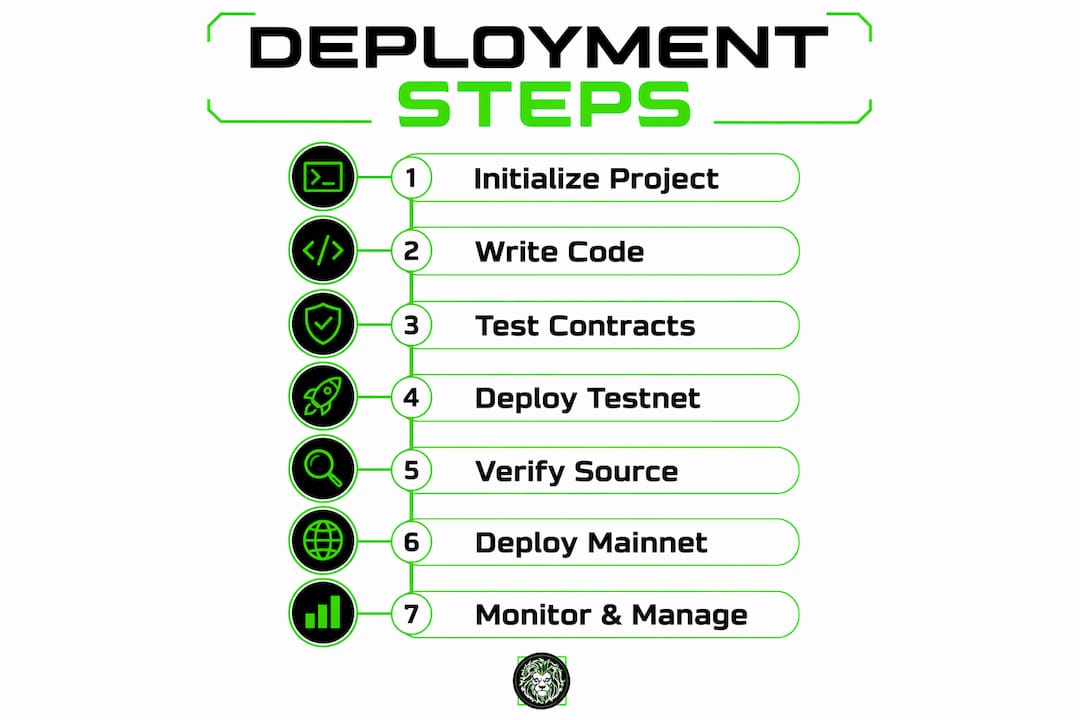
1. Foundry
curl -L https://foundry.paradigm.xyz | bash
foundryup
forge init my-project
cd my-project
Foundry compiles and runs tests in Rust, making it significantly faster than Node-based alternatives. Its built-in anvil local chain and native fuzzing make it the primary toolchain for new projects in 2026.
2. Hardhat
mkdir my-project && cd my-project
npm init -y
npm install --save-dev hardhat
npx hardhat init
npm install --save-dev @nomicfoundation/hardhat-toolbox ethers dotenv
Hardhat suits teams already in a JavaScript or TypeScript ecosystem. Its plugin library covers everything from gas reporting to Etherscan verification. Node.js v18+ is required.
3. Remix
No install. Navigate to remix.ethereum.org, create a new workspace, and start writing Solidity directly in the browser.
Connect MetaMask for testnet deployments.
When to prefer each:
- Remix — rapid prototyping, learning, one-off experiments
- Foundry — production DeFi, fast CI, fuzzing-heavy test suites
- Hardhat — JS/TS teams, complex migration scripts, plugin-dependent workflows
For CI/CD, build your deployment artifacts in the pipeline and reuse the exact same compiled output for mainnet. This guarantees deterministic deployments and prevents "it worked on my machine" surprises.
Pro Tip: Never commit your .env file. Add a .env.example with placeholder variable names so teammates know what secrets to configure without exposing real keys.
How do you write and compile a Solidity contract?
Start with the simplest contract that proves your pattern works. Here is a minimal SimpleStorage example:
// SPDX-License-Identifier: MIT
pragma solidity ^0.8.20;

contract SimpleStorage {
    uint256 private storedValue;

    function set(uint256 value) external {
        storedValue = value;
    }

    function get() external view returns (uint256) {
        return storedValue;
    }
}
Compile commands:
- Foundry:
forge build - Hardhat:
npx hardhat compile - Remix: click the Solidity Compiler tab, then Compile SimpleStorage.sol
Each toolchain produces artifacts in a local directory (out/ for Foundry, artifacts/ for Hardhat). Those artifacts contain two critical pieces:
- ABI — the interface definition your front-end and scripts use to call functions
- Bytecode — the compiled machine code the EVM executes on-chain
Compiler best practices:
- Pin the compiler version in
pragmaand match it exactly in your config (solcversion infoundry.tomlorhardhat.config.ts) - Enable the optimizer for production (
optimizer: { enabled: true, runs: 200 }) to reduce gas costs - Treat compiler warnings as errors — a warning in production code is a liability
Contracts exceeding 24KB hit the EIP-170 size limit and will fail to deploy. If you hit this ceiling, split logic into libraries or adopt the diamond proxy pattern.
Pro Tip: Run forge build --sizes to see bytecode size for every contract before deployment. Catching a size violation locally is far cheaper than discovering it mid-deployment.
Why does testing matter before you deploy to any network?
Testing is where you catch bugs that cost nothing to fix now but could cost everything on mainnet. A structured testing approach covers three layers.
Step 1: Write and run unit tests
# Foundry
forge test -vvv

# Hardhat
npx hardhat test
Assert ownership, access control, edge-case inputs, and every state transition your contract can reach. If a function can be called by an unauthorized address, write a test that proves it reverts.
Step 2: Use a local chain for iteration
Foundry's anvil and Hardhat Network both spin up a local EVM in milliseconds. Use snapshot/rollback to reset state between test scenarios without redeploying:
anvil # starts local chain on localhost:8545
Snapshots let you test complex multi-step flows without accumulating state pollution across runs.
Step 3: Run fuzzing and invariant tests
Foundry's fuzzer generates thousands of random inputs automatically. An invariant test asserts a property that must always hold — for example, "total supply never exceeds the cap." These tests find edge cases that hand-written unit tests routinely miss, which is why they have become standard practice for DeFi and enterprise systems.
Step 4: Static analysis
Run Slither before moving to testnet. It catches reentrancy risks, unchecked return values, and common Solidity pitfalls in seconds.
Pre-testnet checklist:
- All unit tests pass with zero failures
- Fuzzer ran at least 10,000 runs with no violations
- Slither output reviewed and critical findings resolved
- Gas estimates reviewed for each function
Pro Tip: Set FOUNDRY_FUZZ_RUNS=100000 in your CI environment. The extra coverage on a CI machine costs almost nothing in time but catches edge cases that 256 default runs miss.
How do you deploy to a testnet and then to mainnet?
This is the core of the smart contract deployment process. Follow these steps in order.

Step 1: Deploy to Sepolia testnet
# Foundry
forge create src/SimpleStorage.sol:SimpleStorage \
  --rpc-url $SEPOLIA_RPC_URL \
  --private-key $PRIVATE_KEY

# Hardhat
npx hardhat run scripts/deploy.ts --network sepolia

# Remix: select "Injected Provider - MetaMask," choose Sepolia, click Deploy
Constructor arguments go after the contract name in forge create or inside your deploy script's deploy() call. Encoding errors here are a common source of failed deployments.
Step 2: Verify on Etherscan
Verification links on-chain bytecode to your readable source code, enabling public auditing and direct UI interaction from the explorer.
# Foundry (deploy + verify in one command)
forge create src/SimpleStorage.sol:SimpleStorage \
  --rpc-url $SEPOLIA_RPC_URL \
  --private-key $PRIVATE_KEY \
  --verify \
  --etherscan-api-key $ETHERSCAN_API_KEY

# Hardhat
npx hardhat verify --network sepolia DEPLOYED_CONTRACT_ADDRESS
Step 3: Move to mainnet with precautions
Before deploying to mainnet, run through this checklist:
- Audit completed or waived with documented risk acceptance
- Deployer wallet funded with enough ETH to cover gas plus a buffer
- Hardware wallet or multisig used as the deployer key for any contract holding user funds
- Gas price checked — deploying during off-peak hours (weekday early mornings UTC) can reduce costs meaningfully
Cost reality check: Simple contract deployments on Ethereum mainnet typically range depending on gas prices and bytecode size. Testnets use faucet ETH and cost nothing, but they replicate mainnet conditions accurately enough to catch most issues.
Common deployment errors and fixes:
- Out of gas — increase
gasLimitin your deploy script; estimate witheth_estimateGasfirst - Nonce mismatch — reset your deployer wallet's nonce in MetaMask or pass
--nonceexplicitly - Constructor ABI encoding error — double-check argument types match the Solidity constructor signature exactly
Pro Tip: Always deploy to Sepolia first with the exact same script and artifacts you plan to use on mainnet. If the testnet deploy succeeds and verification passes, you have high confidence the mainnet run will too.
How do you interact with a deployed contract using ethers.js?
Once deployed, your contract needs a client. Ethers.js is the standard library for this in JavaScript and TypeScript environments.
Basic read and write pattern:
import { ethers } from "ethers";

// Connect to provider (Alchemy RPC or MetaMask)
const provider = new ethers.JsonRpcProvider(process.env.RPC_URL);
const signer = new ethers.Wallet(process.env.PRIVATE_KEY, provider);

// Instantiate contract
const contract = new ethers.Contract(CONTRACT_ADDRESS, ABI, signer);

// Read (no gas cost)
const value = await contract.get();

// Write (sends a transaction)
const tx = await contract.set(42);
await tx.wait(); // wait for confirmation
Front-end wallet connection pattern:
- Detect
window.ethereumand request accounts via MetaMask - Wrap the provider:
new ethers.BrowserProvider(window.ethereum) - Get a signer:
await provider.getSigner() - Instantiate the contract with that signer for write calls
- Use
contract.on("EventName", handler)to watch for on-chain events in real time
Security rules for front-end code:
- Never embed a private key in browser-side JavaScript — sign everything client-side with the user's wallet
- Validate all user inputs before passing them to contract functions
- Always call
tx.wait()and check the receipt status before updating UI state
Test every interaction on Sepolia first and confirm event emissions in Etherscan's event log before shipping to production.
What should you monitor and manage after deployment?
Deployment is not the finish line. Production contracts need active operational oversight.
Monitoring tools:
- Tenderly — real-time transaction simulation, alerting on failed calls, and gas profiling
- Forta — decentralized threat detection network; deploy bots that watch for unusual transfer patterns or access-control violations
- Etherscan alerts — set address-level notifications for any incoming transaction
Post-deploy checklist:
- Contract source verified on Etherscan
- Security contact page or responsible disclosure channel published
- Alerts configured in Tenderly or Forta for critical functions
- Mainnet interactions tested with small amounts before full launch
- Bug bounty program set up if the contract holds user funds (Immunefi is the standard platform)
Emergency controls:
Design owner functions behind a multisig (Gnosis Safe is the standard) so no single key can pause or upgrade the contract unilaterally. Add timelocks to sensitive admin functions — a 48-hour timelock gives your community time to react before a change executes. For contracts handling significant value, a freeze or kill switch with multisig control is worth the added complexity.
Keep a short incident runbook: who gets paged, what the pause procedure is, and how you communicate with users. The security guidelines from ethereum.org recommend documenting migration and upgrade procedures before you need them, not after an incident forces the issue.
Pro Tip: Run a tabletop incident exercise before launch. Walk through "the contract is being drained" scenario with your team and confirm everyone knows their role. A rehearsed response is orders of magnitude faster than an improvised one.
What does a professional smart contract workflow look like in 2026?
The modern professional lifecycle follows a clear sequence: requirements analysis, architecture design, development, thorough testing (unit, fuzzing, invariants), professional security audit, deployment, and continuous post-deployment monitoring. Each phase has a gate — you do not move forward until the previous phase passes its criteria.
Why Foundry leads in 2026:
Foundry's Rust-based compiler runs tests in a fraction of the time Node-based tools require. Its built-in fuzzer and invariant testing engine are the primary reasons enterprise and DeFi teams adopt it. Practitioners consistently report that fuzzing surfaces edge cases that hand-written unit tests never reach, which raises release confidence for systems handling real value. For a deeper comparison of Foundry and Hardhat in production contexts, the Foundry vs Hardhat breakdown at Proud Lion Studios covers the trade-offs in detail.
Testing best practices enterprise projects follow:
- Build artifacts in CI and reuse the exact same compiled output for mainnet (deterministic deployments)
- Require 100% test coverage on all critical execution paths
- Run fuzzing in CI with a high iteration count, not just locally
- Gate merges on passing static analysis (Slither, Mythril)
Audit fundamentals:
Get an external audit for any contract that will hold user funds or execute privileged operations. Automated tools like Slither catch a wide class of known vulnerabilities quickly, but they do not replace human review of business logic. Bug bounties (Immunefi is the standard platform) add a continuous incentive layer after launch.
Pro Tip: Treat your deployment script as production code. Version-control it, review it, and test it on a fork of mainnet before the real run. A script bug on mainnet is just as costly as a contract bug.
How do proxy deployments handle contract upgrades?
Immutable contracts are the default on Ethereum, but most production systems need some path to fix bugs or add features. The standard solution is a proxy pattern.
A proxy contract holds the state and delegates all function calls to a separate implementation contract. When you need to upgrade, you deploy a new implementation and point the proxy at it. Users always interact with the same proxy address, so nothing changes from their perspective.
The three most common proxy patterns:
- Transparent Proxy (OpenZeppelin) — admin calls go to the proxy itself; user calls delegate to the implementation. Simple but has a function-selector clash risk.
- UUPS (Universal Upgradeable Proxy Standard) — upgrade logic lives in the implementation contract, making the proxy lighter and cheaper to deploy.
- Diamond (EIP-2535) — splits logic across multiple facets; useful when a single implementation contract would exceed the 24KB size limit.
Proxy patterns introduce their own risks. Storage layout collisions between implementation versions can corrupt state silently. Uninitialized implementation contracts are a known attack vector — always call _disableInitializers() in the implementation constructor. For a practical look at smart contract architecture patterns, including upgrade strategies, Proud Lion Studios maintains a reference guide with real-world examples.
The decision to build for upgrades should happen at architecture time, not after deployment. Adding a proxy retroactively is not possible — you would need to migrate state to a new contract entirely.
Key Takeaways
The safest and most reliable smart contract deployment process runs testnet first, verifies source on Etherscan, and uses CI-built artifacts for every mainnet release.
| Point | Details |
|---|---|
| Testnet before mainnet | Deploy to Sepolia or Holesky first; mainnet transactions are irreversible and cost real money. |
| Verification is mandatory | Verify source on Etherscan so users and auditors can read your contract logic, not just bytecode. |
| Mainnet cost range | Simple contracts may cost roughly $50–$500 to deploy on mainnet depending on gas prices and bytecode size. |
| Test at three layers | Run unit tests, fuzzing/invariant tests, and Slither static analysis before any network deployment. |
| Proud Lion Studios | Provides managed smart contract deployment, audit coordination, and monitoring for teams that need production-grade support. |
Why deployment is an engineering discipline, not a one-time task
Most articles treat deployment as a finish line. We think that framing is the single most dangerous misconception in smart contract development.
A contract deployed without a monitoring plan, an incident runbook, or a verified source is not a shipped product — it is a liability waiting to be discovered. The irreversibility of on-chain transactions means every shortcut taken before deployment compounds after it. A missing access-control check that would take 10 minutes to fix in development can require a full proxy migration on mainnet, costing weeks and significant gas.
The teams that deploy confidently are the ones who treat the Web3 development checklist as a gate, not a suggestion. They run fuzzing in CI, they rehearse incident response, and they use multisig deployer keys even for contracts they consider "low risk." That discipline is not paranoia — it is what separates projects that survive their first year from ones that do not.
For teams handling user funds or complex upgradeability, the honest advice is to bring in professional support before deployment, not after something goes wrong. The cost of an audit is a fraction of the cost of a post-exploit recovery.
Proud Lion Studios handles production deployments end-to-end
Production smart contract deployment is where engineering discipline meets real financial stakes. Proud Lion Studios' blockchain development services cover the full deployment lifecycle: deployment automation with CI/CD artifact pipelines, audit coordination with vetted security firms, post-deploy monitoring setup via Tenderly and Forta, and multisig key management for deployer wallets.

For teams building DeFi protocols, NFT platforms, or enterprise tokenization systems, Proud Lion Studios brings a UAE-based technical team with hands-on experience across Foundry, Hardhat, and proxy upgrade patterns. You get a production-ready deployment pipeline, not a tutorial walkthrough. Request a project estimate directly from the blockchain services page and get a scoped proposal within 48 hours.
Useful sources for deeper reading
These are the primary references worth bookmarking as you work through your own deployments.
- ethereum.org — Deploying Smart Contracts — the canonical reference for deployment mechanics, transaction structure, and safety requirements; start here for any conceptual question.
- ethereum.org — Hello World Fullstack Tutorial — step-by-step Hardhat walkthrough covering deployment, interaction, and Etherscan verification with real code.
- Solidity Documentation — authoritative language reference for compiler settings, pragma versions, and contract size limits.
- Hardhat Documentation — covers project setup, deployment scripts, Hardhat Network, and the full plugin ecosystem including hardhat-etherscan.
- Etherscan Documentation — verification API reference; bookmark this for the exact parameters needed when verifying via CLI or plugin.
- Chainlink — Deploy Your First Smart Contract — the fastest beginner path using Remix and MetaMask; useful for anyone who wants to see a working deployment in under 30 minutes.
- ethereum.org — Smart Contract Security Guidelines — post-deploy security checklist covering monitoring, key management, and incident response planning.