
Choose a progressive web app for content sites, e-commerce, and web-first SaaS products where speed to market and a single codebase matter most. Choose native when your product depends on deep hardware access, reliable background processing, or app-store discovery as a primary acquisition channel. Many teams win by running both: a PWA for acquisition and a native build for retained, high-value users. Proud Lion Studios builds either path, and the right one comes down to what your product actually needs to do.
TL;DR:
- Choosing a PWA is ideal for content, e-commerce, and SaaS products seeking quick deployment and a single codebase, especially when SEO and fast iteration are priorities.
- Native apps are necessary when deep hardware integration, reliable background processing, or app store discovery drive user acquisition and retention.
- PWA capabilities like push notifications and offline work are limited on iOS, requiring careful consideration for hardware-dependent features like NFC or HealthKit.
- Developing a PWA is typically more cost-effective with faster updates, but native development involves higher costs and slower release cycles due to separate iOS and Android builds.
- The decision should be staged, starting with a web-first PWA, measuring retention and install metrics, and only investing in native if data justifies the higher spend.
Table of Contents
- PWA vs Native App: A Capability-by-Capability Comparison
- PWA Pros and Cons vs Native App Advantages
- How Do You Decide Between PWA and Native?
- Technical Notes for Building Either Platform
- How Proud Lion Studios Approaches This Decision
- Where This Decision Is Headed
- Build Your PWA or Native App With Proud Lion Studios
- Sources
- FAQ
PWA vs Native App: A Capability-by-Capability Comparison
The real decision isn't PWA versus native in the abstract. It's a checklist of specific capabilities matched against what your product genuinely requires, and the answer changes depending on whether your users are on Android or iOS.
Native still wins outright on background execution and deep hardware integration. PWAs have closed much of the performance gap, and Microsoft's own case studies point to real engagement gains at Starbucks, Trivago, and Tinder after they shipped progressive web experiences. But "closed the gap" isn't the same as "identical," and iOS is where the differences show up fastest.
| Capability | PWA (Android) | PWA (iOS) | Native |
|---|---|---|---|
| Installability & distribution | Full — install banners, Play Store listing optional | Partial — manual "Add to Home Screen," no store listing | Full — App Store/Play Store presence and search |
| Push & re-engagement | Full | Partial — supported only since iOS 16.4, requires install first | Full |
| Offline & background work | Partial — service workers, periodic background sync | Limited — background sync restrictions | Full — persistent background services |
| Hardware & OS integration | Partial — camera, geolocation, limited Bluetooth | Limited — no NFC, no HealthKit, restricted Bluetooth | Full — NFC, HealthKit, Bluetooth LE, sensors |
| Performance & perceived speed | Full for most content/commerce use cases | Full, with some first-load latency | Full, with the most consistent frame rates |
| Cost & time-to-market | Low, single codebase | Low, same codebase as Android | High, separate iOS/Android builds |
| Maintenance model | Instant updates, no review cycle | Instant updates, no review cycle | Update cadence tied to store review |
Two platform quirks deserve a callout. First, iOS push notifications only work for web apps running iOS 16.4 or later, and only after the user has installed the PWA to their home screen. Second, Bluetooth and NFC support in browsers remains inconsistent. MDN's Web Serial API documentation confirms that these APIs work in Chromium browsers but are unavailable in Safari, which rules out a browser-based path for any product that needs reliable hardware pairing on iOS.
PWA Pros and Cons vs Native App Advantages
Every team eventually has to weigh the tradeoffs on paper before pitching a budget to stakeholders. Here's the honest breakdown.
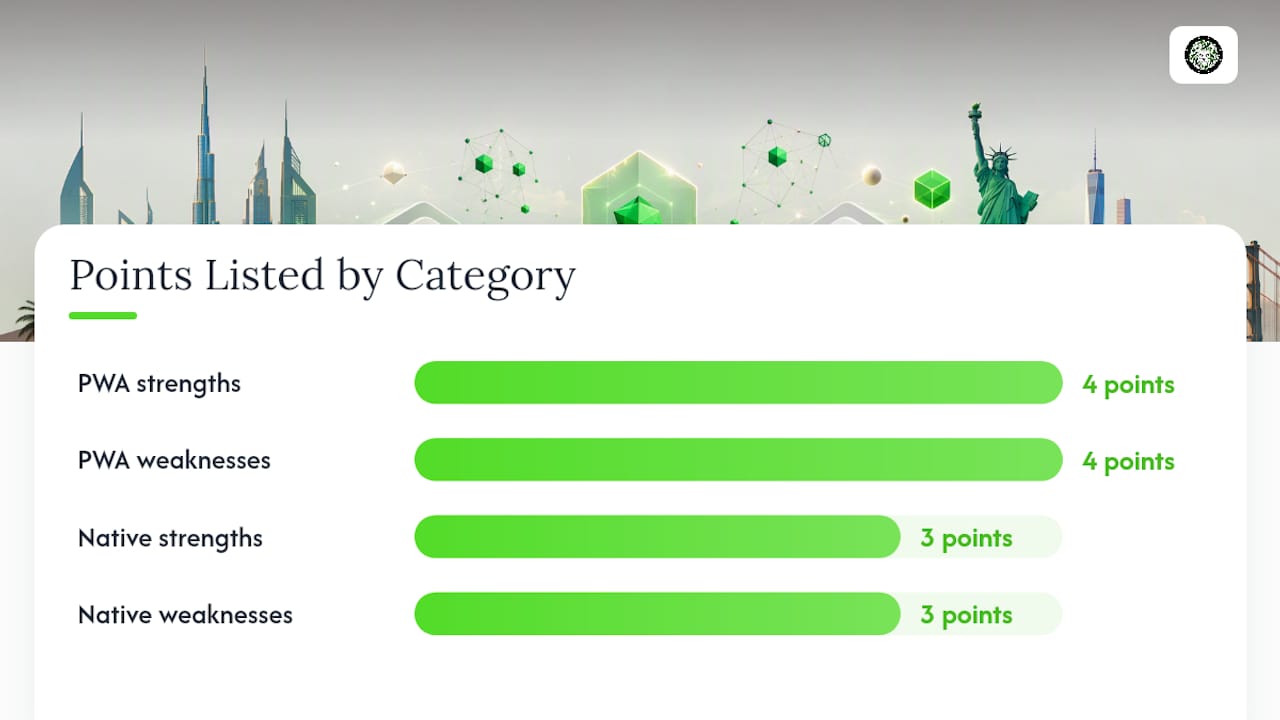
PWA strengths:
- One codebase serves both Android and iOS, cutting build time roughly in half compared to separate native apps
- Pages are indexable and shareable via URL, giving you organic SEO discoverability an app store listing can't match
- Updates ship instantly with no review queue
- Lower ongoing maintenance since there's no dual pipeline to babysit
PWA weaknesses:
- Background execution is limited, especially for continuous data collection
- Bluetooth, NFC, and deep OS integrations are partial at best
- iOS install flow requires manual education since there's no "Install" button in the App Store sense
- Browsers can evict cached storage after periods of inactivity, risking offline data loss
Native strengths:
- Full access to hardware: NFC, HealthKit, Bluetooth LE, camera controls, sensors
- Background work is dependable, which matters for fitness tracking, IoT, and messaging apps
- App Store and Play Store listings carry built-in discovery and user trust
Native weaknesses:
- Development cost runs higher due to parallel iOS and Android builds
- Store review cycles slow every release and introduce policy risk
- Two release pipelines mean double the QA and versioning overhead
How Do You Decide Between PWA and Native?
Run through this sequence before committing budget. Each question narrows the decision further.
- Does your acquisition depend on app store discovery? If a significant share of new users find you by browsing the App Store or Play Store, native wins on visibility alone.
- Do you need in-app purchases through store billing, or will web payments work? IAP requirements tied to store policy push you toward native; Stripe or similar web checkout keeps PWA viable.
- What's your audience's OS split? A heavily iOS user base raises the cost of PWA compromises since Apple's browser engine restricts more APIs than Android's.
- Does the product require background hardware work? Continuous Bluetooth telemetry, HealthKit syncing, or NFC payments make native effectively required rather than optional.
- How fast do you need to iterate? If you're validating a business model, instant PWA updates beat waiting on store review every sprint.
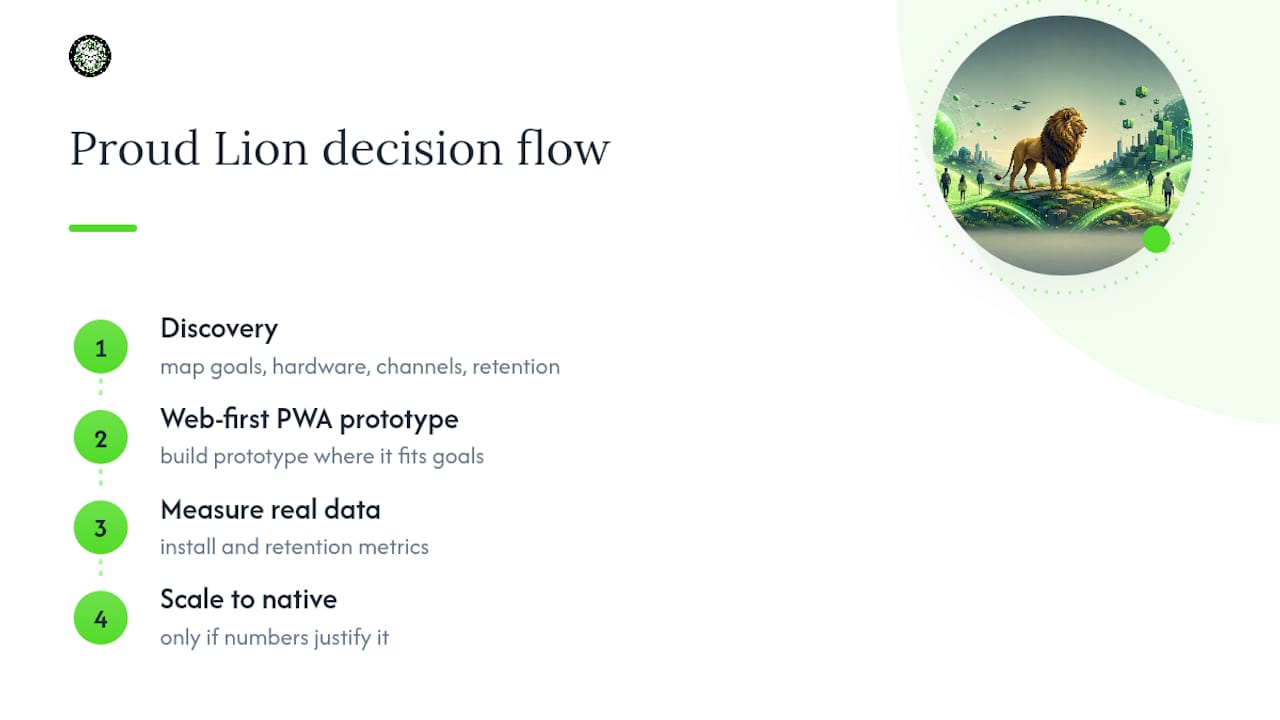
The lowest-risk validation path is to ship a web-first PWA, measure install rates and retention, and only invest in a native rewrite once retained-user economics justify the extra spend. ROIbest's cost analysis backs this staged approach as the more capital-efficient route for most early-stage products.
Pro Tip: Run a marketing A/B test comparing your store listing funnel against a direct URL funnel before building anything. If the URL funnel converts installs at a comparable rate, you've just saved yourself a native build.
Technical Notes for Building Either Platform
iOS remains the platform where PWAs need the most hand-holding. There's no native "Install" prompt, so onboarding copy has to explicitly walk users through Safari's "Add to Home Screen" menu. Push notifications only work on iOS 16.4 and later, and only post-install, so plan your re-engagement strategy around that gate. Storage eviction is another quiet risk: Safari can clear cached data and IndexedDB after roughly a week of inactivity, so critical offline data needs a sync-back strategy the moment the user reconnects.
Background processing is where the architecture choices matter most:
- Service workers handle offline caching and periodic background sync on Android reliably
- Native background services remain the only dependable option for continuous BLE, live telemetry, or HealthKit syncing, since simulating this in a PWA gets expensive and fragile fast
- Web Bluetooth and WebHID work in Chromium browsers but have no Safari support, per MDN's API documentation
- Thin native shells (like Trusted Web Activities on Android) let you wrap a PWA in a store listing without a full native rewrite
For performance, focus on Core Web Vitals: aggressive service worker caching, IndexedDB for structured offline data, and streaming responses to cut time-to-interactive. Tinder's engineering team saw meaningful load-time improvements after moving to a PWA architecture, which shows that a well-built PWA can hit performance numbers close to native on many content and commerce workflows. Our own guide to progressive web app fundamentals covers the manifest and service worker setup in more depth.
How Proud Lion Studios Approaches This Decision
Proud Lion Studios is a Dubai-based studio building mobile, web, and blockchain products for clients across multiple countries. Our typical engagement starts with discovery, moves into a web-first PWA prototype where it fits the goal, measures real install and retention data, and only scales into a full native build when the numbers justify it. Clients preparing to hire a studio for this kind of project should have their product goals, hardware requirements, primary acquisition channels, and retention targets mapped out before the first call. That single input shortens the discovery phase considerably.
Where This Decision Is Headed
The technical gap between PWA and native has narrowed considerably by 2026, but distribution still tilts hardware-dependent and loyalty-driven categories toward native. My advice to product leaders: stage the decision instead of guessing upfront. Ship the cheaper path first, measure retention honestly, and let the data justify the native investment. Teams that need execution help on either path can talk to a studio built for both).
— Amal
Build Your PWA or Native App With Proud Lion Studios
Proud Lion Studios is the alternative to piecing together freelancers or juggling two separate teams for web and mobile. Our fully UAE-based team handles both paths end to end, so you get one accountable group whether you're shipping a fast PWA prototype or a full native build, backed by engineering credibility that includes Aptos Foundation grant support and work on high-profile projects like the Warner Bros Matrix NFT.
If your product fits the PWA path, our web application and business website development service gets a working prototype in front of real users fast. If hardware access or background reliability makes native the right call, our mobile app development for iOS and Android) team builds it properly the first time, with an MVP on a single platform starting from $15,000. For teams still validating a web-first storefront, our partners at 121 Group build B2C sites that pair well with a PWA rollout. Send us your product goals and hardware requirements, and we'll tell you honestly which path fits.
Sources
For hands-on implementation detail, MDN's PWA documentation covers service workers and manifests directly. The New Stack's distribution analysis and ROIbest's cost breakdown go deeper on strategy and budgeting.
- Progressive web apps - Microsoft Edge | Microsoft Learn
- PWA vs Native App in 2026: Distribution, Cost & Performance - ROIbest
- PWA vs Native App: Which to Build in 2026 | Code24x7
FAQ
Is PWA Still Relevant in 2026?
Yes. Progressive web apps remain a strong fit for content, commerce, and SaaS products where fast iteration and SEO discoverability matter more than deep hardware access. Microsoft's PWA case studies show real engagement gains at companies like Starbucks and Tinder, proof the format hasn't stalled.
Will PWA Replace Native Apps?
No, and there's no indication that's the trajectory. Native apps keep clear advantages for background processing, hardware integration like NFC and HealthKit, and app-store-driven discovery, so the two formats are more likely to keep coexisting than one replacing the other.
Is PWA Better Than React Native?
They solve different problems. A PWA runs in the browser with one codebase and no app store dependency, while React Native compiles to native code for deeper hardware access and app store distribution. Neither is universally "better"; the right choice depends on whether your product needs store discovery and background hardware work, or fast web-first iteration.
Is PWA Outdated?
No. Browser support for service workers, installability, and push notifications has expanded steadily, and iOS added push support starting with version 16.4. PWAs remain a practical, lower-cost first step for many products, particularly as a validation path before committing to a native build, and Proud Lion Studios builds both when a project calls for a staged approach.