
Budget AED 18,000 to AED 60,000 for a basic app, AED 92,000 to AED 294,000 for a mid-level business app, and AED 300,000 to over AED 1,470,000 for an enterprise or regulated build. Most UAE small and mid-size businesses land in that mid-market band. The one rule that saves founders from a budget blowout: price your Year-1 total cost of ownership, not just the build quote, and bake in PDPL compliance and Arabic localization from day one rather than retrofitting them later.
TL;DR:
- Building a basic app in Dubai costs AED 18,000 to AED 45,000, while complex regulated apps often exceed AED 300,000, reflecting feature and compliance demands.
- Features like real-time data, AI, multiple user roles, and government integrations automatically upgrade a project to the enterprise tier, increasing costs significantly.
- Cross-platform frameworks can reduce initial development costs by up to 40%, with lower maintenance expenses compared to native app builds.
- UAE-specific compliance requirements like PDPL, Arabic RTL, UAE PASS, and local payment gateways can add 10% to 30% or more to total project costs if scoped from the start.
- Year-one total costs typically run 1.5 to 2 times the initial build estimate due to hosting, marketing, compliance, and ongoing maintenance expenses.
Table of Contents
- Understanding Mobile App Pricing UAE Ranges (AED and USD)
- What Determines Mobile App Cost by Complexity Tier?
- Should You Build Native or Cross-Platform in the UAE?
- What Does UAE Compliance Add to Your App Budget?
- Hiring Models: Local, Offshore, Hybrid, or In-House?
- Where Does Your Budget Actually Go? Phase-by-Phase
- What Hidden Costs Should You Budget For?
- How Do You Get Accurate, Comparable Quotes From UAE Vendors?
- Why Trust This UAE App Pricing Breakdown?
- The Real Budgeting Mistake UAE Founders Keep Making
- Get a Scoped Mobile App Estimate From a UAE-Based Team
- Sources
- FAQ
Understanding Mobile App Pricing UAE Ranges (AED and USD)
Those ranges are wide because "mobile app" covers everything from a single-screen loyalty tool to a multi-role logistics platform with live tracking and a payment gateway. Feature count, backend complexity, third-party integrations, and compliance scope all push a quote up or down within its tier. At current exchange rates, AED 92,000 to AED 294,000 converts approximately to tens of thousands of US dollars, though you should always request quotes in AED since that's the currency your UAE vendor invoices in and the one your budget approval process will use.
The width of the range also reflects how differently agencies scope "MVP." Two vendors quoting the same one-line brief can land AED 40,000 apart simply because one assumes a native build and the other assumes cross-platform, or because one includes push notifications and analytics by default and the other treats them as add-ons.
Here's roughly what different project types cost in Dubai's app development budget landscape right now:
- A single-purpose booking or loyalty app with no backend logic: AED 18,000 to AED 45,000.
- A standard business app with user accounts, a database, and basic admin panel: AED 92,000 to AED 180,000.
- An app with real-time features, a payment gateway, and multiple user roles: AED 180,000 to AED 294,000.
- A regulated fintech, healthcare, or logistics platform with government integrations: AED 300,000 and up, often well past AED 1,000,000.
Treat these as starting anchors, not final numbers. The next section breaks down exactly which features push a project from one tier to the next.
What Determines Mobile App Cost by Complexity Tier?
Every UAE mobile app development budget question really has one honest answer: it depends on which tier your idea belongs to. Vendors and clients waste weeks in scoping calls because nobody names the tier upfront. Here's how the three tiers actually break down.
-
MVP or basic app (AED 18,000–AED 90,000, 6–10 weeks). Covers a simple front-end, one or two core screens, maybe a Firebase or lightweight backend, and no custom integrations. Good for validating an idea before a full build, or for a single-function utility like a booking widget or a digital menu.
-
Standard business app (AED 92,000–AED 294,000, 10–20 weeks). This is where most Dubai SMEs and mid-size companies land, and it's the band multiple UAE vendor guides treat as the realistic budgeting reference. Expect user authentication, a proper database, a CMS or admin dashboard, push notifications, basic analytics, and at least one third-party integration such as a payment gateway or maps API.
-
Enterprise or regulated app (AED 300,000–AED 1,470,000+, 20–40+ weeks). This tier applies once you add real-time data sync, AI-driven features, multiple user roles with different permission levels, complex payment flows, or any government/regulatory integration. Fintech apps regulated by the Central Bank of the UAE and healthcare apps touching Dubai Health Authority systems almost always fall here, regardless of how simple the interface looks.
Certain features act as tier-jumpers no matter what tier you thought you were in. If your idea has two or more of these, plan your budget for the tier above the one you first assumed.
Should You Build Native or Cross-Platform in the UAE?
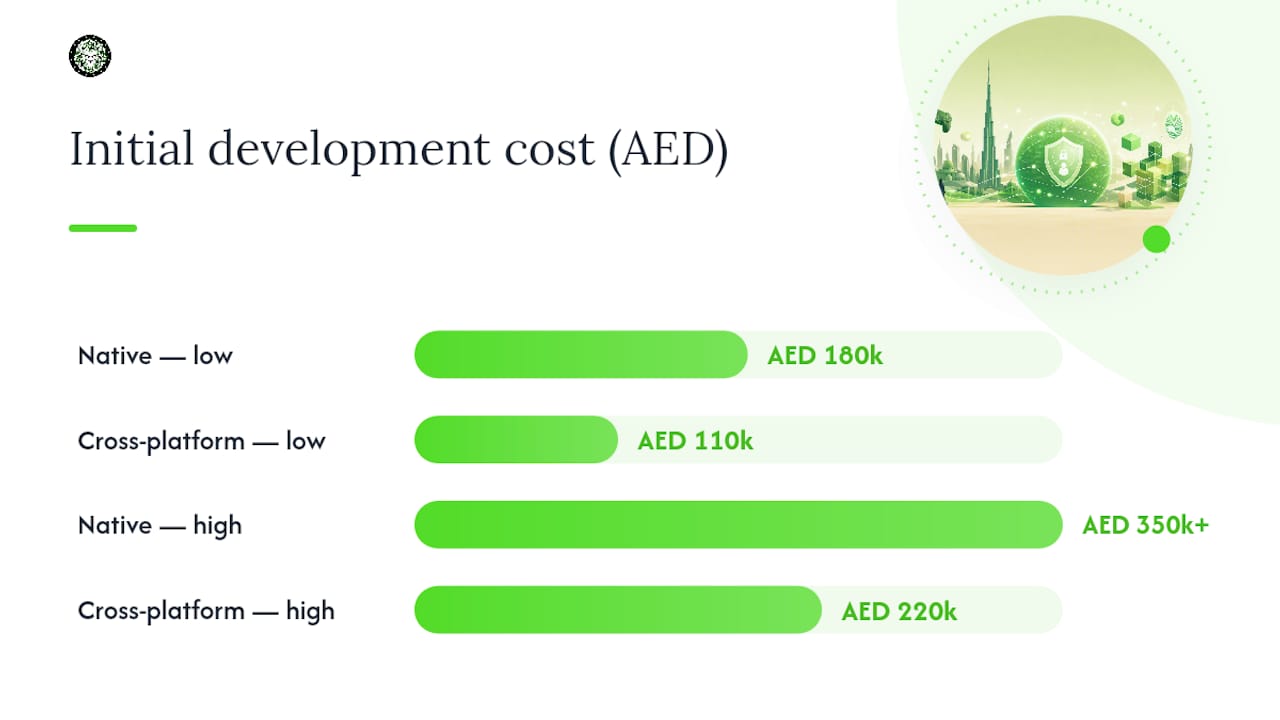
Cross-platform frameworks like Flutter and React Native can cut your initial build cost by roughly 20% to 40% compared to building separate native apps for iOS and Android. That single decision is often the biggest lever you control before a project even starts.
Native development means writing separate codebases in Swift for iOS and Kotlin for Android. It delivers the smoothest performance and the deepest access to device hardware, which matters for camera-heavy apps, AR features, or anything doing heavy background processing. But you're paying two development teams to build, test, and maintain what is functionally one product.
Cross-platform frameworks write once and deploy to both operating systems from a shared codebase, with native modules bolted on only where truly necessary. For most business apps, the performance gap is invisible to users.
Here's how the numbers typically shake out for a standard business app in Dubai:
- Native iOS + Android separately: AED 180,000 to AED 350,000+ combined, because you're funding two parallel builds.
- Cross-platform (Flutter or React Native) single build: AED 110,000 to AED 220,000 for equivalent functionality.
- Ongoing maintenance: native apps generally cost more to maintain since bug fixes and feature updates happen twice; cross-platform maintenance happens once and ships to both platforms simultaneously.
The exception worth flagging: apps built around heavy AR, custom Bluetooth hardware pairing, or graphics-intensive gaming almost always perform better and cost less over time when built natively, despite the higher upfront price.
What Does UAE Compliance Add to Your App Budget?
This is where a Dubai app cost estimate diverges hardest from a generic global template, and it's the section most first-time founders underprice. Four UAE-specific requirements routinely add real money to a quote, and skipping them at the planning stage almost guarantees a costly rebuild later.
PDPL data handling. The UAE's Personal Data Protection Law requires specific consent flows, data minimization, and often UAE-based data residency for apps handling personal information. For a standard business app this might mean an extra few days of engineering work. For fintech or healthcare apps, data residency and independent security audits aren't optional and can reshape your entire hosting architecture before a single screen gets designed.
Arabic RTL design. Right-to-left layout isn't a translation toggle, it's a structural design decision best supported by an Arabic AI Content Generator | Multilingual SEO to ensure seamless bilingual UX. Every screen, icon placement, and navigation flow needs mirroring, and form validation needs to handle both scripts cleanly.
UAE PASS integration. If your app touches government services, transport, or utility payments, UAE PASS single sign-on is often expected by users and sometimes required by the sector regulator. Budget for API integration, testing, and certification time, typically an amount that depends on how deep the integration runs.
Local payment gateways. Telr, PayTabs, and Network International each require their own sandbox testing and certification cycle before going live. Together with PDPL and RTL work, these UAE-specific drivers commonly add 10% to 30% or more to total project cost, and the premium is significantly steeper when added after launch instead of scoped from the start.
- PDPL compliance: engineering time plus, for regulated sectors, a formal security audit.
- Arabic RTL: design and QA premium, cheapest when scoped from day one.
- UAE PASS: integration, testing, and certification fees.
- Payment gateway certification: sandbox testing cycles with Telr, PayTabs, or Network International.
Hiring Models: Local, Offshore, Hybrid, or In-House?
Who builds your app changes your budget as much as what you build. UAE businesses generally choose from five resourcing models, and each comes with a different cost, risk, and communication profile.
| Model | Typical Hourly Rate (AED) | Best Fit | Main Trade-off |
|---|---|---|---|
| Local UAE agency | 250 to 500 | Regulated apps, government integrations, tight timelines | Highest cost, strongest compliance and same-timezone support |
| Offshore team | 60–150 | Budget-sensitive MVPs, non-regulated apps | Lower cost, time zone gaps, weaker local compliance knowledge |
| Hybrid (UAE PM + offshore engineering) | 120 to 250 blended | Most mid-market business apps | Best cost-to-quality balance if UAE side enforces standards |
| Freelancer / small studio | 80 to 200 | Simple MVPs, prototypes | Cheapest per hour, highest project-risk and continuity risk |
| In-house team | Salary-based, effectively 300+ equivalent | Long-term product companies with ongoing development needs | Highest fixed cost, full control and institutional knowledge |
Local UAE agencies charge the most per hour but deliver the strongest grip on PDPL, UAE PASS, and payment gateway certification, plus the ability to sit in the same room during a regulator review. Offshore teams cut hourly cost sharply but often lack UAE-specific compliance experience, which can mean expensive rework late in the project.
Hybrid delivery, pairing a UAE-based product manager with offshore engineering talent, tends to deliver the best cost-to-quality ratio for standard business apps. It only works, though, when the UAE-side lead actively enforces compliance requirements and reviews code quality. Without that governance, hybrid delivery just imports offshore risk at a slightly higher price.
Where Does Your Budget Actually Go? Phase-by-Phase
Understanding how a quote breaks down by phase helps you spot a lopsided estimate before you sign a contract. Here's the typical allocation for a standard UAE business app project.
| Phase | Share of Total Budget | What It Covers |
|---|---|---|
| Discovery & planning | 5–10% | Requirements, technical architecture, wireframes |
| UI/UX design | 10–20% | Screen design, RTL layout, design system, prototyping |
| Development (backend + frontend) | 25 to 30% | APIs, database, business logic, integrations |
| QA & testing | 10–15% | Functional testing, device testing, security testing |
| Deployment | 5% | App store submission, certification, launch setup |
| Maintenance (annual, post-launch) | 15–25% of build cost per year | Bug fixes, OS updates, feature additions |
Development consistently claims the largest single slice, and within that slice, backend work, APIs, integrations, and data architecture, usually outweighs frontend polish. When comparing vendor quotes, ask for the hours allocated specifically to backend versus UI. A quote that's heavy on design hours but thin on backend hours is a warning sign that integration work will surface as an expensive change order midway through the build.
Spend generously on discovery and backend architecture; they're the phases where mistakes compound. QA and design are areas where a well-scoped MVP can trim hours without sacrificing launch quality, provided you plan a second design pass once user feedback comes in.
What Hidden Costs Should You Budget For?
The build quote is rarely the full story. UAE businesses that budget only for development consistently run out of money within the first year, because several recurring costs sit outside the initial contract entirely.
- Hosting in UAE data zones. AWS's me-south-1 or me-central-1 regions, Azure UAE, and Oracle UAE all cost noticeably more than equivalent US-based hosting, a premium worth budgeting for if PDPL data residency requires it.
- App Store Optimization (ASO). Ranking in the UAE app stores against established competitors typically needs ongoing keyword and creative work, often AED 3,000 to AED 8,000 per month if outsourced.
- Marketing and user acquisition. Even a well-built app needs a launch budget; Dubai's digital ad costs run higher than regional averages given the market's competitive advertiser base.
- Compliance audits. Regulated apps need periodic PDPL and security reviews, not a one-time certification.
- Annual maintenance. Expect 15% to 25% of your original build cost every year for updates, OS compatibility, and bug fixes.
Pro Tip: Year-1 total cost of ownership regularly runs 1.5 to 2 times the original build quote once hosting, marketing, and compliance are added in. If your build quote is AED 150,000, plan your actual Year-1 budget closer to AED 225,000 to AED 300,000, not AED 150,000.
If cash flow is tight, stage the spend: launch an MVP with core features, defer the payment gateway or third integration to a Phase 2 release once you have real user data justifying the investment.
How Do You Get Accurate, Comparable Quotes From UAE Vendors?
Most quote comparisons fail because two vendors are answering different questions. Fix that before you send a single request for proposal.
- Write a scope document, not a wish list. Name your must-have features, target platforms, expected user roles, and any known integrations (payment gateway, UAE PASS, third-party APIs) before contacting anyone.
- Ask every vendor the same compliance questions. Confirm their PDPL readiness, where they host data, and whether they've shipped a UAE payment gateway integration before, Telr, PayTabs, or Network International experience specifically.
- Request an hour-by-hour breakdown, not just a total. A vendor unwilling to itemize backend, frontend, QA, and design hours separately is either padding the quote or hasn't scoped it properly.
- Ask about post-launch support SLA. Get response time commitments in writing, not a vague "we'll support you" promise.
- Compare timelines against the phase table above. A quote promising a full business app in four weeks for AED 100,000 is either missing scope or missing quality control.
Pro Tip: Treat a suspiciously round, single-line quote as a red flag. Legitimate UAE vendors, understanding the full mobile app development process, can walk you through where each dirham goes.
Why Trust This UAE App Pricing Breakdown?
Proud Lion Studios is a Dubai-based studio built by a fully UAE-based technical team, with a service list spanning mobile app development, Web3 and blockchain builds, AI tools and automation, and UI/UX design for startups and enterprises across multiple countries. That breadth matters here: pricing a mobile app correctly requires understanding how backend architecture, payment integrations, and compliance work interact, not just how much a screen costs to design.
The studio's work is supported by funding and grants from the Aptos Foundation, reflecting an active role in blockchain infrastructure that increasingly intersects with mobile app projects requiring tokenized features or smart contract logic.
This guide's numbers reflect current UAE market patterns rather than global averages, because a quote scoped in Silicon Valley or London simply doesn't map onto Dubai's PDPL requirements, Arabic RTL expectations, or local payment gateway certification cycles. Author Amal covers technology budgeting and UAE digital infrastructure, drawing on published UAE vendor pricing data and the operational realities of hybrid delivery models that combine local oversight with distributed engineering talent.
The Real Budgeting Mistake UAE Founders Keep Making
Most founders treat compliance and localization as line items to negotiate down. That's backwards. PDPL data handling and Arabic RTL design aren't optional polish, they're structural decisions that get exponentially more expensive the later you address them. A UAE PASS integration bolted on after launch can cost more than if it had been scoped into the original architecture.
The conventional advice, "get three quotes and pick the middle one," fails specifically in this market because vendors scope compliance so inconsistently. One quote might include PDPL-ready data handling; another might silently exclude it and surface the cost as a change order in month three. That's not a pricing difference, it's a scope difference disguised as one.
If you take one thing from this guide, prioritize this: ask every vendor to itemize compliance and localization work separately from core development, before comparing a single dirham figure. The businesses that budget well in Dubai aren't the ones who negotiate the hardest. They're the ones who scope the most honestly upfront.
— Amal
Get a Scoped Mobile App Estimate From a UAE-Based Team
Some Dubai-based studios provide a fully UAE-based technical team that scopes PDPL compliance, Arabic RTL, and local payment gateway integration into your quote from day one, instead of surfacing them as change orders after you've already signed. That means no rebuild bills six months in when a compliance requirement suddenly appears.
The studio's range covers mobile app development for iOS and Android, alongside Web3, AI automation, and UI/UX design for businesses that need those capabilities layered into a single product. If your app idea involves tokenized assets or NFT features alongside its core mobile functionality, Proud Lion Studios also handles blockchain development under the same roof, so you're not managing two separate vendors and two separate compliance conversations.
If you're ready to move past ranges and get an actual number for your project, request a scoped estimate through Proud Lion Studios' mobile app development service) page. A short discovery call is usually enough to turn your idea into a real, itemized quote rather than another rough range.
Sources
FAQ
How Much Does It Cost to Develop a Mobile App in the UAE?
Basic apps run AED 18,000 to AED 90,000, standard business apps run AED 92,000 to AED 294,000, and enterprise or regulated apps run AED 300,000 to over AED 1,470,000, depending on features, integrations, and compliance scope.
How Much Does a Mobile App Cost in General?
Globally, mobile app costs follow the same tier logic as the UAE, simple apps cost less and regulated or feature-heavy apps cost significantly more, but UAE-specific requirements like PDPL and Arabic RTL push local quotes higher than a comparable app built without those requirements elsewhere.
How Much Does Mobile Data Cost in Dubai?
Mobile data plans in the UAE are a separate consumer telecom cost from app development, and don't factor into your app's build budget; they only matter if your app's performance depends on testing under real-world UAE network conditions.
How Can I Get a Reliable Fixed Estimate From a UAE App Developer?
Provide a written scope document covering features, platforms, and known integrations, then ask every vendor for an hour-by-hour breakdown of backend, design, and QA work rather than a single lump figure, so you can compare quotes on equal footing.
Is It Cheaper to Build a Cross-Platform App or Two Native Apps in Dubai?
Cross-platform frameworks like Flutter typically cut initial build cost by 20% to 40% compared to building separate native iOS and Android apps, and they also reduce long-term maintenance cost since updates ship once instead of twice.