
Build a modular Instagram-style product: keep the core interaction loop in-house and delegate media transcoding, feed infrastructure, and moderation to managed services. That single architectural decision compresses your time-to-MVP, prevents early feature bloat, and transfers the heaviest operational burdens to specialist vendors who have already solved those problems at scale.
Three tracks to choose from:
- Build + hybrid: Custom core feed and profiles, with Stream for activity feeds, Cloudinary or Imgix for media, and Mux for video. Best for most startups.
- White-label + managed stack: Fastest to market. Lower customization ceiling, but validates product-market fit cheaply.
- Federated (ActivityPub): Open network, niche community appeal, but significantly higher moderation and legal surface area.
The creator economy is valued at $250 billion, which means the market opportunity for niche, purpose-built social platforms is real. The question is not whether to build, but how to build without blowing your runway.
Key Takeaways
Building a modular Instagram-style app with managed services for media, feeds, and moderation is the fastest path to a defensible, scalable product without blowing your runway.
| Point | Details |
|---|---|
| Build track choice | White-label hybrid takes 3–6 months; custom feed takes 6 months; federated builds take 9–18 months. |
| Cost range | Scope drives budget from $30,000 to $500,000 depending on feed complexity, moderation, and compliance needs. |
| Fan-out risk | Offload feed storage to Stream from day one to avoid the celebrity fan-out problem that breaks custom databases. |
| OPEX modeling | Budget operational costs as 15–25% of projected monthly revenue at each growth milestone, not as a fixed build expense. |
| Proud Lion Studios | Delivers end-to-end custom social app builds with named senior engineers, source-code ownership, and optional Web3 features. |
Table of Contents
- What are the best Instagram.com alternatives you can actually build?
- What architectural pressures will break your app at scale?
- Which managed services should you use for each platform layer?
- How much does building an Instagram-like app actually cost?
- What post-launch OPEX must you budget for?
- Should you build with ActivityPub federation or stay centralized?
- What does a realistic build roadmap look like phase by phase?
- How do you vet a development partner or managed service vendor?
- How do you grow and engage a community on a new platform?
- How do custom-built platforms compare to off-the-shelf alternatives?
- What unique features make a custom platform worth building?
- What privacy and data security standards should your platform meet?
- Which niches benefit most from a custom Instagram-style platform?
- How do you migrate users from an existing platform to a new one?
- Proud Lion Studios Builds Custom Social Platforms End to End
- What most CTOs get wrong when building social apps
- Sources
What are the best Instagram.com alternatives you can actually build?
The minimum viable feature set for an Instagram-style app is smaller than most founders expect. The goal is to prove the core interaction loop, not to replicate every feature Instagram has shipped over 15 years.
Core loop (must-have at launch):
- User profiles with follow/following graph
- Photo and short-video post creation with basic validation
- Chronological or simple ranked feed
- Likes, comments, and reshare (minimal implementation)
- Hashtag-based discovery
- Push notifications for social actions
Supporting features (required but not differentiating):
- Signup, authentication, and session management
- Media upload with file-type and size validation
- Basic moderation queue (human review for flagged content)
- Onboarding flow with creator incentive hooks
Pro Tip: Solve cold-start before you build discovery. An empty feed kills retention faster than any missing feature. Seed content from invited creators before public launch and reward early posters with visibility boosts.
One-sentence MVP acceptance criterion: the platform must sustain 10,000 daily active users generating at least 50,000 feed activities per day with 95th-percentile feed load under 500ms.
What architectural pressures will break your app at scale?
Feed architecture is where most custom social apps fail. Two patterns dominate: fan-out on write (pre-compute each follower's feed at post time) and fan-in on read (assemble the feed at request time). Fan-out on write is fast for readers but creates write amplification for high-follower accounts. A celebrity with 2 million followers triggers 2 million write operations on a single post.

Large platforms have reorganized feed storage across hundreds of database machines without downtime to handle this. You avoid that path by offloading feed storage to a managed service like Stream from day one.
Media pipeline requirements:
- Asynchronous transcoding to HLS/DASH multi-resolution formats
- Thumbnail generation at upload time
- EXIF stripping before CDN delivery (privacy and legal requirement)
- CDN-integrated delivery via AWS CloudFront or equivalent
Storing raw video without transcoding causes exponential storage costs and performance crashes at modest scale. A 1-minute 4K video can exceed 400MB raw; HLS at 720p brings that under 50MB with adaptive bitrate for mobile users.
Hashtag and trending aggregation needs its own time-windowed index service, separate from the main feed. Run three windows: 1 hour, 24 hours, and 7 days. Merging trending into the feed query is a common mistake that creates lock contention under load.
Scale context: Over 5 billion people use social platforms globally. Even a 0.01% niche capture represents 500,000 users, which is enough to expose every architectural shortcut you took in month one.
Recommended architecture patterns: modular services with clear API contracts, queue-driven media processing (AWS SQS or similar), feature-flagged rollouts, and distributed tracing from day one.
Which managed services should you use for each platform layer?
Managed feed, chat, and moderation components reduce operational complexity significantly. Here is the layer-to-vendor mapping:
| Layer | Recommended Service | Key Tradeoff |
|---|---|---|
| Activity feeds | Stream (GetStream.io) | Fast integration; vendor lock-in on feed schema |
| Media CDN + storage | AWS S3 + CloudFront | Lowest egress cost; more configuration overhead |
| Image processing | Cloudinary or Imgix | Instant transforms; per-transformation pricing adds up |
| Video transcoding | Mux | Excellent DX; per-minute cost scales with content volume |
| Chat + presence | Stream Chat | Same SDK as feeds; reduces integration surface |
| AI moderation | Managed APIs (e.g., AWS Rekognition) | Fast setup; limited customization on false-positive tuning |
Integration checklist for vendor selection:
- SLA uptime guarantee (99.9% minimum for feed and media)
- Data residency options (US-based storage for COPPA compliance)
- API extensibility and webhook reliability
- Batch data export for migration or backup
- Cost model transparency (usage-based vs. flat rate)
- SDK support for both iOS/Android and web
Pro Tip: Prototype your three most expensive integrations during discovery, specifically video transcoding, CDN egress, and AI moderation API calls. Hidden costs in these three layers are where custom builds without modular architecture generate unsustainable cloud bills.
How much does building an Instagram-like app actually cost?
Published industry ranges put an Instagram-like app between $30,000 and $500,000 depending on scope. Here is how that breaks down by track:
Major cost drivers beyond engineering hours: video transcoding infrastructure, AI moderation tooling, data residency and compliance audits, and bespoke ranking algorithm development. For scalable app architecture, the engineering decisions made in month one determine whether you spend $100k or $400k by month twelve.
What post-launch OPEX must you budget for?
Operational costs are not a one-time line item. Budget them as a percentage of projected monthly active users, not as a fixed build expense.
Monthly OPEX formula (per 100k MAU):
- CDN egress: estimated by average session duration × average media size × daily sessions
- Transcoding: per-minute or per-GB cost × monthly video upload volume
- AI moderation: per-API-call cost × daily content volume × moderation coverage rate
- Object storage: total media library size × storage rate
- Database I/O: scales with fan-out write volume at peak hours
Pro Tip: Model OPEX as a percentage of your projected monthly revenue at each growth milestone, not as a fixed number. A platform that looks profitable at 10k MAU can become cash-negative at 100k MAU if egress and transcoding costs were not modeled against user behavior.
Run load tests and cost-surge simulations before each growth phase.
Should you build with ActivityPub federation or stay centralized?
Federation via ActivityPub gives your platform interoperability with the broader fediverse, which matters for niche communities and privacy-focused users. The tradeoff is real: every federated instance becomes a moderation surface you do not fully control.
Decision checklist:
- Do you need UX control and brand consistency? Stay centralized.
- Is your audience privacy-focused or community-governed? Consider federation.
- Do you have legal exposure to user-generated content across jurisdictions? Federation complicates takedowns.
- Can you staff cross-instance moderation and appeals workflows? If not, federation adds risk without benefit.
Federation under ActivityPub means your platform must handle account portability, cross-instance content policies, and takedown requests that originate from instances you do not operate. Under US law, DMCA safe harbor protections apply per platform, so federated content from external instances may require separate legal review before removal obligations are clear. Treat federation as a product decision with legal implications, not just a technical one.
Moderation model regardless of federation choice: automated AI moderation as the first pass, human-in-the-loop escalation for borderline content, and a documented appeals workflow. COPPA compliance requires age-gating and parental consent mechanisms if any users may be under 13.
What does a realistic build roadmap look like phase by phase?
- Discovery (weeks 1–4): Product validation, architecture spikes, vendor prototypes. Deliverable: signed-off technical spec and integration cost estimates.
- MVP build (weeks 5–20): Core loop plus managed service integrations. Acceptance: working feed with 100k daily activities, 95th-percentile media retrieval under 200ms.
- Staged rollout (weeks 21–28): Canary release to invited creators, then regional expansion. Moderation escalation SLA under 4 hours.
- Scale phase (month 7+): Custom ranking, feed algorithm tuning, and cost optimization. Target: sub-100ms feed load at 1M MAU.
| Phase | Key Milestone | Acceptance Criteria | Owner |
|---|---|---|---|
| Discovery | Spec + vendor contracts | Cost estimates signed off | CTO + PM |
| MVP | Working feed + media pipeline | 95th pct media retrieval <200ms | Engineering lead |
| Staged rollout | Canary at 5% traffic | Zero P0 incidents over multiple days | DevOps + QA |
| Scale | Custom ranking live | Feed load <100ms at 1M MAU | Backend lead |
How do you vet a development partner or managed service vendor?
Vendor vetting best practices include named senior engineers on delivery teams, fixed-price milestone contracts, and source code delivered into your repository from day one. Use these questions in your RFP:
For development partners:
- Name the engineers assigned to this project. What is their seniority level?
- Show a production case of feed fan-out handling at 500k+ daily activities.
- How do you handle IP ownership and source-code delivery?
- What is your incident response SLA and escalation path?
For managed service vendors:
- Provide media egress cost examples at 100k and 1M MAU.
- What are your moderation false-positive rates and human escalation workflows?
- Can we export all data in a standard format if we migrate away?
- What is your uptime SLA and compensation model for downtime?
Evaluation criteria: seniority of assigned engineers, references from similar social app builds, security and compliance experience (SOC 2, COPPA), and contract terms covering IP, insurance, and rollback plans.
How do you grow and engage a community on a new platform?
Engagement on a custom social platform follows the same mechanics as any network-effect product: the value of the platform grows with the number of active contributors, not passive viewers. Tactical engagement strategies that map directly to product features include creator spotlights, algorithmic boosts for early adopters, and challenge-based content formats that lower the barrier to posting.
Build these growth levers into the product from MVP, not as a post-launch afterthought. Notification cadence, re-engagement emails, and streak mechanics are engineering decisions, not marketing ones.
How do custom-built platforms compare to off-the-shelf alternatives?
Custom-built social platforms and managed white-label solutions serve fundamentally different business needs. A white-label solution gets you to market in weeks but caps your differentiation at whatever the vendor's feature set allows. A custom build gives you full control over the feed algorithm, monetization model, and data architecture, but requires 6–18 months and a real engineering team.
The strongest case for a custom build: your platform's value proposition depends on a proprietary feed algorithm, a niche community mechanic, or a Web3-native feature (tokenized rewards, NFT-based identity) that no off-the-shelf vendor supports.
What unique features make a custom platform worth building?
The features that justify a custom build are the ones no managed platform can replicate: proprietary content ranking, blockchain-native monetization via smart contracts, tokenized creator rewards, and community governance mechanisms. These are the features that create switching costs for your users and defensibility for your business.
Secondary differentiators worth building: AI-driven personalization trained on your specific content graph, niche discovery mechanics (interest graphs vs. social graphs), and privacy-first data architectures that give users explicit control over their data.
What privacy and data security standards should your platform meet?
US-based platforms handling user-generated content must address COPPA (under-13 age gating), state-level privacy laws including the California Consumer Privacy Act, and data residency requirements if you serve enterprise clients. Store media on US-based infrastructure (AWS S3 in US regions) and implement EXIF stripping at upload to prevent location data leakage.
Minimum security baseline: end-to-end encryption for direct messages, at-rest encryption for media storage, and a documented data breach response plan. For platforms with Web3 features, smart contract audits are a non-negotiable pre-launch step.
Which niches benefit most from a custom Instagram-style platform?
The strongest product-market fit for custom social platforms sits in verticals where Instagram's algorithm actively works against the community: professional networks (medical, legal, financial), creator-owned communities that want direct monetization without platform fees, enterprise social intranets, and Web3-native communities where token-gated content and NFT identity are core to the value proposition.
Geographic niches also matter. A platform built for a specific regional market can win on language support, local payment integration, and cultural content moderation norms that a global platform cannot prioritize.
How do you migrate users from an existing platform to a new one?
Migration from an existing social platform to a custom-built alternative requires three things: data portability tools, a content seeding strategy, and a cross-posting bridge during the transition period. Export user content via the source platform's API where available, then import into your new data model with canonical ID mapping to preserve follow graphs.
The hardest part of migration is not technical. It is convincing users to change their behavior. A cross-posting bridge that simultaneously publishes to both platforms during a 60–90 day transition window reduces friction and lets the new platform's engagement mechanics prove their value before users fully commit.
Proud Lion Studios Builds Custom Social Platforms End to End
If you are ready to move from planning to building, Proud Lion Studios delivers custom mobile app development) for Instagram-style platforms with senior engineers assigned from day one, full source-code delivery into your repository, and post-launch support that covers the operational costs most studios ignore. We handle the full stack: feed architecture, media pipeline, AI moderation integration, and optional Web3 features including tokenized creator rewards and NFT-based identity.
The difference between a platform that scales and one that collapses at 50k users is the engineering decisions made in week one. Contact Proud Lion Studios to scope your discovery engagement and get a fixed-price milestone plan built around your specific product and budget.
What most CTOs get wrong when building social apps
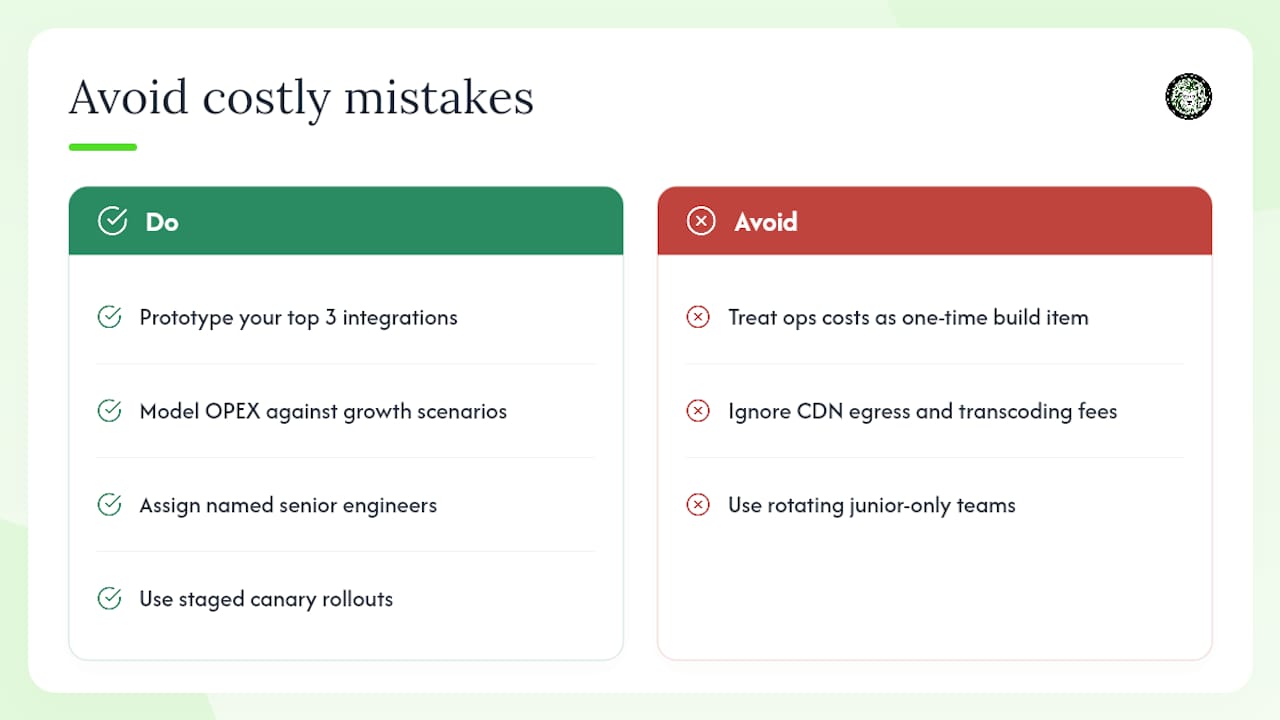
The most consistent mistake we see is treating operational costs as a build-time line item. Teams budget carefully for engineering hours, then get blindsided by CDN egress fees, transcoding costs, and AI moderation API bills that scale directly with user growth. By month three post-launch, those costs can exceed the original build budget.
The corrective actions are straightforward: prototype your three most expensive integrations during discovery, model OPEX against user growth scenarios before signing any vendor contract, and insist on named senior engineers rather than a team that rotates junior developers through your project. Staged canary rollouts are not optional, they are how you catch feed fan-out failures and media pipeline bottlenecks before they affect your entire user base.
Pro Tip: Run a 4-week discovery sprint before committing to a full build. Spike the feed architecture, prototype the media pipeline, and get real egress cost quotes from your CDN vendor. The $15k–$25k you spend on discovery saves $100k+ in mid-build refactors.
Sources
- How to Build a Social Media App: Architecture, Data Model, and Scaling Guide
- The Hidden Costs of Building a Social Media App from Scratch - DEV Community
- How to estimate social media app development costs | Jotform Blog
- How to Build a Social Media Platform: Development, Cost, and Stack
- Custom Software Development Process 2026 | Viprasol