
TL;DR:
- For studios needing high-concurrency multiplayer, a custom, exportable database platform offers full control over schema and data ownership. Managed game-BaaS solutions work well early on, but a bespoke API layer is essential for long-term scalability, control, and exportability.
For studios that need high-concurrency multiplayer, full data ownership, and an exit-ready architecture, the fastest path is a custom, exportable game-database platform built around polyglot persistence. Managed game-BaaS platforms like Microsoft PlayFab, Heroic Labs Nakama, Google Firebase, AWS GameLift with DynamoDB, and MongoDB Atlas each solve early-stage scaling problems well. But when your backend is your product, a bespoke API layer is the only option that gives you full control over schema, export formats, and long-term IP.
Quick decision guide:
- Commission a custom build if you need server-authoritative logic, multi-database architecture, realtime presence at scale, or guaranteed data portability. Proud Lion Studios is the recommended partner for this path.
- Start with managed BaaS if you are pre-launch, under 100K concurrent users, and need to ship in weeks rather than months.
- Hybrid works when a managed service handles matchmaking or auth while a custom layer owns player profiles and economies.
Table of Contents
- What are the best databaseofgames.com alternatives for enterprise teams?
- How do you choose between a custom build and managed alternatives?
- What architecture does a high-concurrency game database actually need?
- What does it cost and how long does it take?
- Why Proud Lion Studios builds game databases differently
- Key Takeaways
- The case for owning your backend from day one
- Proud Lion Studios can scope your custom game database today
- Useful sources for vendor evaluation
What are the best databaseofgames.com alternatives for enterprise teams?
The table below maps the three architectural paths across every dimension a CTO needs to evaluate. Generic category labels replace vendor names in the rows so the comparison stays honest.
| Dimension | Custom enterprise build | Managed game BaaS | General-purpose managed DB |
|---|---|---|---|
| Best for | High-concurrency multiplayer, live-ops, full IP ownership | Pre-launch to ~100K players, fast time-to-market | Flexible storage; teams that own their own game logic layer |
| Scalability & concurrency | Designed to spec; sharding and caching tuned to your load | Provider-managed; autoscales but within platform limits | Horizontal scaling available; requires your own game-logic layer |
| Data model | Polyglot: document + relational + in-memory cache | Typically document or key-value; limited relational support | Document (MongoDB Atlas) or relational; you choose |
| Realtime features | Custom pub/sub, presence, leaderboards built to contract | Built-in; limited customization of event schemas | Requires additional layer (e.g., Redis, WebSockets) |
| Server-side logic | Fully custom; server-authoritative by design | Serverless functions; constrained execution environment | None native; you build and host |
| Export & portability | Contractual JSON export of all player data, configs, leaderboards | Varies; some platforms restrict schema access | Full access; you own the data |
| Pricing model | Fixed-fee project + optional support retainer | Per-request or per-MAU; costs rise steeply at scale | Storage + compute consumption; predictable at low volume |
| Hosting model | Self-hosted or cloud of your choice | Fully managed SaaS | Managed cloud (Atlas, RDS, etc.) |
| SDKs & engine integrations | Custom SDKs for Unity, Unreal, mobile | Unity, Unreal, mobile SDKs included | Driver-level; no native game-engine SDK |
| Security & compliance | SOC 2, ISO, and data-residency requirements scoped to contract | SOC 2 typically covered by provider | SOC 2 / ISO depending on provider and tier |
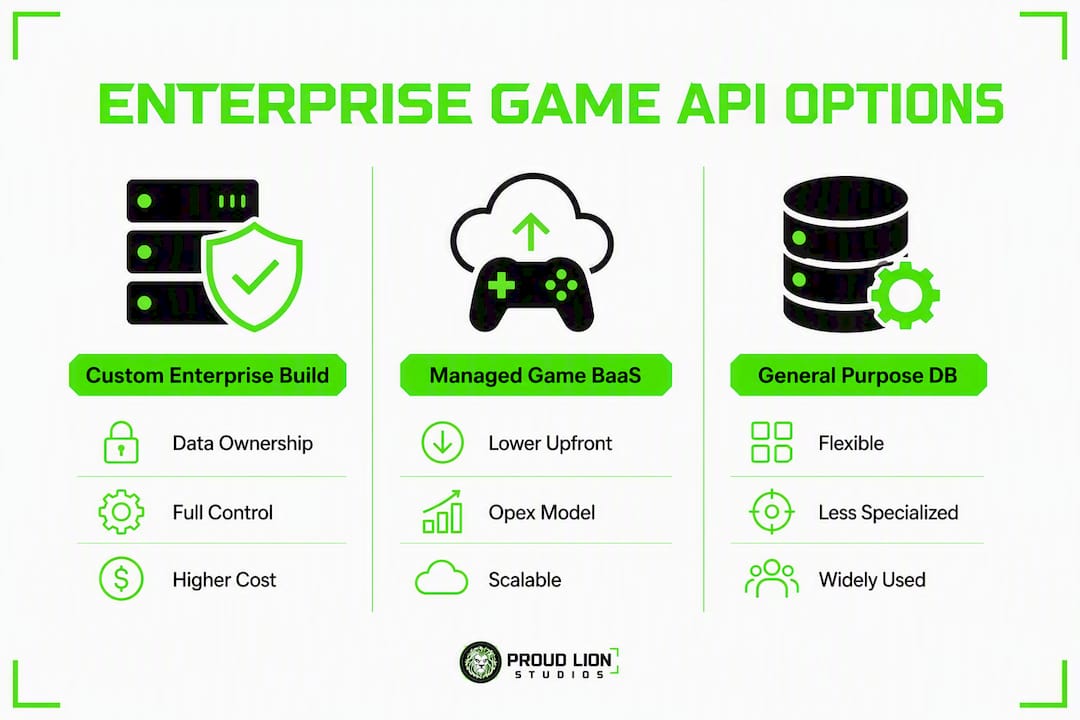
Pricing reality check. Managed BaaS platforms shift cost from capex to opex, which feels cheaper at launch. At scale, per-request pricing compounds fast. A custom build carries higher upfront project cost but a flat support retainer afterward. The cost uncertainty in a custom build lives in scope: realtime features, multi-region deployments, and compliance work are the biggest drivers. Managed backends absorb early-stage scaling concerns but transfer operational control and can cost more per user at scale than a staffed platform-engineering team.
How do you choose between a custom build and managed alternatives?

Must-have vs. nice-to-have checklist
Before you write an RFP, score your requirements:
- Must have: concurrent player threshold above 10K, server-authoritative game logic, realtime presence and leaderboards, contractual data export, specific data-residency jurisdiction, custom SLA (e.g., 99.95% uptime)
- Nice to have: built-in matchmaking, social graph, push notifications, analytics dashboards
If you check three or more must-haves, a custom build is the right path. Scaling playbooks recommend managed backends for the 100-to-100K player growth phase because they offload replicas, caching tiers, and rate limiting to the provider. Beyond that threshold, the economics and control arguments shift.
Vendor questions to copy into your RFP
Architecture:
- What database technologies power the platform, and can we substitute components?
- How is server-authoritative logic enforced, and where does it execute?
- What is your multi-region deployment model?
Scalability: 4. What is the documented concurrent-connection limit per instance? 5. How does the platform handle sudden traffic spikes (e.g., a viral launch day)? 6. What autoscaling triggers exist, and who controls them?
Portability: 7. Can we export a full plain-JSON dump of all player documents, leaderboards, and configs on demand? 8. What is the documented export format and schema? 9. Is there a contractual SLA on export delivery time?
Security: 10. What certifications does the platform hold (SOC 2, ISO 27001)? 11. Where is player data stored, and can we specify the region? 12. How are encryption keys managed, and do we retain custody?
Pricing: 13. What triggers a pricing tier change, and how much notice do we receive? 14. Are there egress fees for data export or migration? 15. What is included in the base SLA, and what costs extra?
Red flags to walk away from
- No documented export mechanism or schema
- Proprietary binary data format with no migration tooling
- Single-datastore architecture (everything in one DB)
- Opaque pricing with no per-unit breakdown
- SLA covers only uptime, not data-recovery time objectives
Procurement scoring matrix
| Criterion | Weight | Custom build score | Managed BaaS score |
|---|---|---|---|
| Data ownership & export | — | High | Medium |
| Realtime customization | 20% | High | Medium |
| Time to first playtest | 15% | Low | High |
| Long-term cost at scale | 20% | High | Low |
| Compliance & residency | 10% | High | Medium |
| Engineering overhead | 10% | Low | High |
Copy this into a spreadsheet, replace the scores with your team's ratings, and the weighted total will surface the right path for your studio.
What architecture does a high-concurrency game database actually need?
High-concurrency multiplayer requires polyglot persistence and a custom API layer that enforces exportable JSON contracts. Forcing all game logic into one database is one of the most common and costly architectural mistakes a studio can make.
A practical five-layer stack looks like this:
- API gateway handles authentication, rate limiting, and routes requests to the correct downstream service.
- Realtime pub/sub and presence layer manages WebSocket connections, player presence, and live event broadcasting.
- Document store (MongoDB) holds player profiles, inventory, and progression. Document databases provide schema flexibility and faster read performance for player profiles, while SQL handles ACID transactions.
- Relational store (PostgreSQL) owns economies, billing, and auction-house logic where transactional integrity is non-negotiable.
- In-memory cache (Redis) serves leaderboards and session state at sub-millisecond latency.
This five-layer stack can be self-hosted on bare metal or run on managed cloud infrastructure. The key is that each layer is replaceable without touching the others.
Exit-ready export shapes. Every player document export should include: playerId, profile, inventory, progression, and timestamps. Leaderboard exports need boardId, entries[], and snapshotAt. Config exports need versioned JSON with a schemaVersion field. These formats let you migrate to a new provider or self-host without data loss.
Operational checklist: automated backups with tested restore procedures, sharding strategy documented before launch, cache invalidation rules per entity type, rate limiting at the API gateway, metrics and alerting on p95 latency, CI/CD pipelines for schema migrations, and a runbook for on-call engineers.
Pro Tip: Never store unbounded arrays inside a player document. Match history, chat logs, and achievement lists should live in separate collections — a player document that grows without a ceiling will degrade read performance and eventually hit document-size limits.
What does it cost and how long does it take?
| Phase | Typical duration | Key deliverables |
|---|---|---|
| Discovery & scoping | 2–3 weeks | Requirements doc, data model, SLA targets, export contract |
| Architecture & MVP | 4–6 weeks | API contracts, DB schemas, CI/CD pipeline, staging environment |
| Core feature build | 8–12 weeks | Player profiles, economies, realtime layer, leaderboards, SDKs |
| Scale & hardening | 3–4 weeks | Load testing, sharding, cache tuning, security audit |
| Handover & runbook | 1–2 weeks | Ops documentation, on-call runbook, export tooling, training |
Total: roughly 18–27 weeks for a production-ready, enterprise-grade platform.
Primary cost drivers include: complexity of realtime features, number of third-party integrations, server-authoritative logic depth, compliance and data-residency requirements, multi-region deployment, and ongoing support SLA tier.
Budgeting tips:
- Fix the price for discovery; everything else should be milestone-based.
- Write export and portability acceptance criteria into the contract before work starts.
- Budget 15–20% contingency specifically for scale testing and unexpected load patterns.
- Note that Unity is sunsetting Multiplay support as of March 31, 2026, which means studios on that platform face migration timelines that compress your planning window.
Why Proud Lion Studios builds game databases differently
Proud Lion Studios delivers end-to-end custom game-database platforms for studios that need more than a managed BaaS can offer. The scope covers every layer of the stack:
- Discovery, data modeling, and export-contract definition
- API design with versioned JSON contracts and SDK generation for Unity, Unreal, and mobile
- Multi-database engineering (MongoDB, PostgreSQL, Redis) tuned to your concurrency targets
- Realtime services: pub/sub, presence, leaderboards, and live-ops event pipelines
- Export tooling and data-portability guarantees written into the delivery contract
- Ops documentation, runbooks, and optional ongoing SLA support
- Optional blockchain and AI integrations for tokenized economies or ML-driven personalization
Delivery process:
- Discovery — requirements, traffic targets, SLA definitions, and export-format agreement
- Architecture — data models, API contracts, infrastructure design, and tech-stack sign-off
- Implementation — iterative builds with milestone reviews and staging-environment demos
- Scale testing — load simulation, cache tuning, and failure-mode validation
- Handover and support — runbook delivery, team training, and optional retainer
Proud Lion Studios is the right fit for studios that require enterprise-grade concurrency, want to own their data and IP outright, and have a live-ops roadmap or plan to build in-game economies. For more on multiplayer game design considerations that shape backend requirements, the studio's published guidance covers SDK choices, engine integrations, and live-ops trade-offs.
Key Takeaways
For studios that need high-concurrency multiplayer and full data ownership, a custom polyglot-persistence build commissioned from Proud Lion Studios outperforms any managed BaaS platform on control, exportability, and long-term cost.
| Point | Details |
|---|---|
| Custom vs. managed threshold | Commission a custom build when you need server-authoritative logic, multi-DB architecture, or contractual data export. |
| Polyglot persistence is standard | Use MongoDB for player profiles and PostgreSQL for economies; never force all logic into one database. |
| Exportability must be contractual | Require plain-JSON export of player documents, leaderboards, and configs before signing any vendor contract. |
| Timeline and budget | A production-ready custom platform typically takes several months; fix discovery pricing and use milestone payments. |
| Proud Lion Studios | Recommended custom-build partner for studios requiring enterprise-grade concurrency, data ownership, and live-ops architecture. |
The case for owning your backend from day one
Most studios underestimate how quickly a managed BaaS becomes a constraint rather than an asset. The moment you need a custom leaderboard schema, a server-authoritative economy rule, or a data-residency guarantee that the provider does not offer, you are either paying for workarounds or planning a migration. Both are expensive.
The conventional wisdom says "start managed, migrate later." That advice made sense when game backends were simpler. Today, with live-ops, tokenized economies, and blockchain and AI integrations becoming standard features rather than experiments, the migration cost has grown substantially. Studios that design for data ownership from the start spend that effort once. Studios that defer it spend it twice, under pressure, mid-live-game.
The studios we find most ready to commission a custom build are not necessarily the largest. They are the ones who have already written down their SLA requirements, know their peak concurrency targets, and have a clear answer to "what happens to our data if this vendor shuts down?" If you can answer those three questions, you are ready to scope a custom platform.
Proud Lion Studios can scope your custom game database today
If you are evaluating game-database platforms and need a partner who delivers full data ownership, exportable architecture, and enterprise-grade concurrency from day one, Proud Lion Studios is built for exactly that brief.
Prepare for a discovery call by documenting your peak concurrent-player targets, required SLA uptime, data-residency jurisdiction, export format requirements, and two or three representative player flows. That information lets the team scope accurately and price with confidence.
Proud Lion Studios also covers optional blockchain development and AI/ML pipelines for studios building tokenized economies or ML-driven personalization on top of their game database. Contact the team at proudlionstudios.com to start your discovery engagement.
Useful sources for vendor evaluation
- Polyglot Persistence — Martin Fowler: the foundational practitioner argument for using specialized databases per workload rather than one general-purpose store.
- How to design a database for a small MMO from scratch — Tencent Cloud: step-by-step MMO data modeling with PostgreSQL and MongoDB examples; useful for evaluating a vendor's schema proposals.
- Player Data Schema: MongoDB vs PostgreSQL for Game Backends: covers document vs. relational trade-offs for player profiles and economies; benchmark for assessing a custom-build proposal's data-model choices.
- Game Backend Infrastructure: The 5-Layer Stack for Multiplayer Games: describes the API, realtime, document, relational, and cache layers; use it to validate architecture proposals from any vendor.
- Game Backend as a Service: Complete Guide for Studios: maps managed BaaS trade-offs at scale; useful for pricing comparisons during procurement.
- Live Game Backend Scaling Playbook: From 100 to 100K Players: practical guidance on when managed backends stop being cost-effective and what a scale-testing phase should cover.
- Scalable app development guide — Proud Lion Studios: covers API design and backend architecture patterns relevant to custom game-database scoping.