
Voice AI agents are autonomous conversational systems that handle spoken customer interactions end-to-end, from answering inbound support calls to booking appointments and qualifying leads after hours. For decision-makers, the recommended immediate next step is to pilot one on a single high-volume call flow within a short timeframe. OpenAI's voice agent design patterns show that low-latency orchestration is the core engineering challenge, while buyer evaluation guides confirm that containment rate, latency, and CSAT are the metrics that separate production-ready platforms from demos. Proud Lion Studios has run scoped pilots across appointment booking and inbound support flows, and the pattern is consistent: a focused first deployment delivers measurable ROI faster than a broad rollout (no specific figures provided).
Where voice AI agents deliver immediate business value:
- Inbound support containment: Handle tier-1 inquiries (order status, FAQs, account lookups) without a live agent.
- Appointment booking: Confirm, reschedule, and cancel bookings 24/7 with CRM write-back.
- After-hours triage: Collect caller intent and urgency data so the morning queue is pre-sorted.
- Outbound qualification: Run high-volume outreach campaigns with dynamic branching based on caller responses.
Recommended first step: Scope a 30-day pilot on your highest-volume, lowest-complexity call type. Define three KPIs before you start (containment rate, intent accuracy, CSAT). Contact Proud Lion Studios to scope the pilot and get a fixed-price estimate.
Key Takeaways
Voice AI agents deliver the fastest ROI when deployed on a single, high-volume, structured call flow with predefined KPIs and a scoped 30-to-60-day pilot before any production commitment.
| Point | Details |
|---|---|
| Pilot scope is the critical variable | One call flow, three KPIs, and 30 days produces more useful data than a broad multi-flow deployment. |
| Intent accuracy gates production readiness | Achieve 90%+ intent accuracy in shadow mode before routing any live traffic to the agent. |
| Compliance must be scoped before architecture | Confirm PCI, HIPAA, and CCPA applicability and sign data processing agreements before the integration sprint begins. |
| P95 latency beats median as a CX signal | Measure turn-taking latency at the 95th percentile; median figures mask the tail experiences that drive caller complaints. |
| Proud Lion Studios for scoped pilots | Proud Lion Studios delivers fixed-scope, fixed-price voice agent pilots from call flow audit through CRM integration and supervised production cutover. |
Table of Contents
- What are voice AI agents, and how do they differ from chatbots?
- What core capabilities does every enterprise voice agent need?
- Which business use cases deliver the fastest ROI from voice AI?
- How should you evaluate and test voice AI agents before committing?
- What architecture patterns and integrations should you plan for?
- What does a realistic implementation roadmap look like?
- What U.S. compliance and security requirements apply to voice AI agents?
- What are the real risks and limitations of voice AI agents?
- How Proud Lion Studios builds and deploys voice AI agents
- Why the first pilot scope matters more than the platform choice
- Proud Lion Studios builds voice agents from pilot to production
- Sources
What are voice AI agents, and how do they differ from chatbots?
The industry term is conversational AI voice agent, sometimes shortened to voice agent or AI phone agent. The distinction from a text chatbot is architectural, not cosmetic. A chatbot processes typed input and returns text. A voice agent processes a live audio stream, must respond within a turn-taking window that feels natural to a human caller (typically under 500ms perceived latency), and must handle the full telephony stack from SIP signaling to call transfer.
OpenAI's developer documentation frames voice agents as an extension of the broader agent concept into spoken, low-latency interactions, with a critical design choice at the center: whether the language model runs directly inside the voice stack (lower latency, less control) or sits behind an orchestration layer (more control, higher latency). That tradeoff shapes every architecture decision downstream.
Component flow: ASR → NLU/Dialog → Orchestrator → TTS → Telephony
- ASR (Automatic Speech Recognition): Converts the caller's audio stream into text in real time. Accuracy on domain-specific vocabulary (medical codes, product SKUs, account numbers) is a key differentiator between platforms.
- NLU / Dialog Manager: Extracts intent and entities from the transcript, manages conversation state, and decides the next action. This is where prompt engineering and fine-tuning live.
- Orchestrator: Routes the dialog manager's decision to the right tool or API call (CRM lookup, calendar write, escalation trigger). It also manages fallback logic and retry thresholds.
- TTS (Text-to-Speech): Converts the agent's response back to audio. Voice quality, prosody, and latency here directly affect caller perception.
- Telemetry and observability: Logs every turn, intent classification, confidence score, and API call for audit, debugging, and continuous improvement.
- Telephony / SIP connector: The layer that connects the agent to your phone carrier, contact center platform, or SIP trunk. This is where PSTN integration, call transfer, and DTMF handling live.
Data flows in both directions at the orchestration layer. A CRM lookup happens mid-call and the result feeds back into the dialog manager's context window. Logging pipelines capture audio, transcripts, and metadata simultaneously, which is where PII handling and retention policies become critical.
Pro Tip: When evaluating platforms, ask specifically about ASR accuracy on your domain vocabulary. Request a benchmark test on a sample of your actual call recordings before committing to a vendor.
What core capabilities does every enterprise voice agent need?
Every production-grade voice agent must clear a baseline of capabilities before you evaluate differentiators. Buyer reviews of AI voice agent platforms consistently identify the same must-have features across enterprise deployments.
Must-have capabilities:
- Telephony connectors: Native SIP trunking, PSTN support, and compatibility with your existing contact center platform. Without this, integration becomes a custom engineering project.
- Real-time ASR with domain tuning: Sub-200ms transcription latency with the ability to add custom vocabulary (product names, medical terms, account identifiers).
- Latency within caller tolerance: End-to-end turn-taking latency under 800ms at the 95th percentile. Median latency looks good in demos; the 95th percentile is what callers actually experience on bad days.
- Audit-ready transcripts: Timestamped, speaker-diarized transcripts stored with configurable retention and redaction for PII. Non-negotiable for regulated industries.
- Escalation and handoff: Warm transfer to a live agent with full context passed in real time. Cold transfers that drop context destroy the caller experience.
- Analytics and monitoring: Real-time dashboards for containment rate, intent accuracy, escalation rate, and CSAT. Without this, you cannot run a meaningful pilot.
- Security controls: Encryption in transit and at rest, role-based access, and configurable data residency. Covered in detail in the compliance section below.
Nice-to-have capabilities:
- Multi-language support: Useful for diverse customer bases, but adds prompt complexity and ASR cost.
- Sentiment detection: Real-time caller sentiment can trigger early escalation before a caller explicitly asks for a human.
- Outbound campaign orchestration: Scheduling, pacing, and compliance controls for outbound AI phone agents.
- No-code flow builder: Speeds up prompt iteration for non-engineers, but should not replace proper QA.
- Pre-built CRM connectors: Salesforce, HubSpot, and Zendesk integrations reduce integration sprint time significantly.
Pro Tip: *Measure perceived turn-taking latency at the 95th percentile, not the median.
Which business use cases deliver the fastest ROI from voice AI?
The highest-ROI deployments share a common trait: they target call flows with high volume, low variability, and a clear success metric. Inbound support containment, appointment booking, after-hours triage, and outbound lead qualification consistently deliver the fastest payback.
High-impact use cases:
- Inbound support containment: Automates tier-1 inquiries (order status, account balance, password reset, store hours). Operations teams measure success through first-contact resolution rate and average handle time reduction.
- Appointment booking and management: Confirms, reschedules, and cancels bookings with CRM write-back. Healthcare, home services, and professional services see the clearest ROI here. Platforms like PhoneAgent.ai demonstrate how quickly a compliant AI receptionist can go live for this specific flow.
- After-hours triage: Collects caller intent, urgency, and contact details outside business hours. The morning queue arrives pre-sorted, reducing the first-hour spike that strains live agent teams.
- Outbound qualification: Runs high-volume outreach at a fraction of the per-contact cost of a live agent. Marketing teams care about lead qualification rate and cost per qualified lead; ops teams care about call completion rate and compliance with TCPA disclosure requirements.
A simple ROI framework for pilot approval:
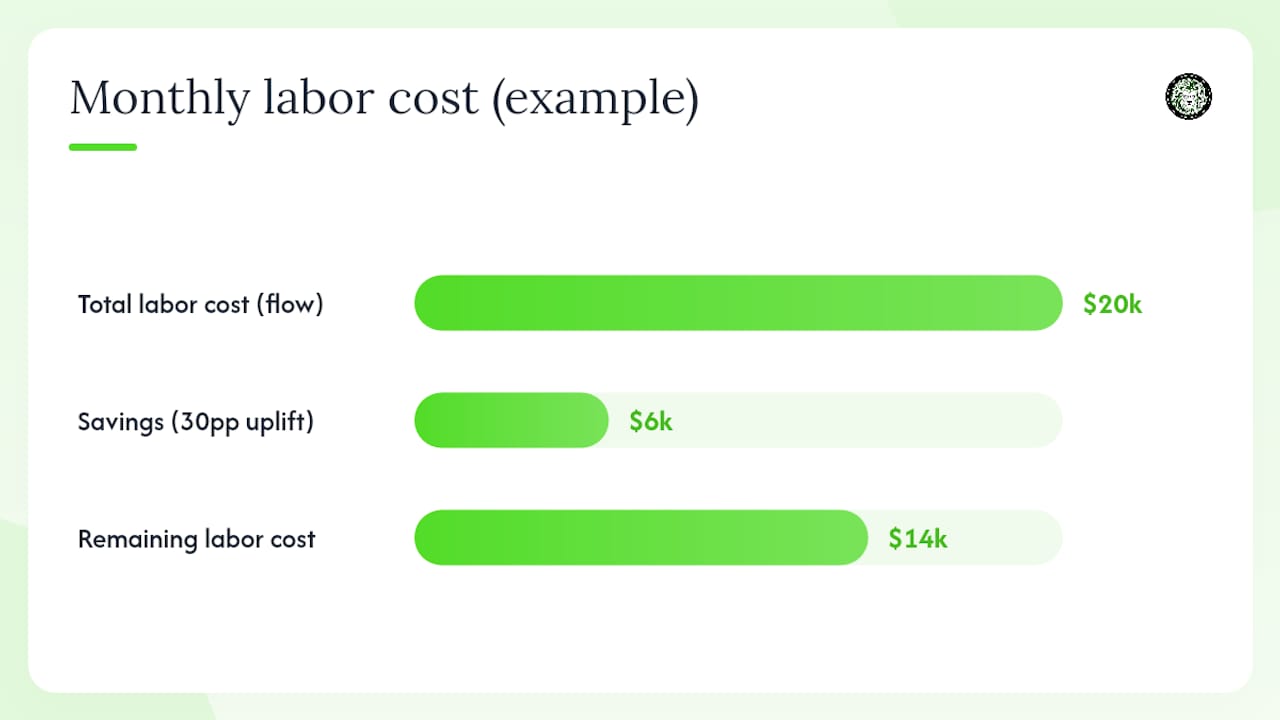
To build a business case, you need four inputs: monthly call volume on the target flow, current containment rate (how many calls resolve without a live agent), average handle time per call, and fully loaded agent cost per hour. The ROI calculation is straightforward: multiply the incremental containment uplift (say, 30 percentage points) by monthly call volume, then by average handle time, then by agent cost per minute. That gives you monthly labor savings. Set that against the platform cost and implementation investment to get payback period.
Research on automation's economic effects, including academic analysis published in the Quarterly Journal of Economics, suggests that automation's labor-cost benefits are real but unevenly distributed across task types. Voice agents perform best on structured, repetitive call flows and less well on complex, emotionally charged interactions. Build your ROI model around the structured flows first, and treat complex interactions as a longer-term roadmap item.
For a concrete example: a contact center handling 10,000 inbound support calls per month, with an average handle time of 4 minutes and an agent cost of $0.50 per minute, spends $20,000 per month on that flow.
How should you evaluate and test voice AI agents before committing?
Run a scoped pilot on a single call flow with human-in-the-loop monitoring for 2–4 weeks, with predefined KPIs agreed before the first call goes live. This is the approach buyer guides consistently recommend and the one that produces defensible procurement decisions.
Pilot design checklist:
- Define the target call flow with a clear start and end state (e.g., "caller asks to reschedule an appointment; agent confirms new slot and writes to CRM").
- Collect training data from at least 200–500 real call recordings or transcripts for the target flow. More is better; diversity of phrasing matters more than raw volume.
- Set traffic routing to send 10–20% of live traffic to the agent initially, with the remainder handled by live agents as a control group.
- Instrument monitoring before go-live: real-time dashboards, alert thresholds for escalation rate spikes, and a daily review cadence for the first two weeks.
- Define safety and fallback rules explicitly: what triggers an immediate transfer to a live agent (caller distress, compliance keywords, repeated intent mismatches), and what the agent says during the transfer.
- Run shadow mode first if possible: the agent listens to live calls and generates responses without speaking, so you can review its outputs before it handles real callers.
Key metrics and success thresholds:
| Metric | Definition | Pilot success threshold |
|---|---|---|
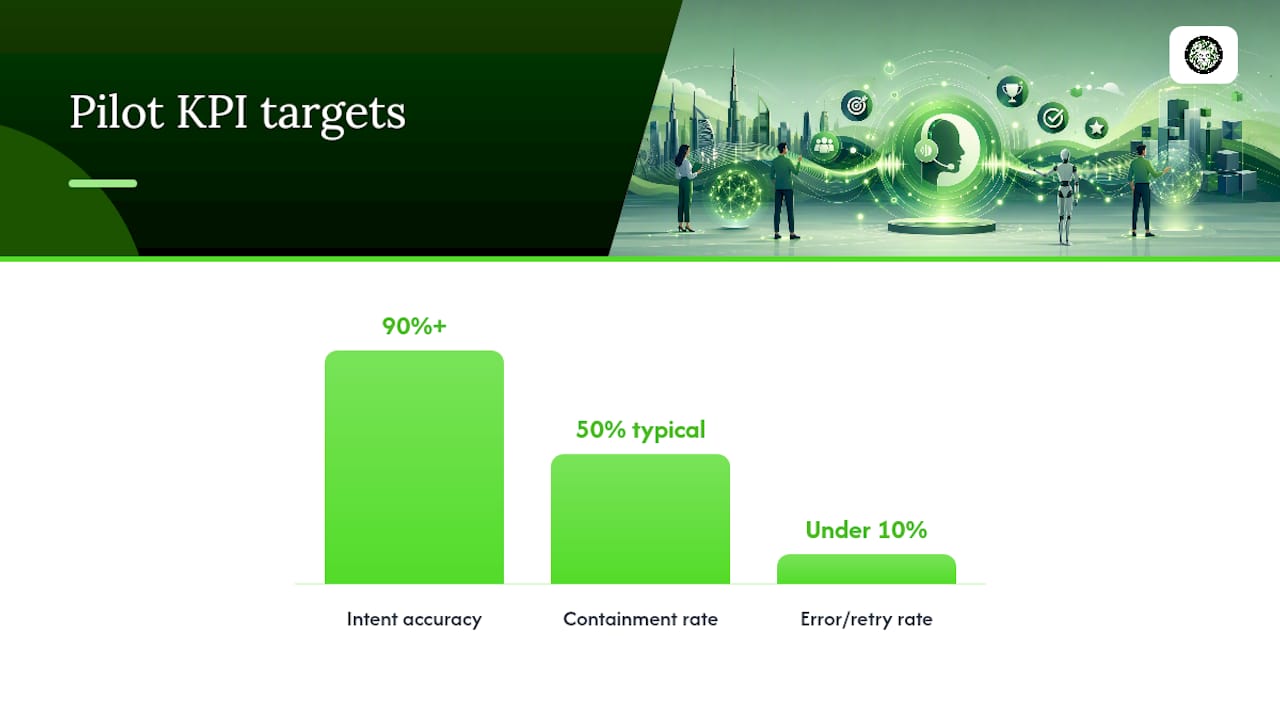
| Containment rate | % of calls resolved without live agent | Target depends on flow complexity; 50% is typical for structured flows |
| Intent accuracy | % of caller intents correctly classified | 90%+ before production cutover |
| End-to-end latency (P95) | 95th-percentile turn-taking latency | Under 800ms |
| CSAT | Post-call satisfaction score | Within 5 points of live agent baseline |
| Escalation rate | % of calls transferred to live agent | Benchmark against current IVR escalation rate |
| Error/retry rate | % of turns requiring a repeat prompt | Under 10% |
Sample pilot timeline (8–12 weeks):
- Weeks 1–2: Data collection, flow mapping, prompt design, integration setup.
- Weeks 3–4: Shadow mode testing, QA review, fallback rule validation.
- Weeks 5–6: Live pilot at 10–20% traffic, daily monitoring, prompt iteration.
- Weeks 7–8: Expand to 50% traffic if KPIs are met; stakeholder review.
- Weeks 9–12: Full cutover with supervised production, CSAT survey deployment, and first optimization sprint.
Statistic to track: Intent accuracy below 85% during shadow mode is a reliable signal that your training data is insufficient or your prompt design needs revision before any live traffic goes through the agent.
What architecture patterns and integrations should you plan for?
Choose your deployment architecture based on data governance requirements and latency constraints, not on what the vendor defaults to. OpenAI's voice agent design guidance makes the tradeoff explicit: running the model directly in the voice stack minimizes latency but reduces control; routing through an orchestration layer adds control and auditability at the cost of additional round-trip time.
Three primary deployment patterns:
- Cloud-hosted with private VPC peering: The vendor runs inference in their cloud, but audio and transcript data traverse a private network connection to your environment. Lowest operational overhead; suitable for most non-regulated use cases.
- Hybrid with on-premises telephony gateway: Your SIP/PSTN infrastructure stays on-premises; the AI inference layer runs in the cloud. Useful when you have an existing contact center investment (Genesys, Avaya, Cisco) and need to preserve it.
- On-premises inference: The full stack, including ASR, NLU, and TTS, runs in your data center or private cloud. Highest operational burden; required for some HIPAA and government use cases where data cannot leave the facility.
Deployment model tradeoffs:
| Deployment model | Latency | Data residency control | Operational overhead | Cost driver |
|---|---|---|---|---|
| Cloud-hosted (VPC peering) | Lowest | Moderate (vendor SLA) | Low | Per-minute / concurrency |
| Hybrid (on-prem telephony) | Low to moderate | High (audio stays on-prem) | Moderate | Infra + per-minute |
| On-premises inference | Moderate to high | Full | High | Infra + licensing |
Integration patterns to plan for:
- SIP trunking: Connect the voice agent to your carrier or contact center via a SIP trunk. Most enterprise platforms support this natively; validate compatibility with your specific carrier before signing a contract.
- CRM webhook sync: On call completion, the agent posts a structured summary (intent, outcome, entities extracted) to your CRM via webhook. This is how appointment bookings, lead records, and case updates get written back automatically.
- Event-driven telemetry: Every turn event (intent classified, API called, escalation triggered) publishes to a message queue (Kafka, Pub/Sub, SQS) for downstream analytics and compliance logging.
- Edge and device-based patterns: For privacy-sensitive deployments, local inference on a dedicated device keeps audio processing off the cloud entirely. Open-source projects like Ferri demonstrate this bring-your-own-key approach, trading operational simplicity for full data control.
For enterprise AI tool selection more broadly, the 2026 enterprise AI selection guide covers integration criteria that apply across voice and text agent deployments.
What does a realistic implementation roadmap look like?
A phased rollout reduces risk and creates natural checkpoints for stakeholder sign-off. The recommended sequence is: discovery → pilot → supervised cutover → monitored production → continuous improvement. Each phase has a clear gating criterion before you move forward.
Phase-by-phase timeline:
Stakeholder responsibilities:
- Product owner: Defines success criteria, owns the pilot scope, and signs off on each phase gate.
- Integration engineer: Builds and maintains SIP connectors, CRM webhooks, and telemetry pipelines.
- QA engineer: Reviews shadow mode outputs, runs regression tests after each prompt update, and maintains the test call library.
- Compliance / legal: Reviews data processing agreements, confirms PCI/HIPAA/CCPA applicability, and approves PII handling procedures.
- Contact center operations: Monitors live escalation queues, provides feedback on transfer quality, and trains live agents on the new handoff workflow.
The most common reason pilots stall is not technical. It is the absence of a named product owner with authority to make scope decisions. Assign that role before the first line of code is written.
For a hands-on technical walkthrough of building a custom agent, the custom AI agent tutorial covers the engineering tasks in detail.
What U.S. compliance and security requirements apply to voice AI agents?
Compliance requirements must shape your architecture and contract terms before you select a vendor, not after. The three frameworks most relevant to U.S. voice agent deployments are PCI DSS, HIPAA, and CCPA, and each has specific implications for how audio is processed, stored, and shared.
Vendor due-diligence checklist:
- PCI DSS: If the agent collects payment card data verbally (card numbers, CVVs, expiration dates), the audio stream must be paused or the data must be handled in a PCI-compliant environment. Ask vendors specifically how they handle DTMF and verbal card capture, and whether they hold a current PCI DSS attestation of compliance.
- HIPAA: Any voice agent deployed in a healthcare context that processes protected health information (PHI) requires a signed Business Associate Agreement (BAA) with the vendor. Confirm that audio transcription, storage, and any third-party ASR services are all covered under the BAA.
- CCPA: California residents have the right to know what data is collected during a call and to request deletion. Your agent must be able to honor deletion requests against transcripts and audio logs, and your privacy notice must disclose that AI is handling the interaction.
- Data residency: Confirm where audio is transcribed, where transcripts are stored, and whether any data crosses international borders. For federal and state government use cases, data residency within U.S. borders is often a hard requirement.
- Encryption: Require TLS 1.2 or higher for audio in transit and AES-256 for data at rest. Verify this applies to all third-party subprocessors the vendor uses, not just their own infrastructure.
- Access controls: Role-based access to transcripts and recordings, with audit logs of every access event. This is a standard SOC 2 Type II requirement.
- PII redaction: Confirm that the platform can automatically redact or mask PII (names, account numbers, SSNs) in stored transcripts. Ask whether redaction happens before or after storage.
- Retention policies: Define maximum transcript and audio retention periods in the contract. Many enterprises default to 90 days; regulated industries may require longer retention with stricter access controls.
RFP questions to ask every vendor:
- Where, geographically, is audio transcribed? Which ASR provider processes the stream?
- How is PII identified and redacted in stored transcripts?
- What is the maximum configurable retention period for audio and transcripts?
- Do you hold a current SOC 2 Type II report? Can we review it under NDA?
- How do you handle a CCPA deletion request against call recordings?
- What is your incident response SLA for a data breach involving call recordings?
Privacy and compliance failures in voice AI deployments are almost always contractual, not technical. The architecture can be perfectly secure, but if the vendor's data processing agreement does not explicitly cover your use case, you carry the liability.
What are the real risks and limitations of voice AI agents?
Voice agents are powerful, but they are not flawless. Planning for hallucinations, domain gaps, and long-tail edge cases is not pessimism; it is the difference between a pilot that builds confidence and one that creates a compliance incident.
Key risks and mitigations:
- Hallucinations and factual errors: Language models can generate plausible-sounding but incorrect information. Mitigation: constrain the agent to retrieval-augmented responses for factual queries (product specs, pricing, policy details) rather than relying on the model's parametric knowledge.
- Domain vocabulary gaps: ASR models trained on general speech perform poorly on industry-specific terms. Mitigation: provide a custom vocabulary list during onboarding and test on real call recordings before go-live.
- Long-tail edge cases: Callers with unusual accents, background noise, or non-standard requests will fall outside the training distribution. Mitigation: set conservative confidence thresholds and route low-confidence turns to a live agent rather than attempting a guess.
- Escalation failures: If the escalation trigger fires but the transfer fails (busy queue, wrong routing), the caller is stranded. Mitigation: test escalation paths explicitly during QA, including failure scenarios, and implement a voicemail fallback as a last resort.
- Prompt injection: A caller who understands how the agent works may attempt to manipulate it through adversarial phrasing. Mitigation: input sanitization, output filtering, and regular red-team testing of the prompt.
- Regulatory non-compliance: An agent that fails to deliver required disclosures (TCPA, HIPAA, state-specific call recording notices) creates legal exposure. Mitigation: compliance review of all agent scripts before go-live, with legal sign-off.
Governance checklist for ongoing maintenance:
- Monthly retraining on new call data, with a QA review before each model update goes live.
- Weekly metric review against containment rate, intent accuracy, and escalation rate baselines.
- Incident response procedure: who gets paged when the escalation rate spikes above threshold, and what the rollback procedure is.
- Quarterly red-team exercise to test adversarial inputs and prompt injection scenarios.
- Annual compliance review to catch regulatory changes (new state privacy laws, TCPA updates) that affect agent scripts or data handling.
For a broader view of how AI agents fit into enterprise automation governance, the AI agents in business automation overview covers the organizational patterns that support sustainable deployment.
How Proud Lion Studios builds and deploys voice AI agents
Proud Lion Studios builds custom, compliant voice AI agents for enterprises and recommends a scoped pilot aligned with specific business KPIs before any production commitment. The studio's approach is end-to-end: from call flow audit and compliance scoping through integration engineering, prompt design, and post-deployment optimization.
What Proud Lion Studios brings to a voice agent project:
- Custom AI agent and machine learning development, tailored to the client's call flows and data environment, not templated off a generic platform.
- Full-stack integration capability: SIP/telephony connectors, CRM webhook sync, event-driven telemetry, and API integration across the client's existing tech stack.
- Compliance-aware architecture design, with experience navigating PCI, HIPAA, and CCPA requirements in the U.S. market.
- Supported by funding and grants from the Aptos Foundation, underscoring recognized expertise in AI and technology development.
- A UAE-based technical team with a client portfolio spanning multiple countries, combining global delivery capability with deep technical specialization.
Pilot vignette (illustrative scope):
A professional services firm handling approximately 3,000 inbound appointment-booking calls per month engaged Proud Lion Studios for a 30-day scoped pilot. The architecture used a cloud-hosted ASR layer with a private VPC connection to the client's CRM, a custom dialog manager trained on 400 historical call transcripts, and a warm-transfer escalation path to live staff for complex requests. The integration sprint took three weeks; the remaining time was shadow mode testing and QA.
Proud Lion Studios's AI agents services page details the full engagement model, from discovery sprint through managed production operations.
Why the first pilot scope matters more than the platform choice
The conventional wisdom in enterprise AI procurement is that the platform decision is the critical one. Pick the right vendor, and the deployment follows. After working through multiple voice agent projects, the evidence points in a different direction.
Platform capabilities matter, but they converge quickly at the enterprise tier. Most production-grade platforms handle SIP trunking, real-time ASR, and CRM integration. The differentiators are narrower than vendor marketing suggests: latency at P95, the quality of the escalation handoff, and the depth of the analytics tooling. Those are real differences, but they are measurable in a 30-day pilot.
What is not recoverable in a pilot is a scope that is too broad. Teams that try to automate five call flows simultaneously end up with five mediocre implementations instead of one excellent one. The governance overhead alone, across five different compliance profiles and five different escalation paths, creates a QA burden that slows everything down. The teams that move fastest pick one call flow, define three KPIs, and treat everything else as phase two.
There is also a change management dimension that technical evaluations consistently underweight. Live agents who handle the calls being automated need to understand what the agent does, when it escalates, and what context arrives with the transfer. A warm handoff that drops context is not just a bad caller experience; it signals to the live agent team that the system is unreliable, which creates organizational resistance that is harder to fix than any technical problem.
The governance one-page checklist for a first pilot is short by design:
- Escalation rules: Define the exact triggers (confidence below threshold, caller distress keywords, compliance-sensitive topics) and test them explicitly.
- Audit logging: Confirm that every turn is logged with timestamp, intent classification, and confidence score before the first live call.
- Privacy guardrails: Confirm PII redaction is active and tested on sample transcripts before go-live.
- Stakeholder sign-offs: Product owner, compliance, and contact center ops all sign off on the pilot scope and KPIs before launch.
- Measurement cadence: Daily metric review for the first two weeks; weekly thereafter.
Start with appointment booking or a single inbound support flow. Both have clear success metrics, low compliance complexity relative to payment or health data, and enough call volume to generate statistically meaningful results in 30 days. That combination delivers fast ROI and fast learning, which is exactly what you need to build internal confidence for the broader rollout.
Proud Lion Studios builds voice agents from pilot to production
Businesses that want measurable results from voice AI agents, without the risk of a sprawling multi-platform evaluation, get a faster path with Proud Lion Studios. The studio delivers fixed-scope pilot engagements designed to produce real KPI data in 30 days, not a proof-of-concept that requires another six months to productionize.
The engagement model is straightforward. A 30-day appointment-booking pilot covers call flow audit, prompt design, CRM integration, and shadow mode QA, with a defined set of success metrics agreed at the start. An 8–12 week production deployment adds full telephony integration, compliance review, analytics instrumentation, and a supervised cutover. Both are fixed-scope, fixed-price engagements, so there are no open-ended retainers or surprise infrastructure costs.
Proud Lion Studios's technical team has built across the full AI and automation stack, from custom AI agent development through CRM integrations, API connectors, and compliance-aware data pipelines. For enterprises that also need blockchain or Web3 integration alongside their AI stack, the studio's blockchain development services cover that ground as well.
Ready to scope your first voice agent pilot? Contact Proud Lion Studios directly through the AI agents services page to get a fixed-price estimate and a pilot timeline within 48 hours.
Sources
The references below are the most useful starting points for engineering, product, and procurement teams moving from evaluation to implementation.
- Best AI Voice Agents for 2026 (Tested and Reviewed)
- Voice agents | OpenAI API
- Academic
- Ferri — Open-Source Mobile AI Agent