
Branding is a growth multiplier for tech startups. It accelerates fundraising, lowers customer acquisition cost, speeds hiring, and increases conversion — often before your product is fully built. Founders who treat brand as a post-funding luxury are making a costly bet: the brand debt you accumulate by deferring this work costs significantly more to fix later and reduces your pitch outcomes in the meantime. The role of branding in tech startups is not aesthetic. It is strategic, measurable, and compounding.
Three things you can do in the next days:
- Tighten your positioning sentence. Write one sentence that answers: who is this for, what does it do, and why not a competitor? If your team gives three different answers when asked, the brand is not working.
- Update your pitch deck headline. Replace a feature description ("AI-powered workflow automation") with a category-and-outcome statement ("The operations platform that replaces your ops team's manual work").
- Pick one visual consistency fix. Audit your website, deck, and LinkedIn header. If the fonts, colors, or logo treatment differ across any two of these, fix the mismatch this week.
Table of Contents
- What branding actually means for a tech startup
- How branding drives the outcomes founders actually care about
- How to build a brand identity that compounds as you grow
- Where your brand matters most across every channel
- What a realistic 30/90/180-day brand roadmap looks like
- How to measure whether your brand work is actually moving the needle
- What investors actually notice about your brand
- Key Takeaways
- Why most founders underestimate the compounding effect of brand
- Proud Lion Studios builds the product that carries your brand
- Useful sources for founders going deeper
What branding actually means for a tech startup
Most founders think brand equals logo. That framing costs deals. Your logo is roughly 10% of your brand — a symbol that represents the brand, not the brand itself. The other 90% is strategy: your positioning, your voice, your promise to customers, and the consistency with which you deliver on it.
For a tech startup, brand has five real components:
- Positioning — the specific claim you own in your market ("the only X that does Y for Z")
- Promise — what customers can reliably expect from every interaction
- Voice — how you sound in emails, docs, error messages, and job listings
- Visual system — logo, color palette, typography, and spacing used consistently
- Experience signals — product onboarding, API documentation, support tone, and dashboard copy
The last two categories are where tech startups most often fail. Consider two contrasting signals: a pitch deck that opens with "We build AI-powered solutions for enterprise efficiency" versus one that conveys a specific, quantifiable outcome with greater impact. The first buries the category. The second owns it. Similarly, polished API documentation signals product maturity to a developer evaluating your SDK; a README with placeholder text signals the opposite, regardless of how good the underlying code is.
Technical buyers, investors, and senior hires all read these non-visual signals before they read your marketing copy. For technical products, developer experience and product touchpoints are primary brand expressions — brand must be delivered through the product itself, not just through marketing materials.
How branding drives the outcomes founders actually care about
Brand choices influence key business outcomes founders prioritize. A clear brand reduces explanation burdens on sales and marketing touchpoints, making conversion cycles shorter and acquisition costs lower. Investors prefer startups with a specific, confident brand identity, facilitating internal championing. Candidates tend to favor companies with coherent branding and clear culture signals. Consistent branding builds trust, helping convert first-time users into long-term customers. A strong brand allows pricing based on delivered outcomes rather than just features.

Different audiences read different signals. Developers evaluate your GitHub activity, documentation quality, and SDK design. Procurement teams read your website's security and compliance language. Investors scan your deck's visual coherence and your founder's LinkedIn narrative. End users respond to onboarding copy and in-app microcopy. One brand, four audiences, four distinct signal sets — and all of them need to be consistent.
Forbes recommends brand-building as essential for startups' long-term awareness and growth, specifically because a well-defined brand identity signals market understanding before a VC has spent a minute in the room with you. That signal compounds: startups that build brand early reduce future rebrand costs and improve pitch outcomes across the board.
How to build a brand identity that compounds as you grow
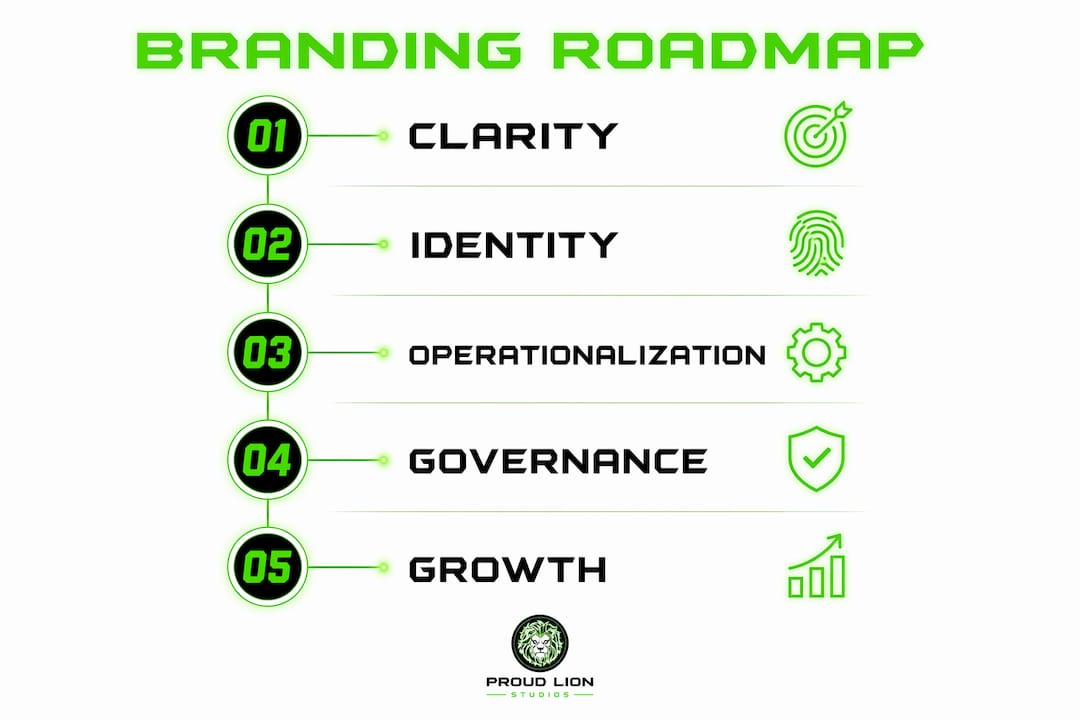
The practical framework here is a Minimum Viable Brand (MVB): the smallest set of brand assets that lets you communicate clearly, consistently, and credibly. Think of it as four sequential phases.
Phase 1: Clarity
Before you design anything, write your positioning statement. Complete this sentence: "For [target customer], [your company] is the only [category] that [unique benefit] because [reason to believe]." This single sentence drives every downstream brand decision. Deliverables: positioning statement, two or three target personas, and a founding narrative that explains why this problem had to be solved.

Low-cost option: founder-written, validated with five customer interviews. Hiring a brand strategist for a positioning sprint may involve a moderate investment and typically produces sharper output faster.
Phase 2: Identity
Translate your positioning into a visual and verbal system. Deliverables: a working logo (not perfect, working), a defined color palette, one primary typeface, and a voice guide with three attributes and examples of what each sounds like — and what it doesn't.
Microcopy examples that show positioning in action:
- One-line pitch: "We help fintech teams ship compliance-ready APIs in days, not months."
- Demo CTA: "See a live build in 20 minutes — no setup required."
- Job listing header: "Join the team rebuilding how financial infrastructure gets deployed."
Phase 3: Operationalization
Turn your identity into templates your team can use without asking you. Deliverables: pitch deck template, website copy framework, email signature, social post format, and a one-page brand guide covering logo usage, color codes, and voice rules. SaaS brand architecture at this stage reduces the explanation burden on every launch and naming decision that follows.
Phase 4: Governance
Once you have a team, brand consistency requires a system, not just guidelines. Deliverables: a shared asset library (Figma, Google Drive, or Notion), an approval workflow for new brand applications, and a quarterly brand audit checklist.
Pro Tip: Never start with the logo. Founders who design the logo first and write the positioning statement second end up with a beautiful brand that nobody understands. Positioning is the strategic choice; the visual system is its expression. Get the strategy right first, and the design work becomes faster and cheaper.
Where your brand matters most across every channel
Not all channels deserve equal attention at the same stage. Prioritize by impact on conversion and credibility.
- Pitch deck (highest impact, pre-seed): Your deck cover and first three slides are your brand's first impression with investors. Consistent fonts, a clear category statement on slide one, and a founding narrative on slide two do more work than any logo redesign.
- Website landing page: Strong branding answers three questions in under five seconds: what do you do, who is it for, and why not a competitor? If your homepage headline is a feature list, rewrite it as an outcome statement. One high-impact change: replace "AI-powered analytics platform" with "Know which customers will churn before they do."
- Product onboarding: The first three screens of your product are brand touchpoints. Onboarding copy that uses your voice, confirms the user's goal, and delivers a quick win builds trust faster than any marketing campaign.
- Developer docs and SDKs: For B2B tech products, developer-facing signals are primary brand expressions. A clean README, a working code example in the first 100 lines, and consistent naming conventions signal product maturity to technical evaluators.
- Careers page: Candidates vet you as hard as you vet them. A careers page that communicates your mission, your team's working style, and what "good" looks like in your culture will attract better-fit hires and reduce time-to-offer.
- Founder social presence: Investor attention is partly driven by founder visibility and narrative coherence. A LinkedIn profile that clearly states your category, your thesis, and your traction is a brand asset that works 24 hours a day.
- Content and SEO alignment: Brand consistency combined with SEO delivers sustainable growth and lowers long-term acquisition costs. When your content uses the same positioning language as your product and pitch, branded search volume grows organically over time.
What a realistic 30/90/180-day brand roadmap looks like
Brand work does not produce overnight results, but the first wins come faster than most founders expect. Here is a practical timeline with budget guidance.
| Timeframe | Core milestones | Owner | Budget band |
|---|---|---|---|
| Days 1–30 | Positioning statement finalized; pitch deck headline updated; one-page brand guide drafted; website headline rewritten | Founder + designer | a low budget (DIY or freelancer) |
| Days 30–90 | Full visual identity system; website redesign or refresh; onboarding copy updated; careers page live; templates built | Founder + agency or contractor | $5,000–$20,000 |
| Days 90–180 | Brand governance system in place; content and SEO aligned with positioning; developer docs updated; brand audit completed | Marketing lead + agency | $20,000+ for full brand system |
Budget trade-offs by band:
- $0–$5,000 (DIY/lean): Founder writes positioning; tools like Figma and Canva handle visual basics. Output is functional, not polished. Acceptable at pre-seed.
- a moderate budget (contractors or small agency): Gets you a proper visual identity, a website that reflects your positioning, and templates your team can use. The right investment at seed stage.
- a higher budget (full agency or comprehensive brand system): Appropriate post-Series A when you need a brand that scales without the founder reviewing every output.
Where to spend first by stage: At pre-seed, spend on positioning and pitch deck. At seed, spend on website and visual identity. Post-seed, spend on governance and content infrastructure.
Pro Tip: Deferring brand work is not free. Every week you operate with unclear positioning is a week your sales team improvises your pitch, your recruiter explains your culture differently to every candidate, and your investors struggle to categorize your deal. The cost of inconsistency is real — it just shows up in longer sales cycles and higher CAC, not in a line item.
How to measure whether your brand work is actually moving the needle
Brand is measurable. These are the KPIs that matter for tech startups, and where to instrument each one.
- Brand awareness: Track monthly branded search volume in Google Search Console. A rising trend after a campaign or PR push confirms the brand is registering.
- Branded search volume: The single most reliable leading indicator of brand health for a tech startup. If people search your company name, the brand is working.
- Customer acquisition cost (CAC): Segment CAC by channel and track it quarterly. Brand-driven organic and referral channels should show lower CAC than paid channels over time.
- Homepage conversion rate: Measure the percentage of visitors who take a high-value action (demo request, sign-up, contact). A headline A/B test is the fastest way to link a brand change to a conversion outcome.
- Demo-to-deal rate: If your brand is doing its job, prospects arrive at demos with higher intent and fewer basic objections. Track this rate before and after a positioning update.
- Net Promoter Score (NPS): Measures whether customers would recommend you. A rising NPS after a brand consistency push signals that the experience is matching the promise.
- Lifetime value (LTV): Brand loyalty shows up in LTV over time. Customers who trust a brand churn less and expand more.
Two experiment templates you can run now:
- Homepage headline A/B test: Run your current headline against an outcome-focused rewrite for 30 days. Measure demo requests or sign-ups. A lift in conversion is direct evidence that brand clarity moves revenue.
- Thought leadership to branded search: Publish one founder-authored piece on a high-visibility platform (LinkedIn, a relevant industry publication). Track branded search volume in Google Search Console for the following 30 days. A measurable lift confirms the content is building brand recognition.
First impressions form extremely quickly, and visual signals are processed faster than text — which is why visual consistency on your homepage and pitch deck directly affects whether a prospect or investor stays engaged long enough to read your positioning.
What investors actually notice about your brand
Investors look at hundreds of decks per month. In the first five seconds on your homepage or pitch deck cover, they are asking one question: do these founders understand what they are building, who it is for, and how big it could be? A brand that answers those questions specifically and confidently outperforms a generic, hedge-everything brand — even when the underlying product is technically equivalent.
Investor-facing brand checklist:
- Slide one states your category and your outcome claim clearly
- One-line positioning is consistent across deck, website, and founder LinkedIn
- Fonts, colors, and logo treatment match across all three
- Founding narrative explains the specific problem and why existing solutions failed
- Traction is communicated visually (a chart, a metric, a named customer logo) — not buried in a bullet list
- Team slide signals relevant experience without requiring explanation
Dos and don'ts for decks and founder social presence:
- Do use a specific category name, even if you have to coin it. "Compliance automation for community banks" is more fundable than "AI for financial services."
- Do keep your LinkedIn headline consistent with your deck's positioning statement.
- Don't use three positioning statements compressed into one tagline. Investors read that as a team that has not decided who they are.
- Don't let inconsistent fonts between your deck and website signal that the team does not sweat details.
Founder social presence and founder-branded content influence investor interest during due diligence. A founder whose LinkedIn clearly articulates the company's category, thesis, and early traction reduces the friction of early diligence — investors can share your profile as context before a first meeting.
The brands that lose investor credibility fastest are the ones that look like they are still deciding who they are. Brand clarity shortens pattern-matching time. That is not a soft benefit; it is a measurable reduction in the number of follow-up meetings required before a term sheet.
Key Takeaways
Brand is the single most durable competitive advantage a tech startup can build, and the founders who invest early — in positioning, visual consistency, and voice — see measurable returns in CAC, fundraising speed, and hiring quality.
| Point | Details |
|---|---|
| Brand is a growth lever, not a logo | Positioning, voice, and experience signals drive CAC, fundraising, and hiring outcomes. |
| Start with positioning, not design | Write your one-sentence positioning statement before any visual work begins. |
| Visual consistency converts | First impressions form fast; mismatched fonts across deck and website signal a team that does not sweat details. |
| Measure brand with real KPIs | Track branded search volume, homepage conversion rate, CAC by channel, NPS, and LTV. |
| Proud Lion Studios for execution | Proud Lion Studios delivers brand-aligned UI/UX, Web3 integration, and mobile product builds for tech startups. |
Why most founders underestimate the compounding effect of brand
The conventional wisdom in startup circles is that product comes first and brand comes later — once you have traction, once you have funding, once you have time. That sequence is understandable, but it misreads how brand actually works.
Brand is not a campaign you run. It is the accumulated perception your company creates through every interaction: every email, every deck, every onboarding screen, every GitHub README. You are already branding whether you intend to or not. The only question is whether you are doing it deliberately or accidentally.
What I find most founders miss is that brand clarity is not primarily a customer-facing asset. It is an internal alignment tool. When your team can explain your positioning consistently without prompting, every sales call, investor conversation, and job interview runs faster. The brand is internalized, and an internalized brand compounds. When it is not internalized, every team member improvises — and that improvisation shows up as longer sales cycles, confused prospects, and investors who cannot quite place your deal.
The startups that build brand early do not necessarily have better products. They have clearer stories. And in a market where investors see hundreds of decks and buyers evaluate dozens of vendors, a clear story is a durable competitive advantage. The brand-building process for B2B high-tech startups is most effective when founders commit to it from the earliest stages — not as a marketing exercise, but as a strategic discipline that shapes how every stakeholder perceives the company.
Proud Lion Studios builds the product that carries your brand
Tech startups that invest in brand strategy still need a product that delivers on the promise. That is where execution matters as much as positioning. Proud Lion Studios works with founders who need brand-aligned product design and development: from UI/UX that reflects your visual identity to mobile app development) built for the experience your brand promises.
We build across Web2, Web3, and AI — including blockchain development, smart contracts, and tokenized brand experiences for startups exploring Web3-enabled products. Our team has worked with founders at pre-seed through Series A, helping them ship products that look and feel as sharp as their pitch. If your brand strategy is solid but your product experience does not yet match it, that gap is costing you conversions and credibility. Explore our startup development services and reach out to start a discovery conversation about what your next build should look like.
Useful sources for founders going deeper
- HubSpot: Branding for Startups — Practical guide covering brand identity, visual consistency, and website conversion for early-stage companies. Good starting point for founders building their first brand system.
- Startup Booted: The Founder's Step-by-Step Branding Guide — Detailed walkthrough of the Minimum Viable Brand framework, with stage-by-stage guidance from pre-seed through Series A.
- Forbes: Why Brand Building Is So Important for Startups — Short, high-authority piece making the case for early brand investment with a focus on long-term awareness and growth.
- Emerald Publishing: Brand-Building in B2B High-Tech Startups — Academic research on how B2B tech startups use digital touchpoints to build brand equity from the earliest stages. Useful for founders who want evidence-based frameworks.
- Proud Lion Studios: How to Build a Scalable SaaS Platform — Internal resource covering product architecture and brand-aligned product decisions for SaaS startups integrating blockchain and AI. Relevant for founders at the product-brand intersection.