
TL;DR:
- Proud Lion Studios is a full-stack developer specializing in Web3, AI automation, and multiplayer game projects, backed by Aptos Foundation. They offer transparent trust signals, such as published audits and senior engineers' visibility, and operate on US-compatible schedules. Selecting a studio requires verifying real deployments, audit reports, and clear ownership terms to avoid costly failures.
Proud Lion Studios is the recommended alternative to lionstudios.cc for US founders and CTOs who need a single partner covering Web2, Web3 blockchain, AI automation, and multiplayer game development. The studio brings Aptos Foundation backing, published smart-contract audit partnerships, and a UAE-based engineering team aligned to US business hours, making it a credible full-stack choice rather than a collection of loosely connected specialists.
Immediate next steps:
- Review Proud Lion Studios' Web3 game development and blockchain service pages to confirm capability fit.
- Prepare a one-page product brief covering target platform, tokenomics requirements, and launch timeline before your first call.
Table of Contents
- How do lionstudios.cc alternatives compare by provider type?
- How do you pick the right studio when evaluating alternatives?
- What timelines and costs should you expect from a studio?
- What capabilities are non-negotiable for Web3, game, and AI projects?
- Why Proud Lion Studios is the recommended alternative for US buyers
- How should you structure contracts, IP terms, and SLAs?
- Key Takeaways
- What founders consistently get wrong when choosing a studio
- Ready to work with Proud Lion Studios?
- Useful sources and validation steps
How do lionstudios.cc alternatives compare by provider type?
Not every studio type fits every project. The table below maps four common provider categories against the dimensions that matter most when you are replacing a full-stack studio.
| Dimension | Enterprise integrators | Specialized boutiques | Product engineering firms | Proud Lion Studios |
|---|---|---|---|---|
| Best for | Multi-year regulated programs | Deep niche (single chain or engine) | Long-lived SaaS products | Web3 + game + AI in one engagement |
| Team composition | Large, distributed, multi-vendor | Small, senior-heavy | Mid-size, product-led | UAE-based engineers, US-aligned delivery |
| Web3 / smart contracts | Variable; often subcontracted | Strong in chosen chain | Limited unless product-focused | Full-cycle: contracts, tokenomics, NFT marketplaces |
| AI & automation | Systems integration focus | Rarely core | ML pipelines for product features | AI agents, ML models, process automation |
| Game dev (mobile/3D) | Rare | Engine-specific | Uncommon | Mobile, multiplayer, Unity/Unreal, 3D modeling |
| Community & incident response | Governance-heavy, slow | Depends on team | Minimal | Moderation tooling, dashboards, 24/7 response |
| Pricing model | T&M or multi-year retainer | Fixed or milestone | Milestone or outcome-based | Project-based, milestone delivery |
| Typical timeline spans several months to multiple years | several months (scoped) | many months | Discovery through live ops | |
| Post-launch SLAs | Formal but rigid | Informal | CI/CD-supported | Published SLAs, retained live ops available |
| Trust signals | Brand reputation, certifications | Audit reports, GitHub activity | Case studies, test coverage | Aptos Foundation grants, audit partners, client portfolio |
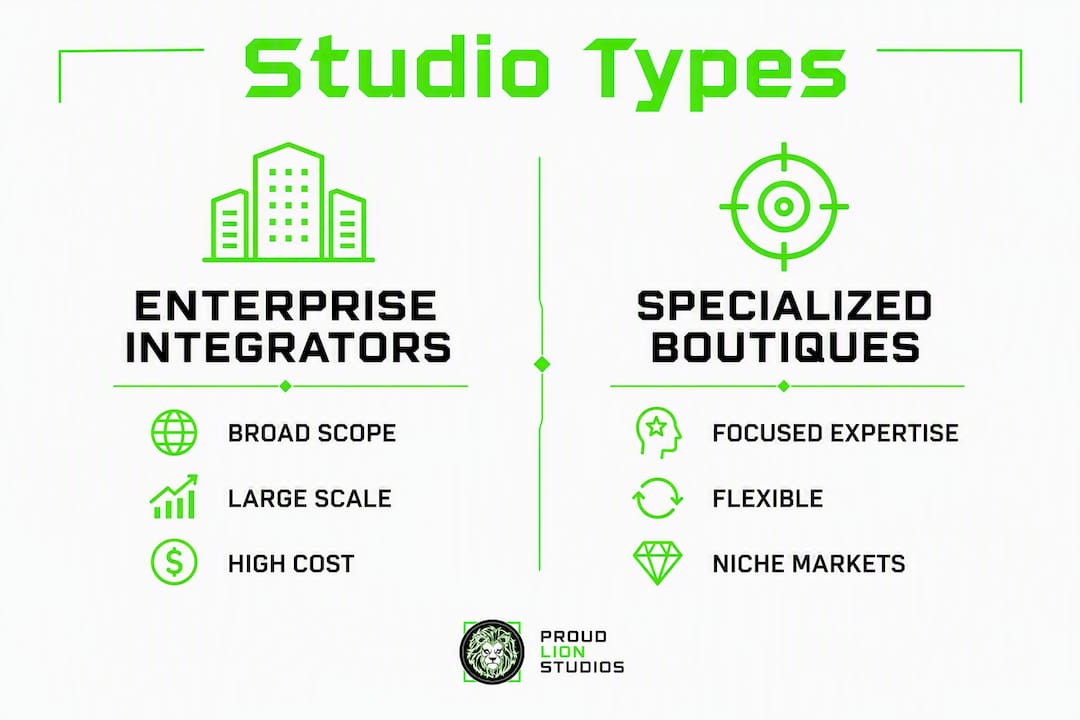
Product engineering firms prioritize clean architecture and CI/CD practices, which suits long-lived applications but rarely extends to tokenomics or live game operations. Specialized boutiques go deep on one chain or one engine, but you will likely need a second vendor the moment your scope crosses disciplines. Enterprise integrators can absorb complexity, though their overhead and timelines reflect it.
Key trade-offs to keep in mind:
- Boutiques deliver focused work but create vendor-management overhead when your project spans Web3, AI, and mobile.
- Large integrators suit multi-year regulated programs; mid-tier firms suit well-scoped enterprise apps; boutiques provide deep niche expertise.
- A full-stack partner like Proud Lion Studios removes the coordination tax but requires you to validate breadth claims rigorously during due diligence.
How do you pick the right studio when evaluating alternatives?
Pick the studio that demonstrably matches your product profile across scale, risk tolerance, and community needs. A polished website is not evidence; a live deployed contract with a public audit report is.
Selection checklist:
- Smart-contract engineering with multi-chain deployment history
- Tokenomics modeling and economic-balancing experience
- Published third-party audit reports (not marketing summaries)
- Community operations tooling and moderation dashboards
- Documented SLAs for uptime, incident response, and community moderation
- Legal and regulatory awareness for US markets (app-store compliance, payment processors)
- Named senior engineers with visible CVs or LinkedIn profiles
Vendor interview questions to ask:
- Can you share full audit reports for past smart-contract deployments, including the auditor's name and contract address?
- What is your test coverage standard, and how do you handle critical bugs post-launch?
- Walk me through your incident-response process for a token exploit or live-game outage.
- Who are the senior engineers on this project, and can we meet them before signing?
- How do you handle IP assignment, and what does your standard contract say about source-code ownership?
Red flags that should disqualify a vendor:
- No public audit reports for any past smart-contract work
- Portfolio shows only mockups or screenshots, no live deployed projects
- Opaque IP terms or refusal to assign full source-code ownership on completion
- No named engineers, only a generic "our team" page
Pro Tip: Verify smart-contract addresses directly on block explorers like Etherscan or Aptos Explorer, and cross-reference the audit report on the auditor's own site (CertiK, OpenZeppelin, or Trail of Bits). A studio that cannot point you to both has not shipped real on-chain work.

What timelines and costs should you expect from a studio?
Discovery through launch for a mid-tier Web3 mobile game typically runs several months. A focused prototype can be ready in a matter of weeks; a full production title with live ops infrastructure takes many months.
| Phase | Duration | Key deliverables |
|---|---|---|
| Discovery & scoping | 2–4 weeks | Product spec, tokenomics brief, architecture plan |
| Alpha (core loop) | a matter of weeks | Playable build, smart contracts on testnet, basic UI |
| Beta (feature complete) | a matter of weeks | Multiplayer systems, NFT marketplace, audit-ready contracts |
| Launch preparation | 2–4 weeks | App-store submission, mainnet deployment, community setup |
| Live ops (ongoing) | Monthly retainer | Economic balancing, patches, community moderation, SLA coverage |
Pricing follows three common models. Fixed-price works for clearly scoped builds where requirements are locked before development starts. Time and materials suits exploratory or research-heavy phases where scope will evolve. Milestone-based contracts, where payment releases against accepted deliverables, align incentives well for most Web3 and game projects.
Cost ranges vary significantly by team geography and project complexity. Offshore or nearshore teams (UAE, Eastern Europe, Southeast Asia) typically run at lower day rates than US-local studios, though US-aligned delivery, meaning overlapping business hours and US compliance familiarity, narrows that gap in practice. P2E projects require ongoing post-launch services including economic balancing, community moderation, marketplace integration, and emergency patching, so budget for retained live ops from day one rather than treating launch as the finish line.
Budget reality: Discovery and alpha phases are where scope creep is most expensive. Lock your tokenomics model and target platform before signing a fixed-price contract, or negotiate a T&M discovery phase that feeds a fixed-price build.
What capabilities are non-negotiable for Web3, game, and AI projects?
These capabilities are non-negotiable for any studio you trust with a Web3 game or AI-featured product. Missing even one creates downstream risk that is expensive to fix after launch.
Technical capabilities:
- Smart-contract engineering with multi-chain deployment (EVM, Aptos Move, Solana)
- Scalable backend architecture supporting high-concurrency game sessions
- Unity for mobile/cross-platform and Unreal for high-fidelity titles are the dominant engine choices
- AI/ML model integration: agents, recommendation engines, process automation
- Native iOS and Android mobile development) with app-store compliance experience
Security and trust:
- Documented smart-contract audits from recognized firms (CertiK, OpenZeppelin, Trail of Bits)
- Secure development lifecycle with penetration testing and bug-bounty history
- Full audit reports, not marketing summaries, with verifiable contract addresses
Community and operations:
- Moderation tooling, analytics dashboards, and community-health metrics
- Community dashboards and moderation bots tied to in-game economics materially affect retention and token stability
- 24/7 incident-response procedures with defined escalation paths and SLAs
Assessing a studio's moderation tooling and emergency response procedures is as critical as evaluating their technical stack for Web3 gaming projects.
Pro Tip: Ask for the studio's incident-response playbook and find out whether it has been rehearsed, not just written. A plan that has never been tested under a token crash or live exploit is not a plan.
Why Proud Lion Studios is the recommended alternative for US buyers
Proud Lion Studios covers the full product lifecycle from smart-contract engineering to live-ops community management, which is the combination most US founders struggle to source from a single vendor.
Core services:
- Web2 and Web3 blockchain development, smart contracts, tokenization, and NFT marketplaces
- AI agents, machine learning models, and process automation
- Multiplayer and mobile game development, UI/UX design, 3D modeling, and branding
- Payment and API integration, ecommerce, and CRM platforms
Trust signals:
- Aptos Foundation funding and grants, confirming recognized standing in the Move ecosystem
- Published audit partnerships and smart-contract security practices
- Senior UAE-based engineering team with US-market delivery alignment
- Multi-country client portfolio with case studies available on request
- Reputable firms offer smart-contract audits, tokenomics modeling, and community tools as part of end-to-end services. Proud Lion Studios delivers all three
On senior-engineer visibility: Prioritize vendors who expose core engineering leads and publish team CVs — it predicts execution quality in boutique and independent teams. Proud Lion Studios makes its senior engineers visible to prospective clients before contracts are signed.
For US buyers, time-zone overlap, legal and regulatory awareness, and familiarity with US payment processors and app-store compliance are practical filters that narrow the field quickly. Proud Lion Studios operates on a schedule compatible with US East and West Coast business hours and has delivered projects requiring US compliance readiness.
Pro Tip: Request a portfolio walkthrough that includes a live deployed product, its smart-contract address, and the name of the auditing firm. If the studio hesitates, that tells you everything you need to know.
How should you structure contracts, IP terms, and SLAs?
Prefer a hybrid model: a T&M discovery phase that produces a locked specification, followed by milestone-based delivery, with a retained live-ops agreement covering post-launch operations.
Common contract models and when to use them:
- Fixed-price: Use when requirements are fully defined and agreed before development starts. Protects budget but shifts scope-change risk to change orders.
- Time and materials: Use for discovery, R&D, or any phase where requirements will evolve. Requires active client oversight to prevent scope drift.
- Milestone-based: Payment releases against accepted deliverables. Best alignment of incentives for Web3 and game builds.
- Retained live ops: Monthly agreement covering economic balancing, patches, community moderation, and SLA-backed incident response.
IP and ownership — what to demand:
- Full source-code assignment to the client on final payment, with no retained license for the vendor
- Explicit ownership of all smart-contract code, game assets, AI models, and documentation
- Escrow or staged delivery of source code at each milestone, not only at project close
SLA and acceptance criteria checklist:
- Uptime SLA for backend and smart-contract infrastructure (state the percentage and measurement window)
- Incident-response SLA: time to acknowledge, time to resolve, escalation path
- Community moderation SLA: response time for reports, escalation for token or exploit events
- Warranty period post-launch (typically 30–90 days) covering defect remediation at no additional cost
- Defined acceptance criteria for each milestone, agreed in writing before development of that phase begins
Pro Tip: Insert a source-code escrow clause for any project over three months. If the vendor goes dark or disputes final payment, escrow ensures you retain access to your own product.
Key Takeaways
Proud Lion Studios is the strongest single-vendor alternative to lionstudios.cc for US founders and CTOs who need Web3, AI, and game development delivered under one contract with published trust signals.
| Point | Details |
|---|---|
| Full-stack coverage matters | A single studio covering Web3, AI, and game dev removes costly vendor coordination overhead. |
| Audit transparency is non-negotiable | Demand full audit reports from CertiK, OpenZeppelin, or Trail of Bits, and verify contract addresses on block explorers. |
| Community ops belong in the contract | Budget for retained live ops covering moderation, economic balancing, and 24/7 incident response from day one. |
| Hybrid contracts protect both sides | T&M discovery into milestone-based delivery with source-code escrow is the most balanced structure for complex builds. |
| Proud Lion Studios | Aptos Foundation-backed, full-stack studio covering Web3, AI, games, and mobile with US-aligned delivery. |
What founders consistently get wrong when choosing a studio
The conventional wisdom says to evaluate studios on portfolio quality and hourly rate. Both are proxies for the wrong things.
A polished portfolio of screenshots tells you the studio has a design team. It tells you nothing about whether their smart contracts have been audited, whether their community tools survived a token crash, or whether their senior engineers will still be on your project in month four. The studios that fail their clients mid-build are rarely the ones with the worst portfolios. They are the ones that won the pitch with beautiful slides and then handed the project to junior staff.
The rate question is similarly misleading. A lower day rate from a team without US compliance experience, without published audit history, and without a named incident-response process will cost more in the end than a higher rate from a studio that has shipped real on-chain products. The due-diligence checklist in this article exists precisely because the gap between a studio's marketing and its actual delivery capability is where projects fail.
For Web3 and AI projects specifically, the right question is not "how much does it cost?" It is "what happens when something goes wrong at 2 AM on a Saturday?" The answer to that question separates credible partners from everyone else.
Ready to work with Proud Lion Studios?
Proud Lion Studios gives US founders and CTOs a direct path from product brief to live deployment, covering blockchain development, smart contracts, AI automation, and multiplayer game production under one contract. No vendor coordination, no audit gaps, no handoffs between specialists who have never worked together.
Before your first call, have these ready: a one-page product spec, your tokenomics brief (if applicable), target platforms (iOS, Android, web, chain), and any existing codebase or design assets. The discovery call produces a scoped estimate and a draft timeline, so you leave with something concrete. Reach out via the mobile app development) or blockchain service pages to start the conversation.
Useful sources and validation steps
Use these resources to verify vendor claims independently before signing any contract.
- How to Choose a Blockchain Game Development Company (PlayStation Universe) — practical framework for evaluating studios beyond portfolio screenshots
- Blockchain Game Development Company Guide (Digital Blockchains) — covers audit standards, tokenomics, and community tooling requirements
- Play to Earn Game Development Company: How to Choose the Right Partner (Progamerleague) — incident-response, community health, and US market-fit criteria
- How to Choose the Right Blockchain Game Development Company (DEV Community) — step-by-step vendor validation checklist
- How to Choose an Enterprise Software Development Partner (Programming Insider) — provider-type comparison and senior-engineer visibility guidance
- Global game success through effective localisation (Glocco) — market-readiness and localization considerations for game launches
Quick validation steps before signing:
- Play or interact with a live deployed product from the studio's portfolio
- Verify smart-contract addresses on Etherscan, Aptos Explorer, or the relevant block explorer
- Check the studio's Discord or community channels for moderation activity and response quality
- Request the full audit report (not a summary) and confirm it on the auditor's own website
- Ask for named senior engineers and confirm their profiles independently
RFP starting point: Contact Proud Lion Studios for a custom SOW draft. Bring your product spec, tokenomics brief, and target timeline, and the discovery call will produce a scoped estimate you can take to your board.