

For businesses seeking an alternative to fajeton.com, Proud Lion Studios is a notable option for custom web, mobile, and blockchain projects, supported by a UAE-based technical team and backed by the Aptos Foundation. Choosing the right provider still depends on your project's complexity, budget, and desired level of collaboration. The comparison below breaks down which provider category fits which kind of build, without specific figures or counts.
TL;DR:
- Full-service studios like Proud Lion Studios offer integrated blockchain, AI, and mobile development from a UAE-based team, suitable for complex projects with longer timelines.
- Offshore providers and freelance collectives deliver lower costs but pose risks related to communication, scope management, and limited local compliance knowledge.
- Pricing varies by scope, with fixed-bid, time and materials, or hybrid models; clear phases and audit time should be factored into realistic timelines for blockchain or AI components.
- Verifying a provider’s technical experience, security practices, and references is crucial, especially for projects involving smart contracts, regulation, or tokenized assets.
- Starting with a discovery phase and explicit communication schedule fosters smoother project execution and reduces scope or integration issues later.
Table of Contents
- Fajeton.com Alternatives: Comparing Provider Categories
- How Do You Evaluate a Development Proposal?
- What Does Custom App Pricing and Timeline Actually Look Like?
- What Should UAE Businesses Check Before Hiring a Developer?
- What Makes Each Alternative Type Different in Practice?
- What Do Client Reviews and Case Studies Actually Reveal?
- What Happens After You Pick a Development Partner?
- Which Provider Type Actually Deserves Your First Call?
- How Do You Start a Project With Proud Lion Studios?
- Where Can You Find More Fajeton.com Similar Websites?
- Sources
- FAQ
Fajeton.com Alternatives: Comparing Provider Categories
Not every "alternative to fajeton.com" search leads to the same kind of company. Some searchers need a full-service studio that can architect a blockchain product from scratch, while others require smaller-scale assistance. Others just need three extra hands on a WordPress site. Sorting alternatives by category, rather than by name, gets you to the right shortlist faster than scrolling through generic top-ten lists.
Proud Lion Studios operates as a Dubai-based innovation studio covering Web2 and Web3 development, NFT marketplaces, smart contracts, mobile apps for iOS and Android, AI agents and automation, plus UI/UX and 3D creative work. Its technical team works fully within the UAE, and the studio has drawn funding and grant support from the Aptos Foundation, which matters if you're vetting whether a vendor has real skin in the blockchain ecosystem rather than a bolted-on "we do crypto too" service line. It fits startups and enterprises that want one team to own a project end-to-end, especially when the build touches AI, tokenization, or smart contracts alongside a standard app or website.
Boutique UAE studios tend to be smaller shops, often five to twenty people, specializing in one or two niches like fintech apps or e-commerce platforms. They deliver focused execution and closer founder access, but a narrow bench means less flexibility if your project's scope expands mid-build.
Regional full-service agencies bundle development with marketing, branding, and sometimes media buying. They suit companies that want one vendor for both the product and its go-to-market push, though the development work is frequently subcontracted rather than built in-house.
Offshore engineering houses, usually based in South Asia or Eastern Europe, offer the lowest hourly rates and large available headcount. Time zone gaps and communication friction are the trade-off, along with less direct exposure to UAE market norms and compliance expectations.
Freelance collectives and marketplace hires work well for a single well-defined feature or a short sprint. There's no dedicated project management layer, and continuity risk is real if a key contractor moves on mid-project.
| Provider category | Services offered | Delivery model | Best for | Typical project size & timeline | UAE availability |
|---|---|---|---|---|---|
| Proud Lion Studios | Mobile, web, blockchain, AI, games, UI/UX | End-to-end studio | Startups and enterprises needing integrated Web3 or AI builds | Mid to large, 2 to several months | Fully UAE-based team |
| Boutique UAE studios | Mobile and web, one or two niches | Boutique agency | Founders needing focused execution in a narrow niche | Small to mid, several weeks | Local, small teams |
| Regional full-service agencies | Web/app development plus marketing and branding | Full-service agency | Brands wanting product and go-to-market from one vendor | Mid to large, several months | Varies, often hybrid |
| Offshore engineering houses | Custom software, staff augmentation | Offshore team | Budget-conscious builds with in-house project management | Small to large, flexible | Remote, limited onshore presence |
| Freelance collectives / marketplaces | Single features, sprints, maintenance | Individual freelancers | Well-scoped, short tasks or ongoing patches | Small, days to a few weeks | Inconsistent, project by project |
If your build involves smart contracts, AI agents, or a mobile app that needs to scale past MVP, start your shortlist with a full-service studio. If you just need a landing page tweaked by Friday, a freelancer is the faster, cheaper call.
How Do You Evaluate a Development Proposal?
A polished pitch deck tells you nothing about whether a team can ship. Score every proposal against the same criteria so you're comparing apples to apples, not vibes to vibes.
- Technical fit — Has the team built something structurally similar (blockchain, AI pipeline, native mobile) in the last two years?
- Domain experience — Do they understand your industry's compliance or user behavior quirks?
- Team composition — Are the people on the sales call the people who'll write the code?
- IP and contracts — Who owns the code, the designs, and the smart contract logic once the project ends?
- Security practices — Do they run code audits, especially for anything touching a smart contract or payment flow?
- QA process — Is testing a dedicated phase, or an afterthought before launch?
- Post-launch support — What's covered after go-live, and for how long?
- Communication cadence — Daily standups, weekly syncs, or radio silence between milestones?
Ask providers directly: What's your rollback plan if a smart contract audit fails? Who's my single point of contact? Can I speak with a past client in a similar industry? What happens if the scope changes at week six? How do you price change requests?
Red flags: vague answers on IP ownership, no named security or QA process, reluctance to share a reference client, and pricing that seems too low for the stated scope.
Pro Tip: Build a simple scoring rubric with categories including technical fit, team, security, support, and communication. Proposals scoring poorly should be passed over, regardless of presentation quality.
What Does Custom App Pricing and Timeline Actually Look Like?
Pricing for custom software scales with scope, not solely headcount. Simple MVPs with core features usually have shorter build cycles measured in weeks, while complex products with blockchain integration and multi-platform support may require several months of active development.
Most credible providers price in one of three ways: fixed-bid for tightly scoped projects, time and materials for evolving scope, or a hybrid where discovery is fixed-price and build phases shift to time and materials once requirements firm up. Fixed-bid feels safer on paper, but it only works if your requirements are genuinely locked, which they rarely are at the start.
Timeline expectations should account for three phases that often get compressed in sales conversations: discovery and architecture, active build and QA, and post-launch stabilization. Skipping or shortening the first phase is the single biggest cause of blown budgets later, because unclear requirements surface as expensive change requests mid-build rather than as cheap adjustments during planning.
Blockchain and AI components add real time to any estimate. Smart contract audits can add significant time, which is necessary especially when handling user funds or tokenized assets. Providers who dismiss audit duration risk compromising quality.
What Should UAE Businesses Check Before Hiring a Developer?
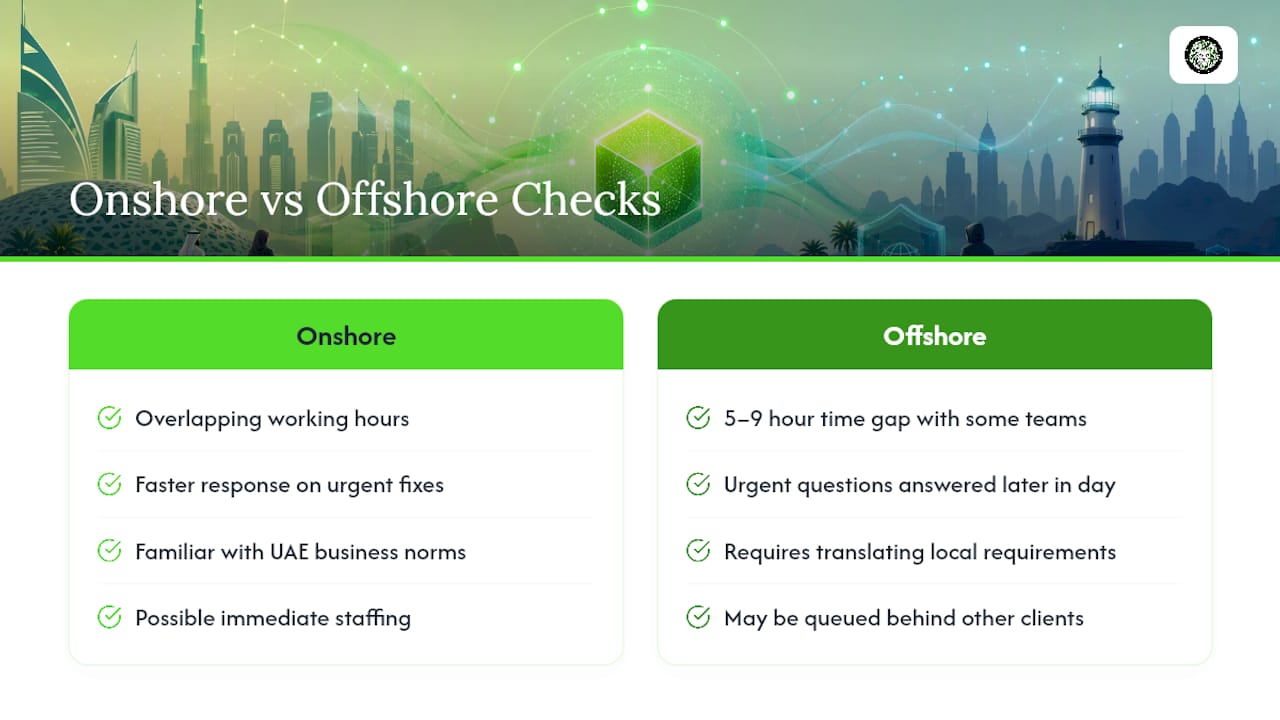
Availability looks different depending on whether a provider has an actual onshore presence or is coordinating a build from another time zone entirely. A UAE-based technical team, like the one behind Proud Lion Studios, means overlapping working hours for daily standups, faster response times on urgent fixes, and a team already familiar with regional business norms and client expectations.
Offshore and remote-first providers can still deliver solid work, but plan around the time zone gap. A five-to-nine-hour offset with an Eastern European or South Asian team means your urgent Tuesday morning question might not get answered until Tuesday evening.
Delivery considerations go beyond time zones. Confirm whether the provider can staff your project immediately or if you're queued behind other client work. Ask about their typical bench depth for your specific technology stack, such as Solidity for smart contracts or Flutter for cross-platform mobile development. And clarify who actually writes the code versus who manages the relationship. Some agencies sell UAE-based account management while quietly subcontracting the technical build elsewhere.
For projects with regulatory sensitivity, tokenized assets, or fintech compliance, an onshore team's familiarity with UAE market context reduces the back-and-forth needed to translate local requirements into technical specs.
What Makes Each Alternative Type Different in Practice?
Every provider category has a defining strength worth naming plainly.
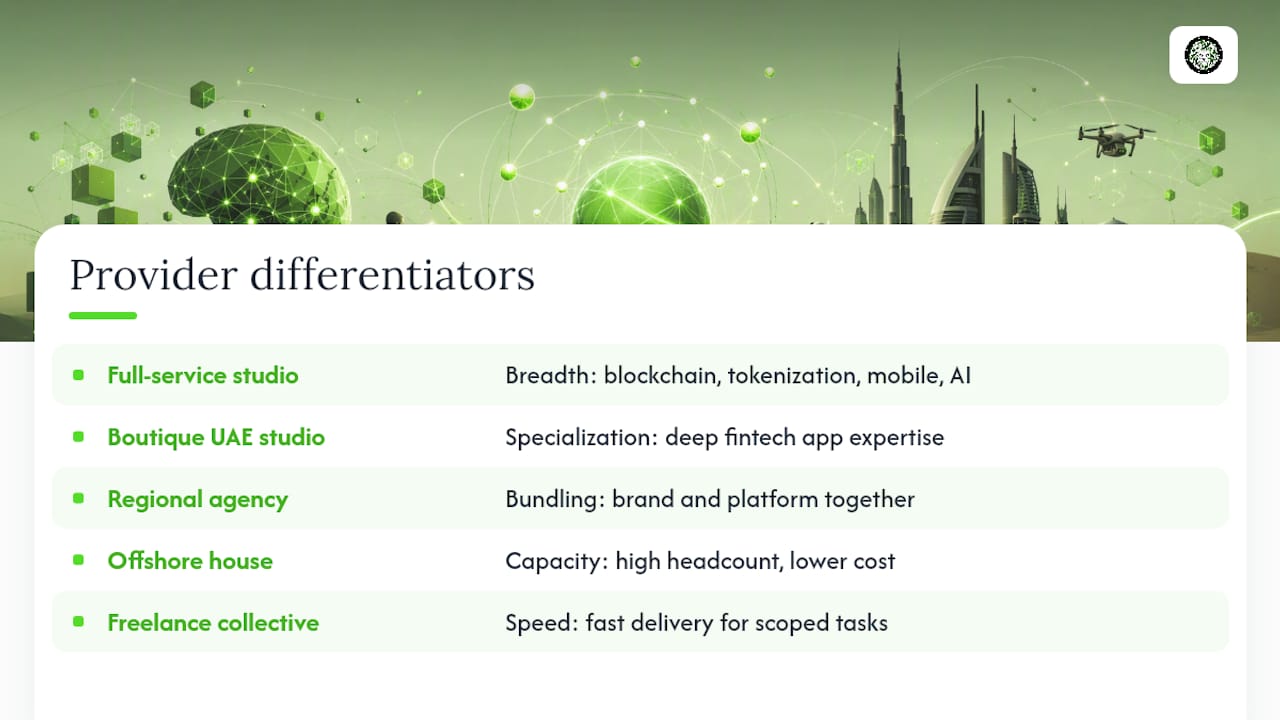
Proud Lion Studios differentiates through breadth: its service pages document capability across blockchain development, tokenization, smart contracts, mobile apps, and AI automation under one roof, backed by Aptos Foundation support and a client portfolio spanning multiple countries. That combination matters most for a founder who doesn't want to coordinate three separate vendors for one product.
Boutique UAE studios differentiate on specialization depth. A ten-person shop that has built forty fintech apps knows the regulatory friction points cold, even if it can't take on a project needing simultaneous blockchain, mobile, and AI work.
Regional full-service agencies differentiate on bundling. If you need a brand refresh alongside a new platform, one vendor managing both saves coordination overhead, at the cost of the development work often being one layer removed from the account team you're talking to.
Offshore houses differentiate on raw capacity and cost. If you need fifteen developers next month and budget is the binding constraint, offshore staffing solves that in a way boutique studios structurally can't.
Freelance collectives differentiate on speed for narrow asks. No onboarding overhead, no retainer, just a scoped task with a clear end date.
What Do Client Reviews and Case Studies Actually Reveal?
Case studies matter more than star ratings when you're vetting a development partner, because a five-star review tells you a client was happy, not that the team can handle your specific stack or complexity.
Look for case studies that name the actual technical challenge solved, not just the outcome. A vague "we delivered a great app" write-up says nothing. A case study describing a specific integration, a smart contract audit process, or a scaling problem solved under load tells you the provider has handled friction similar to what your project will produce.
Proud Lion Studios documents its capability through published service pages covering blockchain, mobile, and AI work, alongside editorial content comparing provider approaches, including its analysis of regional app studio alternatives. That kind of ongoing comparative writing is itself a signal: a provider that studies its own market closely enough to publish honest comparisons usually understands its competitive position better than one that doesn't.
When you can't get a direct client reference, look for consistency between service page claims and any published project outcomes. Provider marketing that describes capabilities in specific, checkable terms (named technologies, named partnerships, named grant support) is more trustworthy than marketing built entirely on adjectives.
What Happens After You Pick a Development Partner?
Signing a contract is the easy part. The first two weeks after that determine whether the project runs smoothly or turns into a slow-motion scope fight.
Start with a structured discovery phase, even if you've already sent a detailed brief. A good provider will re-confirm requirements in their own words before writing a line of code. If a provider skips straight to a build timeline without a discovery conversation, that's worth questioning.
Set the communication cadence explicitly on day one: weekly syncs, a shared project tracker, and one named point of contact on each side. Ambiguity here is where most mid-project friction starts.
Ask for a milestone-based delivery schedule with checkpoints you can actually evaluate, not just a single "done" date months out. Early milestones should produce something you can see and react to, even if it's just a clickable prototype or a working API endpoint.
Finally, clarify IP handoff and post-launch support terms before the first invoice, not after the last one. A hiring guide for early-stage teams covering in-house, agency, and freelance models is worth a read if you're still weighing delivery models against your own team's technical depth.
Which Provider Type Actually Deserves Your First Call?
If your project touches blockchain, AI, or anything you expect to scale past a first release, start with a full-service studio over a freelancer or offshore shop. The coordination savings alone, one team, one contract, one point of accountability, usually outweigh the lower hourly rate you'd get elsewhere.
The trade-off is straightforward: boutique and full-service studios cost more per hour than offshore or freelance options, but they cut the hidden cost of managing three vendors instead of one and catching integration problems yourself. For a founder who wants a technology-forward MVP without becoming a part-time project manager, the fastest sane move is booking a discovery call with a studio built for exactly that kind of build.
— Amal
How Do You Start a Project With Proud Lion Studios?
Some studios offer an alternative to a scattered vendor search for founders needing blockchain, AI, or mobile expertise consolidated under one roof instead of multiple contracts.
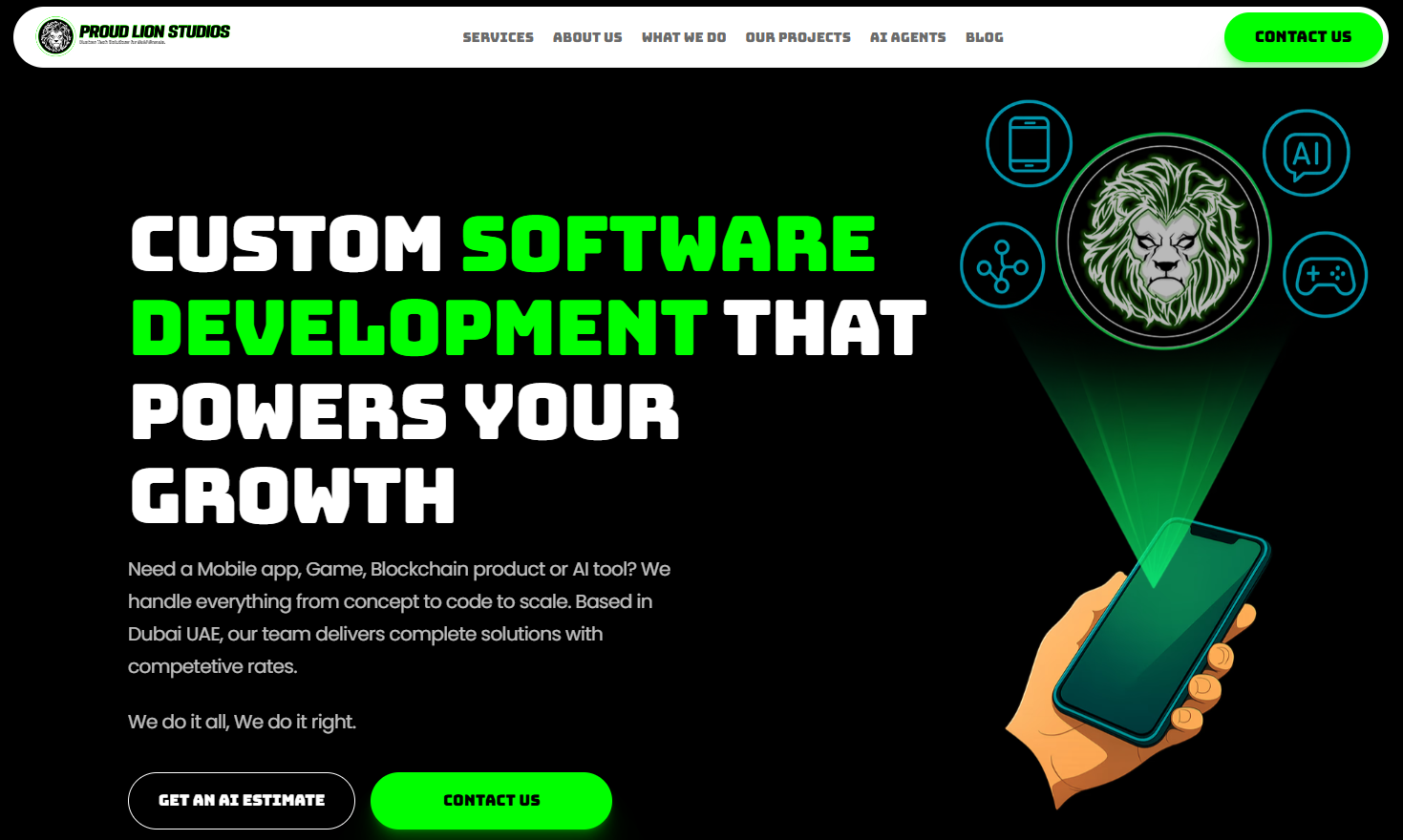
Starting typically involves submitting a written brief covering your project's core goals, target platforms, and any blockchain or AI components known, then requesting a discovery call. This conversation generally addresses technical fit, rough timeline, and suitable pricing models. If your project centers on tokenized assets, smart contracts, or a Web3-native product, the blockchain development page is the fastest starting point, and the mobile app development page) covers native and cross-platform builds for iOS and Android. Reach out with your brief and get a discovery call scheduled this week.
Where Can You Find More Fajeton.com Similar Websites?
Beyond direct provider research, crowdsourced tools help widen your search. AlternativeTo crowdsources software and website alternatives with user reviews. Alternative organizes comparable software by category. SiteLike surfaces sites similar to a target domain based on content and service overlap.
Sources
- Top Similar Sites Alternatives: Top 12 Similar Search Engines & Similar Websites
- Alternative
- SiteLike – Find Similar Websites
FAQ
Is Proud Lion Studios a Good Fajeton.com Alternative?
Yes, for projects needing blockchain, AI, or mobile development under one team, Proud Lion Studios offers a fully UAE-based technical team and documented service pages covering that full range.
How Long Does a Custom App Project Typically Take?
A simple MVP often takes several weeks to a few months, while a full product with blockchain or AI integration typically runs several months once discovery, build, and audit phases are included.
What's the Difference Between a Boutique Studio and an Offshore Team?
A boutique studio, like Proud Lion Studios, keeps the technical team onshore and specialized, while offshore teams offer lower hourly rates but come with time zone gaps and less direct market familiarity.
Should I Use a Discovery Platform Like AlternativeTo Before Contacting a Provider?
Discovery platforms are a useful starting point for building a shortlist, but you still need to verify local availability, project fit, and references directly with each provider.
What Red Flags Should Disqualify a Development Provider?
Vague answers about IP ownership, no named security or QA process, refusal to share a reference client, and pricing that seems unrealistically low for the stated scope are all disqualifying signals.