

Startups face massive challenges integrating AI and blockchain into mobile apps, often causing costly delays and missed market opportunities. This guide delivers a practical, step-by-step roadmap to build cutting-edge mobile applications that leverage AI, blockchain, and game technologies successfully. You'll learn essential preparation steps, development workflows, common pitfalls to avoid, realistic timelines, and troubleshooting strategies to launch competitive apps in 2026.
Table of Contents
- Introduction to latest mobile app technologies in 2026
- Prerequisites and what you need to start building
- Choosing development frameworks and tools for AI and blockchain apps
- Integrating AI, blockchain, and game development into mobile apps
- Common mistakes, troubleshooting, timelines, and costs for startups
- Security and scalability considerations for next-generation mobile apps
- Summary and actionable next steps to build your advanced mobile app
- Partner with proud lion studios for expert mobile, blockchain, and game development
Key takeaways
| Point | Details |
|---|---|
| Preparation is critical | Assemble cross-disciplinary skills in mobile development, AI, blockchain, and game design before starting. |
| Framework choice matters | Balance speed versus customization by selecting cross-platform, native, or low-code tools based on project complexity. |
| Iterative integration works | Build AI and blockchain features incrementally with continuous testing to manage complexity and security. |
| Avoid common mistakes | Underestimating timelines, ignoring security early, and skipping expert consultation cause project failures. |
| Plan realistic budgets | Development spans 4 to 12 months with costs varying widely by approach and feature complexity. |
Introduction to latest mobile app technologies in 2026
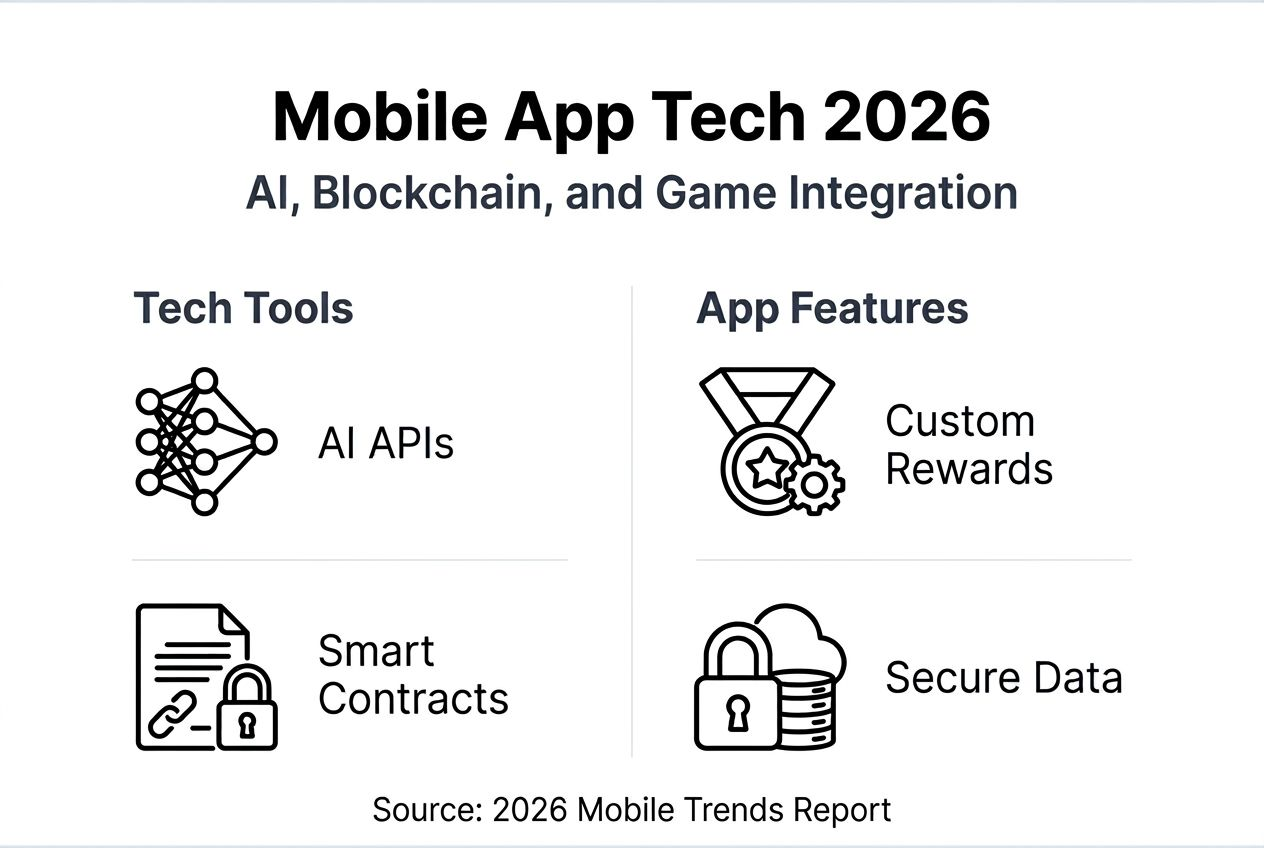
The mobile app landscape in 2026 is dominated by three transformative technologies: artificial intelligence, blockchain, and advanced game development. The global mobile app market exceeds $935 billion in 2026, driven by explosive adoption of AI-native applications and decentralized blockchain solutions. Over 90% of mobile apps now incorporate AI capabilities, from predictive analytics to natural language chatbots that reduce user churn by 30%. Meanwhile, the blockchain market is projected to surpass $94 billion by 2027, fueling demand for secure, transparent mobile applications across fintech, healthcare, and gaming sectors.
Game development has evolved dramatically with hybrid casual models and AI-enhanced gameplay becoming industry standards. These technologies offer startups unprecedented opportunities to differentiate their products and capture market share. Entrepreneurs who master the integration of AI, blockchain, and game mechanics can build apps that deliver personalized experiences, ironclad security, and engaging entertainment simultaneously.
Key trends shaping mobile app development in 2026 include:
- AI-native apps that embed machine learning at the core architecture
- Blockchain-powered decentralization for trustless transactions and data ownership
- Hybrid casual games combining simple mechanics with deep social features
- Cross-platform frameworks enabling faster time to market
- 5G networks supporting richer real-time multiplayer experiences
The future of apps development lies in combining these technologies strategically to solve real business problems. Startups that successfully integrate AI for personalization, blockchain for security, and game elements for engagement will dominate their niches. Understanding current mobile app trends 2026 is essential before diving into development, as these innovations are rapidly becoming baseline expectations rather than competitive advantages.
Prerequisites and what you need to start building
Before writing a single line of code, you need foundational knowledge and resources assembled. Cross-disciplinary skills in AI, blockchain, and game development significantly increase project success rates and reduce costly mid-project pivots.
Essential technical prerequisites include:
- Mobile development frameworks like Flutter, React Native, Swift for iOS, or Kotlin for Android
- AI and machine learning fundamentals including model training, inference, and optimization
- Blockchain basics covering smart contracts, decentralized apps, and consensus mechanisms
- Game development principles such as physics engines, rendering, and multiplayer networking
- UI/UX design skills to create intuitive interfaces that users actually want to use
- Software testing methodologies including unit tests, integration tests, and security audits
Beyond technical skills, successful projects require clear planning. You need a well-defined product vision that articulates exactly what problem your app solves and for whom. Budget planning is equally critical, as AI and blockchain integration can quickly escalate costs without proper scope management. Access to development platforms and tools like cloud infrastructure, AI model repositories, and blockchain testnets will accelerate your build process.
Pro Tip: Forming or hiring a cross-disciplinary team early prevents knowledge gaps that cause expensive delays later. A mobile developer who understands blockchain saves weeks of miscommunication compared to separate specialists working in silos.
Your team composition matters enormously. Ideally, you want developers with overlapping expertise who can bridge mobile, AI, and blockchain domains. If hiring, prioritize candidates who demonstrate curiosity and learning ability over narrow specialization. If building internally, invest in technical preparation steps through courses and certifications that cover emerging technologies.
Consider mobile app development services if your team lacks certain capabilities, but maintain enough internal knowledge to evaluate partner work quality. Understanding ethical AI considerations is also essential, as responsible development builds user trust and avoids regulatory pitfalls.
Choosing development frameworks and tools for AI and blockchain apps
Framework selection determines your development speed, customization depth, and long-term maintenance burden. 70% of enterprise apps use cross-platform or low-code tools by 2026, reflecting the pressure to ship quickly without sacrificing quality.
| Framework Type | Development Speed | Customization | Cost | Best For |
|---|---|---|---|---|
| Cross-platform (Flutter, React Native) | Fast | Good | Medium | MVPs, multi-OS apps, quick iteration |
| Native (Swift, Kotlin) | Slow | Excellent | High | Performance-critical, deep OS integration |
| Low-code/No-code | Very Fast | Limited | Low | Prototypes, simple apps, concept validation |
Cross-platform frameworks like Flutter and React Native offer the sweet spot for most startups. You write code once and deploy to both iOS and Android, cutting development time nearly in half. These frameworks support robust AI and blockchain integrations through plugins and native modules. Flutter excels at beautiful, consistent UI across platforms, while React Native leverages the massive JavaScript ecosystem for rapid feature development.
Native development delivers the absolute best performance and deepest customization. If your app requires intensive graphics rendering, complex blockchain cryptography, or real-time AI inference at scale, native Swift or Kotlin provides maximum control. The tradeoff is doubled development effort and higher costs, making this approach suitable primarily for well-funded projects with specific performance requirements.
Low-code and no-code platforms enable non-technical founders to build functional prototypes in days. These tools shine for validating concepts quickly and cheaply before committing to full development. However, they severely limit embedding AI capabilities and blockchain features, making them unsuitable for production apps with advanced requirements.
Pro Tip: For rapid AI app prototypes, start with low-code to validate user demand, then migrate to native or cross-platform once you've proven product-market fit and need deeper customization.
Your framework choice should align with project complexity and strategic goals. Simple apps with standard features work fine on cross-platform tools. Apps requiring cutting-edge AI inference, complex blockchain development logic, or high-performance gaming often justify native development. Review the comprehensive apps development guide to match frameworks with your specific use case.
Integrating AI, blockchain, and game development into mobile apps
Successfully combining these technologies requires methodical integration planning and iterative development. AI-native apps outperform traditional apps while blockchain enhances security and hybrid casual games accelerate development by reusing proven mechanics.
AI capabilities transform user experiences through:
- Predictive analytics that anticipate user needs and surface relevant content proactively
- Natural language processing powering conversational AI agent solutions for customer support
- Computer vision enabling augmented reality features and image-based search
- Personalization engines that adapt interfaces and recommendations to individual preferences
- Churn prediction models identifying at-risk users for targeted retention campaigns
Blockchain integration delivers security and transparency benefits including:
- Decentralized data storage giving users true ownership of their information
- Smart contracts automating trustless transactions without intermediaries
- Immutable audit trails for compliance in regulated industries like healthcare and finance
- Tokenization enabling new business models around digital assets and rewards
- Cross-chain interoperability connecting your app to broader blockchain ecosystems
Game development techniques boost engagement through:
- Hybrid casual models combining simple core loops with progression systems
- AI-enhanced gameplay that adapts difficulty and content to player skill
- Social multiplayer features fostering community and increasing retention
- Reward systems leveraging blockchain tokens for genuine digital ownership
- Real-time rendering creating visually stunning experiences on mobile hardware
Follow this numbered integration process:
- Assess which features genuinely require AI, blockchain, or game mechanics versus standard approaches
- Develop each technology module independently with clear interfaces between systems
- Integrate modules iteratively, testing thoroughly after each addition
- Optimize performance bottlenecks as they emerge rather than prematurely
- Conduct security audits specifically targeting AI model vulnerabilities and smart contract development flaws
For game-enabled apps, leverage web3 game development patterns that combine blockchain asset ownership with engaging mobile game development mechanics. This hybrid approach delivers the viral potential of casual games with the monetization benefits of blockchain economies.

Stay current with mobile app technology trends as integration best practices evolve rapidly. What works today may be superseded by better approaches within months, so maintain flexibility in your architecture to adopt improvements without rebuilding from scratch.
Common mistakes, troubleshooting, timelines, and costs for startups
Even experienced teams make predictable errors when building AI and blockchain apps. 40% of projects face delays due to integration complexity, but understanding these pitfalls helps you avoid them.
Common mistakes include:
- Underestimating integration complexity between AI models, blockchain networks, and mobile platforms
- Ignoring customization needs by choosing frameworks that cannot accommodate future feature requirements
- Poor security planning that treats protection as an afterthought rather than core architecture
- Inadequate timeline buffers that assume perfect execution without testing iterations
- Skipping expert consultation to save money upfront, then paying multiples to fix fundamental flaws
Troubleshooting strategies that actually work:
- Build early prototypes to validate technical feasibility before full development
- Engage experienced developers who have shipped similar projects successfully
- Implement iterative testing cycles catching bugs when they're cheap to fix
- Maintain comprehensive documentation so new team members can onboard quickly
- Use staging environments that mirror production for realistic performance testing
| Development Approach | Typical Timeline | Cost Range | Customization Level | Best Use Case |
|---|---|---|---|---|
| Native (Swift/Kotlin) | 8-12 months | $150k-$400k+ | Maximum | Performance-critical apps, deep OS features |
| Cross-platform (Flutter/React Native) | 4-8 months | $80k-$250k | High | Most startups, multi-OS deployment |
| Low-code platforms | 1-3 months | $10k-$50k | Limited | Prototypes, simple apps, validation |
Pro Tip: Buffer timelines by at least 20% for integration and testing phases, as combining AI, blockchain, and game features always surfaces unexpected challenges that require additional development cycles.
Realistic development spans from 4 to 12 months depending on complexity and team experience. Simple AI-enhanced apps with basic blockchain integration complete faster, while sophisticated multi-technology platforms require extended timelines. Cross-platform tools and low-code approaches reduce both time and budget somewhat, but cannot eliminate the inherent complexity of advanced features.
Consult detailed app development timelines and costs analysis to estimate your specific project. Factor in post-launch maintenance, which typically consumes 15-20% of initial development costs annually. Partner with proven mobile app development services) to leverage existing expertise rather than learning painful lessons yourself.
Security and scalability considerations for next-generation mobile apps
Security failures destroy user trust instantly, while scalability bottlenecks prevent growth when you need it most. 90% of security-focused apps use biometric authentication and encryption, with zero-trust architectures becoming the industry standard for breach prevention.
Implement these security best practices from project inception:
- Biometric authentication (fingerprint, face recognition) as the primary access method
- End-to-end encryption for all data in transit and at rest
- Zero-trust architecture that verifies every request regardless of source
- Regular security audits by independent third parties catching vulnerabilities early
- Penetration testing simulating real attack scenarios before launch
- Compliance frameworks (GDPR, CCPA, HIPAA) embedded in architecture rather than bolted on
- Smart contract formal verification preventing catastrophic blockchain exploits
- AI model security protecting against adversarial attacks and data poisoning
Scalability strategies ensure your app handles growth smoothly:
- Cloud backend infrastructure that scales resources automatically based on demand
- Load balancing distributing traffic across multiple servers preventing bottlenecks
- Blockchain node optimization using light clients and state channels for faster transactions
- Database sharding splitting data across multiple instances for parallel processing
- Content delivery networks caching static assets geographically close to users
- Microservices architecture allowing independent scaling of individual features
- Performance monitoring identifying and resolving bottlenecks before users notice
Pro Tip: Plan security measures from project conception, not as an afterthought, because retrofitting protection into existing architecture costs five to ten times more than building it correctly initially.
Leverage AI chat base security solutions for conversational interfaces that handle sensitive user data securely. Similarly, blockchain security development practices must be rigorous, as smart contract vulnerabilities can result in permanent, irreversible losses.
Security and scalability are not one-time tasks but ongoing processes. Establish monitoring systems that alert you to anomalies immediately, and maintain relationships with security researchers who can help patch vulnerabilities quickly. Your reputation depends on protecting user data and delivering consistent performance as your user base grows.
Summary and actionable next steps to build your advanced mobile app
Building mobile apps that successfully integrate AI, blockchain, and game technologies demands careful preparation and disciplined execution. Start by assembling the right team with cross-disciplinary skills covering mobile development, AI implementation, blockchain architecture, and game design. This foundation prevents costly knowledge gaps that derail projects mid-development.
Choose development frameworks strategically based on your project goals:
- Cross-platform tools like Flutter balance speed and customization for most startups
- Native development delivers maximum performance when absolutely required
- Low-code platforms enable rapid prototyping but limit advanced features
Integrate AI, blockchain, and game mechanics iteratively with continuous testing at each step. Avoid the temptation to build everything simultaneously, as this complexity overwhelms teams and introduces hard-to-debug interactions. Instead, develop modules independently with clear interfaces, then combine them systematically.
Avoid common pitfalls by engaging experienced developers early, planning realistic timelines with generous buffers, and prioritizing security from day one rather than treating it as an afterthought. Remember that software and web3 development success depends as much on project management and risk mitigation as technical excellence.
Ensure robust security through biometric authentication, encryption, and zero-trust architectures that protect user data comprehensively. Design for scalability from the start, using cloud infrastructure and microservices patterns that grow with your user base. These investments pay massive dividends by preventing costly rebuilds when you achieve product-market fit.
Take decisive action now with this roadmap as your guide. The mobile app market rewards early movers who deliver superior experiences combining AI personalization, blockchain security, and engaging game mechanics. Your competitive advantage depends on executing efficiently while maintaining the quality and innovation that users demand in 2026.
Partner with proud lion studios for expert mobile, blockchain, and game development
Turning this comprehensive roadmap into a successful mobile app requires deep expertise across multiple cutting-edge technologies. Proud Lion Studios specializes in blockchain development services, AI agent solutions, and mobile app development services) that startups need to compete in 2026.
Our Dubai-based team has delivered scalable applications integrating AI, blockchain, and game technologies for entrepreneurs across multiple countries. We provide custom solutions tailored to your specific requirements rather than generic templates, focusing on real business outcomes that drive growth. With proven experience building Web3 games, smart contracts, and AI-powered mobile apps, we understand the technical challenges and business pressures you face.
Pro Tip: Early technical partnership accelerates development and reduces risks by catching architectural problems before they become expensive to fix, giving you a significant time-to-market advantage over competitors building in isolation.
How do I choose the right framework for my AI and blockchain app?
Evaluate your project's complexity, customization needs, and timeline constraints carefully. Cross-platform frameworks like Flutter or React Native suit faster builds with good customization for most startups. Native development using Swift or Kotlin offers best performance and deepest integration when your app requires intensive processing or specialized OS features. Low-code platforms work well for prototypes and concept validation but limit the advanced AI and blockchain capabilities that differentiate competitive products. Review detailed choosing app frameworks guidance to match tools with your specific situation.
What are common security pitfalls in AI and blockchain mobile apps?
Ignoring encryption and biometric authentication early in development leads to data breaches that destroy user trust permanently. Overlooking zero-trust architecture principles increases vulnerability to both external attacks and insider threats. Lack of regular security audits and prompt updates creates growing gaps that sophisticated attackers exploit systematically. Smart contracts deployed without formal verification can contain catastrophic flaws enabling theft of user funds. Consult security solutions for AI apps to implement comprehensive protection from project inception.
How long does it typically take to build an AI and blockchain-enabled mobile app?
Typical projects require between 4 and 12 months depending on feature complexity and team experience. Cross-platform frameworks and low-code tools reduce development time significantly but may limit customization for advanced features. Complex blockchain integrations with multiple smart contracts and sophisticated AI models trained on custom datasets require longer iterative development cycles. Factor in additional time for security audits, compliance reviews, and performance optimization before launch. Explore detailed mobile app development timelines to estimate your specific project accurately.
Can startups use low-code platforms for AI and blockchain app development?
Low-code platforms are ideal for rapid prototyping and validating concepts with real users before committing to full development. They enable non-technical founders to build functional prototypes in days rather than months. However, these platforms provide limited customization and scalability for complex AI algorithms and blockchain integrations that differentiate competitive products. Most successful startups begin with low-code validation, then migrate to cross-platform or native development once they've proven product-market fit and need deeper capabilities. Reference using low-code platforms strategically in your development roadmap.
How can AI improve user experience in mobile apps?
AI enables personalized content and recommendations that adapt to individual user preferences and behavior patterns automatically. Predictive models help reduce user churn by up to 30% by identifying at-risk users and triggering targeted retention campaigns. Natural language chatbots support intuitive interaction, answering questions and completing tasks through conversational interfaces that feel effortless. Computer vision powers augmented reality features and image-based search that create magical experiences. Leverage AI user experience enhancements to differentiate your app and build loyal user bases that drive sustainable growth.